The most over-sold, under-explained AI-money model — decoded. How faceless YouTube actually makes money, which niches pay, the AI production stack, and the honest timeline behind the 'passive income' pitch.
This post contains affiliate links. If you buy through them, Aliteq may earn a commission — at no extra cost to you. Prices verified at publish time.
Share
The faceless YouTube channel is the most over-sold, under-explained business in the AI-money world. The pitch — 'a bot makes videos, you wake up to ad revenue' — is a fantasy. But underneath the guru noise there's a genuinely real model: you can build a monetized channel without ever showing your face, and AI now does the three jobs that used to need a writer, a voice actor and a footage budget. The catch is that it's a media business, not a money printer — someone still has to pick a niche that pays, write hooks people don't skip, and upload for months before it earns. This is the honest map of that whole business.
I run this pipeline for parts of my own content, so treat this as a strategist's overview, not a hype reel: how the money actually works, which niches are worth your time, the AI production stack, and where the real effort (and risk) lives. Each stage below has its own deep-dive; this page is the one that ties them together and tells you, honestly, whether it's worth starting.
A faceless channel is a media business run from one desk — not a bot that prints money. Generated with Higgsfield. · Generated with Higgsfield
What's actually real (and what's a lie)
Real: monetized channels genuinely run faceless — compilations, explainers, documentaries, list videos — and plenty of them use AI for scripts, voice and visuals. The cost to produce a video collapsed, so a solo person can now run a content operation that used to need a small team. A lie: that it's hands-off or fast. You are trading a camera and a crew for the jobs AI can't do — deciding what to make, judging which AI output is actually good, and keeping a schedule long enough for the algorithm to trust you. If you want the passive part, it only arrives after the unpaid months, and only for the channels that made something worth watching.
Step 1 — pick a niche that pays (this is the whole game)
The single biggest decision is the niche, because ad rates vary enormously by topic. Advertisers in finance, tech and business pay far more to reach their audiences than advertisers in gaming or entertainment do — creator-reported RPMs (revenue per 1,000 views) commonly run in the tens of dollars for finance and tech versus low single digits for gaming, a spread of roughly 10x. Those figures are directional and self-reported, not audited, and your mileage depends on your audience and format — but the relative gap is real and consistent. Evergreen, search-shaped topics (‘how X works', ‘the story of Y') also compound for years, where news reactions die in a week.
Relative ad rates by niche (directional, creator-reported — not audited)
Finance / investinghighest
premium advertisers, high-intent audience
Tech / business / softwarehigh
B2B advertisers, strong buy-intent
Education / how-tosolid
evergreen, compounds in search
Gaming / entertainmentlowest
big audiences, cheap ad inventory
Don't just chase the highest RPM, though — a finance channel you can't sustain the research for loses to an education channel you can post twice a week for a year. Pick the intersection of ‘pays decently' and ‘you can keep making it'. The full breakdown of proven faceless niches, their trade-offs, and how to validate one cheaply is in the best faceless YouTube niches for 2026.
Step 2 — the AI production stack
Four jobs, and AI now does most of the expensive parts of three of them. The exact step-by-step (niche → script → visuals → voice → edit → upload) lives in the execution guide: how to start a faceless YouTube/TikTok channel with AI. Here's the stack at a glance and where each deep-dive goes.
The faceless production stack
Script
What AI does
Drafts structure + beats from your outline
What stays human
The hook, the angle, the fact-check
Voiceover
What AI does
Narrates the whole script in a consistent voice
What stays human
Voice choice, pacing, fixing mispronunciations
Visuals / b-roll
What AI does
Generates exact-on-brief footage + thumbnails
What stays human
Picking the good take, editing taste
Edit & upload
What AI does
Auto-captions, basic assembly
What stays human
Cutting on the beats, retention analysis, schedule
What AI does
What stays human
Script
Drafts structure + beats from your outline
The hook, the angle, the fact-check
Voiceover
Narrates the whole script in a consistent voice
Voice choice, pacing, fixing mispronunciations
Visuals / b-roll
Generates exact-on-brief footage + thumbnails
Picking the good take, editing taste
Edit & upload
Auto-captions, basic assembly
Cutting on the beats, retention analysis, schedule
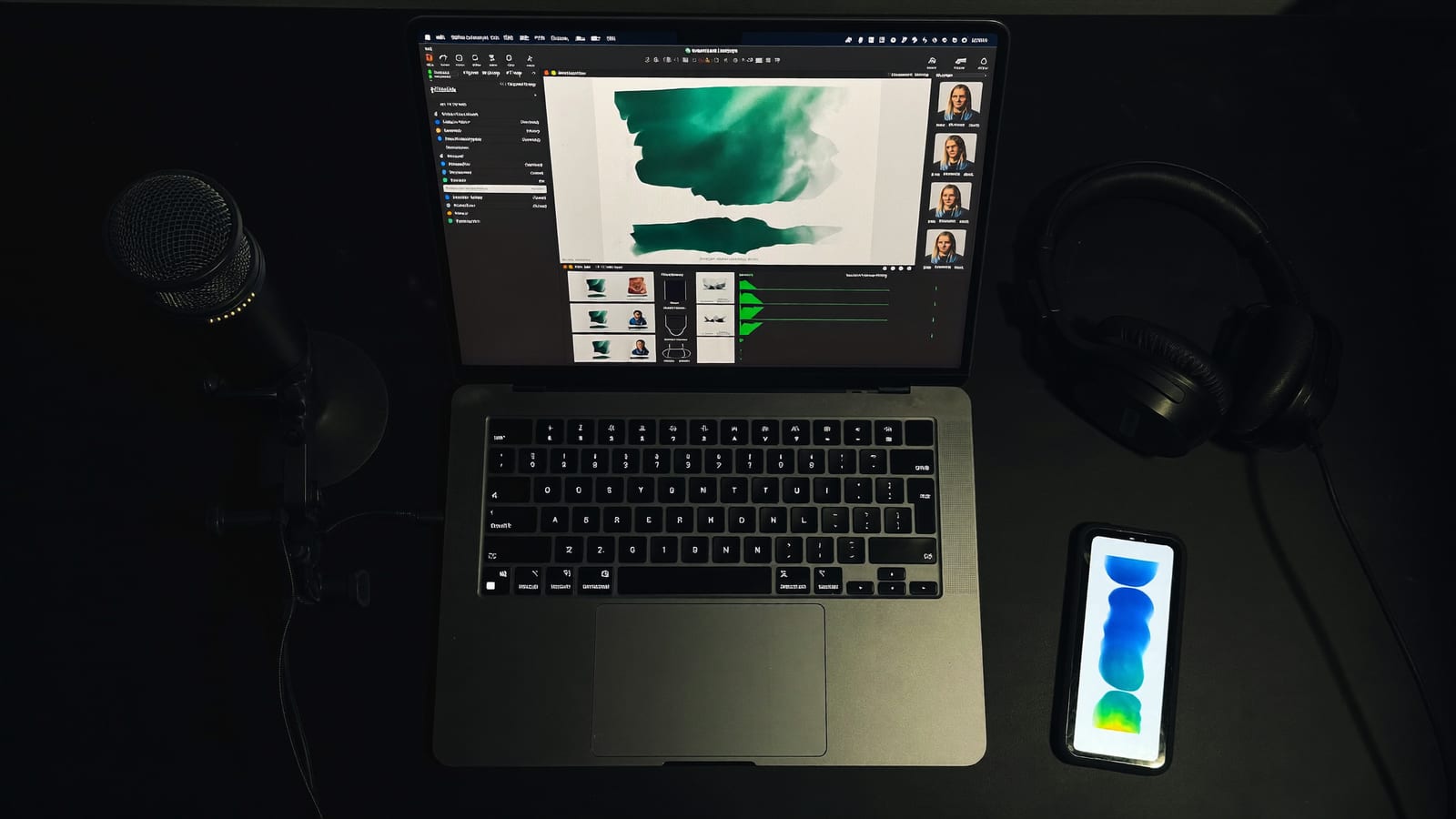
AI b-roll like this comes from one prompt — no location shoot, no stock-footage subscription. Generated with Higgsfield. · Generated with Higgsfield
The two parts that eat the most time — and where AI helps most — are the AI voiceover (get the voice consistent and it feels like a real channel) and the thumbnails (on YouTube, the thumbnail and title decide whether anything else you did matters). Get those two right and you're ahead of most faceless channels.
Higgsfield · B-roll, thumbnails & voice
Sponsored
Higgsfield covers the visual-and-voice half of a faceless channel in one place — cinematic b-roll, thumbnail candidates from the same batch, and AI voiceover — the two most time-consuming parts. Free tier to make your first video's assets before you commit.
Ad revenue is the slowest and needs the YouTube Partner Program: an early tier at 500 subscribers (with 3 recent uploads and either 3,000 watch-hours in 12 months or 3M Shorts views in 90 days) unlocks fan features, and full ad revenue needs 1,000 subscribers plus 4,000 watch-hours or 10M Shorts views. Affiliate links in your description can pay from your very first video if your niche references products or tools. Sponsorships come last, once a brand has an audience to point at. The mistake is building a channel that only works if ad revenue hits — layer affiliate in from day one. Full mechanics, realistic numbers and the honest timeline: how faceless YouTube monetization actually works.
One production line feeds long-form YouTube, Shorts and TikTok from the same assets. Generated with Higgsfield. · Generated with Higgsfield
Quick answers
Is a faceless YouTube channel really passive income?
Not at the start, and never fully. AI removes the crew, but you're still choosing niches, writing hooks, judging AI outputs, editing and reading retention data every week. It gets lower-effort once you have a system and a backlog — but 'passive from day one' is the false part of the pitch. Treat the first few months as unpaid R&D.
How much can you actually make?
Anywhere from nothing to a full income, and most channels land near nothing because they quit or picked a dead niche. Earnings depend on niche RPM, views and consistency — finance/tech channels can earn multiples of entertainment channels per view, but all of them take months of uploads first. Results aren't typical and nothing here guarantees income.
Will YouTube demonetize AI content?
Not for using AI — for using it lazily. Mass-produced, repetitious, or undisclosed realistic-synthetic content gets penalized; genuinely different videos with real value don't. Disclose synthetic media where required, make each video distinct, and you're within policy.
YouTube, TikTok, or Instagram for faceless content?
YouTube pays the most per view via ad revenue and rewards evergreen search content, so it's the best long-term money base — this cluster focuses there. Short-form platforms (TikTok, and a faceless Instagram page) are better for fast reach and funneling attention, and your AI assets repurpose across all three from one production line.
Build the visual + voice half of your channel this week
Generate cinematic b-roll for your script, thumbnail candidates from the same batch, and a consistent AI voiceover — no camera, no crew, no stock-footage subscription. Free tier to start.