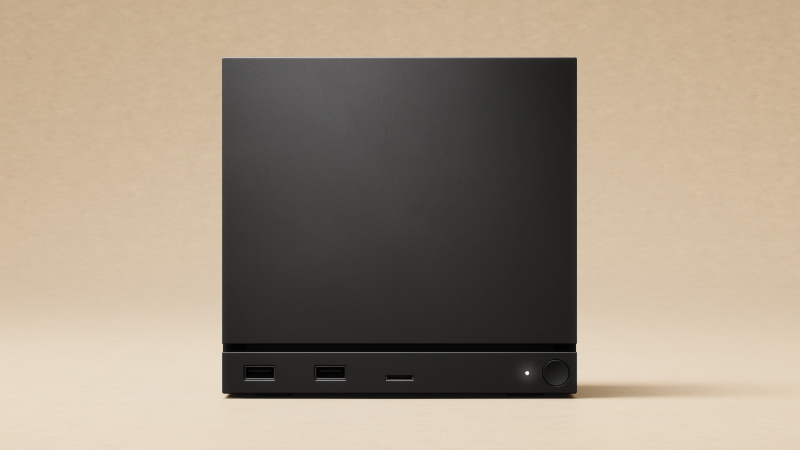
Valve's Steam Machine started shipping June 29 — and you couldn't just buy one. Getting into the first wave meant joining a randomized reservation queue before June 25, using a Steam account with a purchase history predating April 27. The base 512GB model runs $1,049. Here's what that number actually buys, and the spec line worth paying attention to.
$1,049 / $1,349
Price (512GB / 2TB)
2TB + Controller + faceplates bundle: $1,428
Semi-custom AMD Zen 4, 6 cores
CPU
up to 4.8GHz
Semi-custom AMD RDNA3
GPU
~6x Steam Deck's graphics power, per Valve
16GB DDR RAM + 8GB GDDR6 VRAM
Memory
fixed, not upgradeable
Valve didn't run a normal launch. You needed a Steam account in good standing that had made at least one purchase before April 27, 2026, reservations were capped at one per household, and getting into the first wave meant joining the list before June 25 at 10 a.m. Pacific — then waiting for a randomized draw, not a first-come queue. Valve's stated reasoning: it's fairer than a race, and it takes the incentive out of scalping since speed doesn't help your odds.
8GB of GDDR6 is comfortable for 1080p and most 1440p gaming at sensible settings today — that's not the concern. The concern is ceiling: it's the same VRAM class the Steam Deck shipped with, just driven by considerably faster silicon. If part of the appeal was a compact box that could moonlight as a local-AI machine, 8GB rules out nearly everything past small, heavily quantized models — the same wall we keep hitting on this beat, just wearing a different case this time.
We see the whole PC catalog as our launch exclusive. — Valve, on why the Steam Machine has no console-style exclusive lineup
Priced against discrete parts — a similarly capable APU-class chip, a case, a PSU, cooling — the Steam Machine isn't obviously cheaper to build yourself, and Valve has said outright it isn't selling the box at a loss. The value isn't really in the parts. It's in SteamOS doing the compatibility work a DIY build doesn't get handed to it for free: a controller-first interface, verified game compatibility, and one company accountable when something doesn't run.
What we're actually watching next: independent VRAM-limited benchmarks once review units are out in the wild, and whether SteamOS driver stability holds up running on hardware Valve fully controls versus the more variable PCs it's had to support until now.