A US SaaS or AI app owes EU VAT from the first consumer sale, and the €10,000 threshold you keep reading about isn't yours. How the non-Union One-Stop Shop works, when reverse charge saves you, and what a $29 plan keeps after German VAT.
Almost every guide to EU VAT is written for sellers inside the EU. A US founder reads "you can ignore VAT until €10,000", builds the checkout around it, and is wrong. This guide is written the other way round: you are based in the US, you sell a SaaS product or an AI app, and some of your customers live in Europe.
We read the European Commission's One-Stop Shop pages, the VIES FAQ, the VAT Directive on EUR-Lex and gov.uk on 3 October 2026. aliteq doesn't file VAT returns for anyone and isn't a tax adviser. Every rule below links to the official page that states it, and where the text doesn't say something outright, we mark it as our reading.
You owe EU VAT on digital sales to EU consumers from the first sale. The place of supply for these services is where the customer lives, so the tax follows the buyer, not your office.
The VAT Directive's Article 58 says the place of supply of "electronically supplied services" to a non-taxable person (a consumer) is "the place where that person is established, has his permanent address or usually resides". Annex II lists examples, including "(2) supply of software and updating thereof" and "(1) Website supply, web-hosting, distance maintenance of programmes and equipment".
Is a SaaS subscription or an AI app an "electronically supplied service"? The regulation doesn't use the word SaaS. Its definition, in Article 7 of Regulation 282/2011, covers services "delivered over the Internet or an electronic network" whose supply is "essentially automated and involving minimal human intervention", including "software and changes to or upgrades of software". In our reading, a product delivered through a browser or app with no human doing the work fits that wording. A service where a person does the work for each customer, such as consulting, probably doesn't. If you're on the edge, ask an accountant.
The €10,000 threshold is not for you
The Commission's page says the threshold of €10,000 per year for cross-border digital services "requires that that supplier be only established in one single Member State (and nowhere else)". In the VAT Directive's Article 59c, the first condition is that the supplier is established "only in one Member State". Businesses established outside the EU "cannot make use of the threshold".
So a US company with no EU establishment has no free allowance. The rule's logic is for a Danish or Irish startup selling a little to its neighbors: below €10,000 (about $11,225 at today's rate) it can keep charging its home VAT. We cover that case in one short section further down.
How the non-Union One-Stop Shop works
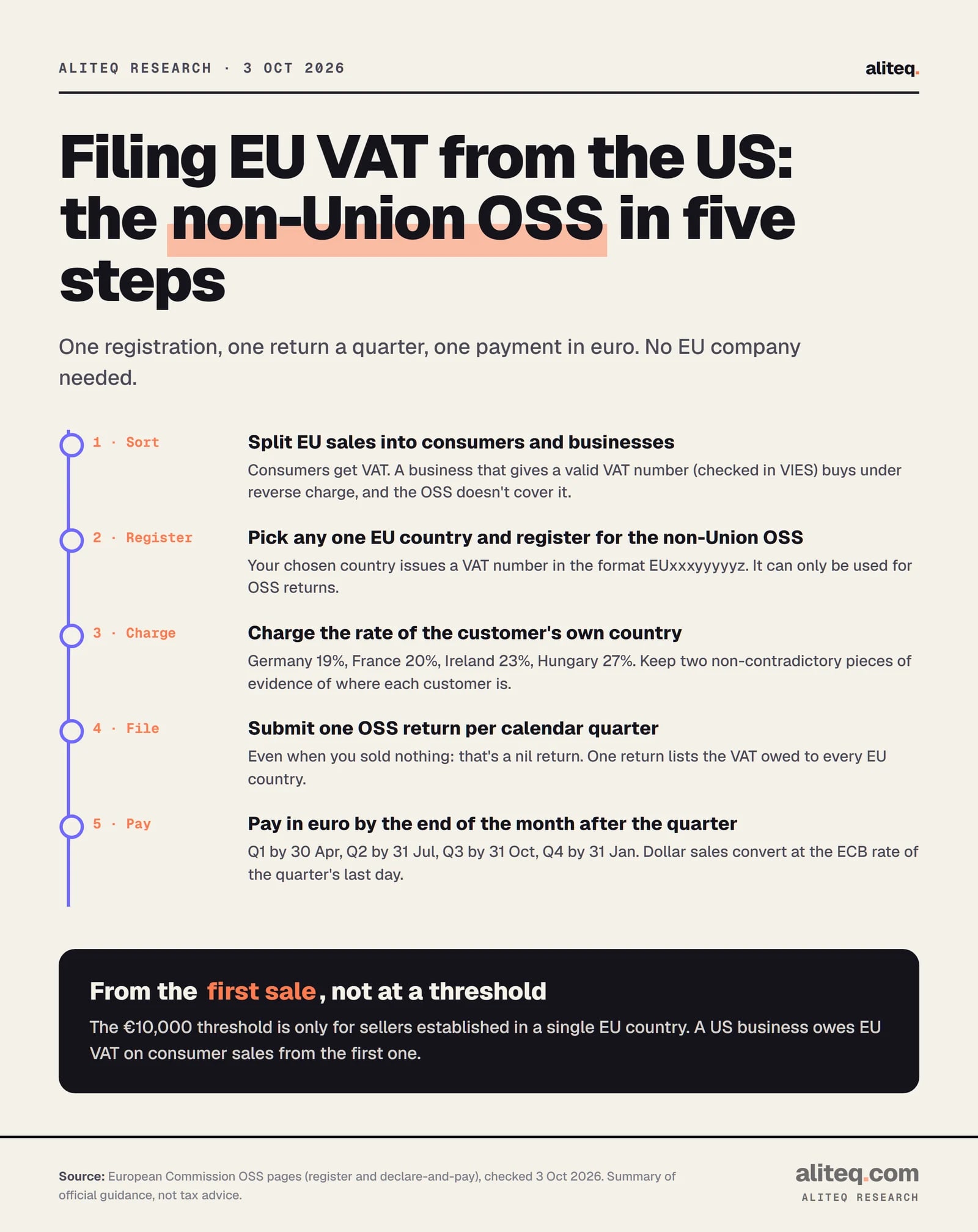
The non-Union OSS lets a business outside the EU declare and pay VAT for all its EU consumer sales in one place. You register in one EU country and file one return per quarter, instead of registering in every country where you have customers.
The non-Union OSS in five steps. One registration replaces up to 27 national ones. · aliteq research
What the Commission's pages say about each part:
Who can use it. "Any taxable person, not established in the EU, who supplies services to non-taxable persons taking place in the EU, can register in the non-Union scheme." The scheme is for business-to-consumer sales. Having an EU VAT number or an EU registration for other reasons "does not prevent the taxable person from using the non-Union scheme".
Where you register. You register in "one single Member State, the Member State of identification". A non-EU business "can choose any Member State". That country gives you an individual VAT number in the format EUxxxyyyyyz, which "can only be used to declare supplies falling under the non-Union scheme".
How often you file. The tax period is the calendar quarter. The return and payment are due "by the end of the month following the tax period".
Nil returns. You file a return for each period "whether or not services or goods were supplied". A quarter with no EU sales still needs a nil return.
Currency. The return is generally in euro. Sales in other currencies are converted at the ECB rate "on the last day of the tax period".
The deadlines for every year are the same four dates:
Q1
Covers
1 Jan to 31 Mar
Return and payment due
30 April
Q2
Covers
1 Apr to 30 Jun
Return and payment due
31 July
Q3
Covers
1 Jul to 30 Sep
Return and payment due
31 October
Q4
Covers
1 Oct to 31 Dec
Return and payment due
31 January (next year)
Covers
Return and payment due
Q1
1 Jan to 31 Mar
30 April
Q2
1 Apr to 30 Jun
31 July
Q3
1 Jul to 30 Sep
31 October
Q4
1 Oct to 31 Dec
31 January (next year)
Two practical notes. The return lists your sales country by country, and you pay one total to the country where you registered, which passes the money on. And each country's rate is its own: the Commission's database shows these standard rates for 2026.
Hungary
Standard VAT rate
27%
Ireland
Standard VAT rate
23%
Italy
Standard VAT rate
22%
Spain, Netherlands
Standard VAT rate
21%
France
Standard VAT rate
20%
Germany
Standard VAT rate
19%
Luxembourg
Standard VAT rate
17%
Standard VAT rate
Hungary
27%
Ireland
23%
Italy
22%
Spain, Netherlands
21%
France
20%
Germany
19%
Luxembourg
17%
Denmark is 25%. Your checkout or tax tool has to apply the right one per customer, which is why most small sellers use software for this rather than a spreadsheet.
Selling to EU businesses: reverse charge and VIES
When your customer is an EU business with a valid VAT number, you don't charge VAT. The customer accounts for it in its own country. That is the reverse charge, and it's why B2B is easier than B2C for a US seller.
The legal basis has two steps. Article 44 of the VAT Directive says the place of supply of services to a business is "the place where that person has established his business". Article 196 then says the VAT is "payable by any taxable person… to whom the services referred to in Article 44 are supplied, if the services are supplied by a taxable person not established within the territory of the Member State". In plain words, the buyer pays the tax, not you.
The catch is proving the buyer is a business. The Commission's VIES system exists for this: it's "an electronic mean of validating VAT-identification numbers of economic operators registered in the European Union for cross border transactions on goods or services". The rules of thumb, from the VIES FAQ:
Ask for the VAT number at checkout and check it in VIES. The FAQ says the valid number "should be mentioned on your" invoice.
No valid number, charge VAT. "If the customer does not have a valid VAT number, then the supplier will charge VAT."
If you can't check, don't guess. "If you believe that your customer is not a taxable person, you should not exempt the supply but should charge VAT."
An invalid result is the customer's problem to fix. If a number comes up invalid, the customer "should take the matter up with his fiscal administration".
A founder with one user in Lyon who gives you a company VAT number and one user in Lyon who doesn't are two different tax cases. Build the checkout so it can tell them apart: a VAT number field, a live VIES check, and an invoice that prints the number.
Proving where your customer is
You have to be able to show where each consumer lives, because the rate depends on it. For a seller outside the EU, the rule is two pieces of non-contradictory evidence per customer.
The rule is in Regulation 282/2011, Article 24b, as amended by Regulation 2017/2459: the customer's location is presumed to be the place the supplier identifies "on the basis of two items of non-contradictory evidence as listed in Article 24f". Article 24f lists, in particular:
the customer's billing address;
"the internet Protocol (IP) address of the device used by the customer or any method of geolocation";
bank details, such as "the location of the bank account used for payment or the billing address of the customer held by that bank";
the Mobile Country Code on the customer's SIM card;
the location of the customer's fixed land line;
"other commercially relevant information".
For a web app, the usual pair is the billing address and the IP address, with the card's issuing country as a tiebreaker. "Non-contradictory" matters: if the billing address says Germany and the IP says France, you don't have two pieces pointing the same way.
There's a simplification worth knowing about, and it doesn't apply to you. For sellers established in an EU country, one piece of evidence from a third party such as the payment provider is enough, up to €100,000 a year of these supplies. The text limits it to supplies made "from his business establishment or a fixed establishment located in a Member State". In our reading, a US company with no EU establishment doesn't get that shortcut and needs two pieces of evidence. Keep the records; the regulation doesn't say for how long, so ask your accountant.
The UK is separate
The UK is outside the EU's OSS, so it's its own registration. For a non-UK business, gov.uk says you must register "regardless of taxable turnover" if you're based outside the UK, your business is based outside the UK and you supply goods or services to the UK. The £90,000 threshold on the same page applies to UK businesses, not to you.
gov.uk's guide for digital services says supplies to UK consumers "are liable to UK VAT", and that "you will need to register for UK VAT if you are based outside the UK". The standard rate is 20%. For business customers, the same guide says "the customer will be responsible for accounting for any VAT due", and a customer can't ask for business treatment "if they have not given a valid VAT registration number". The UK guide was last updated in March 2022 and still uses the old MOSS name, so treat it as the rule on place of supply and check HMRC for current filing steps. We didn't verify the filing process itself, and we don't describe it here.
If you're an EU-established seller
An EU-established seller can use the €10,000 threshold, and the rest of this guide's mechanics differ. This is a short section because aliteq is a US company and the readers we're writing for are in the US.
The Commission's page says that a supplier established in one Member State can keep charging its home VAT on cross-border B2C digital sales while they total at most €10,000 (about $11,225) "without VAT" across the current and the preceding calendar year. "As soon as the threshold is exceeded, the general rule applies without exception", meaning the customer's country rate. A seller can also choose to apply destination rules from the start and is then "bound by this decision for two calendar years". After that, the Union OSS handles filing. Your home tax authority's pages explain registration for domestic VAT; this guide doesn't cover it.
Worked example: a $29 plan sold to a German consumer
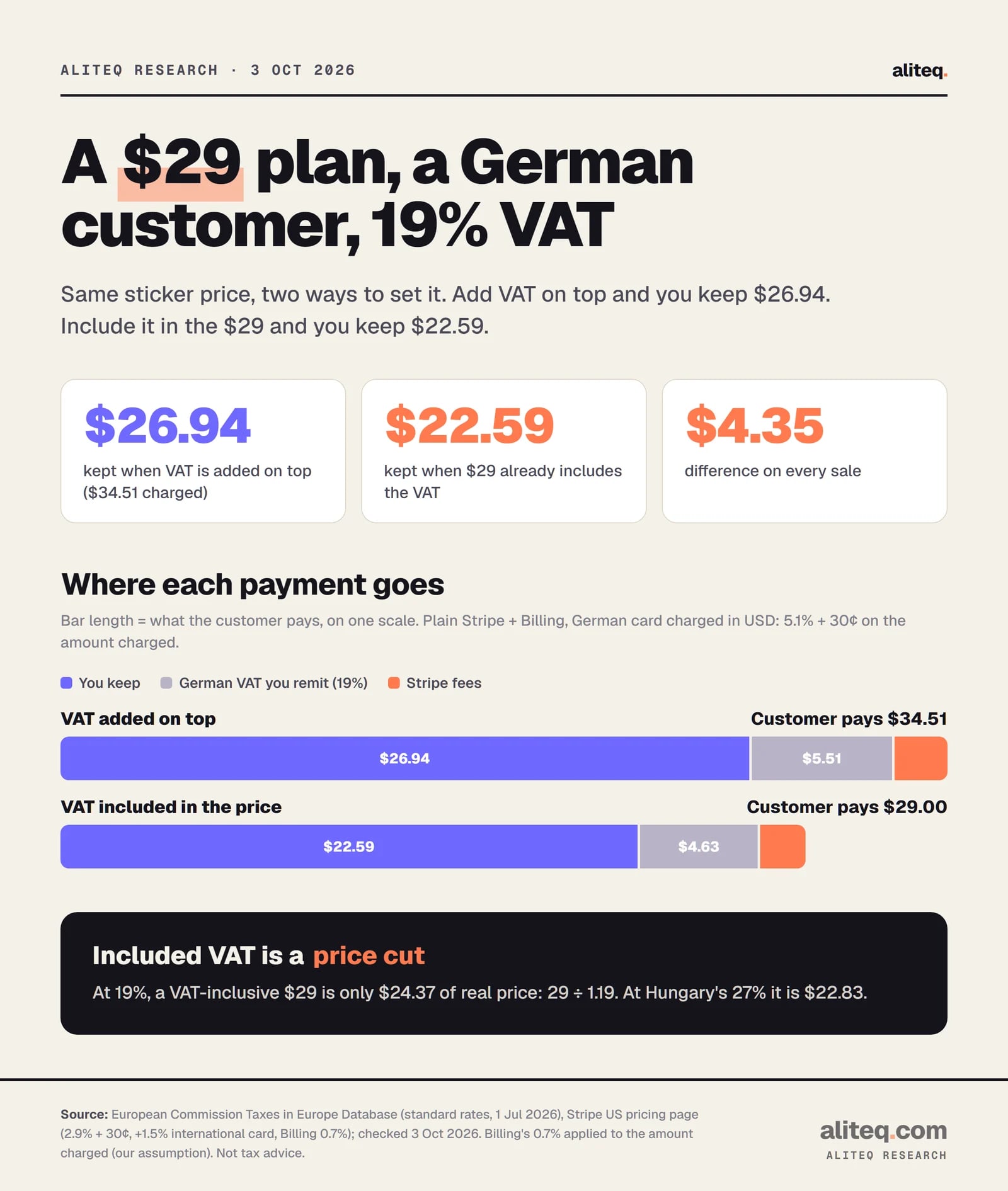
Selling a $29 monthly plan to a German consumer at 19% VAT leaves you $26.94 if VAT is added on top and $22.59 if the $29 already includes it. The $4.35 gap is the whole question of how to display your price.
Same plan, two price displays. Plain Stripe with Billing, a German card charged in USD. · aliteq research
The assumptions: you're a US seller on plain Stripe with Billing. Stripe's US pricing page says "2.9% + 30¢ per successful transaction for domestic cards", "+ 1.5% for international cards" and "0.7% of Billing volume". A German card is international for a US seller. We charge in dollars, so there's no currency conversion fee (Stripe adds 1% when conversion is required). We apply Billing's 0.7% to the amount charged, which Stripe's page doesn't spell out. That makes the percentage 5.1%, plus 30¢.
VAT added on top (VAT-exclusive pricing). The German customer pays 29 × 1.19 = $34.51.
German VAT: $5.51. You remit it through the OSS.
Stripe's fee: 34.51 × 5.1% + 30¢ = $2.06.
You keep 34.51 − 5.51 − 2.06 = $26.94.
VAT included in the price (VAT-inclusive pricing). The customer pays $29.00, and 19% VAT is already inside it.
German VAT: 29 − 29 ÷ 1.19 = $4.63. The real price is $24.37.
Stripe's fee: 29 × 5.1% + 30¢ = $1.78.
You keep 29 − 4.63 − 1.78 = $22.59.
On a quarter with 10 German subscribers paying monthly, the VAT added on top comes to 30 payments × $5.51 = $165.30. Your return is in euro, so at today's ECB rate that is about €147.26. The real conversion uses the rate of the quarter's last day.
Two things follow. First, VAT-inclusive pricing is a price cut in countries with high rates: at Hungary's 27%, a $29 inclusive price is only $22.83 of real price. Second, the fee is a percentage of whatever the customer pays, so VAT added on top also adds to your fee. Try your own price and customer mix:
What each option takes from one sale
Cheapest per sale
Stripe + Billing
$1.34 a sale · you file the tax
Cheapest that files tax for you
Creem
$1.53 a sale · 5.3%
Price of not filing yourself
$19/mo
Creem vs Stripe + Billing, at 100 sales a month
Option
Per sale
Take rate
You keep a month
Files tax
Stripe + Billing
$1.34
4.6%
$2,766
You
Stripe + Billing + Tax BasicTax Basic only calculates where you're registered
$1.49
5.1%
$2,751
You
Creem
$1.53
5.3%
$2,747
Provider
Dodo Payments
$1.71
5.9%
$2,730
Provider
Paddle
$1.95
6.7%
$2,705
Provider
Polar (free plan)
$1.95
6.7%
$2,705
Provider
Lemon Squeezy
$2.09
7.2%
$2,691
Provider
Stripe Managed Payments + Billing3.5% is charged on the total including tax
$2.36
8.1%
$2,664
Provider
US sales tax: you only register in a state once your sales there pass its threshold ($100,000 in most states, $500,000 in California, Texas and New York), and not every state taxes software.
Rates from Stripe (US and Denmark pricing pages), Paddle, Lemon Squeezy, Polar, Dodo Payments and Creem, and Lovable's payments docs, all read 27 Sep 2026. Card payments; fee on the amount charged, before disputes, payouts and currency conversion. Stripe Denmark's 1.80 kr fixed fee converted at the ECB rate of 25 Sep 2026. “You keep” is before VAT or sales tax and before income tax. Not tax advice.
This example doesn't include Stripe Tax or any other tax tool's fee. Our fee comparison has those, and the Managed Payments piece works the same German sale through Stripe's merchant of record.
What a merchant of record takes off your plate
A merchant of record is the legal seller, so it registers for VAT, collects it and files it, and you never do the work above. You pay for that in a bigger fee, and the sale appears under its name.
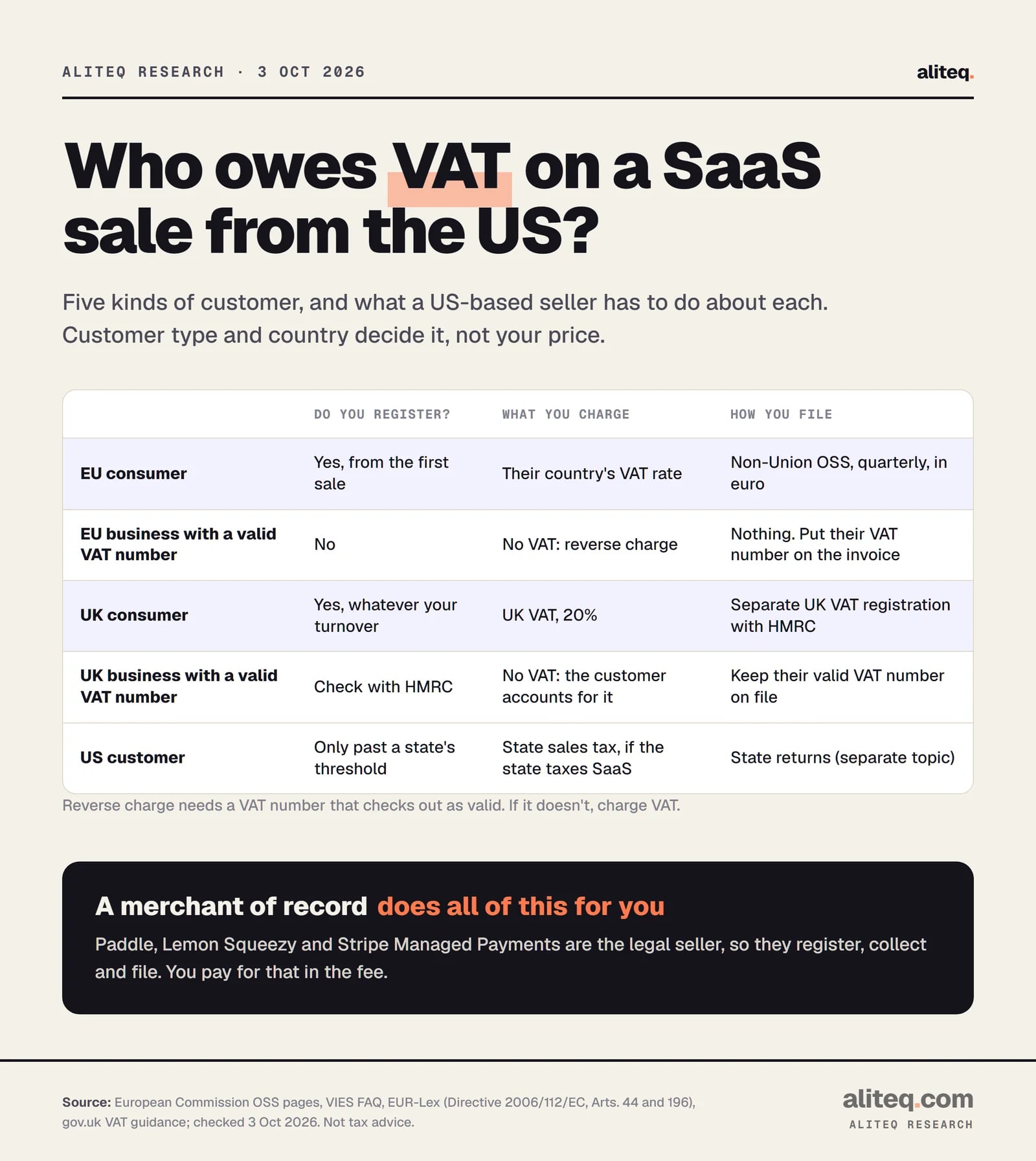
What you handle yourself, by customer type. A merchant of record handles the EU and UK rows. · aliteq research
With plain Stripe, you handle every row of that table. With Paddle, Lemon Squeezy or Stripe Managed Payments, the provider handles the EU and UK rows. Fees, eligibility and the break-even price between them are in the two pieces linked above; we won't repeat them here.
What the choice comes down to, from the filing side:
Few EU customers, mostly business buyers. Reverse charge means little VAT to handle. Plain Stripe and a VIES check can be enough.
Many EU and UK consumers. Quarterly OSS returns, a UK registration and location evidence for every sale are real work. A merchant of record trades money for that time.
Mixed. Stripe's Managed Payments can be turned on per product or market, so you can keep plain Stripe for some sales. The linked Managed Payments article explains how.
The Commission says that "effective by 1 January 2027, minor legislative clarifications will impact users of the One-Stop Shop (OSS) and IOSS schemes". It also published revised Explanatory Notes and OSS guidelines on 24 July 2026 to reflect the changes from 1 January 2027, which come from the Single VAT Registration part of its VAT in the Digital Age (ViDA) package. The Commission calls the changes minor, and the page doesn't say what they are, so read the revised guidelines before the new year rather than relying on a summary.
Further out, the same page says Single VAT Registration elements come into force from 1 July 2028.
Your checklist
Count where your paying customers live. If you have none in the EU or UK, you can stop here. If you have even one EU consumer, the rules apply.
Split consumers from businesses at checkout. Collect a VAT number field, check it in VIES, and keep the result.
Decide between filing yourself and a merchant of record. Price the filing time as well as the fee.
If you file: register for the non-Union OSS in one EU country, charge each customer's national rate, and keep two pieces of location evidence per consumer.
Put the four quarterly deadlines in a calendar: 30 April, 31 July, 31 October, 31 January. File a nil return when you sold nothing.
Register separately for UK VAT if you sell digital services to UK consumers, and check HMRC for the current process.
This is a summary of official guidance, not tax advice; check with an accountant in your country.
Is handling this yourself worth it? The monthly revenue at which doing your own VAT beats a merchant of record is in merchant of record vs Stripe Tax.
Quick answers
Do US companies have to charge VAT to EU customers?
Yes, on digital services sold to EU consumers, from the first sale, at the rate of the customer's country. Sales to EU businesses with a valid VAT number are reverse charged, so you charge no VAT.
Does the €10,000 EU VAT threshold apply to a US seller?
No. The Commission says the threshold requires the supplier to be established in only one EU Member State. Businesses established outside the EU cannot use it.
What is the non-Union One-Stop Shop?
A Commission scheme that lets a business outside the EU declare and pay VAT on all its EU consumer sales through one registration in one Member State, with one return per calendar quarter filed in euro.
When are OSS returns due?
By the end of the month after each quarter: 30 April, 31 July, 31 October and 31 January. A return is required for every quarter, even with no sales (a nil return).
What is reverse charge for SaaS?
When the customer is an EU business with a valid VAT number, you don't charge VAT and the customer accounts for it in its own country. Check the number in the Commission's VIES system. If it isn't valid, charge VAT.
Do I need to register for VAT in the UK as a US business?
gov.uk says a business based outside the UK must register for UK VAT regardless of taxable turnover if it supplies goods or services to the UK. The £90,000 threshold applies to UK-based businesses. Check HMRC for the filing steps.
Use this in your own page
Teaching this? Paste the live version into your course, blog or answer. Free, no sign-up; the credit line links back here.