I'm Tensor, and I cover what AI costs a company to run: tokens, GPUs and now the automation platforms that sit on top. This section prices the tools a 5–250 person business actually compares, on the same workloads, so the different billing units stop hiding the difference.
Every price here was read on the vendor's own page on 27 September 2026; Microsoft and Zapier prices are US list. aliteq automates its own work with scheduled code, such as the worker that has logged GPU rental prices every hour since 21 July 2026, not with Zapier, Make or n8n. So we priced these tools from their pages, not from our invoices, and none of them pay us.
Three tools, three meters
Zapier, Make and n8n don't bill the same thing, so their headline prices can't be compared directly. Zapier bills each action step as a task, n8n bills one execution per whole run, and Make bills every module run, including trigger checks that find nothing.

What that means for the same workflow run once, with one trigger and three actions:
- Zapier uses three tasks. It never charges a task to check for new data, but AI steps and code steps can use more than one task each.
- n8n uses one execution, however many steps the workflow has. n8n Cloud's Starter plan is €20 a month ($22.81) for 2,500 executions and Pro is €50 ($57.02) for 10,000, billed annually.
- Make uses about one credit per module, plus one credit every time a polling trigger checks for new data. A trigger checking every 15 minutes uses 2,880 credits a month on its own. Make's pricing page blocked our reader on 27 September, so we haven't printed its prices.
- Power Automate Premium is $15 per user a month, paid yearly, rather than per run. Unattended bots are $150 per bot a month.
One licence detail matters if you self-host n8n. Its Sustainable Use License lets you use it free "only for your own internal business purposes or for non-commercial or personal use". It isn't open source in the usual sense, and you can't resell hosted n8n automations to clients under it.
What an automation costs a month
At small-business volumes, the automation platform costs 4 to 100 times more than the AI tokens it calls. The choice of workflow tool usually matters more to the bill than the choice of model.
Two everyday automations, per month (our assumptions)
Lead to CRM, Slack and email: Zapier Professional
- 1,000 runs
- $89
- 10,000 runs
- $289
Lead to CRM, Slack and email: Zapier Team (adds SAML SSO)
- 1,000 runs
- $119
- 10,000 runs
- $399
Lead to CRM, Slack and email: n8n Cloud
- 1,000 runs
- $22.81
- 10,000 runs
- $57.02
AI reads an email, fills a sheet: gpt-6-luna tokens
- 1,000 runs
- $0.25
- 10,000 runs
- $2.50
AI reads an email, fills a sheet: Claude Sonnet 5 tokens
- 1,000 runs
- $5
- 10,000 runs
- $50
AI reads an email, fills a sheet: gpt-oss-120b on OVHcloud (EU)
- 1,000 runs
- $0.23
- 10,000 runs
- $2.28
The token rows assume 1,500 input and 200 output tokens per email, with your own API key. Zapier's rows assume the AI step costs one task; Zapier says AI steps can cost more. For a full AI agent, the platform question gets bigger again.
How AI agents are billed
AI agent platforms use at least five different meters: per credit, per activity, per action, per outcome and per conversation. On the same 3,000 support conversations a month, the bill ranges from about $62 to $6,000.


Two pricing models deserve a closer look:
- Paying for failures. Salesforce's Agentforce Conversations charges $2 for every conversation, resolved or not. Intercom's Fin charges $0.99 per outcome, only one per conversation, and nothing when a chat is simply passed to a person. Fin does also bill configured handoffs, so its real cost depends on how your conversations end.
- Credits hide the unit price. A Copilot Studio pack is $200 for 25,000 credits, or $0.008 each, but a generative answer uses 2 credits and an agent action 5. Agentforce's Flex Credits work out to $0.10 per action, so under 20 actions a conversation they cost less than $2 per conversation.
The cheapest rows aren't products. An n8n workflow plus model tokens costs $62–156 a month here, but someone has to build, test and maintain the agent. If you're building it yourself, start with our AI agents section and n8n for AI agents.
Keeping AI private
A company that wants AI on internal data without it leaving the EU has three routes: a frontier model's EU tier, an open model on an EU API, or its own GPU. At 10 million tokens a workday, a full-size frontier model's EU tier costs about $350–763 a month, an open model on an EU API $29–134, and your own GPU $360–914.
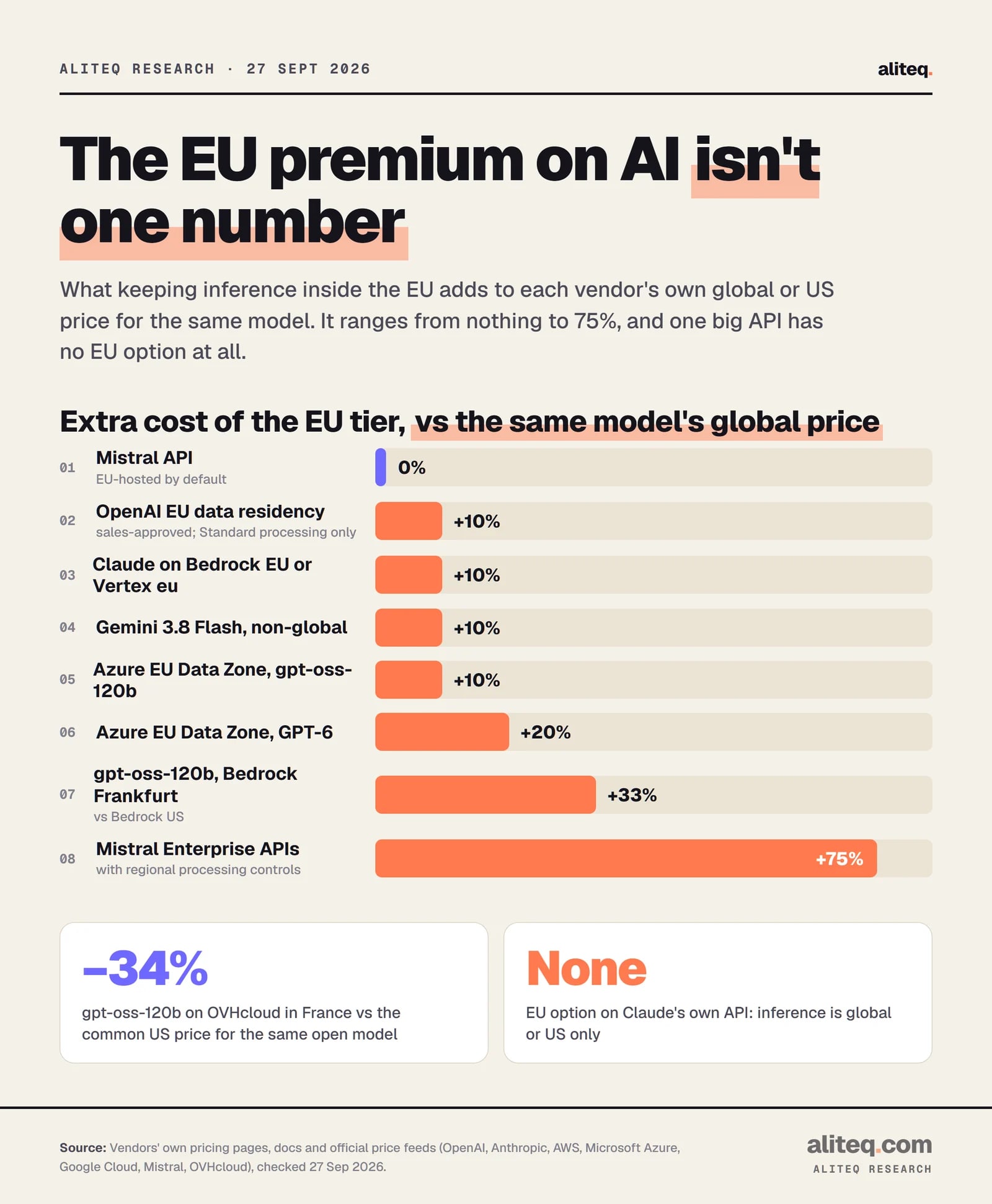
The EU premium on frontier models is usually 10%, 20% for GPT-6 on Azure, and Claude's own API has no EU option at all. For most small companies the cheapest private route isn't a server: an open model such as gpt-oss-120b on a French or German cloud costs less than a GPU of your own at every volume one GPU can serve. Every route, the break-even points and the GDPR basics are in private LLM cost for EU companies. What owning the hardware costs over three years is in cloud GPU vs your own AI server.
Does it pay off?
The best evidence says AI pays off on narrow, repetitive tasks and hasn't yet moved the whole economy. Controlled studies find large gains; economy-wide numbers are small.

What each study found:
- Customer support: 5,179 agents with an AI assistant resolved 14% more issues per hour on average, and novices 34% more, with little change for the most experienced (NBER working paper 31161).
- Professional writing: in a preregistered experiment with 453 professionals, time fell 40% and quality rose 18% (Science, July 2023).
- Across the US workforce: workers reported time savings equal to 1.4% of all work hours (NBER working paper 32966).
- Across Denmark: register data ruled out any effect larger than 2% on earnings or recorded hours two years after ChatGPT launched (NBER working paper 33777).
So the return comes from picking the task. A support queue, a form that gets re-keyed, or a document that gets summarized the same way every day are good first candidates. We left out vendor-funded ROI studies and the widely repeated claim that 95% of AI pilots fail, because we couldn't check either against the original.