A merchant of record costs a few hundred dollars a month at $10k MRR, and you only get that money back if filing yourself costs less. The break-even formula, a table for four filing costs, and the question that comes first: do you owe tax at all?
Most "merchant of record vs Stripe Tax" posts end with "it depends on your volume". This one puts a number on it. You pick a plan price and a monthly cost for doing the filing, and the formula returns the revenue at which each path wins.
We read Stripe's, Paddle's and Lemon Squeezy's pricing pages on 3 October 2026, plus the tax authorities' own pages. aliteq doesn't file tax for anyone and isn't a tax adviser. Fees are facts from the vendors. The cost of filing is our assumption, shown as four inputs you can replace with your own accountant's quote.
You owe EU and UK VAT on consumer sales from the first sale if you're based in the US, so any such customer puts your filing cost above zero. Business buyers with a valid VAT number are a different case, and US customers only matter past a state's threshold.
The thresholds that decide it, from the authorities' own pages:
EU, seller outside the EU
When you must register
From the first consumer sale. The €10,000 threshold requires a supplier "established in one single Member State"
Source
European Commission OSS page
UK, seller outside the UK
When you must register
"Regardless of taxable turnover", if you supply goods or services to the UK. The £90,000 threshold is for UK-based businesses
Source
gov.uk
South Dakota
When you must register
Gross revenue from sales into the state over $100,000 in the previous or current calendar year
Source
SD Department of Revenue
California
When you must register
Remote sales for delivery in California over $500,000
Source
CDTFA
Texas
When you must register
Remote sellers under $500,000 in the preceding twelve calendar months need no permit
Source
Texas Comptroller
When you must register
Source
EU, seller outside the EU
From the first consumer sale. The €10,000 threshold requires a supplier "established in one single Member State"
European Commission OSS page
UK, seller outside the UK
"Regardless of taxable turnover", if you supply goods or services to the UK. The £90,000 threshold is for UK-based businesses
gov.uk
South Dakota
Gross revenue from sales into the state over $100,000 in the previous or current calendar year
SD Department of Revenue
California
Remote sales for delivery in California over $500,000
CDTFA
Texas
Remote sellers under $500,000 in the preceding twelve calendar months need no permit
Texas Comptroller
Two things the table doesn't settle. First, whether your product is taxable in a given US state differs by state, so check each one you cross before you register anywhere. Second, EU business customers with a valid VAT number buy under reverse charge: you charge no VAT and they account for it. A seller whose EU customers are all businesses has little to file. The mechanics are in our EU VAT guide for SaaS sellers.
The gate gives three outcomes:
No customers outside the US, under every state threshold. Nothing to file. Plain Stripe wins at every MRR, because a merchant of record sells you a service you don't need.
EU or UK consumers. You owe VAT from the first sale. Filing costs are above zero, and the break-even below applies.
A US state threshold crossed. Add that state's registration and returns to your filing cost.
What each path costs per sale
At $29 a month, plain Stripe with Billing and Stripe Tax costs about $1.34 on a US card and $1.92 on an international card, against $1.95 on Paddle and $2.36 to $2.79 on Stripe Managed Payments. Lemon Squeezy lands between them at about $2.10 to $2.53.
The inputs, all from vendor pages read on 3 October 2026:
Stripe, US pricing: "2.9% + 30¢ per successful transaction for domestic cards", "+ 1.5% for international cards", and Billing at "0.7% of Billing volume".
Stripe Tax Basic: "0.5% per transaction, where you're registered to collect taxes". Tax Complete, which adds registrations and filings, is "Starting at $90.00 per month, 1-year contract".
Stripe Managed Payments: "3.5% per successful Managed Payments transaction in addition to Payments fees".
Paddle: "5% + 50¢ per Checkout transaction", with Paddle as the merchant of record.
Lemon Squeezy: 5% + 50¢, plus "+1.5% for international (outside of the US) transactions" and "+0.5% for subscription payments". It states that it is "known as the merchant of record for all sales through our platform".
Stripe + Billing (+ Tax Basic on international sales)
US card
$1.34
International card
$1.92
Who files VAT and sales tax
You
Paddle
US card
$1.95
International card
$1.95
Who files VAT and sales tax
Paddle
Lemon Squeezy
US card
about $2.10
International card
$2.53
Who files VAT and sales tax
Lemon Squeezy
Stripe Managed Payments + Billing
US card
$2.36
International card
$2.79
Who files VAT and sales tax
Stripe
US card
International card
Who files VAT and sales tax
Stripe + Billing (+ Tax Basic on international sales)
$1.34
$1.92
You
Paddle
$1.95
$1.95
Paddle
Lemon Squeezy
about $2.10
$2.53
Lemon Squeezy
Stripe Managed Payments + Billing
$2.36
$2.79
Stripe
Assumptions, so you can check the arithmetic: a card payment, one charge a month, and every fee computed on the $29 charged, with no tax added on top. We count Stripe Tax's 0.5% on international sales only, treating those as customers in places where you've registered (EU, UK, AU). We count no Tax fee on US sales, because we assume you're under every state's threshold. We leave out disputes, refunds, payout fees and currency conversion.
An important limit on Stripe Tax Basic: it calculates and collects tax where you're registered. You are still the seller, so you still register and file. That is the work the rest of this article prices.
The monthly fee gap, at $1k to $100k MRR
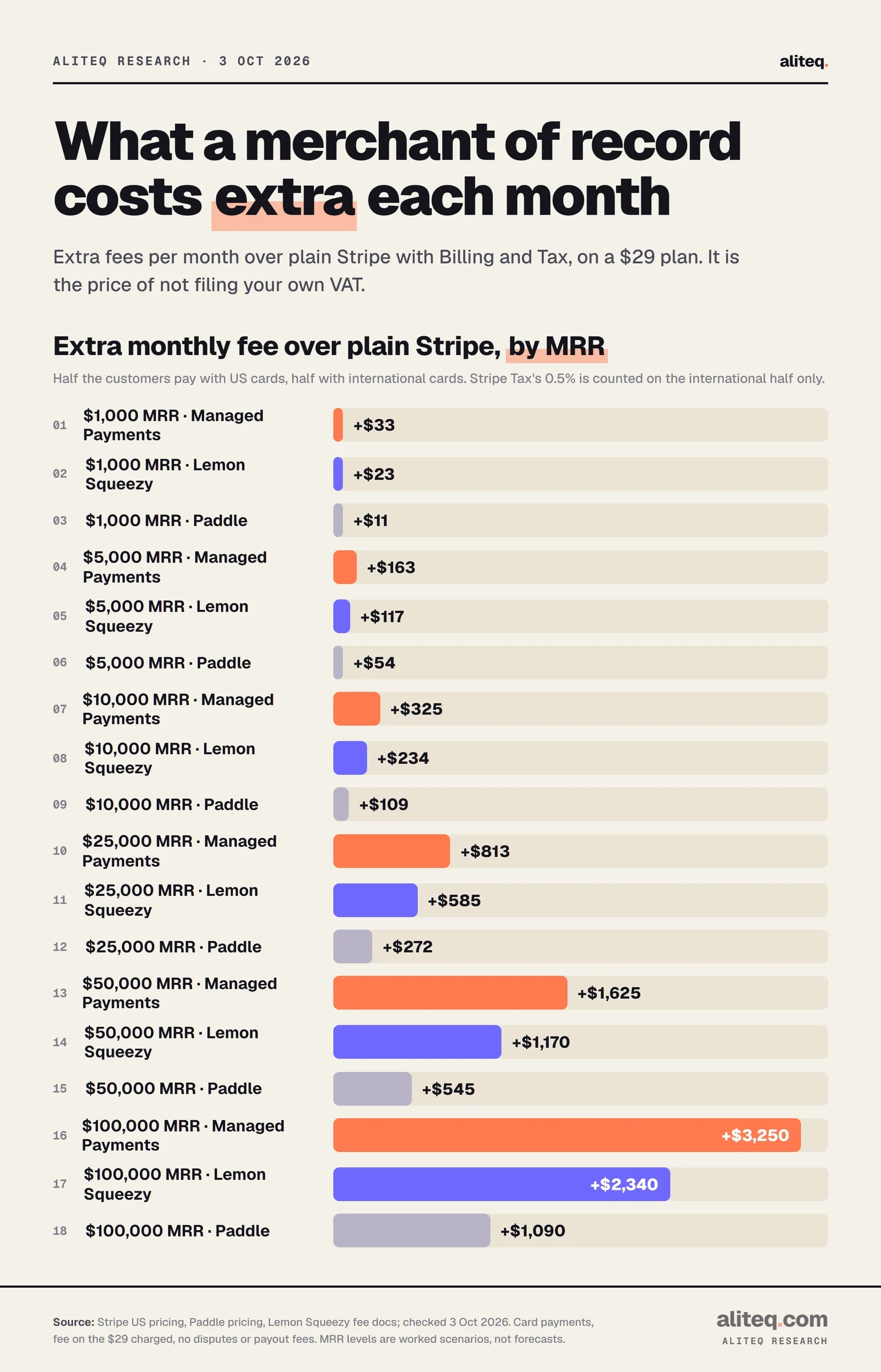
On a $29 plan with half your customers on international cards, a merchant of record costs $11 to $33 a month more than plain Stripe at $1,000 MRR, and $1,090 to $3,250 more at $100,000. The gap scales with revenue; your filing costs mostly don't.
Extra fee per month over plain Stripe with Billing and Tax. Worked scenarios on a $29 plan, not forecasts. · aliteq research
$1,000
Subscribers at $29
34
Plain Stripe fees
$56
Paddle extra
$11
Lemon Squeezy extra
$23
Managed Payments extra
$33
$5,000
Subscribers at $29
172
Plain Stripe fees
$282
Paddle extra
$54
Lemon Squeezy extra
$117
Managed Payments extra
$163
$10,000
Subscribers at $29
345
Plain Stripe fees
$563
Paddle extra
$109
Lemon Squeezy extra
$234
Managed Payments extra
$325
$25,000
Subscribers at $29
862
Plain Stripe fees
$1,409
Paddle extra
$272
Lemon Squeezy extra
$585
Managed Payments extra
$813
$50,000
Subscribers at $29
1,724
Plain Stripe fees
$2,817
Paddle extra
$545
Lemon Squeezy extra
$1,170
Managed Payments extra
$1,625
$100,000
Subscribers at $29
3,448
Plain Stripe fees
$5,634
Paddle extra
$1,090
Lemon Squeezy extra
$2,340
Managed Payments extra
$3,250
Subscribers at $29
Plain Stripe fees
Paddle extra
Lemon Squeezy extra
Managed Payments extra
$1,000
34
$56
$11
$23
$33
$5,000
172
$282
$54
$117
$163
$10,000
345
$563
$109
$234
$325
$25,000
862
$1,409
$272
$585
$813
$50,000
1,724
$2,817
$545
$1,170
$1,625
$100,000
3,448
$5,634
$1,090
$2,340
$3,250
The method: the average fee per subscriber on each path (half US, half international), minus plain Stripe's $1.634, times the number of subscribers. Subscribers are MRR divided by $29, so the counts are fractional; we round them in the table.
The break-even formula
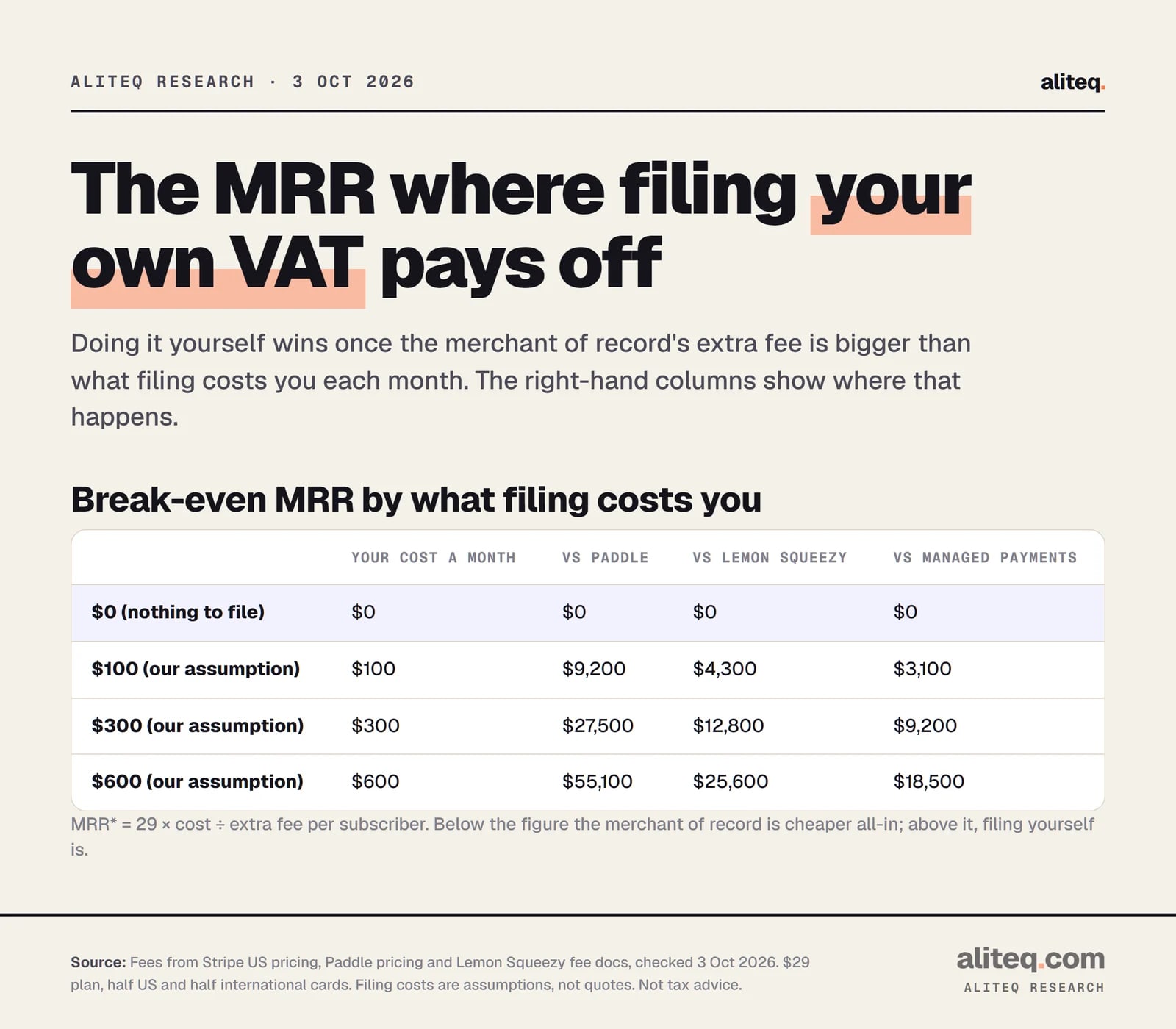
Filing yourself wins when the merchant of record's extra fee is bigger than what filing costs you per month. In one line: break-even MRR = 29 × X ÷ g, where X is your monthly filing cost and g is the extra fee per subscriber per month.
With our numbers, g is $0.316 for Paddle, $0.679 for Lemon Squeezy and $0.943 for Managed Payments. If your filing costs $300 a month and you compare against Paddle, you need 300 ÷ 0.316 = 949 subscribers, which is 29 × 949 = about $27,500 MRR. Below that, Paddle's extra fee is smaller than your filing bill.
X is the number nobody can give you from a pricing page. It covers an accountant or bookkeeper, your own hours priced at what they're worth, and any filing service. We found no verified quote for any of those, so instead of inventing one we show four inputs:
Break-even MRR for four assumed monthly filing costs. Replace them with your own accountant's quote. · aliteq research
$0
vs Paddle
$0
vs Lemon Squeezy
$0
vs Managed Payments
$0
$100
vs Paddle
$9,177
vs Lemon Squeezy
$4,274
vs Managed Payments
$3,077
$300
vs Paddle
$27,532
vs Lemon Squeezy
$12,822
vs Managed Payments
$9,231
$600
vs Paddle
$55,063
vs Lemon Squeezy
$25,645
vs Managed Payments
$18,462
vs Paddle
vs Lemon Squeezy
vs Managed Payments
$0
$0
$0
$0
$100
$9,177
$4,274
$3,077
$300
$27,532
$12,822
$9,231
$600
$55,063
$25,645
$18,462
How to read it: below the number, the merchant of record is the cheaper way to get paid; above it, filing yourself keeps more. At a cost of $0 the answer is "do it yourself at any size", which is the US-only seller with nothing to file. The $100 row is roughly where Stripe's Tax Complete starts, as a reference point: Stripe's page says "Starting at $90.00 per month" and doesn't say what else is billed, so we don't count it as the whole cost.
This is a fee comparison, not a recommendation. It leaves out the time you spend learning the rules and the risk of getting a return wrong. A merchant of record takes on that liability as the seller. You can price those two things yourself by raising X.
Where the answer changes: your customer mix
The more international your customers, the closer Paddle gets to plain Stripe, so the Paddle break-even moves far out. The Managed Payments gap barely moves.
Paddle charges the same 5% + 50¢ everywhere. Plain Stripe gets more expensive on international cards (the extra 1.5% and Stripe Tax's 0.5%). So the share of international cards decides how big Paddle's gap is:
25%
Paddle extra per subscriber
$0.46
Paddle break-even at $100 / $300 / $600 a month
$6,291 / $18,872 / $37,744
Managed Payments extra per subscriber
$0.98
50%
Paddle extra per subscriber
$0.32
Paddle break-even at $100 / $300 / $600 a month
$9,177 / $27,532 / $55,063
Managed Payments extra per subscriber
$0.94
75%
Paddle extra per subscriber
$0.17
Paddle break-even at $100 / $300 / $600 a month
$16,959 / $50,877 / $101,754
Managed Payments extra per subscriber
$0.91
100%
Paddle extra per subscriber
$0.03
Paddle break-even at $100 / $300 / $600 a month
$111,538 / $334,615 / $669,231
Managed Payments extra per subscriber
$0.87
Paddle extra per subscriber
Paddle break-even at $100 / $300 / $600 a month
Managed Payments extra per subscriber
25%
$0.46
$6,291 / $18,872 / $37,744
$0.98
50%
$0.32
$9,177 / $27,532 / $55,063
$0.94
75%
$0.17
$16,959 / $50,877 / $101,754
$0.91
100%
$0.03
$111,538 / $334,615 / $669,231
$0.87
At 100% international, plain Stripe with Billing and Tax is $1.92 and Paddle is $1.95, a gap of 3¢. The break-even at that point is so large that it means "Paddle never costs you meaningfully more than doing it yourself". If most of your revenue comes from outside the US, the fee gap is the wrong argument; the question is whether you want to be the seller of record, with the control and the work that comes with it.
Managed Payments is different because its 3.5% sits on top of Stripe's regular fees. It costs about 87¢ to 98¢ more per $29 subscriber however you mix your customers.
What filing yourself involves
Filing yourself means registering where you owe, collecting at the right rate, keeping location evidence, and filing returns on a calendar. Stripe Tax Basic does the calculating and collecting; the registrations and returns stay with you.
For the EU, the Commission's non-Union One-Stop Shop lets you register in one Member State, file one return per quarter, and pay in euro, with a nil return when you sold nothing. That's four returns a year for the whole EU. The UK is a separate registration. Each US state you cross is its own registration and its own returns. Our EU VAT guide walks through the OSS steps and a $29 example sold to a German consumer.
For the model, that work is X. A plausible reading of the table's rows:
X near $0: you only sell to US customers under every threshold, or only to EU businesses under reverse charge.
X near $100: a handful of filings a year, mostly automated, and a bookkeeper to check them.
X near $300 or $600: several jurisdictions, an accountant who files for you, and registrations that need upkeep.
Those bands are our illustration of the inputs, not market prices. Get your own quote.
Try your own numbers
The fee calculator below takes the price and the customer mix. Use it with the break-even formula: find your fee on each path, subtract, multiply by subscribers, then compare with your monthly filing cost.
What each option takes from one sale
Cheapest per sale
Stripe + Billing
$1.34 a sale · you file the tax
Cheapest that files tax for you
Creem
$1.53 a sale · 5.3%
Price of not filing yourself
$19/mo
Creem vs Stripe + Billing, at 100 sales a month
Option
Per sale
Take rate
You keep a month
Files tax
Stripe + Billing
$1.34
4.6%
$2,766
You
Stripe + Billing + Tax BasicTax Basic only calculates where you're registered
$1.49
5.1%
$2,751
You
Creem
$1.53
5.3%
$2,747
Provider
Dodo Payments
$1.71
5.9%
$2,730
Provider
Paddle
$1.95
6.7%
$2,705
Provider
Polar (free plan)
$1.95
6.7%
$2,705
Provider
Lemon Squeezy
$2.09
7.2%
$2,691
Provider
Stripe Managed Payments + Billing3.5% is charged on the total including tax
$2.36
8.1%
$2,664
Provider
US sales tax: you only register in a state once your sales there pass its threshold ($100,000 in most states, $500,000 in California, Texas and New York), and not every state taxes software.
Rates from Stripe (US and Denmark pricing pages), Paddle, Lemon Squeezy, Polar, Dodo Payments and Creem, and Lovable's payments docs, all read 27 Sep 2026. Card payments; fee on the amount charged, before disputes, payouts and currency conversion. Stripe Denmark's 1.80 kr fixed fee converted at the ECB rate of 25 Sep 2026. “You keep” is before VAT or sales tax and before income tax. Not tax advice.
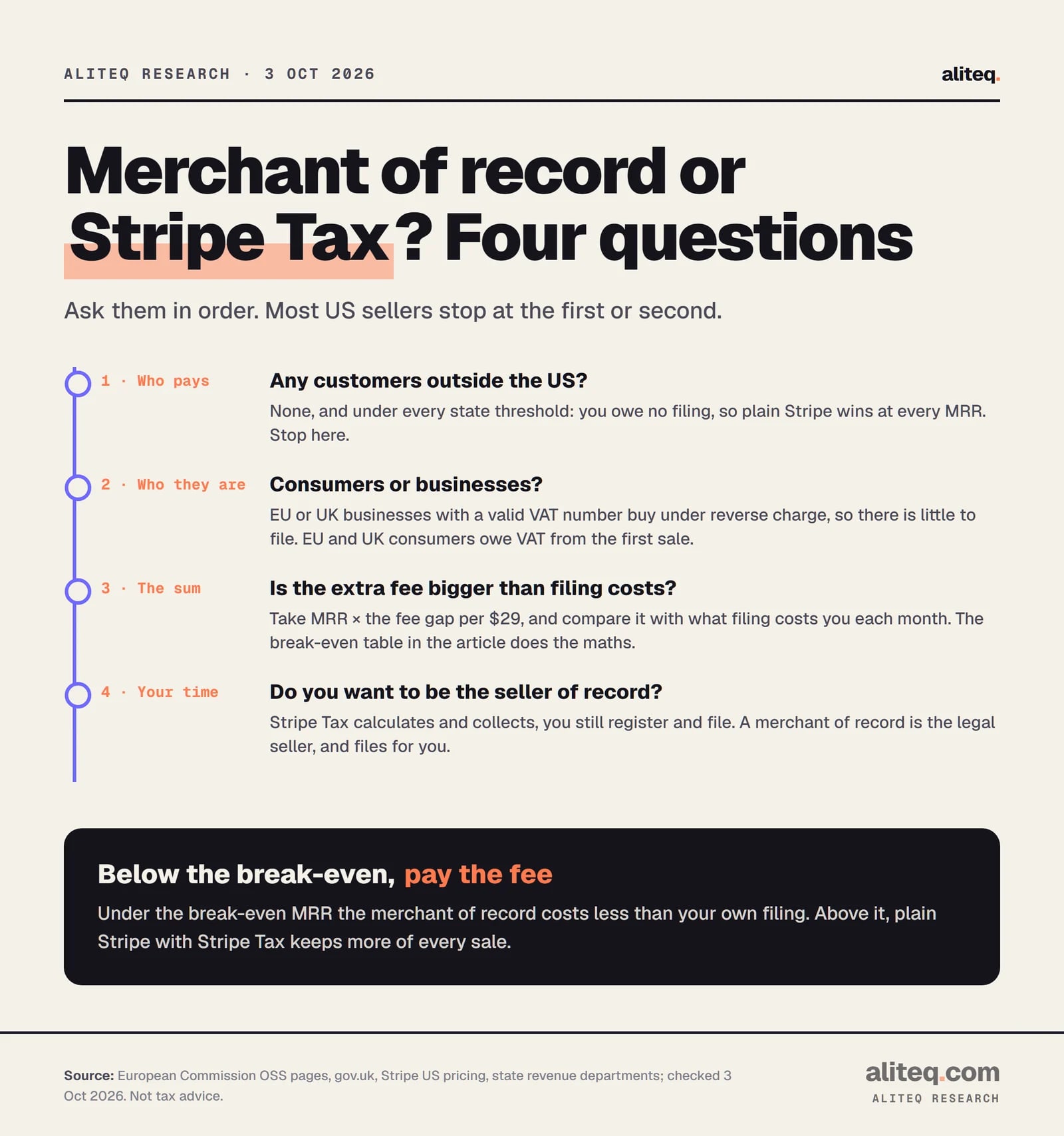
Which path, in four questions
Ask the four questions in order. Most US sellers stop at the first or the second.
A decision path. Below the break-even, pay the merchant of record fee. · aliteq research
If you're building a usage-based or credit-based product, the percentage fees apply to metered invoices too, so read our guide to usage-based billing for an AI app before you fix a price.
What this model leaves out
The model prices fees and filing, and nothing else. Real choices also depend on things it can't see:
Approval. A merchant of record reviews your product and can reject it. A lower fee is worthless if the account is closed. The fee comparison covers the acceptance rules.
Eligibility. Stripe Managed Payments isn't open to every seller or product. The Managed Payments piece lists what it excludes.
Cash flow and control. A merchant of record is the seller and holds the money before it pays you out. We don't model payout timing or fees.
Price display. VAT-inclusive pricing cuts what you keep; our EU VAT guide shows the $4.35 gap on a $29 sale to Germany.
One-off costs. Registration setup, and the first return, usually cost more than later ones. Add them to X in the first year.
Income tax. A merchant of record pays you a net amount; you still owe income or corporate tax on it. Ask your accountant.
This is a summary of official guidance and our own arithmetic, not tax advice; check with an accountant in your country.
At what MRR should I switch from a merchant of record to Stripe Tax?
When the merchant of record's extra fee is bigger than what filing costs you each month. The formula is MRR = 29 × monthly filing cost ÷ extra fee per subscriber, on a $29 plan. With a $300 monthly filing cost it comes to about $9,200 (Managed Payments), $12,800 (Lemon Squeezy) or $27,500 (Paddle). Your filing cost is an input, not a fact.
Does Stripe Tax file my VAT for me?
Not on the Basic plan. Stripe's pricing says Tax Basic costs 0.5% per transaction "where you're registered to collect taxes", so it calculates and collects, and you still register and file. Tax Complete, from $90 a month, adds registrations and filings, and Stripe's page doesn't say what else is billed.
Do I need a merchant of record if I only sell to US customers?
Not for tax, until you cross a state's threshold. South Dakota's is $100,000 of sales into the state; California's and Texas's are $500,000. Whether your product is taxable in a state differs by state, so check before you register.
Is a merchant of record cheaper than Stripe?
Per sale, no. On a $29 plan Paddle's 5% + 50¢ is $1.95, against $1.34 to $1.92 for plain Stripe with Billing and Tax. A merchant of record is cheaper all-in only if it saves you more in filing costs than the fee gap.
Do US sellers owe VAT to the EU and the UK?
Yes, on consumer sales, from the first sale. The Commission says the €10,000 threshold requires a supplier established in one EU country, and gov.uk says a business outside the UK must register regardless of turnover. EU business customers with a valid VAT number are reverse charged.
What does a merchant of record take off my plate?
It becomes the legal seller, so it handles VAT and sales tax collection, filing and remittance. Stripe's Managed Payments page says it is "responsible for global indirect tax (sales, VAT, GST)", and Lemon Squeezy says you shouldn't need to report sales tax on its sales. You still owe income tax on your payouts.
Use this in your own page
Teaching this? Paste the live version into your course, blog or answer. Free, no sign-up; the credit line links back here.