I'm Laxman. I ran Aliteq in Kathmandu from 2019 to 2024 as a PC hardware shop, building, repairing and selling machines, and today Aliteq is a US-based company and I build AI apps. This section is where I price the infrastructure a small company actually has to buy: servers, clouds, GPUs, backup and the IT support that keeps it running.
Every figure here was read on the vendor's own price page or in government statistics on 27 September 2026, and converted to US dollars where needed. The GPU rental prices are aliteq's own: we've logged Runpod's and Vast's prices every hour since 21 July 2026. We sell no hardware, no cloud and no IT services; our Vast and Runpod links are referral links, disclosed where they appear.
Run AI yourself, rent a GPU, or pay per token?
For most small companies, paying per token is the cheapest way to use AI by a wide margin. Over three years, a 25-person document chat costs $356–$5,148 through an API, about $10,391 on a rented RTX PRO 6000 in business hours, and about $32,029 on an owned one once admin time is counted.
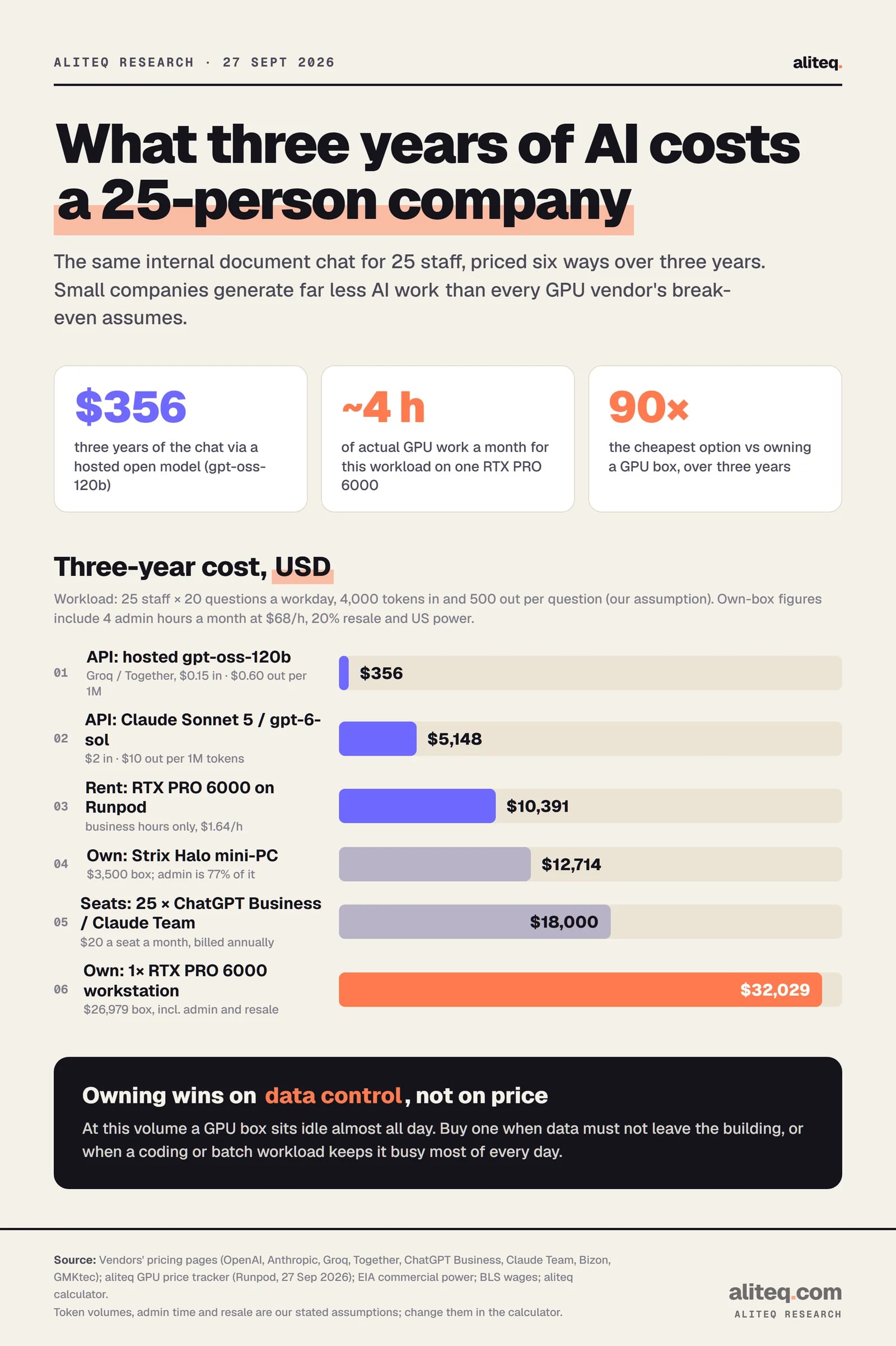
The reason is volume: a small company's chat and document work keeps a dedicated GPU busy only a few hours a month, while owning only beats renting when a box works 18 or more hours a day. The full numbers, a calculator and the cases where owning does make sense are in cloud GPU vs your own AI server. Live rental prices are on our GPU price tracker, and which GPUs fit which models is on the cost to run pages.
Managed IT: what it costs per person
A 10–50 person US company pays a managed IT provider about $125–175 per user a month for basic support, according to MSPs' own published prices. UK firms publish £30–120 ($40–159), and Danish firms 300–1,200 kr ($46–183). Every one of these ranges comes from a company selling the service.

One data point cuts against the price guides: in Kaseya's 2023 survey of 1,091 MSPs, the most common per-user price band was $50–100 a month. For 25 people, the US range works out to $3,125–4,375 a month, or $112,500–157,500 over three years. Compare that with one in-house US systems administrator, whose median wage is $99,130 a year before benefits according to the BLS.
Backups: the bill you only see in a disaster
Storing 10 TB of company backups costs anywhere from about $24 a month on a Hetzner Storage Box to $236 on AWS S3. The bigger difference shows up in the month you need everything back: downloading all 10 TB adds nothing on most specialist providers, but $913 on S3 Standard and $1,220 on S3 Glacier.

Two details matter as much as price. Immutable storage (Object Lock on Backblaze, Wasabi and S3, bucket locks on Cloudflare R2) stops ransomware from deleting your backups; Hetzner's Storage Box offers snapshots but no object lock. And Microsoft 365 isn't backed up by default in the way most people assume: Microsoft's own backup product is a paid add-on at $0.15 per GB a month, and third-party tools such as Afi and Veeam charge about $3–3.50 per user a month.
It matters because ransomware is common: Verizon's 2026 Data Breach Investigations Report found it in 48% of breaches and says small organisations are disproportionately hit. For the basics of why backups fail when you need them, see backups, and losing everything.
Devices and productivity suites
Microsoft 365 Business Premium, which includes Intune device management, costs $22 per user a month billed annually since Microsoft's 1 July 2026 price update, or $26.40 billed monthly. Apple Business, including built-in device management, has been free since 14 April 2026. Mosyle manages up to 30 Apple devices for free.
For a small mixed fleet, the choices are narrower than the price lists suggest. If you already pay for Microsoft 365 Business Premium, Intune is included. Standalone Intune is $8 per user a month. Jamf Now starts at $4 per device a month for companies under 25 people. Kandji is now called Iru and quotes on request. Many comparison pages still list Apple Business Essentials prices; that subscription no longer exists.
Windows Server 2016 ends 12 January 2027
Extended support for Windows Server 2016 ends on 12 January 2027. You can pay for up to three years of security updates, upgrade the licence, or move the workload. For one 16-core host, extended updates via Azure Arc cost about $2,999 over three years for Standard and $17,268 for Datacenter, and they require Software Assurance.

A new Windows Server 2025 Standard licence lists at $1,176 for 16 cores, less than three years of Standard extended updates, if your hardware can run it. Extended updates are free for three years if you move the server into Azure, but you then pay for Azure compute. And some small companies are leaving Windows Server altogether; the virtualisation side of that move is covered in Proxmox's upgrade path.
Watch the cloud bill's small print
Hyperscaler bills surprise small companies through line items, not headline prices. On AWS, a NAT gateway costs about $32.85 a month before it moves a byte, each public IPv4 address about $3.65 a month, and data out $0.09 per GB after the first 100 GB. One H100 runs $6.88 an hour on AWS against $2.69 on Runpod.
For GPU work specifically, specialist clouds are far cheaper than hyperscalers; see the GPU cloud pricing comparison and our live price table.