The real workflow: generate original line-art pages with AI, assemble a book, publish on Amazon KDP, and market it — plus the honest truth about a flooded market and what still actually sells.
This post contains affiliate links. If you buy through them, Aliteq may earn a commission — at no extra cost to you. Prices verified at publish time.
Share
Scroll KDP's low-content forums and you'll see the number thrown around constantly: "$5,000/month selling coloring books." It's not a fabrication — a handful of people genuinely do that. It's also not the median. The honest number for someone starting today, doing it properly, is closer to $50–300/month per book, and most books earn close to nothing. The people making real money aren't publishing one book — they're publishing a dozen, testing which niches move, and treating the ones that work as a small product line, not a lottery ticket.
What changed in the last year is the production cost. A coloring book used to mean either paying an illustrator per page or spending a weekend badly tracing clip art. Now you can generate original, clean line-art pages with an AI image model in minutes, at near-zero marginal cost. That collapse in production cost is also exactly why the KDP coloring-book category is flooded — thousands of people had the same idea. This is the workflow that still works inside that reality: how to actually generate the pages, assemble the book, publish it, and market it, plus the prompts to start with today.
1. Pick a niche before you generate a single page
This is the step almost everyone skips, and it's the difference between a book that sells and one that sits at zero. "Coloring book" and "animal coloring book" are so saturated that a new listing has no realistic path to a search result a buyer will ever see. What still works is stacking two or three specifics: an audience (adults, toddlers, teens), a theme (cottagecore, dinosaurs, ocean life, mandalas, cozy autumn), and sometimes an occasion (Christmas, back-to-school, birthday). Browse Amazon's own "coloring books for adults" and "coloring books for kids" categories, sort by best-seller, and look at what specific sub-themes already have traction with real reviews — that's demand you can niche into a notch further, not a market you're inventing from nothing.
A good sanity check before you commit: search the exact title you're considering on Amazon. If the results page is wall-to-wall near-identical books with no reviews, that's a graveyard, not a gap — it means other people tried the same shortcut and nobody bought. If you see a few books with genuine reviews and reasonable rank, that's a real, if competitive, niche.
2. Generate the pages
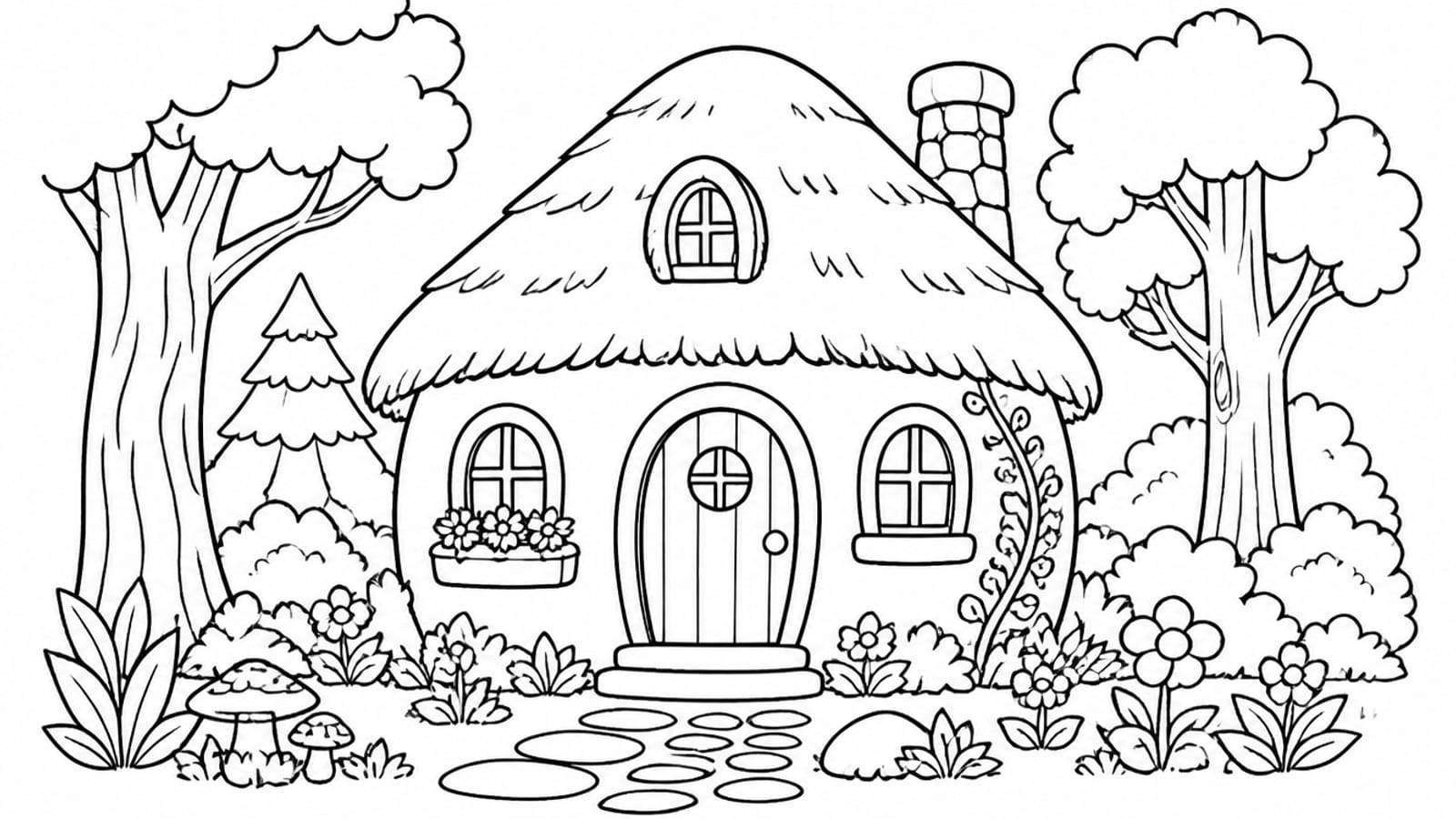
This is where AI actually changes the economics. A coloring-book page is, technically, a simple ask for an image model: clean black outlines, no shading, no color, no gradient, white background. Most current image models can produce this directly when you ask for it explicitly — the trick is being specific about the style, not just the subject. "A fox in a meadow" gets you a fully rendered illustration. "A fox in a meadow, clean black outline coloring-book line art, white background, no shading, no color" gets you an actual printable page.
Generate more pages than you need and cull hard. Line weight consistency matters more than any single page being clever — a book where every fifth page has thicker or thinner outlines than the rest reads as sloppy even to a buyer who can't articulate why. Pick your best 20–30 pages from a larger generated batch, not your first 20–30 attempts.
Copy-paste coloring-page prompts
Paste any of these into an AI image generator as a starting point — swap the subject, keep the style keywords at the end. All are original, generic subjects (no copyrighted characters, no branded IP — KDP will reject or take down anything that isn't yours to sell, and Amazon does enforce this).
a friendly original cartoon owl perched on a tree branch under the stars, clean black outline coloring-book line art, thick even linework, white background, no shading, no color, no text
a hot air balloon floating over a patchwork of farm fields, whimsical original scene, clean black outline coloring-book line art, white background, no shading, no color, no text
a chunky original cartoon dinosaur munching on ferns in a prehistoric jungle, clean black outline coloring-book line art, thick even linework, white background, no shading, no color, no text
an underwater scene with an original cartoon sea turtle swimming past coral and bubbles, clean black outline coloring-book line art, white background, no shading, no color, no text
a cozy campfire scene with an original cartoon bear roasting marshmallows, clean black outline coloring-book line art, thick even linework, white background, no shading, no color, no text
a detailed original mandala built from seashells and starfish, symmetrical geometric pattern, clean black outline coloring-book line art, white background, no shading, no color, no text
a steam train chugging through original cartoon mountains with puffy clouds, clean black outline coloring-book line art, thick even linework, white background, no shading, no color, no text
a garden greenhouse full of original cartoon potted succulents and hanging vines, clean black outline coloring-book line art, white background, no shading, no color, no text
An example generated coloring page — clean outlines, no shading, ready to lay out. · Generated with Higgsfield
Higgsfield · Line-art pages
Sponsored
Higgsfield's image models will generate clean black-outline coloring pages directly from a text prompt — no drawing skill, no per-illustrator cost. Free tier to test a page before you commit to a full book.
This is the unglamorous part, and it's where a lot of first attempts get bounced. KDP low-content books are almost always 8.5" × 11", one image per page, single-sided (so ink doesn't bleed through if a kid colors both sides — most successful coloring books print single-sided even though it costs more paper). Lay your pages out in a simple design tool — Canva, Affinity, or even a slide deck exported to PDF — at the exact trim size KDP specifies, with the margins their template requires; KDP publishes free templates for this, and using them is the fastest way to avoid a print-quality rejection.
You also need a cover. This is a second, distinct job from the interior pages — a cover is a full-color, eye-catching illustration (not a coloring-page-style outline), because it's the thing that has to stop a scroll on a results page. Generate a colorful, polished cover image separately, then use KDP's cover template (front, spine, back) to build the wraparound file. Fill out the metadata carefully: your title should contain your actual niche keywords (a buyer searching "ocean coloring book for kids" needs to see those words), a real category, and honest age-range/page-count details — misleading metadata gets books suppressed or pulled.
4. Market it — publishing is not marketing
The single biggest reason niche-down coloring books fail isn't quality — it's that nobody publishes them anywhere buyers are looking. Amazon's own search and "customers also bought" placement is the main channel, and it responds to the same signals as any other listing: a keyword-rich title and backend search terms, a handful of genuine early reviews (ask friends and family honestly, don't buy reviews — that's a bannable offense), and Amazon ads (a small automatic-targeting campaign, even $5/day, gives the algorithm data to start ranking you organically). Outside Amazon, a Pinterest board of your page previews is disproportionately effective for coloring books specifically, because Pinterest's audience already searches "printable coloring pages" and "coloring book ideas" at real volume — pin a preview page linking to your Amazon listing.
A mandala-style page — this genre holds up well for adult coloring books specifically. · Generated with Higgsfield
HiggsfieldSponsored
Generate your first coloring-book page today
Test a niche with a handful of pages before you commit to a full 30-page book — generate the line art and the cover in the same place. Free tier to try it.
− The category is genuinely flooded — thousands of near-identical AI-generated books were dumped on KDP in 2024–2025, and most earn nothing
− Amazon's low-content-book policies tighten periodically; generic "clip art dump" books get suppressed
− Royalties per book are small (often $1–3) — you need either volume or real per-title demand to add up to meaningful income
− Reviews are slow to accumulate without your own audience or ad spend
− Line-art consistency across a whole book takes real curation — a rushed batch reads as low-effort even when the individual pages are fine
Quick answers
Is the coloring-book market too saturated to bother with in 2026?
The generic end of it — "animals coloring book," "cute coloring book" — is genuinely oversaturated and not worth your time. The specific end (a well-chosen niche theme, done with consistent quality, marketed with even minimal effort) still sells, because most of the flood is low-effort clip-art dumps with no marketing behind them at all. You're not competing with the whole category — you're competing with the handful of books that also niched down and also marketed themselves, and there's real room there.
Do I need to draw or use design software I don't know?
No drawing. You do need basic layout skills (or the patience to learn Canva for an afternoon) to place generated pages onto KDP's templated trim size with correct margins — that part is mechanical, not artistic.
How much does it actually cost to publish a coloring book?
KDP itself is free to publish on — you only pay Amazon's cut per sale (print cost + their share), there's no upfront fee. Your real cost is an AI image-generation subscription (often free-tier-viable for a first test book) and, optionally, a small ad budget once you're live.
Can I use AI to generate a whole book overnight?
You can generate the raw pages that fast, yes — but the curation (picking your best, consistent-linework 25–30 pages out of a larger batch) and the KDP formatting are what actually take the time, and skipping them is exactly why most AI coloring books fail. Budget a weekend for a first book done properly, not an hour.
Coloring books are one entry point into a wider AI-assisted low-content publishing lane — the same generation workflow extends to activity books, journals, and puzzle books once you've got one title live. I track the ones actually worth trying in AI Studio.