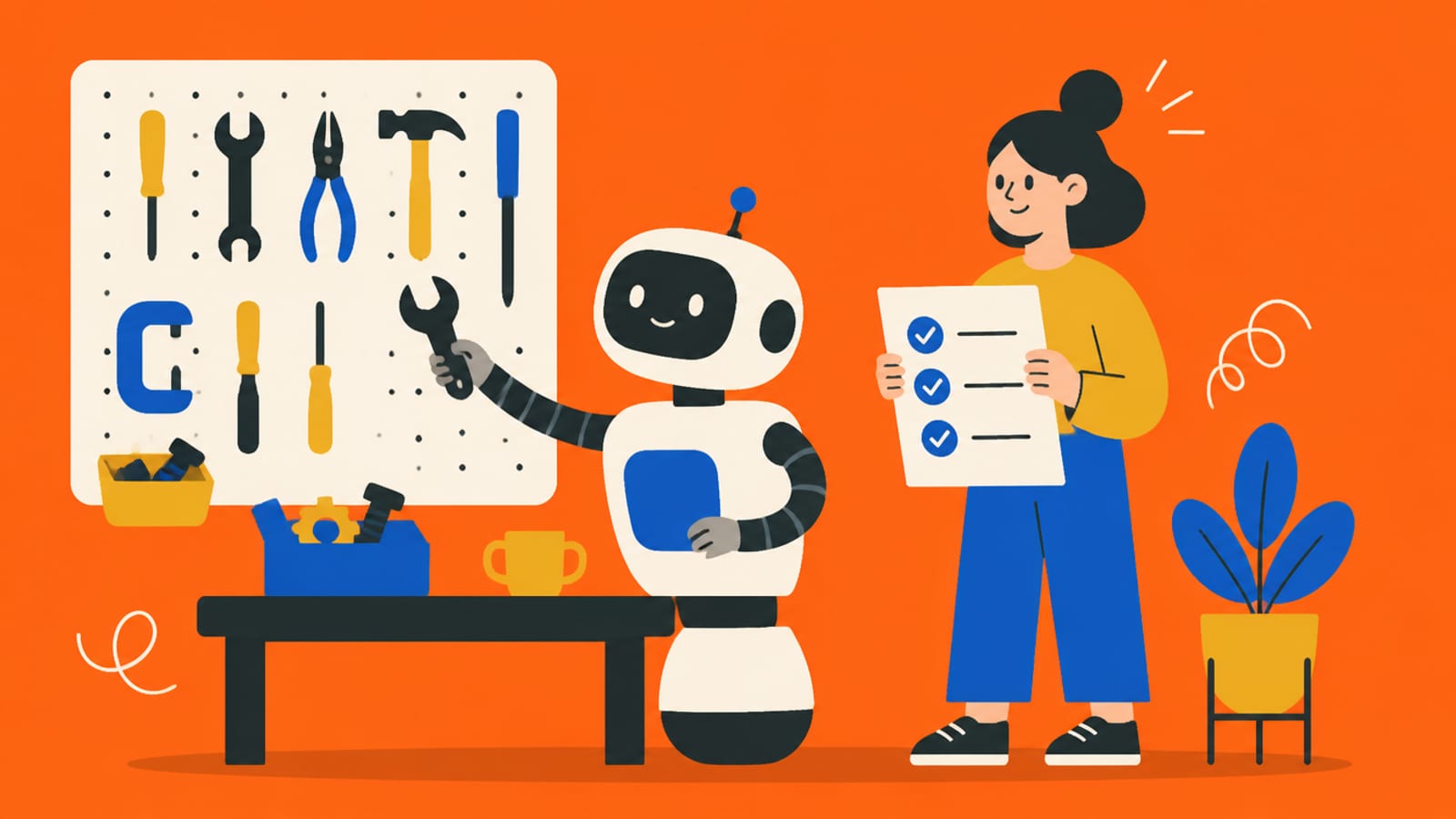
Follow the arrows below: the AI didn't guess the answer, it asked for a tool.
That request is a tool call. A system where the model keeps choosing its own next tool call is an agent.
- You ask
"What's in my orders table?"
- Model requests a tool
A structured call: run_query("orders")
- The app runs it
With whatever permissions the app has
- Result goes back
Into the model's context window
- Model answers
Using the real result
- You ask
"What's in my orders table?"
- Model requests a tool
A structured call: run_query("orders")
- The app runs it
With whatever permissions the app has
- Result goes back
Into the model's context window
- Model answers
Using the real result
Anthropic's tool-use docs: the model "returns a structured call that your application executes (client tools) or that Anthropic executes (server tools)."
Anthropic's engineering guide draws the line: workflows are "orchestrated through predefined code paths", while agents "dynamically direct their own processes and tool usage."
Coding tools like Claude Code are agents: they read files, run commands and decide the next step. Our coding agents on local models guide covers running them.
More autonomy means more care. The same guide recommends "finding the simplest solution possible, and only increasing complexity when needed."
Try it with the rules off. In the sandbox, give the agent a delete tool with no approval step, then ask it to "clean up". That's the argument for approval prompts.
Check yourself
0/4 got itSaved on this device only. No account, no streaks.
Next in how the AI thinks: Local model vs API: what changes.