Agents that plan, use tools and act — not just answer. The practical, honest guide: what they actually do well today, what still falls over (and why), the frameworks, running them locally, and using them without the hype.
AI agents are the biggest story in AI right now, and also the most over-promised. The pitch is intoxicating: instead of a chatbot that answers, an agent that acts — it plans, uses tools, writes and runs code, browses, and completes a multi-step task while you do something else. Some of that is real and genuinely useful today. A lot of it, in late 2026, still falls over the moment a task gets long or ambiguous. I build and run this stuff, so I'm going to give you the version that separates what agents can actually do from the demo-ware — because the gap between a slick demo and a reliable agent is the whole story, and almost nobody selling you an 'AI employee' will admit it.
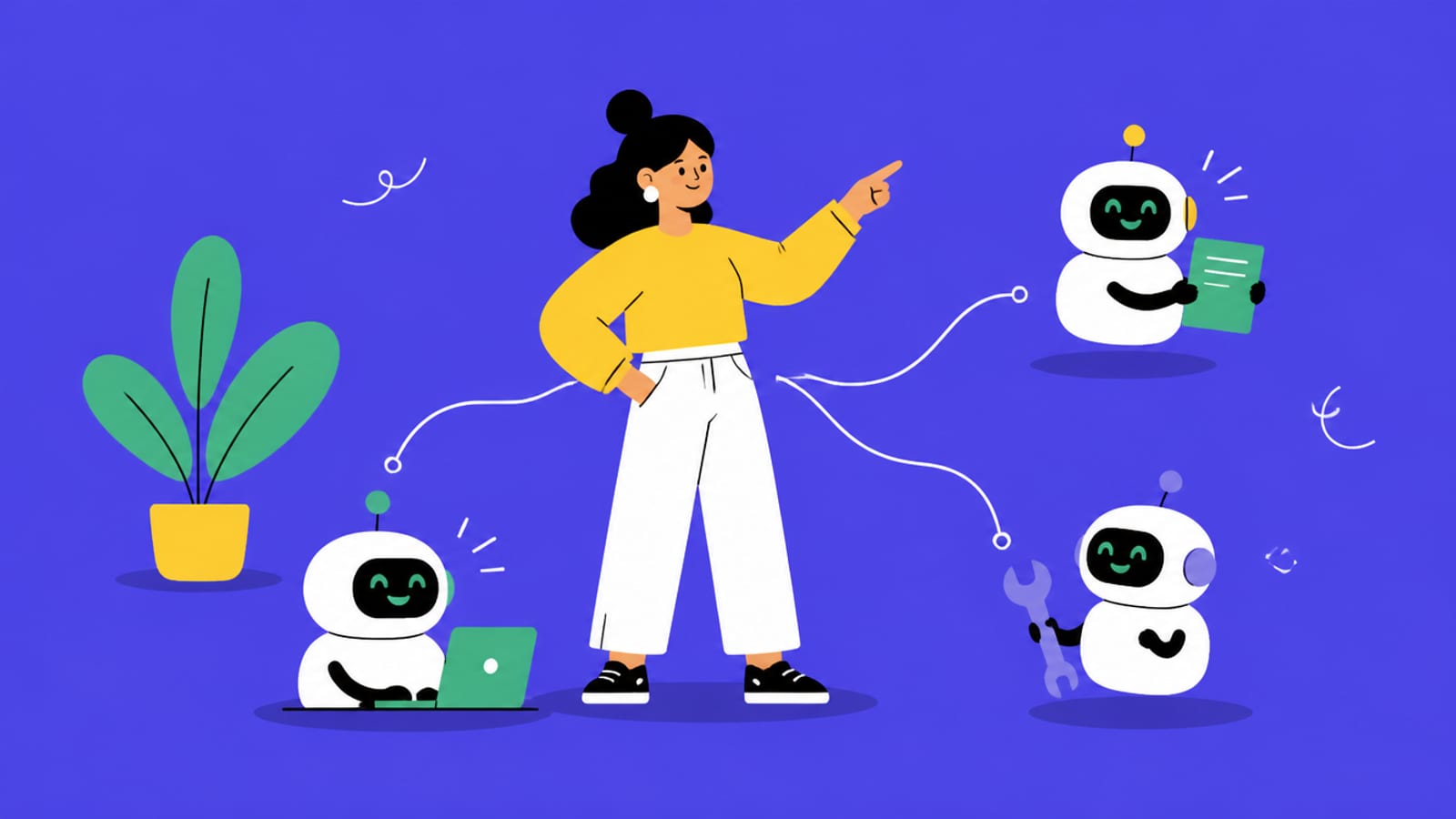
An agent is an LLM given a goal, tools, memory and a loop — it acts, rather than just answering. Illustration by Aliteq. · Illustration by Aliteq / generated with Higgsfield
What an AI agent actually is
Cut through the branding: an AI agent is a large language model wrapped in a loop and given tools. You hand it a goal; it plans a step, takes an action (calls a tool, runs code, searches the web), observes the result, and repeats until it decides the task is done. The three things that turn a chatbot into an agent are tools (it can do, not just say), memory (it carries state across steps), and autonomy (it decides the next step itself). That's it. Everything else — 'multi-agent crews', 'agentic workflows', 'AI employees' — is a variation on that loop, with more or less human oversight bolted on.
Chatbot vs workflow vs agent
Chatbot
What it is
Answers a prompt
Who decides the steps
You (one turn at a time)
Workflow / automation
What it is
Runs pre-defined steps
Who decides the steps
You, in advance (fixed path)
AI agent
What it is
Pursues a goal with tools + a loop
Who decides the steps
The model, step by step (dynamic)
What it is
Who decides the steps
Chatbot
Answers a prompt
You (one turn at a time)
Workflow / automation
Runs pre-defined steps
You, in advance (fixed path)
AI agent
Pursues a goal with tools + a loop
The model, step by step (dynamic)
What agents do well today
Narrow, tool-using tasks with a human check. 'Research these 10 companies and fill this table', 'refactor this function and run the tests' — scoped jobs where a person reviews the output.
Coding assistance. Agentic coding tools that read a repo, make changes and run tests are genuinely useful, precisely because the feedback loop (tests pass/fail) grounds the agent.
Business-process automation. Connecting apps and triggering multi-step flows across SaaS tools — where the logic is simple but touches many systems (n8n's sweet spot).
Retrieval + synthesis. Pulling from documents/APIs and composing an answer, with citations you can verify.
Notice the pattern: agents shine when the task is bounded, the tools give real feedback (tests, search results, API responses), and a human is in the loop to catch mistakes. That's not a limitation to apologise for — it's the design that actually works.
⚠️ What agents can't do reliably yet
Here's the part the 'autonomous AI workforce' pitch skips, and it's the most important section on this page. Long, hands-off, multi-step autonomy is not reliable in 2026, and the reasons are structural, not just 'the model isn't smart enough yet':
Compounding errors. Even a 95%-reliable step becomes coin-flip reliable over ~14 steps (0.95^14 ≈ 0.49). Agents that must chain many steps degrade fast, because small error rates multiply.
Hallucinated actions. Agents don't just make up facts — they make up tool calls, invent parameters, or misread a result and confidently act on it. A wrong action is worse than a wrong sentence.
Cost and loops. An agent that retries, reasons and calls tools burns tokens; a stuck agent can loop expensively. Real deployments need hard caps (max iterations, budgets) — which is exactly what the good frameworks add.
No genuine judgment. Agents don't know when they're wrong or when to stop. They'll declare a botched task 'complete'. That's why human review isn't optional for anything that matters.
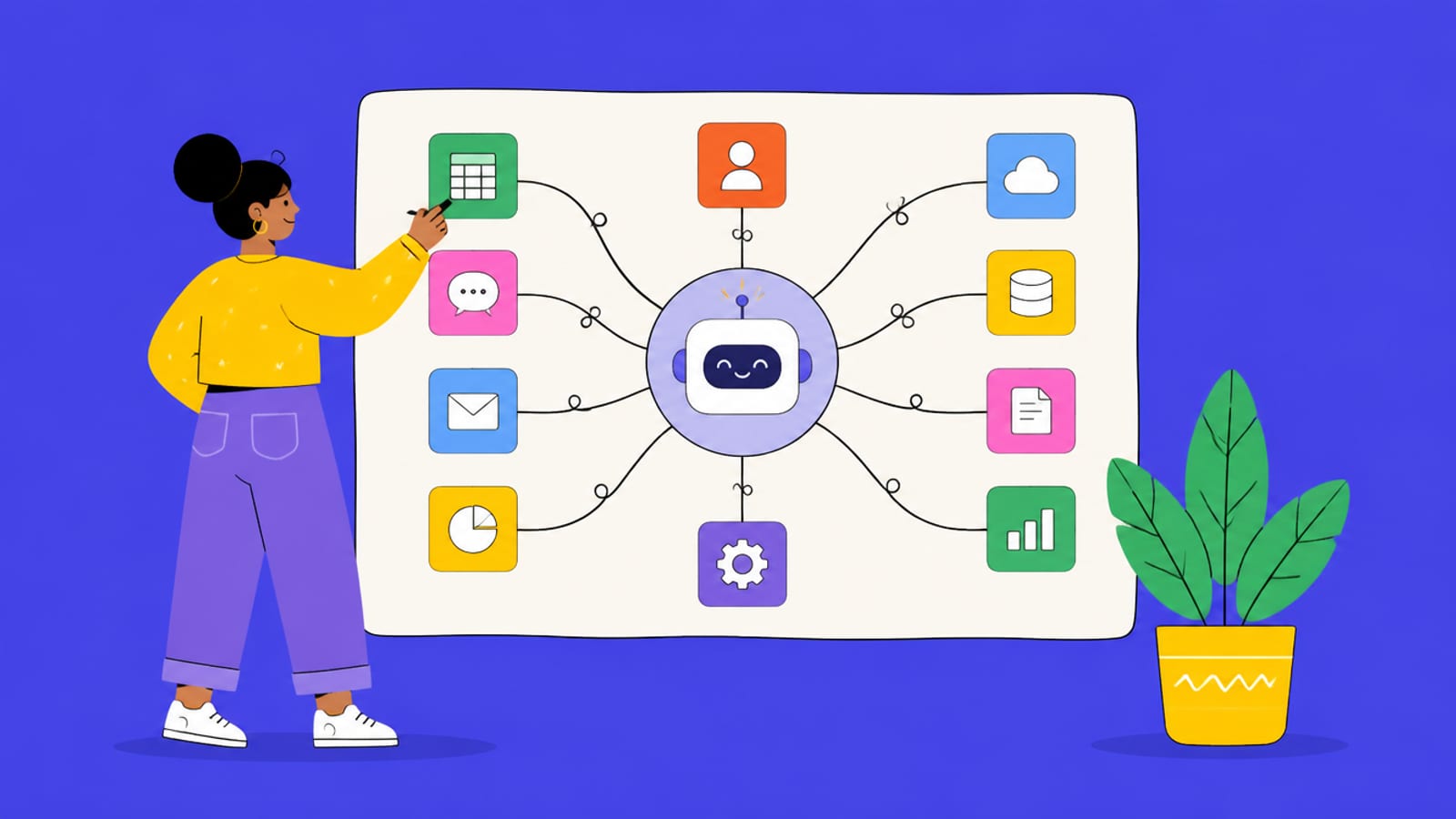
Under the branding, an agent is a plan-act-observe loop over tools — powerful when bounded, fragile when unbounded. · Illustration by Aliteq / generated with Higgsfield
The frameworks (and how to pick)
You don't build the loop from scratch — you use a framework. The four that matter most in 2026, briefly: LangGraph for durable, auditable production agents; CrewAI for the fastest multi-agent prototype; the OpenAI Agents SDK for GPT-centric builds; and n8n for no-code automation across hundreds of apps. Full breakdown in the best AI agent frameworks, compared, the two most-compared head-to-head in LangGraph vs CrewAI, plus deep-dives on the OpenAI Agents SDK and n8n for AI agents.
Running agents locally — our angle
Most agent hype assumes a frontier cloud model. But agents run on local models too, and for privacy, cost and control that's often the right call — an agent looping over your files or code doesn't need to send all of it to an API. It does need enough hardware, because an agent hits the model repeatedly. See how to run a local AI agent and how much RAM/VRAM local agents need, and size the machine with the best GPU for local AI. This local-and-hardware angle is exactly where we're more useful than the hype crowd.
Making money — the honest version
'AI agents will replace your employees and print money' is the fantasy. The real, boring, genuinely-valuable version is automating a specific workflow you already do — and it's worth doing well. That's covered honestly (no income promises) in how to actually use AI agents to save time and money, which connects to our wider ways-people-make-money-with-AI coverage.
Quick answers
What's the difference between an AI agent and a chatbot?
A chatbot answers your prompts one turn at a time. An agent is given a goal and a set of tools (code, web, APIs) plus memory, and it loops — planning a step, acting, observing the result, and repeating — until the task is done. Agents act; chatbots respond.
Can AI agents work autonomously without supervision?
For narrow, bounded, easily-verified tasks, largely yes. For long, open-ended, multi-step work, not reliably in 2026 — small per-step error rates compound, agents hallucinate actions, and they don't know when they're wrong. Human-in-the-loop is the responsible default for anything that matters.
Which AI agent framework should I use?
Depends on the job: LangGraph for durable, auditable production agents; CrewAI for the fastest multi-agent prototype; the OpenAI Agents SDK for GPT-centric builds; n8n for no-code automation across many apps. See our frameworks comparison for the full matrix.
Do I need the cloud, or can agents run locally?
Both work. Local models can power agents and are often better for privacy and cost, since an agent looping over your data doesn't need to ship it all to an API — you just need enough hardware, because agents call the model repeatedly. See our local-agent guides.
Are AI agents overhyped?
The technology is real and useful for bounded tasks; the 'autonomous AI workforce replacing everyone' framing is overhyped. Judge any agent by how cheaply you can verify and undo its work. That honest lens is worth more than any demo.