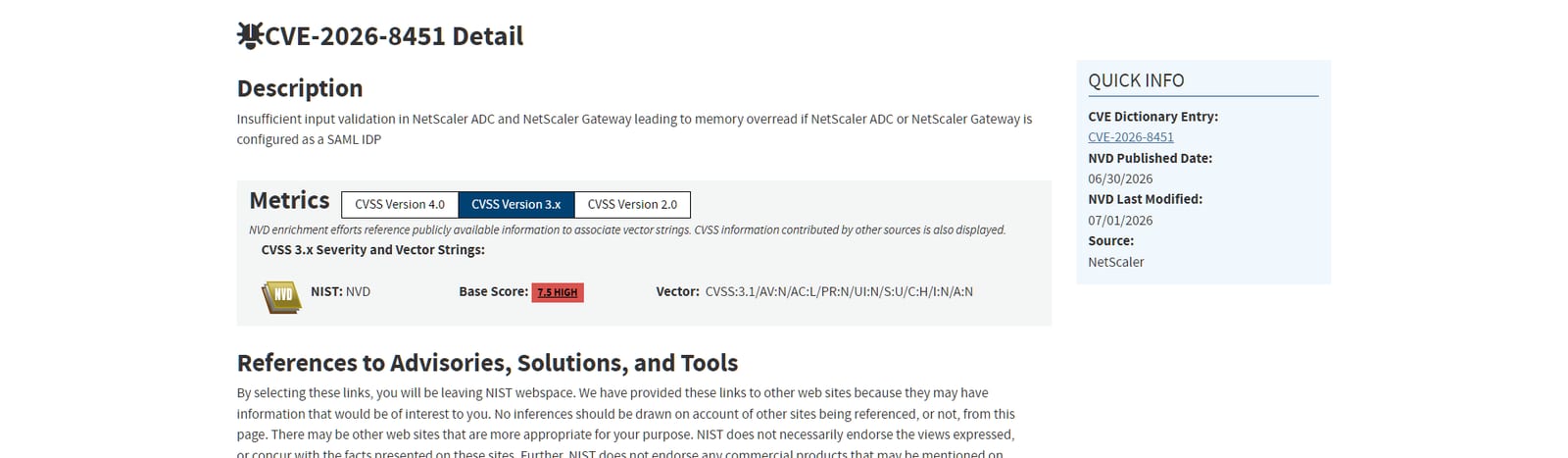
CVE-2026-8451 makes NetScaler ADC and Gateway over-read memory when configured as a SAML identity provider, potentially spilling session tokens. It's the same class of bug behind the original CitrixBleed. Patch it.
If 'CitrixBleed' rings a bell, it should — the original was one of the most exploited vulnerabilities of its year, because leaking memory from a network gateway means leaking the session tokens that let an attacker walk straight past authentication. CVE-2026-8451 is the same class of flaw: a memory over-read in Citrix NetScaler ADC and Gateway that triggers when the device is configured as a SAML identity provider, potentially spilling sensitive memory to an unauthenticated attacker. It's rated 8.8 by NetScaler, it's network-based and needs no login, and if you run NetScaler as a SAML IDP, it's a patch-now situation.
8.8/ 10
CVSS severity: High
Unauthenticated memory over-read (CWE-125) that can leak session tokens — the CitrixBleed pattern.
Why memory leaks on a gateway are so dangerous
A memory over-read sounds less scary than 'remote code execution' — until you consider what's in a gateway's memory. NetScaler sits at the network edge handling authentication, and its memory contains session tokens, credentials, and other secrets. A flaw that lets an unauthenticated attacker read chunks of that memory can hand them a valid session token, which is as good as a password — they log in as a legitimate user without ever cracking one. That's exactly how the original CitrixBleed was weaponized, and it's why this class of bug on an internet-facing appliance gets treated with the same urgency as an RCE. The impact is authentication bypass, dressed up as a 'memory' issue.
NetScaler handles authentication at the network edge — so leaking its memory can leak the session tokens that unlock everything behind it. · Unsplash
What to do
Update NetScaler ADC/Gateway to the patched builds: 13.1-63.18, 14.1-72.61, or the corresponding FIPS/NDcPP release.
If you use NetScaler as a SAML IDP, treat this as urgent — that's the vulnerable configuration.
After patching, terminate existing sessions and rotate tokens — a leaked token stays valid until it expires.
Restrict management access and monitor for anomalous authentication from unexpected sources.
Quick answers
Is CVE-2026-8451 the same as the original CitrixBleed?
It's the same class — a memory over-read on NetScaler that can leak sensitive data including session tokens — but a distinct, newer CVE. The original CitrixBleed (from a prior year) was mass-exploited because leaked tokens enable authentication bypass. This one triggers specifically when NetScaler is configured as a SAML identity provider. The lineage matters because it tells you how attackers use these: harvest tokens, then log in as legitimate users.
Am I affected if I don't use SAML?
The vulnerability is triggered by the SAML IDP configuration specifically, so devices not configured that way are at lower risk from this particular flaw. But NetScaler as a SAML IDP is a common enterprise setup, and you should patch regardless — security updates often bundle multiple fixes, and confirming your configuration and version is quick. If you do use SAML IDP, treat it as urgent; if not, still apply the update on your normal cycle.
What should I do after patching?
Because the flaw can leak session tokens, patching alone doesn't invalidate tokens that may already have been stolen. After updating, terminate active sessions and rotate/expire tokens so any leaked ones become useless. Then monitor for unusual authentication activity. Treating it as a potential token-exposure event — not just a patch — is the right posture for a CitrixBleed-class bug, especially if the device was internet-facing.
CitrixBleed-class bugs are dangerous because they turn 'read some memory' into 'log in as anyone.' If you run NetScaler as a SAML IDP, patch now and rotate sessions. Sources: NVD and Citrix. It's the edge-appliance cousin of the month's WebLogic and Ivanti criticals.