CVE-2026-10520 scores a maximum 10.0 — the rarest severity rating there is. No login, one network request, and an attacker owns the box as root. It's on CISA's exploited list, with public exploit code and confirmed backdoors.
Most 'critical' vulnerabilities aren't actually a perfect ten. CVE-2026-10520 is. Ivanti scored this flaw in its Sentry appliance a full 10.0 — the maximum the scale allows, which fewer than a handful of bugs earn in any given year — and it isn't theoretical: it's on CISA's exploited list, public exploit code is circulating, and security firms have already found backdoored instances in the wild. The one-line version is about as bad as security news gets: a stranger on the internet, with no account and no clicks required, can run commands as root on your Sentry box. If you run one, this is a stop-everything moment.
10.0/ 10
CVSS severity: the maximum
Unauthenticated, network-based, root-level RCE that breaks out of its security scope — everything that pushes a score to a perfect 10.
What makes a score a perfect 10
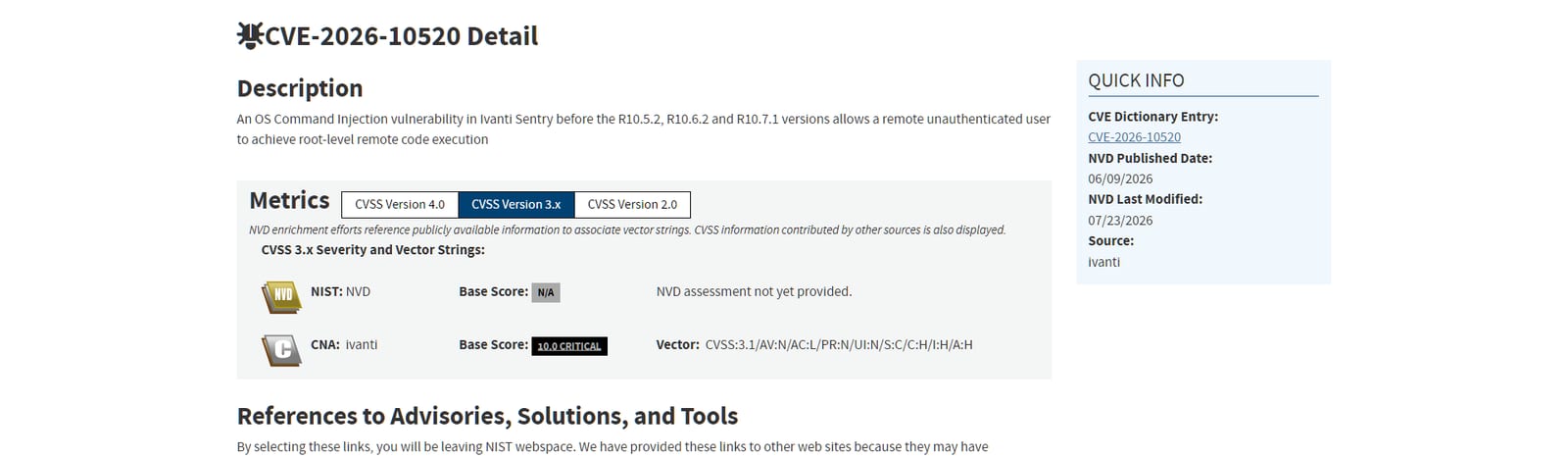
It's worth understanding why this one hits the ceiling, because it tells you exactly how bad it is. A CVSS 10.0 requires the worst value on nearly every axis at once. The vector — AV:N/AC:L/PR:N/UI:N/S:C/C:H/I:H/A:H — reads as: reachable over the network, low complexity, no privileges required, no user interaction, and — the detail that pushes it past 9.8 — Scope: Changed. Scope-changed means the exploit doesn't just compromise the vulnerable component; it breaks out of it to affect the wider system. Combine that with full loss of confidentiality, integrity and availability, and you get the rare perfect 10. Most severe bugs are a 9.8 (a takeover confined to the component). A 10.0 is a takeover that spreads.
The NVD entry: 10.0 CRITICAL, S:C (scope-changed), 'a remote unauthenticated user to achieve root-level remote code execution.' · NIST National Vulnerability Database (screenshot)
Why an appliance is the worst place for this
Ivanti Sentry is a gateway appliance — it sits at the edge of the network, managing and securing access to mobile and back-end systems, which by design means it's reachable from outside and trusted on the inside. That's the worst possible location for an unauthenticated root RCE. An attacker who owns your Sentry hasn't just compromised one server; they've compromised the thing that guards the door, with a foothold that's trusted by everything behind it. This is the same reason network edge devices from Ivanti, Fortinet, Citrix and others are attacked relentlessly: they're internet-facing, they run as root, and one flaw turns the guard into the intruder.
From one request to owning the gateway
Send the request
One crafted request to an internet-facing Ivanti Sentry. No login needed.
Command injection
Unsanitised input is executed as an OS command (CWE-78).
Root code execution
The command runs as root — total control of the appliance.
Trusted foothold
The gateway is trusted inside the network — a launch point for everything behind it.
Send the request
One crafted request to an internet-facing Ivanti Sentry. No login needed.
Command injection
Unsanitised input is executed as an OS command (CWE-78).
Root code execution
The command runs as root — total control of the appliance.
Trusted foothold
The gateway is trusted inside the network — a launch point for everything behind it.
No credentials at any step. The appliance that secures your network becomes the attacker's foothold inside it.
What to do now
Patch Ivanti Sentry to R10.5.2, R10.6.2 or R10.7.1 immediately — these are the fixed versions.
If you can't patch this hour, remove the appliance from the public internet — restrict access to trusted management networks only.
Hunt for compromise: unexpected root processes, new/modified accounts, config changes, and unusual outbound traffic from the appliance.
If you find anything, treat it as a full incident — a root foothold on a gateway can reach far beyond the box itself.
Quick answers
How serious is a CVSS 10.0 really?
It's the maximum severity the scoring system allows, and it's genuinely rare — most 'critical' bugs top out at 9.8. The difference is 'Scope: Changed': a 10.0 doesn't just compromise the vulnerable component, it breaks out to affect the wider system. Combined with unauthenticated network access and full impact on confidentiality, integrity and availability, a 10.0 is the most dangerous class of vulnerability there is. Treat it as a drop-everything emergency.
Which Ivanti Sentry versions are affected?
Versions before R10.5.2, the 10.6.0–10.6.1 range, and 10.7.0. The fixes are R10.5.2, R10.6.2 and R10.7.1 — update to the patched release on your branch. If you're unsure of your version, check it now; an unpatched, internet-facing Sentry is exactly what attackers are scanning for, and this one is confirmed exploited in the wild.
We patched. Are we safe?
Patching closes the hole, but because this was exploited before you patched — with public exploit code and confirmed backdoors — you should verify you weren't already compromised. Hunt for persistence: unexpected processes, accounts, config changes, outbound connections. A gateway appliance breach can spread into the network behind it, so scope the potential blast radius rather than assuming the patch undid any access that already happened.
Why do Ivanti, Fortinet and Citrix keep having these?
Edge appliances are a magnet for attackers: they're internet-facing by design, they run with high privilege, they're trusted inside the network, and their code often handles untrusted input in older, complex ways. One flaw turns a security device into the attacker's best foothold. It's a structural problem across the whole category — which is why keeping these appliances patched fast, and off the public internet where possible, matters more than for almost any other system.
Primary detail is on the NVD entry and CISA's KEV catalog; patched builds are on Ivanti's download portal. A perfect-10, unauthenticated root RCE on an internet-facing gateway is about as urgent as vulnerability management gets — if you run Ivanti Sentry, patch and hunt today. It's the same lesson as the month's other appliance and server bugs, from the Windows DHCP RCE to the SharePoint zero-day: the systems that guard your network are the ones you can least afford to leave unpatched.