Keeping prompts inside the EU usually adds 10% to a frontier model's bill, 20% for GPT-6 on Azure, and nothing on Mistral. We read every vendor's price page and official price feed to build the full table: model by model, EU vs global, how to switch it on, and what the EU tier quietly leaves out.
Most EU buyers asking "can we keep this in the EU?" get a yes from every big AI vendor. What they rarely get is the price. It sits in a dozen places: a one-line uplift on OpenAI's pricing page, meter names in Microsoft's price feed, a second price table on Google's page, and per-region SKUs in AWS's price list.
So we read them all on 27 September 2026. For AWS and Microsoft, whose price pages load in JavaScript, we pulled the numbers from their own official price APIs. We didn't call these endpoints or deploy anything, and none of these vendors pay us. This page is the full residency table. For what a private LLM costs a company per month across every route, including running your own GPU, see our private LLM cost guide for EU companies.
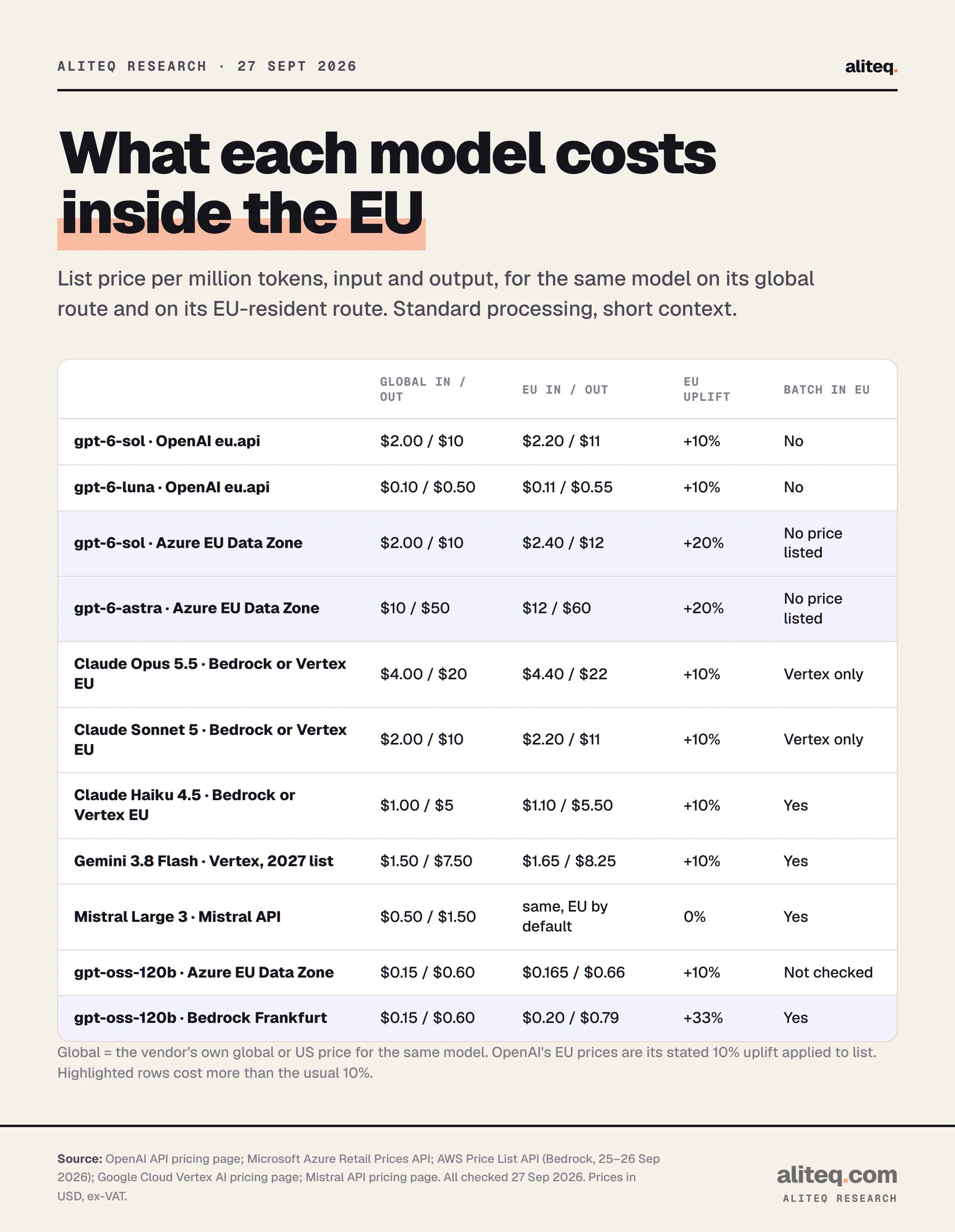
EU vs global price, model by model
For frontier models the EU tier is a flat 10% on top of the global price, except GPT-6 on Azure, which is 20%. Cached input rises by the same share. On open models the EU price depends on the region you pin, not on "the EU".
gpt-6-astra, OpenAI eu.api
Global in / cached / out
$10 / $1.00 / $50
EU in / cached / out
$11 / $1.10 / $55
EU uplift
+10%
gpt-6-sol, OpenAI eu.api
Global in / cached / out
$2.00 / $0.20 / $10
EU in / cached / out
$2.20 / $0.22 / $11
EU uplift
+10%
gpt-6-luna, OpenAI eu.api
Global in / cached / out
$0.10 / $0.01 / $0.50
EU in / cached / out
$0.11 / $0.011 / $0.55
EU uplift
+10%
gpt-6-astra, Azure EU Data Zone
Global in / cached / out
$10 / $1.00 / $50
EU in / cached / out
$12 / $1.20 / $60
EU uplift
+20%
gpt-6-sol, Azure EU Data Zone
Global in / cached / out
$2.00 / $0.20 / $10
EU in / cached / out
$2.40 / $0.24 / $12
EU uplift
+20%
gpt-6-luna, Azure EU Data Zone
Global in / cached / out
$0.10 / $0.01 / $0.50
EU in / cached / out
$0.12 / $0.012 / $0.60
EU uplift
+20%
gpt-5.6-sol, Azure EU Data Zone
Global in / cached / out
$4.00 / $0.40 / $20
EU in / cached / out
$4.40 / $0.44 / $22
EU uplift
+10%
Claude Opus 5.5, Bedrock or Vertex EU
Global in / cached / out
$4.00 / $0.20 / $20
EU in / cached / out
$4.40 / $0.22 / $22
EU uplift
+10%
Claude Sonnet 5, Bedrock or Vertex EU
Global in / cached / out
$2.00 / $0.20 / $10
EU in / cached / out
$2.20 / $0.22 / $11
EU uplift
+10%
Claude Haiku 4.5, Bedrock or Vertex EU
Global in / cached / out
$1.00 / $0.10 / $5
EU in / cached / out
$1.10 / $0.11 / $5.50
EU uplift
+10%
Gemini 3.8 Flash, Vertex (2027 list)
Global in / cached / out
$1.50 / $0.15 / $7.50
EU in / cached / out
$1.65 / $0.165 / $8.25
EU uplift
+10%
Gemini 3.8 Flash, Vertex (promo to 31 Dec 2026)
Global in / cached / out
$0.75 / $0.075 / $3.75
EU in / cached / out
$0.825 / $0.0825 / $4.125
EU uplift
+10%
Mistral Medium 3.5, Mistral API
Global in / cached / out
EU-hosted by default
EU in / cached / out
$1.50 / not listed / $7.50
EU uplift
0%
Mistral Large 3, Mistral API
Global in / cached / out
EU-hosted by default
EU in / cached / out
$0.50 / not listed / $1.50
EU uplift
0%
Mistral Large 3, Bedrock EU regions
Global in / cached / out
$0.50 / – / $1.50 (US East)
EU in / cached / out
$0.60 / – / $1.80
EU uplift
+20%
gpt-oss-120b, Azure EU Data Zone
Global in / cached / out
$0.15 / – / $0.60
EU in / cached / out
$0.165 / – / $0.66
EU uplift
+10%
gpt-oss-120b, Bedrock Stockholm
Global in / cached / out
$0.15 / – / $0.60 (US East)
EU in / cached / out
$0.15 / – / $0.60
EU uplift
0%
gpt-oss-120b, Bedrock Ireland
Global in / cached / out
$0.15 / – / $0.60 (US East)
EU in / cached / out
$0.18 / – / $0.70
EU uplift
+20%
gpt-oss-120b, Bedrock Frankfurt or Milan
Global in / cached / out
$0.15 / – / $0.60 (US East)
EU in / cached / out
$0.20 / – / $0.79
EU uplift
+33%
Global in / cached / out
EU in / cached / out
EU uplift
gpt-6-astra, OpenAI eu.api
$10 / $1.00 / $50
$11 / $1.10 / $55
+10%
gpt-6-sol, OpenAI eu.api
$2.00 / $0.20 / $10
$2.20 / $0.22 / $11
+10%
gpt-6-luna, OpenAI eu.api
$0.10 / $0.01 / $0.50
$0.11 / $0.011 / $0.55
+10%
gpt-6-astra, Azure EU Data Zone
$10 / $1.00 / $50
$12 / $1.20 / $60
+20%
gpt-6-sol, Azure EU Data Zone
$2.00 / $0.20 / $10
$2.40 / $0.24 / $12
+20%
gpt-6-luna, Azure EU Data Zone
$0.10 / $0.01 / $0.50
$0.12 / $0.012 / $0.60
+20%
gpt-5.6-sol, Azure EU Data Zone
$4.00 / $0.40 / $20
$4.40 / $0.44 / $22
+10%
Claude Opus 5.5, Bedrock or Vertex EU
$4.00 / $0.20 / $20
$4.40 / $0.22 / $22
+10%
Claude Sonnet 5, Bedrock or Vertex EU
$2.00 / $0.20 / $10
$2.20 / $0.22 / $11
+10%
Claude Haiku 4.5, Bedrock or Vertex EU
$1.00 / $0.10 / $5
$1.10 / $0.11 / $5.50
+10%
Gemini 3.8 Flash, Vertex (2027 list)
$1.50 / $0.15 / $7.50
$1.65 / $0.165 / $8.25
+10%
Gemini 3.8 Flash, Vertex (promo to 31 Dec 2026)
$0.75 / $0.075 / $3.75
$0.825 / $0.0825 / $4.125
+10%
Mistral Medium 3.5, Mistral API
EU-hosted by default
$1.50 / not listed / $7.50
0%
Mistral Large 3, Mistral API
EU-hosted by default
$0.50 / not listed / $1.50
0%
Mistral Large 3, Bedrock EU regions
$0.50 / – / $1.50 (US East)
$0.60 / – / $1.80
+20%
gpt-oss-120b, Azure EU Data Zone
$0.15 / – / $0.60
$0.165 / – / $0.66
+10%
gpt-oss-120b, Bedrock Stockholm
$0.15 / – / $0.60 (US East)
$0.15 / – / $0.60
0%
gpt-oss-120b, Bedrock Ireland
$0.15 / – / $0.60 (US East)
$0.18 / – / $0.70
+20%
gpt-oss-120b, Bedrock Frankfurt or Milan
$0.15 / – / $0.60 (US East)
$0.20 / – / $0.79
+33%
Four notes on reading the table:
OpenAI publishes the uplift, not the EU prices. Its pricing page says regional processing endpoints "are charged a 10% uplift for models released on or after March 5, 2026". We applied 10% to every token class. Azure's, AWS's and Google's EU prices are printed in their own feeds and pages.
In euros, gpt-6-sol on OpenAI's EU endpoint is about €1.93 in and €9.65 out per million tokens; on Azure's Data Zone it is about €2.10 and €10.52.
Gemini 3.8 Flash's lower price ends on 31 December 2026. Google marks it as promotional. Budget a year on the 2027 row.
Mistral's Enterprise APIs, which add "regional data processing controls", cost "75% above list pricing on select APIs", Mistral says. It doesn't list which APIs, so we don't print per-model Enterprise prices.
The same model, global and EU-resident, from each vendor's own page or price feed on 27 September 2026. · aliteq research
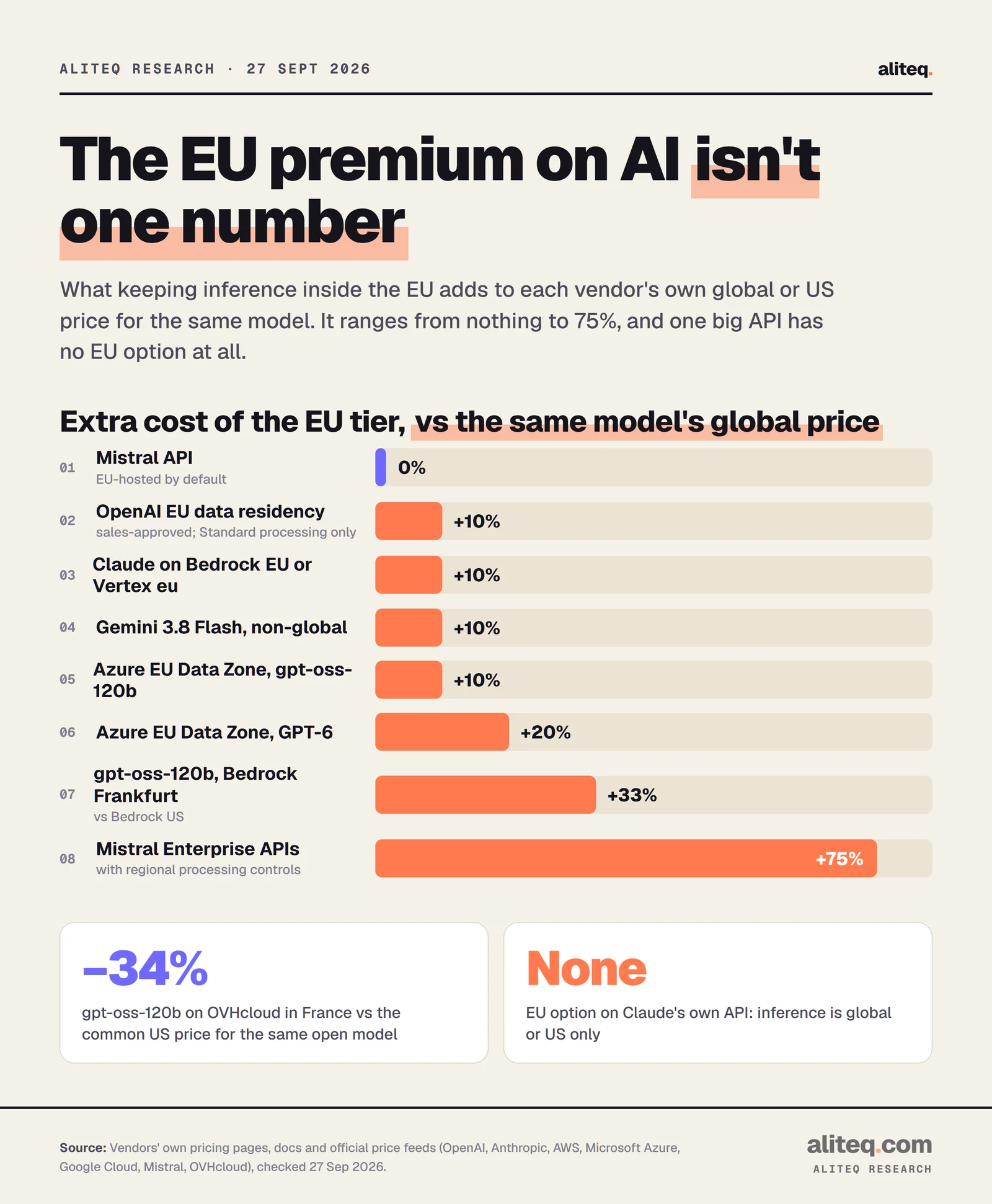
The EU premium isn't one number
The uplift ranges from 0% to 75% depending on vendor, model generation and region. Azure charges 10% on GPT-5.6 and gpt-oss-120b but 20% on GPT-6. AWS charges the US price for gpt-oss-120b in Stockholm and a third more in Frankfurt.
What the EU tier adds, vendor by vendor. · aliteq research
What that means for a buyer:
For GPT-6, OpenAI's own EU endpoint is cheaper than Azure's. gpt-6-sol costs $2.20 in on OpenAI's EU endpoint and $2.40 on Azure's EU Data Zone. Azure's advantage is that it's self-serve.
For Claude, Bedrock and Vertex cost the same in the EU: +10% on every token class. The difference is batch pricing and region choice, covered below.
For open models, the region is the price. If gpt-oss-120b is good enough, Bedrock in Stockholm charges the US East price. Our cost to run page for gpt-oss-120b shows what the same model takes on your own hardware.
How to turn EU residency on
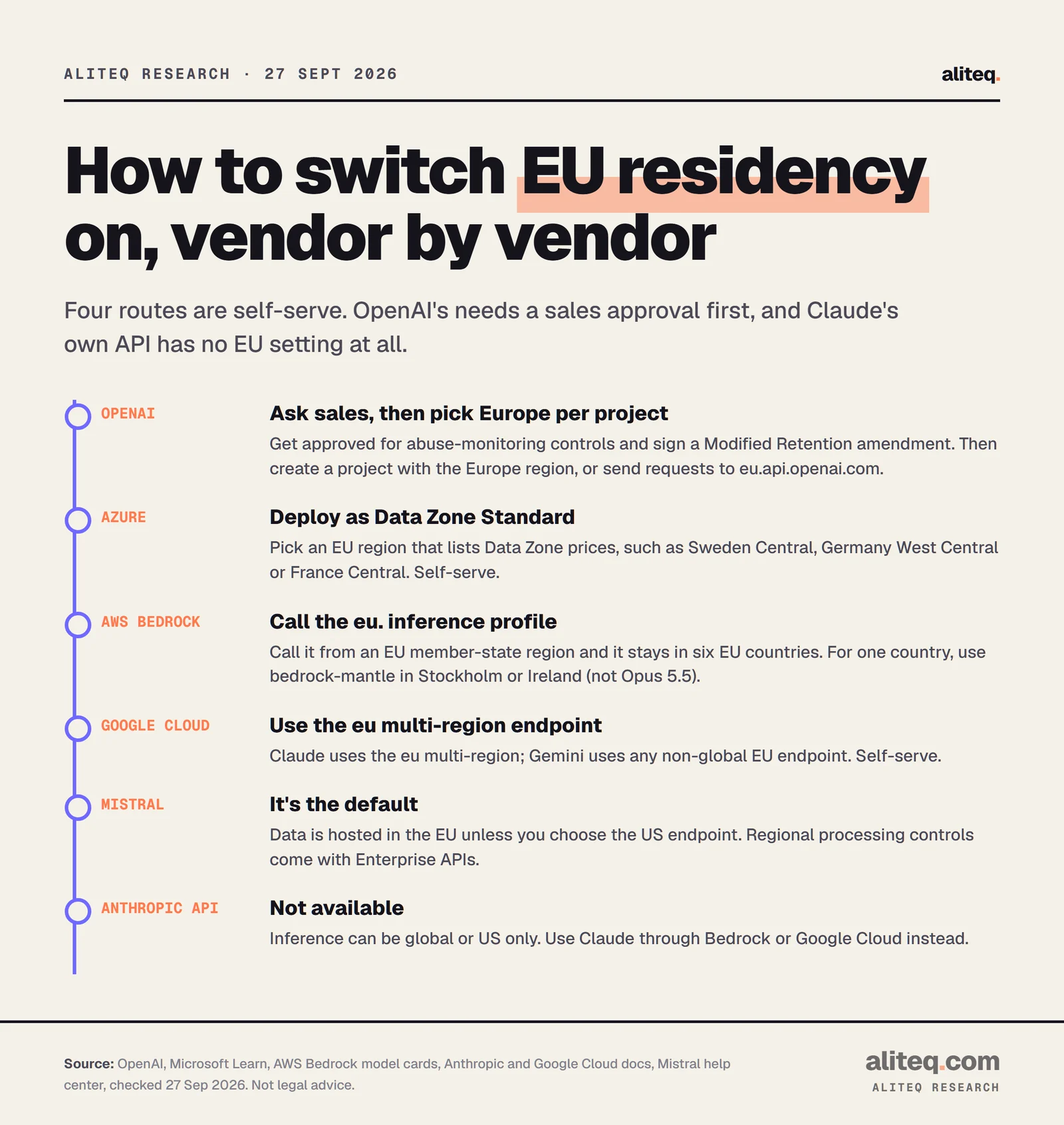
Azure, AWS Bedrock and Google Cloud let you choose EU residency yourself when you deploy. Mistral is EU-hosted by default. OpenAI's EU residency needs a sales approval first. Anthropic's own API has no EU setting.
Where the EU switch is, vendor by vendor, from each vendor's docs. · aliteq research
OpenAI. Its docs say to "Contact our sales team to see if you're eligible for using data residency controls." For any region other than the US, you must also "be approved for abuse monitoring controls, and execute a Modified Retention amendment." Once approved, you pick the Europe region when you create a project, or send single requests to eu.api.openai.com with a key from a Global project.
Azure (Microsoft Foundry). Deploy the model with the Data Zone Standard deployment type. Microsoft's price feed lists GPT-6 Data Zone meters in six EU regions: Sweden Central, Germany West Central, France Central, West Europe, Poland Central and Spain Central. Norway East, Switzerland North and UK South list Global meters only.
AWS Bedrock. Call the model with its eu. inference profile. For a single country, AWS's model cards say to use the bedrock-mantle endpoint instead, which offers Claude Sonnet 5 in-region in Stockholm and Ireland only.
Google Cloud. Claude's newer models run on the eu multi-region endpoint, not on single-country regions, according to Anthropic's docs. Gemini uses any non-global endpoint and is billed at the "Non-global" price.
Mistral. Its help center says "By default, your data is hosted in the European Union." Just don't switch to its US endpoint.
Anthropic API. Its data residency docs list two inference locations, global and us, and "Currently, "us" is the only available workspace geo." For Claude in the EU, go through Bedrock or Google Cloud.
Which regions count as "EU"
Each vendor's "EU" is a slightly different map. OpenAI's European region covers the EEA plus Switzerland. Azure's EU Data Zone and Bedrock's EU profile stay in EU member states if you deploy or call from an EU member-state region. If your contract says "EU-27 only", check the map, not the label.
OpenAI names the region "Europe (EEA + Switzerland)". That includes Norway, Iceland, Liechtenstein and Switzerland. The UK is a separate region at gb.api.openai.com.
AWS Bedrock publishes the destinations for Claude Haiku 4.5's EU profile. Called from Frankfurt, Stockholm, Milan, Spain, Ireland or Paris, it routes only to those six regions. Called from Zurich it adds Zurich, and called from London it adds London. The Sonnet 5 and Opus 5.5 cards say only that the EU profile "Keeps data within EU regions", without a destination list.
AWS also warns that profile requests can reach opt-in regions you never enabled, and that "Your input prompts and output results may be stored in the opt-in Regions for abuse detection purposes."
Google Cloud calls its EU multi-region eu. Anthropic's docs say specific single regions support "Claude Sonnet 4.6 and earlier; newer models use the global or multi-region endpoints."
Mistral says data "can be temporarily transferred outside of the European Union" for some features, to listed sub-processors.
What EU residency doesn't cover
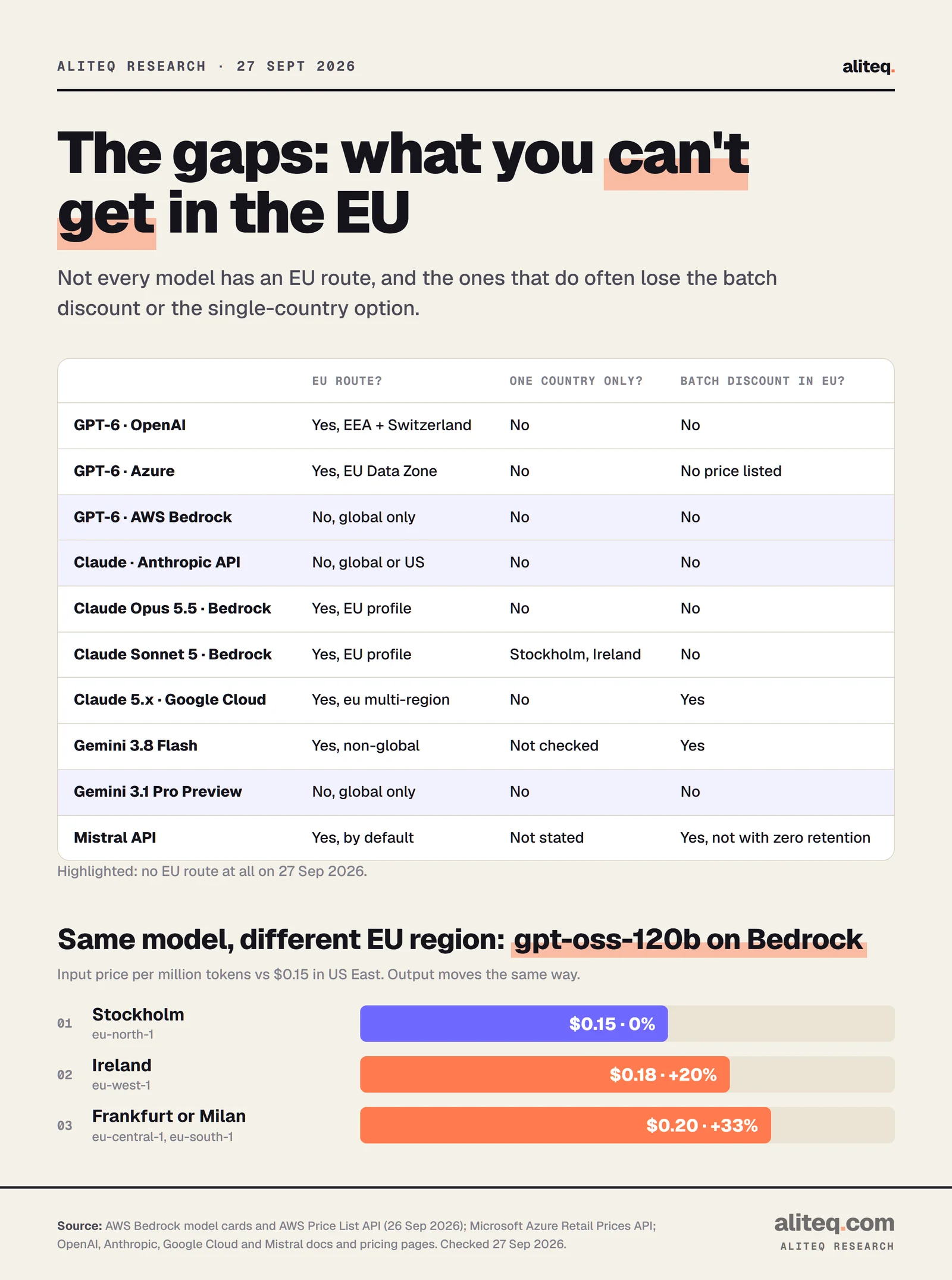
The EU tiers keep your prompts and outputs in the region, not everything. They exclude account and usage data, often drop the batch discount, and some models have no EU route at all.
Models and discounts you can't get with EU residency, as of 27 September 2026. · aliteq research
System data. OpenAI's docs say data residency "does not apply to system data", meaning account data, metadata and usage data "that do not contain Customer Content", which "may be processed and stored outside the selected region." Its list of limitations also excludes transfers caused by where your own users or infrastructure are.
No batch discount for GPT-6 in the EU. OpenAI says "For GPT-6 Sol and Luna, EU data residency is available only with Standard processing", so the 50% Batch and Flex discounts are gone. Microsoft's price feed has no Batch meter for GPT-6 in any region, though older models have Data Zone Batch prices.
No batch for Claude's newest models on Bedrock. AWS's price feed has no regional Batch price for Sonnet 5 or Opus 5.5, and the Opus 5.5 model card lists Batch as not supported. Google Cloud does list EU batch prices: Sonnet 5 at $1.10 in and $5.50 out, Opus 5.5 at $2.20 and $11. If you batch Claude in the EU, that's the route.
Opus 5.5 can't be pinned to one country on Bedrock. Its card lists no European in-region option, only the multi-country EU profile.
GPT-6 on Bedrock has no EU route. From every European region, AWS's card for GPT-6 Sol lists only global cross-region inference.
Gemini 3.1 Pro Preview is global only on Google's price page. Gemini 3.8 Flash keeps an EU batch price: $0.825 in and $4.125 out from 2027.
Mistral's zero retention excludes batch. Mistral says zero data retention is "available only with pay-as-you-go and only for stateless API calls", not for batch processing files.
Retention and training terms, vendor by vendor
Every vendor here says in its docs that it doesn't train on API data by default, except Mistral, whose pay-as-you-go wording doesn't say which way the setting starts. Zero data retention almost always needs an application or a sales conversation.
OpenAI API
Trains on API data?
No, "unless you explicitly opt in"
Default retention
Abuse monitoring logs up to 30 days
Zero data retention
Needs OpenAI's prior approval; the EU region requires modified abuse monitoring or zero retention
Azure OpenAI
Trains on API data?
No, "without your permission or instruction"
Default retention
Microsoft's abuse monitoring applies
Zero data retention
Apply to modify abuse monitoring
AWS Bedrock (Claude, GPT)
Trains on API data?
AWS says model providers have no access to prompts or completions
Default retention
Prompts may be stored for abuse detection in profile regions
Zero data retention
Not covered in the docs we read
Google Cloud (Claude, Gemini)
Trains on API data?
No, "without your prior permission or instruction"
Default retention
Set by Google's data governance terms
Zero data retention
Customer steps, including an abuse-monitoring exception
Anthropic API (not EU)
Trains on API data?
No, "without your express permission"
Default retention
Not retained by default, except some models held 30 days
Zero data retention
Through Anthropic's sales team
Mistral API
Trains on API data?
Opt-out available; switch it off yourself
Default retention
EU-hosted
Zero data retention
On request, pay-as-you-go stateless calls only
Trains on API data?
Default retention
Zero data retention
OpenAI API
No, "unless you explicitly opt in"
Abuse monitoring logs up to 30 days
Needs OpenAI's prior approval; the EU region requires modified abuse monitoring or zero retention
Azure OpenAI
No, "without your permission or instruction"
Microsoft's abuse monitoring applies
Apply to modify abuse monitoring
AWS Bedrock (Claude, GPT)
AWS says model providers have no access to prompts or completions
Prompts may be stored for abuse detection in profile regions
Not covered in the docs we read
Google Cloud (Claude, Gemini)
No, "without your prior permission or instruction"
Set by Google's data governance terms
Customer steps, including an abuse-monitoring exception
Anthropic API (not EU)
No, "without your express permission"
Not retained by default, except some models held 30 days
Through Anthropic's sales team
Mistral API
Opt-out available; switch it off yourself
EU-hosted
On request, pay-as-you-go stateless calls only
We couldn't read OpenAI's Data Processing Addendum: its page returned an access error to our reader on 27 September 2026. Ask for it through your account rather than relying on a summary.
What it adds to a monthly bill
At 10 million tokens a workday, the EU tier of gpt-6-sol costs about $63 to $127 more a month than the global price. That's $636 (€558) globally, $699 (€613) on OpenAI's EU endpoint and $763 (€669) on Azure's EU Data Zone, over 22 workdays with eight input tokens per output token.
Try your own volume. The calculator covers the EU routes above plus open models and your own GPU:
What a private LLM costs a month
Cheapest EU route
$28.94/mo
gpt-oss-120b · OVHcloud (France)
Cheapest frontier model, EU
$34.96/mo
gpt-6-luna · OpenAI EU
Cheapest own GPU
$360/mo
Rent RTX PRO 6000 · Runpod EU
gpt-oss-120b · OVHcloud (France)Open model, EU API$28.94
List prices read 27 Sep 2026 on each vendor's page or official price feed (OpenAI, Azure, AWS, Google Cloud, Mistral, Scaleway, OVHcloud), ex-VAT, EUR converted at the ECB rate of 25 Sep 2026. No caching or batch discounts. Own-GPU rows run gpt-oss-120b on one 80–96 GB GPU, which serves about 99M tokens in an 8-hour day in theory; real traffic peaks leave less. Rental rates from aliteq's GPU price tracker. Admin time and utilization are our assumptions. An estimate, not a quote.
If the EU premium on a frontier model looks large next to an open model's price, our private LLM cost guide compares every route at three volumes, including when a GPU of your own pays off. More guides for companies putting AI to work are on our AI automation hub.
Does EU residency make you GDPR-compliant?
No, and GDPR doesn't require it. GDPR requires a written processor contract with the AI vendor and a lawful basis for any transfer outside the EU. EU residency removes the transfer question for prompts and outputs. It doesn't remove the contract, and it doesn't cover system data.
A processor contract. Article 28 says you may use only processors giving "sufficient guarantees", under a written contract covering what's processed, for how long and on whose instructions. That's the vendor's Data Processing Agreement, needed whether inference runs in Paris or Oregon.
A transfer basis. For US companies that participate in the EU–US Data Privacy Framework, the Commission's adequacy decision of 10 July 2023 lets data flow freely. Check each vendor on the official Data Privacy Framework list.
Why buyers pay for residency anyway. The framework faces an appeal, case C-703/25 P, lodged on 31 October 2025, and we found no ruling as of September 2026. EU residency means a ruling against it wouldn't touch your prompts.
This is a summary of the law and official guidance, not legal advice.
Security reviews and compliance timelines for companies selling AI features are on our security and compliance hub.
The practical steps
List the models you need. GPT-6 in the EU means OpenAI's EU endpoint or Azure. Claude means Bedrock or Google Cloud. Gemini 3.1 Pro Preview has no EU route.
If you need OpenAI's EU endpoint, contact its sales team early. Approval and a Modified Retention amendment come before any EU traffic.
Pin the region, not just the label. Deploy Azure in an EU member-state region, call Bedrock's EU profile from an EU member-state region, and remember OpenAI's Europe includes Switzerland and the EEA.
Budget without batch. Assume Standard prices for GPT-6 and for Claude Sonnet 5 and Opus 5.5 on Bedrock, or use Google Cloud for EU batch.
Get the vendor's Data Processing Agreement, switch off any training setting, and apply for zero data retention where you need it.
Re-check prices before you sign. We read these on 27 September 2026, and Azure's GPT-6 uplift already differs from its GPT-5.6 uplift.
Quick answers
How much does EU data residency cost for AI APIs?
Usually 10% on top of the global price: OpenAI's EU endpoint, Claude on AWS Bedrock or Google Cloud, and Gemini's non-global endpoints. GPT-6 on Azure's EU Data Zone costs 20% more. Mistral hosts in the EU at its list price. Prices read on 27 September 2026.
Does Claude have EU data residency?
Not through Anthropic's own API, which offers global or US inference only. Claude runs in the EU through AWS Bedrock's EU profile or Google Cloud's eu multi-region, at a 10% premium: Sonnet 5 costs $2.20 in and $11 out per million tokens.
Is OpenAI's EU data residency self-serve?
No. OpenAI's docs say to contact sales for eligibility, and non-US regions require approval for abuse-monitoring controls and a Modified Retention amendment. Azure's EU Data Zone is self-serve but costs 20% more for GPT-6.
Can I use batch discounts with EU data residency?
Not for GPT-6: OpenAI allows only Standard processing in the EU for Sol and Luna, and Azure lists no GPT-6 batch price. Not for Claude Sonnet 5 or Opus 5.5 on Bedrock either. Google Cloud does list EU batch prices for Claude and Gemini.
Does "EU" mean the same thing at every vendor?
No. OpenAI's European region covers the EEA plus Switzerland. AWS's EU profile stays in six EU member states when called from one of them, but adds Zurich or London when called from those regions.
Does EU data residency make us GDPR-compliant?
Not by itself. GDPR requires a written processor contract under Article 28 and a lawful basis for transfers. Residency removes the transfer question for prompts, not the contract, and it excludes system data. This is a summary of the law and official guidance, not legal advice.
Use this in your own page
Teaching this? Paste the live version into your course, blog or answer. Free, no sign-up; the credit line links back here.