Lovable lets each project run one payment provider, and switching later leaves your subscribers behind. We read Lovable's payments docs on 27 September 2026 and worked out what each choice costs at $9, $29 and $99, who files your sales tax and VAT, and when to skip both and connect your own Stripe. Try your own price in the calculator.
You asked Lovable for a pricing page, and it came back with a question: Stripe or Paddle? If you've never taken a payment online, both names mean about the same thing. They aren't the same. One makes you the legal seller of your app. The other becomes the seller for you, and that decides who has to deal with sales tax and VAT.
We read Lovable's payments docs, and its page on connecting your own Stripe account, on 27 September 2026. This guide is only about that choice inside Lovable. aliteq is a US-based company, so the default reader here is a US seller charging in US dollars. We don't sell anything through Stripe or Paddle, and neither pays us. For the wider comparison, including Lemon Squeezy and smaller providers, see Stripe vs Paddle vs Lemon Squeezy for AI SaaS.
What Lovable is actually asking you
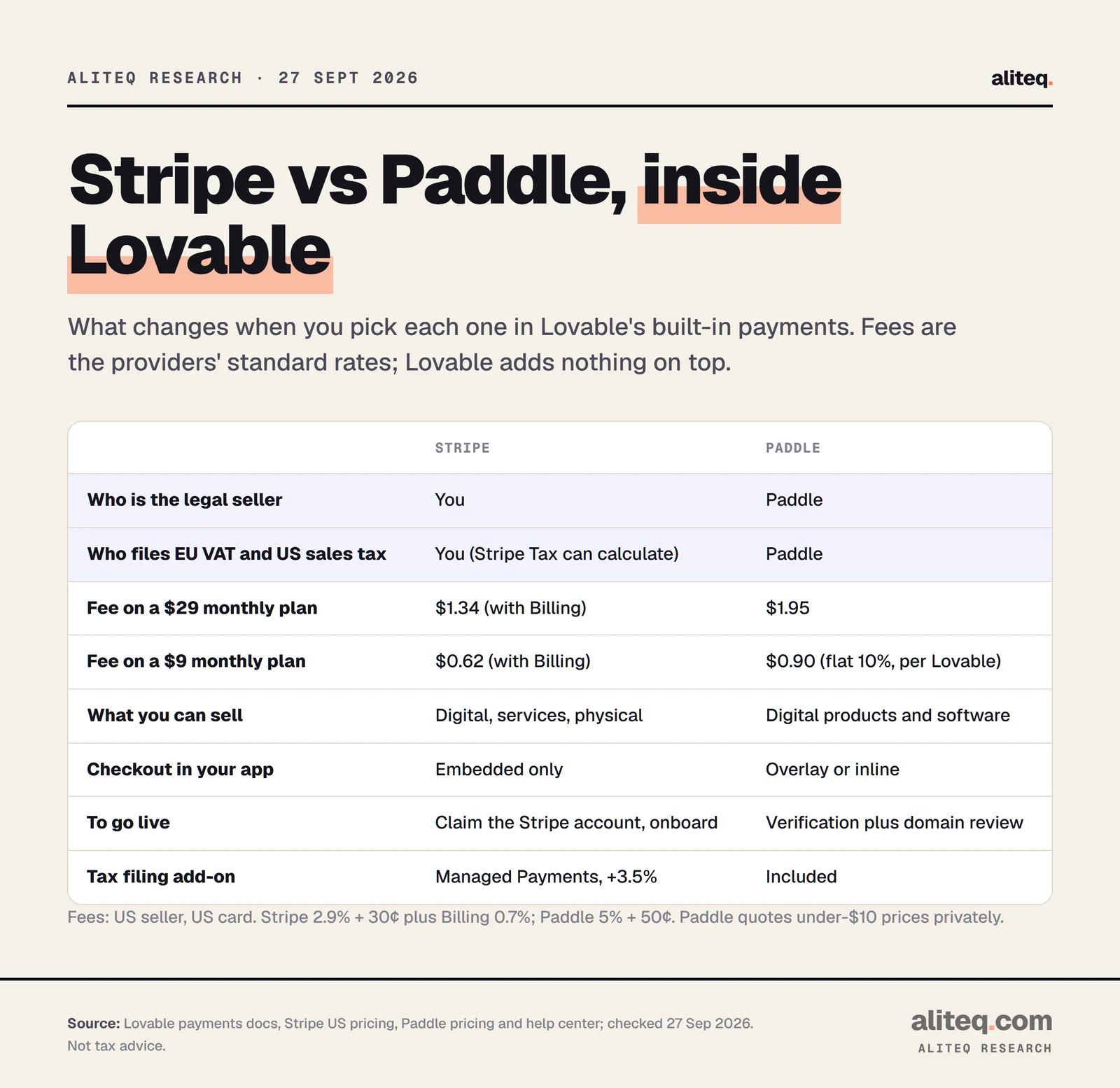
Lovable is asking who should be the seller of record. Paddle is a merchant of record: it sells your product to the customer and pays you, so it handles the sales tax and VAT. Stripe is a payment processor: it moves the money, and you stay the seller.
Lovable's docs put it in one table. Paddle is a "Merchant of Record (MoR)". Stripe is a "PSP with optional MoR (Managed Payments)", where PSP means payment service provider. Lovable says it "analyzes your project and either presents both options or recommends a specific provider based on what you are selling."
A few things are the same either way:
Built-in payments need a paid plan. Lovable's docs say Pro or higher, and Pro starts at $25 a month. On the Free plan, you connect your own Stripe account instead.
Lovable adds no fee on top. Its docs say using either provider through Lovable "costs the same as setting up the provider directly."
Lovable creates the provider account for you. You fill in a short form, test with test cards in the preview, then go live.
The two options in Lovable's built-in payments, side by side. · aliteq research
What each one does with your VAT and sales tax
With Paddle, Paddle is the seller, so it collects and pays the VAT and US sales tax on your sales. With Stripe, you are the seller, so any registration and filing is your job. For a US seller, that difference is small at home and large abroad.
Here is what "you file it" means for a US-based seller on Stripe:
Customers in the EU: a business established outside the EU owes EU VAT on digital sales to EU consumers from the first sale. The EU's €10,000 threshold only applies to sellers established in an EU country. You register in one EU country through the One-Stop Shop and file a return every quarter.
Customers in the UK: the UK government says a business based outside the UK must register for VAT "regardless of taxable turnover" if it sells to UK consumers.
Customers in the US: you only register in a state once your sales there pass its threshold. That's $100,000 in most states, and $500,000 in California, Texas and New York. Not every state taxes software.
With Paddle, all of that is Paddle's work. Paddle's help center says it is "responsible for the collection and payment of VAT and tax instead of you." You still owe income tax on what Paddle pays out to you, whichever provider you pick. The thresholds for each region are on our business payments hub.
Stripe does sell a middle option. Stripe Tax calculates and collects tax, but only where you've told it you're registered, so it doesn't make Stripe the seller. Stripe Managed Payments does make Stripe the seller, for 3.5% more. More on that below.
What it costs at $9, $29 and $99
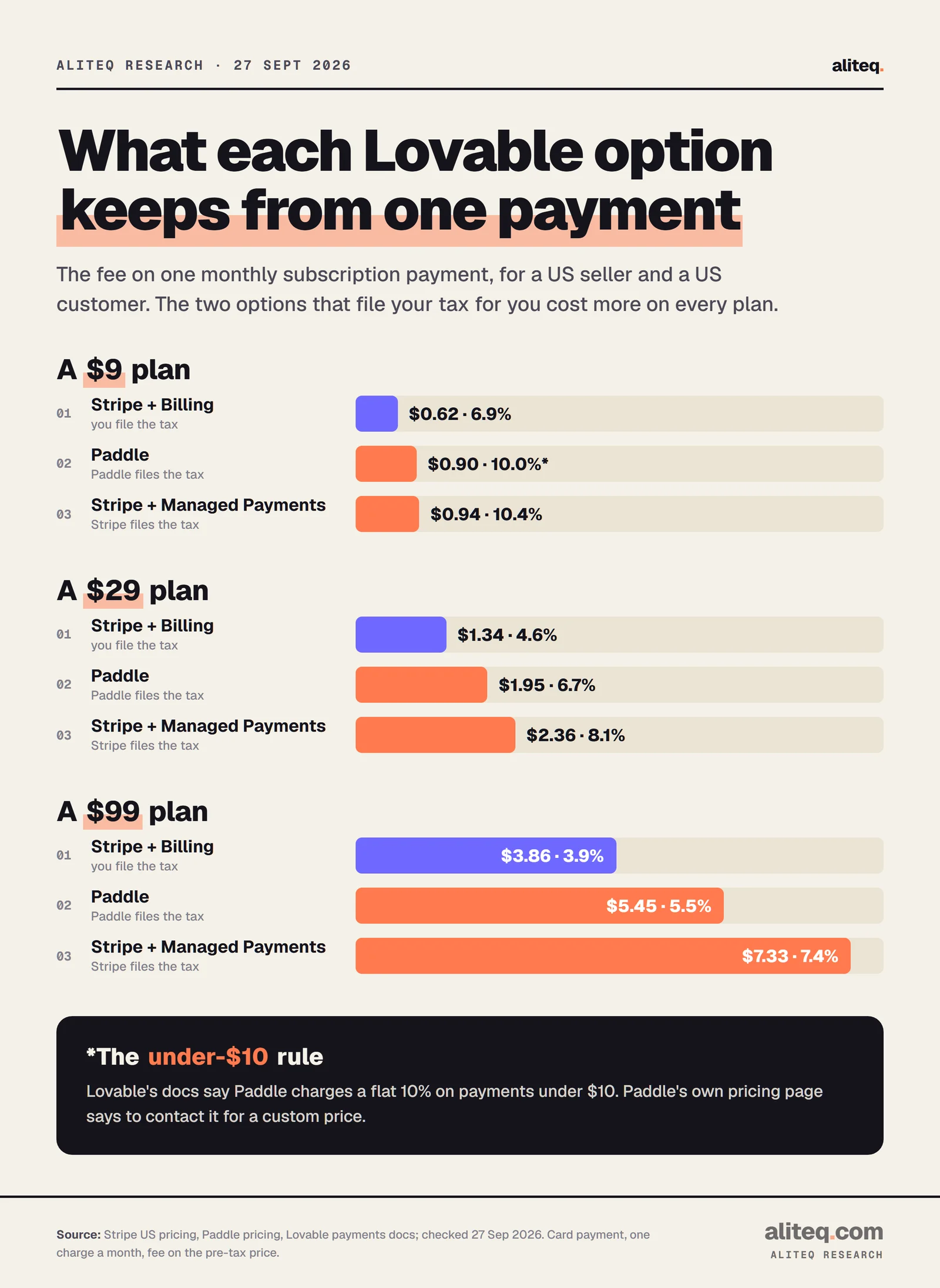
Stripe is cheaper on every plan. For a US seller and a US customer, a $29 monthly subscription pays about $1.34 to Stripe and $1.95 to Paddle. With 100 subscribers at $29, the fees come to $134 on Stripe and $195 on Paddle each month.
Violet: you file the tax. Coral: the provider files it. · aliteq research
The inputs, from each provider's own page:
Stripe (US): 2.9% + 30¢ for a domestic card. Subscriptions also pay Stripe Billing's 0.7%. A card from outside the US adds 1.5%, which takes a $29 payment to about $1.78.
Paddle: 5% + 50¢, the rate Lovable's docs also list. International cards and subscriptions don't cost extra.
Stripe Managed Payments: 3.5% on top of Stripe's normal fees.
Tap the calculator to try your own price and customer mix:
What each option takes from one sale
Cheapest per sale
Stripe + Billing
$1.34 a sale · you file the tax
Cheapest that files tax for you
Creem
$1.53 a sale · 5.3%
Price of not filing yourself
$19/mo
Creem vs Stripe + Billing, at 100 sales a month
Option
Per sale
Take rate
You keep a month
Files tax
Stripe + Billing
$1.34
4.6%
$2,766
You
Stripe + Billing + Tax BasicTax Basic only calculates where you're registered
$1.49
5.1%
$2,751
You
Creem
$1.53
5.3%
$2,747
Provider
Dodo Payments
$1.71
5.9%
$2,730
Provider
Paddle
$1.95
6.7%
$2,705
Provider
Polar (free plan)
$1.95
6.7%
$2,705
Provider
Lemon Squeezy
$2.09
7.2%
$2,691
Provider
Stripe Managed Payments + Billing3.5% is charged on the total including tax
$2.36
8.1%
$2,664
Provider
US sales tax: you only register in a state once your sales there pass its threshold ($100,000 in most states, $500,000 in California, Texas and New York), and not every state taxes software.
Rates from Stripe (US and Denmark pricing pages), Paddle, Lemon Squeezy, Polar, Dodo Payments and Creem, and Lovable's payments docs, all read 27 Sep 2026. Card payments; fee on the amount charged, before disputes, payouts and currency conversion. Stripe Denmark's 1.80 kr fixed fee converted at the ECB rate of 25 Sep 2026. “You keep” is before VAT or sales tax and before income tax. Not tax advice.
The gap is the price of the tax work. On a $29 plan, Paddle costs about 61¢ a sale more than Stripe. If most of your customers are in the US and below every state threshold, that's money for work you don't have yet. If a real share are in Europe or the UK, it's often cheaper than registering and filing abroad yourself.
The under-$10 rule
Lovable's docs say Paddle charges a flat 10% on transactions under $10, "so that payment fees never exceed 10% of the purchase price." On a $9 plan, that's 90¢. Paddle's own pricing page doesn't publish that number; it says to contact Paddle for custom pricing under $10.
Stripe has no special small-payment rate on its US page, but its 30¢ fixed fee plus Billing comes to about 62¢ on $9, or 6.9%. If you want a cheap plan on Paddle, an annual price pays the fixed fee once instead of twelve times.
Will Paddle accept your AI app?
Maybe not, and that can settle the choice before fees do. Paddle's acceptable-use policy, updated 13 April 2026, lists human-like faces as a restricted category, and bans face swaps, deepfakes, voice impersonation, content using someone's likeness without consent, and automated decision-making or categorization of people.
Lovable's docs cover this case: "If your product is restricted under one provider's policies, Lovable will guide you to the other." They also warn that restricted products "may require additional review and are not guaranteed approval."
What that means in practice:
A chatbot, writing tool or coding helper usually fits both providers' rules.
An app that generates faces, voices or anyone's likeness should read Paddle's policy before picking it.
A service with a human in it, such as coaching or consulting, points to Stripe. Lovable's docs list Paddle for "digital products and software" and Stripe for "digital products, services, and physical products."
Stripe Managed Payments: the middle option
Stripe has its own merchant of record, called Managed Payments. It makes Stripe the seller and files the tax, for 3.5% per transaction on top of normal Stripe fees. On a $29 plan with Billing, that's about $2.36 a sale, more than Paddle's $1.95.
Lovable's docs say Managed Payments "can be enabled on a per-transaction basis for digital products" and is available in fewer countries than Stripe's normal processing. Stripe's docs list 37 business locations, the US included, subject to an eligibility review.
One detail isn't spelled out anywhere we read. Lovable says its Stripe checkout is "embedded checkout only". Stripe's Managed Payments docs list Checkout and Payment Links as supported, and its setup guide walks through the Stripe-hosted page. Neither Lovable nor Stripe says how to switch Managed Payments on for a Lovable-built app. If this is your plan, ask Lovable in the project chat before you count on it.
The settings you can't undo
This is the part to read before you click Continue. Lovable's docs list several limits that are hard or impossible to reverse:
One provider per project. You can't run Paddle and Stripe in the same project.
Switching strands your subscribers. Products and prices don't carry over, and "Existing subscriptions do not migrate." Current subscribers stay on the old provider until they cancel and resubscribe.
Disconnecting is permanent. You can't reconnect the same Paddle or Stripe account to that project. It also doesn't cancel anyone's subscription: customers "continue to be billed by the provider until you cancel."
No remixing. "Once payments are enabled, the project cannot be forked."
One subscription per user by default. Ask Lovable if you want add-ons.
Leave the webhooks alone. Lovable registers two webhook endpoints per environment. Delete your app's one and "purchases still succeed, but subscriptions never activate and features never unlock."
If you're not sure yet, build and test in the preview first. Test mode uses test cards and charges nothing.
What going live takes
Both providers check your published site before they take real money. Lovable's readiness check looks for a privacy policy, terms of service, a refund policy and genuine content.
Paddle: after the readiness check comes Paddle's seller verification, then a review of your live domain. Lovable's docs say "Most users are approved within a day, but it can take several days." A domain Paddle fully rejects "can only be restored by Paddle support."
Stripe: you claim the Stripe account Lovable created, finish Stripe's onboarding, and pass the same readiness check. You can link it to a Stripe account you already have.
Lovable also recommends a custom domain before going live, because "A custom domain looks more legitimate than .lovable.app." Paddle's setup form uses your project name as your business name and the statement descriptor on customers' bank statements, so pick a name customers will recognize.
When to connect your own Stripe instead
Lovable has a second route: connecting a Stripe account you own with an API key. Lovable's own docs say "Most projects should use built-in payments instead", but this route fits three cases:
You're on the Free plan. It doesn't need a paid Lovable plan.
Your older app uses your own Supabase. Built-in payments on older React + Vite apps need Lovable Cloud; your own Stripe works with either.
You want full control of the account, keys and webhooks.
The trade-off: "business verification, payouts, taxes, and disputes all happen in Stripe," there's no separate test environment in the preview once you use a live key, and you manage webhooks yourself. Paste the key only into Lovable's Connect Stripe form, never into the chat. If you wire checkout by hand, our guide to adding a Stripe checkout button to a vibe-coded app shows the safe way to prompt for it: secret key on the server, prices set on the server, signed webhooks.
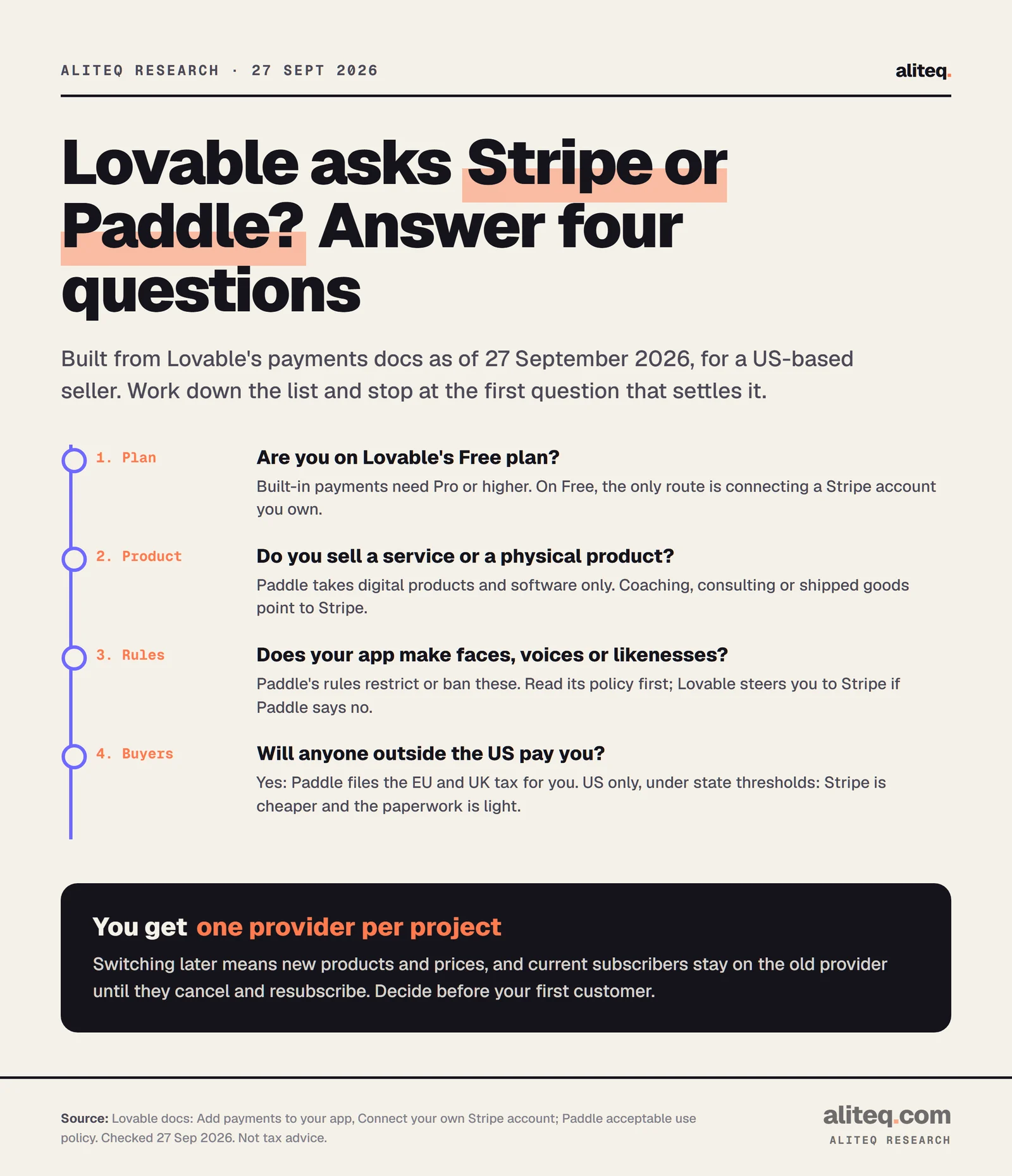
Pick in four questions
Stop at the first question that settles it. · aliteq research
On Lovable's Free plan? Built-in payments need Pro, so connect your own Stripe account.
Selling a service or a physical product? Paddle takes digital products and software only, so pick Stripe.
Does your app generate faces, voices or likenesses? Read Paddle's acceptable-use policy first, and expect Lovable to steer you to Stripe if Paddle says no.
Customers outside the US, and you don't want to register for VAT? Pick Paddle. Mostly US customers under state thresholds? Stripe costs less per sale.
Whichever you pick, test the full subscription cycle in the preview before you go live, and don't touch the webhooks Lovable creates.
Quick answers
Should I pick Stripe or Paddle in Lovable?
Paddle if you sell software or a digital product to customers outside the US and want someone else to file the VAT and sales tax. Stripe if you sell services or physical goods, sell mostly in the US, or your app works with faces or voices. Stripe is cheaper per sale; Paddle does the tax work.
Does Lovable take a cut of my payments?
No. Lovable's docs say using Stripe or Paddle through Lovable costs the same as going to the provider directly. You pay the provider's fees; building the feature in Lovable uses credits like any other edit.
Who pays the VAT if I pick Paddle?
Paddle does. It is the merchant of record, so it is the legal seller and collects and pays VAT and US sales tax on your sales. You still owe income tax on what Paddle pays out to you.
Can I switch from Paddle to Stripe later?
Yes, but it's disruptive. Products and prices don't carry over, and current subscribers stay on the old provider until they cancel and resubscribe. Disconnecting is permanent for that account and project.
How much does Paddle take on a $9 plan?
Lovable's docs say Paddle charges a flat 10% on payments under $10, which is 90¢ on $9. Paddle's own pricing page doesn't publish that rate; it asks you to contact it for custom pricing under $10.
Can I use Lovable payments on the Free plan?
Not the built-in ones: they need Pro or higher, which starts at $25 a month. On the Free plan you can connect a Stripe account you own with an API key, and handle taxes and webhooks yourself.
Use this in your own page
Teaching this? Paste the live version into your course, blog or answer. Free, no sign-up; the credit line links back here.