Your AI app pays per token, so a flat $20 plan quietly loses money on its heaviest users. Here are the three ways to charge for usage, what each billing platform costs as of 2 Oct 2026, and the margin math at light, median and heavy usage.
A normal SaaS app costs about the same to serve whether a customer logs in once or every hour. An AI app doesn't. Every prompt your user sends is a bill from OpenAI, Anthropic or Google, priced per token. Charge everyone the same flat fee and your lightest users quietly pay for your heaviest ones, until one heavy user costs more than the whole plan.
The fix is to bill for usage, at least partly. That means choosing a pricing model (credits, metering, or a flat fee with overage) and a billing platform that can count tokens and turn them into invoices. We read the pricing pages and docs of Stripe, Metronome, Orb, Lago, Polar and Chargebee on 2 October 2026. aliteq doesn't use any of them for billing and isn't paid by any of them. Every price below is from the vendor's own page, and the margin example is worked math on stated assumptions, not a forecast of what you'll earn.
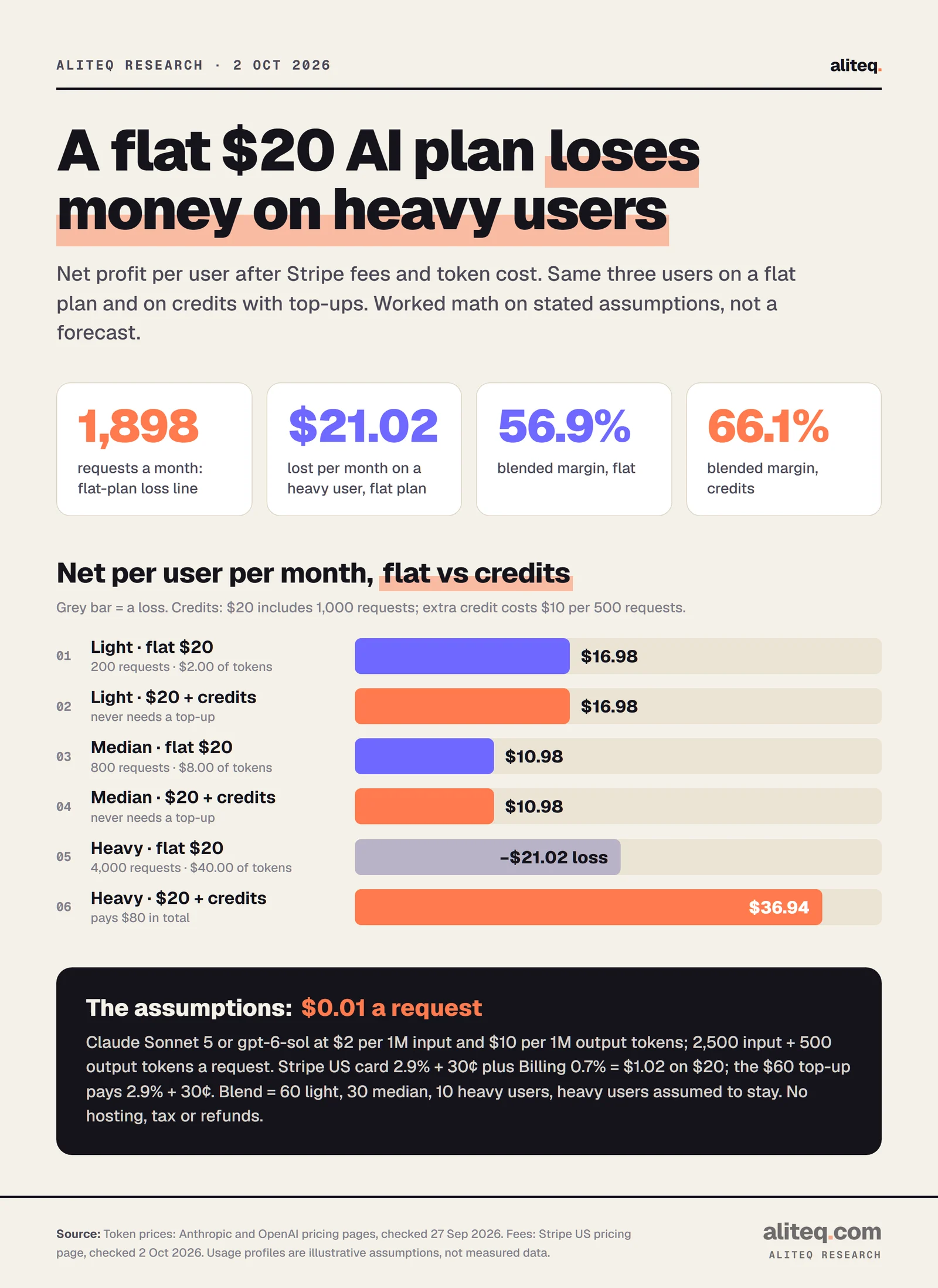
A flat plan only works while your token cost per user stays well under the price. With a $20 plan and a mid-priced model, our example user breaks even at about 1,900 requests a month. Anyone above that line costs you money every month they stay.
Here is the setup we use through the whole piece. These are our assumptions, not measured data:
Price: $20 a month, paid by card through plain Stripe with Stripe Billing.
Model: Claude Sonnet 5 or OpenAI's gpt-6-sol. Both list at $2 per million input tokens and $10 per million output tokens.
One request: 2,500 input tokens (prompt plus context) and 500 output tokens. That costs $0.005 + $0.005 = $0.01 a request. If you're new to tokens, our plain-English token explainer shows what 2,500 of them looks like.
Three users: light (200 requests a month, $2 of tokens), median (800, $8) and heavy (4,000, $40).
Payment fees: Stripe's 2.9% + 30¢ plus Billing's 0.7%, so $1.02 on a $20 charge.
The flat-plan result is simple subtraction. The light user leaves you $16.98. The median user leaves $10.98. The heavy user costs $40 in tokens on a $20 plan and loses you $21.02 a month. The loss line is (20 − 1.02) ÷ 0.01 = 1,898 requests.
Same three users, two pricing models. Credits change nothing for light and median users; they rescue the heavy one. · aliteq research
Notice what credits don't change: the light and median users pay $20 either way. Usage pricing isn't about charging most people more. It's about making sure the top of the curve pays for what it burns.
Model prices move this line a lot. On a model listing at a tenth of the price, the same user breaks even near 19,000 requests. You can compare models' running costs on our cost-to-run pages. One more trap: Anthropic says its Claude 4.7 and newer models use "approximately 30% more tokens for the same text". Meter the token counts the API reports back, not your own estimate.
The three ways to charge for tokens
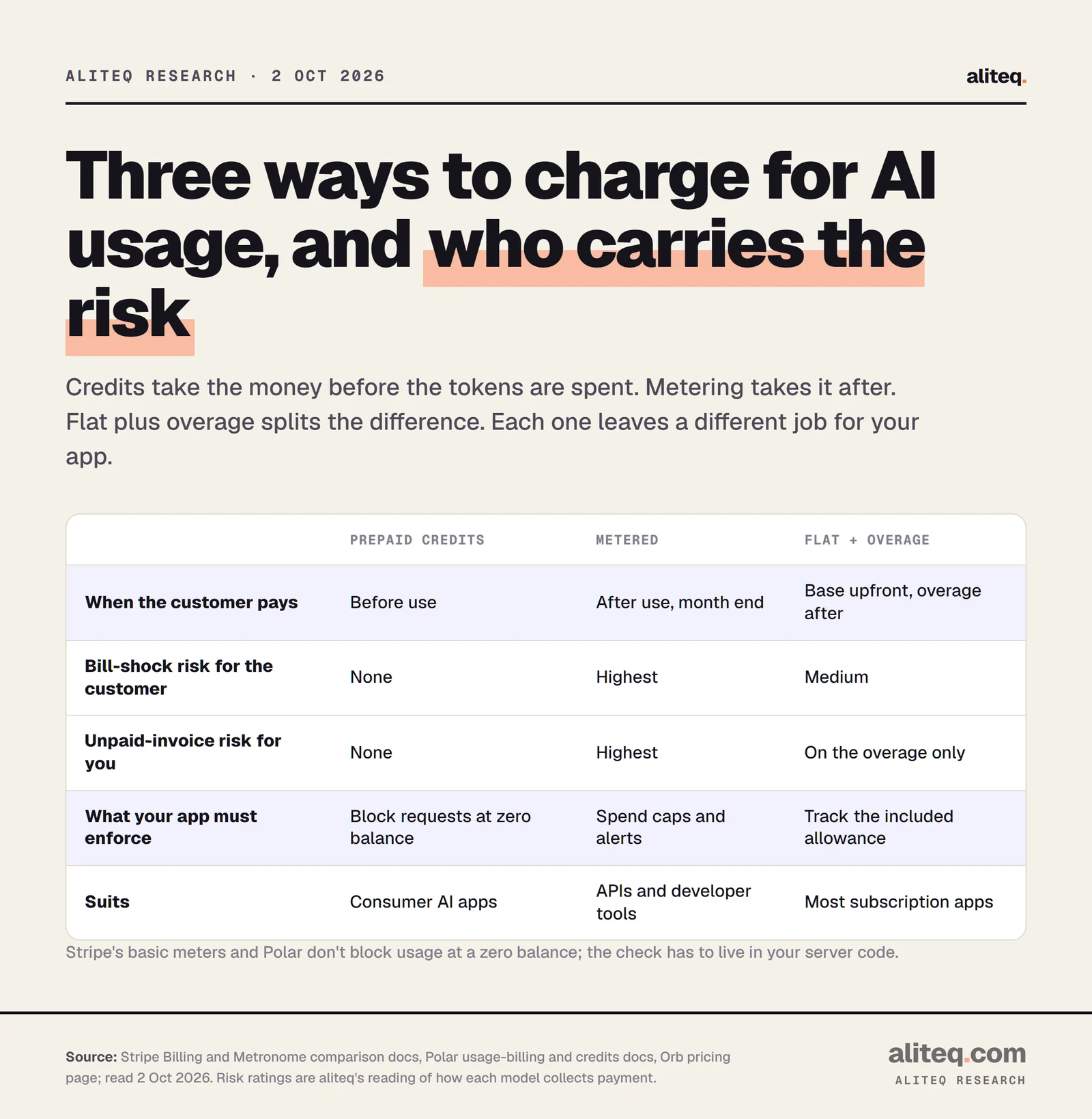
There are three common models. Credits collect the money before usage, metering collects it after, and flat plus overage mixes a predictable base with a usage tail.
Who carries the risk changes with each model: credits put it on the customer's balance, metering puts it on your unpaid invoices. · aliteq research
Prepaid credits. The customer buys a balance up front ("1,000 credits for $20") and each request draws it down. You hold the cash before you spend on tokens, and nobody gets a surprise bill. The work is on your side: you must define what a credit is worth and stop the app when the balance hits zero.
Metered pay-as-you-go. You count usage through the month and invoice at the end. It's the fairest model and the one developers expect from an API. The risk is yours: a user can run up $500 of tokens on a card that then declines.
Flat plus overage. A monthly fee includes an allowance ("1,000 requests") and anything above it is billed per unit at month end. Most consumer AI apps land here or on credits because a fixed price sells better than a meter.
Whichever you pick, the price per unit is where your markup lives. In our example a credit costs you $0.01 in tokens and sells for $0.02. That 2× markup is a 50% gross margin on usage before payment fees. Set it from your real blended token cost, including retries and system prompts, not from the cheapest request.
What the billing platforms charge
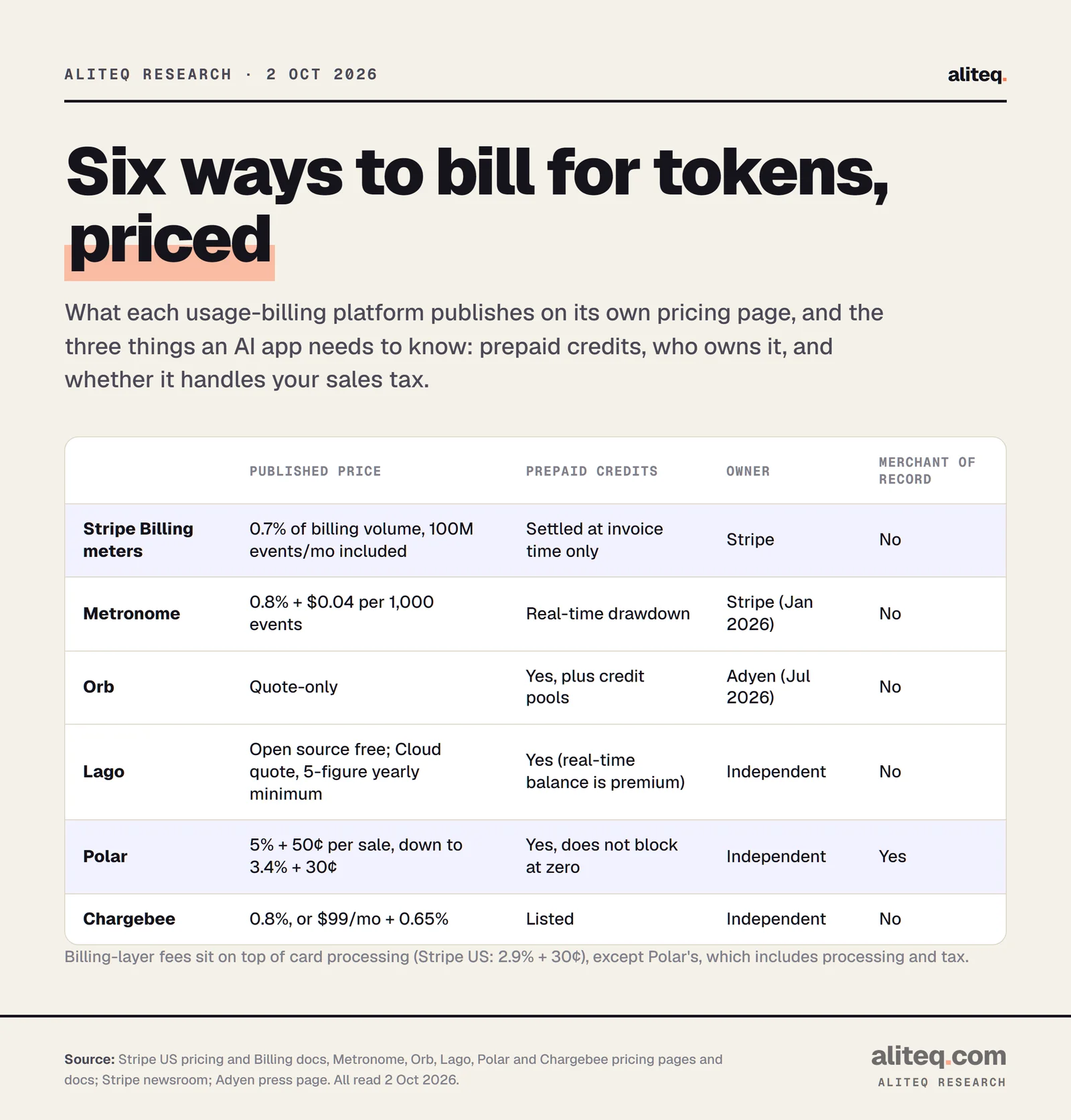
Four of the six platforms we checked publish a price. Stripe Billing costs 0.7% of billing volume, Metronome 0.8% plus 4 cents per 1,000 usage events, and Chargebee 0.8% with no monthly fee. Polar charges 5% + 50¢, which includes card processing and the tax work because it's the merchant of record. Orb and Lago Cloud are quote-only.
Prices from each vendor's own page on 2 Oct 2026. Billing-layer fees sit on top of card processing, except Polar's, which includes it. · aliteq research
Stripe Billing meters
Published price (2 Oct 2026)
0.7% of billing volume, up to 100M events a month included
Prepaid credits
Reconciled at invoice time only
Merchant of record
No (Managed Payments is a separate +3.5%)
Metronome (Stripe)
Published price (2 Oct 2026)
0.8% of billing volume + $0.04 per 1,000 events
Prepaid credits
Yes, real-time drawdown
Merchant of record
No
Orb (Adyen)
Published price (2 Oct 2026)
Quote-only, all three plans
Prepaid credits
Yes
Merchant of record
No
Lago
Published price (2 Oct 2026)
Open source free (AGPLv3); Cloud quote-only, five-figure annual minimum
Prepaid credits
Yes (real-time balance is premium)
Merchant of record
No
Polar
Published price (2 Oct 2026)
5% + 50¢ per sale (paid plans down to 3.4% + 30¢)
Prepaid credits
Yes, as a benefit on a product
Merchant of record
Yes
Chargebee
Published price (2 Oct 2026)
0.8%, or $99 a month + 0.65%
Prepaid credits
Listed
Merchant of record
No
Published price (2 Oct 2026)
Prepaid credits
Merchant of record
Stripe Billing meters
0.7% of billing volume, up to 100M events a month included
Reconciled at invoice time only
No (Managed Payments is a separate +3.5%)
Metronome (Stripe)
0.8% of billing volume + $0.04 per 1,000 events
Yes, real-time drawdown
No
Orb (Adyen)
Quote-only, all three plans
Yes
No
Lago
Open source free (AGPLv3); Cloud quote-only, five-figure annual minimum
Yes (real-time balance is premium)
No
Polar
5% + 50¢ per sale (paid plans down to 3.4% + 30¢)
Yes, as a benefit on a product
Yes
Chargebee
0.8%, or $99 a month + 0.65%
Listed
No
Those percentages are on top of card processing for every platform except Polar. If you want to see how processing, billing and tax fees stack on one charge, try the calculator:
What each option takes from one sale
Cheapest per sale
Stripe + Billing
$1.02 a sale · you file the tax
Cheapest that files tax for you
Creem
$1.18 a sale · 5.9%
Price of not filing yourself
$16/mo
Creem vs Stripe + Billing, at 100 sales a month
Option
Per sale
Take rate
You keep a month
Files tax
Stripe + Billing
$1.02
5.1%
$1,898
You
Stripe + Billing + Tax BasicTax Basic only calculates where you're registered
$1.12
5.6%
$1,888
You
Creem
$1.18
5.9%
$1,882
Provider
Dodo Payments
$1.30
6.5%
$1,870
Provider
Paddle
$1.50
7.5%
$1,850
Provider
Polar (free plan)
$1.50
7.5%
$1,850
Provider
Lemon Squeezy
$1.60
8.0%
$1,840
Provider
Stripe Managed Payments + Billing3.5% is charged on the total including tax
$1.72
8.6%
$1,828
Provider
US sales tax: you only register in a state once your sales there pass its threshold ($100,000 in most states, $500,000 in California, Texas and New York), and not every state taxes software.
Rates from Stripe (US and Denmark pricing pages), Paddle, Lemon Squeezy, Polar, Dodo Payments and Creem, and Lovable's payments docs, all read 27 Sep 2026. Card payments; fee on the amount charged, before disputes, payouts and currency conversion. Stripe Denmark's 1.80 kr fixed fee converted at the ECB rate of 25 Sep 2026. “You keep” is before VAT or sales tax and before income tax. Not tax advice.
Stripe Billing meters: the cheap default, with a catch on credits
Stripe's basic usage-based billing runs on its Meters API and costs nothing beyond Billing's 0.7%. Stripe's pricing page says Meters stay available "as part of Billing pricing, with up to 100M events per month included". For pay-as-you-go and flat-plus-overage, that's the cheapest published option.
The catch is credits. Stripe's own comparison says credits on basic billing are "only reconciled at invoice time. Customers can exceed their balance during the cycle." There's no real-time usage view either. And Stripe now says plainly that Metronome is "Stripe's primary usage-based billing platform, recommended for all new integrations", with basic billing "fully supported for existing integrations".
Basic billing still has one strong reason to exist. It works with Checkout, Connect, Adaptive Pricing and the Stripe Dashboard. Metronome doesn't support Connect, Adaptive Pricing or the Dashboard, and its Checkout support is "Limited", needing "custom API calls and webhook configuration".
Metronome: Stripe's usage engine, priced per event
Stripe completed its Metronome acquisition on 14 January 2026. The Startup plan is 0.8% of billing volume plus $0.04 per 1,000 ingested events; a Custom plan is quote-only. In Stripe's words, "Metronome handles metering, rating, and billing, while Stripe handles payment collection, tax calculation, and revenue recognition."
What you get for the extra cost is the AI-specific toolkit: prepaid credits that draw down in real time, enterprise commits and minimums, and one meter that charges different rates by model. Stripe also runs LLM token billing on Metronome, in public preview. It syncs list prices for OpenAI, Anthropic and Google models and lets you set your own markup, so a provider price change flows through to your rate card automatically. You can define a custom unit such as an "AI Credit" and sell top-up packs.
On our heavy user, Metronome's own fee is small: 0.8% of $80 is $0.64, plus 4,000 events at 4 cents per thousand, $0.16. The event fee only matters at scale. A million requests a month is $40 in event fees.
Orb: enterprise metering, now owned by Adyen
Orb publishes no prices. All three plans (Core, Advanced, Enterprise) say "Custom pricing" and "Contact Sales". Adyen announced it would buy Orb on 11 June 2026 and closed the deal on 1 July 2026.
Feature-wise, Orb is built for scale and finance teams: real-time ingestion "at volumes such as 250K+ events/second", custom SQL metrics, prepaid credits and credit pools, and threshold billing that triggers an invoice once a customer hits a set dollar amount. That last one is a direct answer to the unpaid-metered-bill risk. Tax runs through integrations such as Avalara, Anrok and Stripe Tax, so you remain the seller.
Lago: free if you host it, five figures if you don't
Lago is the open-source option. Its pricing page says the self-hosted edition is free under the AGPLv3 license and can "meter usage and run subscription, usage-based, prepaid, and hybrid billing". The repository had about 10,600 GitHub stars on 2 October 2026.
Lago Cloud, the managed version, is quote-only, and Lago states it "carries a minimum annual commitment in the five figures". Some features are premium on either edition, including credit notes, tax integrations, SSO and a real-time wallet balance. If you self-host, you also run and back up a billing database yourself, which is real work for a solo founder.
Polar: usage billing with the tax handled
Polar is the only platform here that's also the merchant of record, so it sells to your customer and handles sales tax and VAT. Its fee is 5% + 50¢ a sale on the free Starter plan, plus 1.5% for non-US cards, falling to 3.4% + 30¢ on the $400-a-month Scale plan. On our $20 plan that's $1.50 a sale against $1.02 on plain Stripe, and the extra 48 cents buys the tax work.
Its usage features are newer. Polar's docs still call usage billing "a new feature". You send events, build meters that sum a field such as token count, and attach a metered price (unit, volume or graduated, with an optional cap) to a subscription product. Usage is invoiced at the end of the month. Credits come as a benefit on a product, and Polar ships a helper that wraps an AI SDK model call and reports its prompt and completion tokens. Its Cost Insights feature lets you attach your token cost to each event to see profit per customer.
Chargebee and the rest
Chargebee's Flow plan publishes two rates: 0.8% of monthly invoicing volume with no monthly fee, or $99 a month plus 0.65%, with 100 million usage events included. It works with 40+ payment gateways, which matters if you aren't on Stripe. We didn't find usage-billing docs for Paddle or Lemon Squeezy at the URLs we tried, so we don't rate them here. Our Paddle and Lemon Squeezy comparison covers their fees.
The worked example: a $20 plan, three users, three ways to bill
Credits or overage turn the heavy user from a $21.02 loss into about $37 of profit, and leave light and median users exactly where they were. Across a realistic mix, margin rises from 56.9% to 66.1%.
Light, 200 requests
Flat $20 plan
$16.98 (84.9%)
$20 + credit top-ups
$16.98 (84.9%)
$20 + metered overage
$16.98 (84.9%)
Median, 800 requests
Flat $20 plan
$10.98 (54.9%)
$20 + credit top-ups
$10.98 (54.9%)
$20 + metered overage
$10.98 (54.9%)
Heavy, 4,000 requests
Flat $20 plan
−$21.02 (−105.1%)
$20 + credit top-ups
$36.94 (46.2%)
$20 + metered overage
$36.82 (46.0%)
Flat $20 plan
$20 + credit top-ups
$20 + metered overage
Light, 200 requests
$16.98 (84.9%)
$16.98 (84.9%)
$16.98 (84.9%)
Median, 800 requests
$10.98 (54.9%)
$10.98 (54.9%)
$10.98 (54.9%)
Heavy, 4,000 requests
−$21.02 (−105.1%)
$36.94 (46.2%)
$36.82 (46.0%)
How each cell is built (net = revenue − payment fees − token cost):
Flat: $20 − $1.02 − tokens.
Credits: $20 buys 1,000 requests of credit. Extra credit costs $10 per 500 requests. The heavy user needs 3,000 more, so buys $60 of top-ups in one Checkout payment. Fees: $1.02 on the plan plus 2.9% + 30¢ on the $60 ($2.04), total $3.06. Net: $80 − $3.06 − $40 = $36.94.
Metered overage: $20 includes 1,000 requests, then 2 cents each. The heavy user's invoice is $80. Fees: 3.6% + 30¢ = $3.18. Net: $80 − $3.18 − $40 = $36.82.
Blend: 60 light, 30 median and 10 heavy users. Flat: $1,138.00 on $2,000 of revenue (56.9%). Credits: $1,717.60 on $2,600 (66.1%). That assumes the heavy users pay rather than leave. Some will leave, and on a flat plan that would actually help you.
What the example leaves out: hosting, sales tax, refunds, failed payments and the billing platform's own fee. On Metronome, add 0.8% of revenue and the event fee. If you sell through Polar instead of Stripe, swap the $1.02 for $1.50 and drop your own tax work. Our Stripe Managed Payments fee breakdown shows the same trade-off inside Stripe.
Credits don't stop usage by themselves
The most common mistake is assuming the billing platform will cut a user off at zero. Two of the cheaper options say outright that they won't. Your app has to check the balance before every model call.
Stripe's basic billing lets customers "exceed their balance during the cycle" because credits only settle on the invoice. Polar's docs are just as direct:
Polar doesn't block usage if the customer exceeds their balance. You're responsible for implementing the logic you need to prevent usage if they exceed it.
Polar docs, Credits
So the check lives in your code, on the server, right before the request goes to the model. Read the balance, refuse or queue the request if it's empty, then record the usage event after the model answers with its real token count. Metronome and Orb give you real-time balances and alerts to build on; Stripe's basic meters and Polar give you the numbers at a lag.
If an AI coding tool writes this for you, ask for the check on the server, not in the browser, and ask how it handles two requests arriving at once with one credit left. A balance check in the front end is a suggestion, not a limit.
Merchant of record or not
Only Polar on this list takes on sales tax and VAT for you. Every other platform rates and invoices usage, then hands the payment to a processor, and you stay the legal seller.
For a US seller with mostly US customers under state thresholds, that's usually fine: Stripe Tax can calculate and collect where you're registered. Once you sell to consumers in the EU or UK, a merchant of record removes a filing burden that usage billing makes harder, since every invoice has a different amount. Our business payments hub lists the thresholds. Stripe's own merchant-of-record add-on, Managed Payments, requires subscriptions created through Checkout or Payment Links; its docs we read don't say how it handles metered prices, so check before you build on that combination.
Which one fits your stage
Pick the cheapest tool that enforces the model you actually chose. For most small AI apps that's Stripe Billing with your own balance check, or Polar if you want the tax handled.
Do the math first. Divide your plan's net price by your blended cost per request. If your heaviest users sit above that number, a flat plan is subsidizing them.
Pre-revenue or under a few thousand a month: Stripe Billing meters (0.7%, events included) plus a server-side balance check, or Polar at 5% + 50¢ if you want a merchant of record.
Real-time credits, per-model rates, or enterprise commits: Metronome at 0.8% + 4 cents per 1,000 events, or ask Orb for a quote.
Want to own the stack and can run a database: Lago's open-source edition is free under AGPLv3. Budget for hosting and upkeep.
Whatever you pick, block usage at zero balance on the server and cap metered spend, so one card decline can't cost you hundreds in tokens.
Quick answers
What is usage-based billing for an AI app?
Charging customers by what they use, such as tokens, requests or credits, instead of only a flat monthly fee. It matters for AI apps because every request costs you money at the model provider, so heavy users can cost more than they pay on a flat plan.
Should I use credits or metered billing?
Credits collect the money before usage and avoid surprise bills, so they suit consumer apps. Metered billing charges after usage and suits developer tools and APIs, but you carry the risk of unpaid invoices. Many apps use a flat fee with included usage plus overage or top-ups.
How much does Stripe charge for usage-based billing?
Stripe Billing costs 0.7% of billing volume on pay-as-you-go, with up to 100 million meter events a month included, on top of card processing of 2.9% + 30 cents for US cards. Metronome, which Stripe owns, costs 0.8% of billing volume plus 4 cents per 1,000 events.
Is Lago free?
The self-hosted open-source edition is free under the AGPLv3 license and handles metering, subscriptions, usage-based and prepaid billing. Lago Cloud is quote-only with a five-figure minimum annual commitment, and some features such as tax integrations and a real-time wallet balance are premium.
Does Polar support usage-based billing?
Yes. Polar has meters, metered prices with optional caps, and credits, and it is a merchant of record that handles sales tax and VAT. Its docs call usage billing a new feature, and Polar does not block usage when a customer's credit balance runs out.
How much markup should I put on tokens?
There's no standard. In our worked example, selling at twice the token cost gives a 50% gross margin on usage before payment fees. Base the markup on your real blended cost per request, including system prompts and retries.
Use this in your own page
Teaching this? Paste the live version into your course, blog or answer. Free, no sign-up; the credit line links back here.