Stripe's merchant of record looks like a flat 3.5% add-on. It isn't quite: the fee lands on the tax as well as the price, Billing charges its own 0.7% on subscriptions, and above about $9.52 a month Paddle keeps less. The full fee stack, the break-even formula, and the five checks you have to pass first.
Stripe's merchant of record is usually summed up as "3.5% on top". That line is true, and it leaves out three things that decide what you actually pay: what the 3.5% is charged on, which other Stripe fees stay in place, and at what price a flat-rate rival like Paddle comes out cheaper.
We read Stripe's pricing page, its Managed Payments support article and five of its Managed Payments docs pages on 27 September 2026, and did the arithmetic for a US-based seller. aliteq hasn't used Managed Payments and sells nothing through Stripe or Paddle. Every number below comes from the providers' own pages, and every formula is shown so you can check it.
If you're still choosing between Stripe, Paddle and Lemon Squeezy in general, start with our full comparison at $9, $29 and $99. This piece goes deep on one option.
The fee stack on one sale
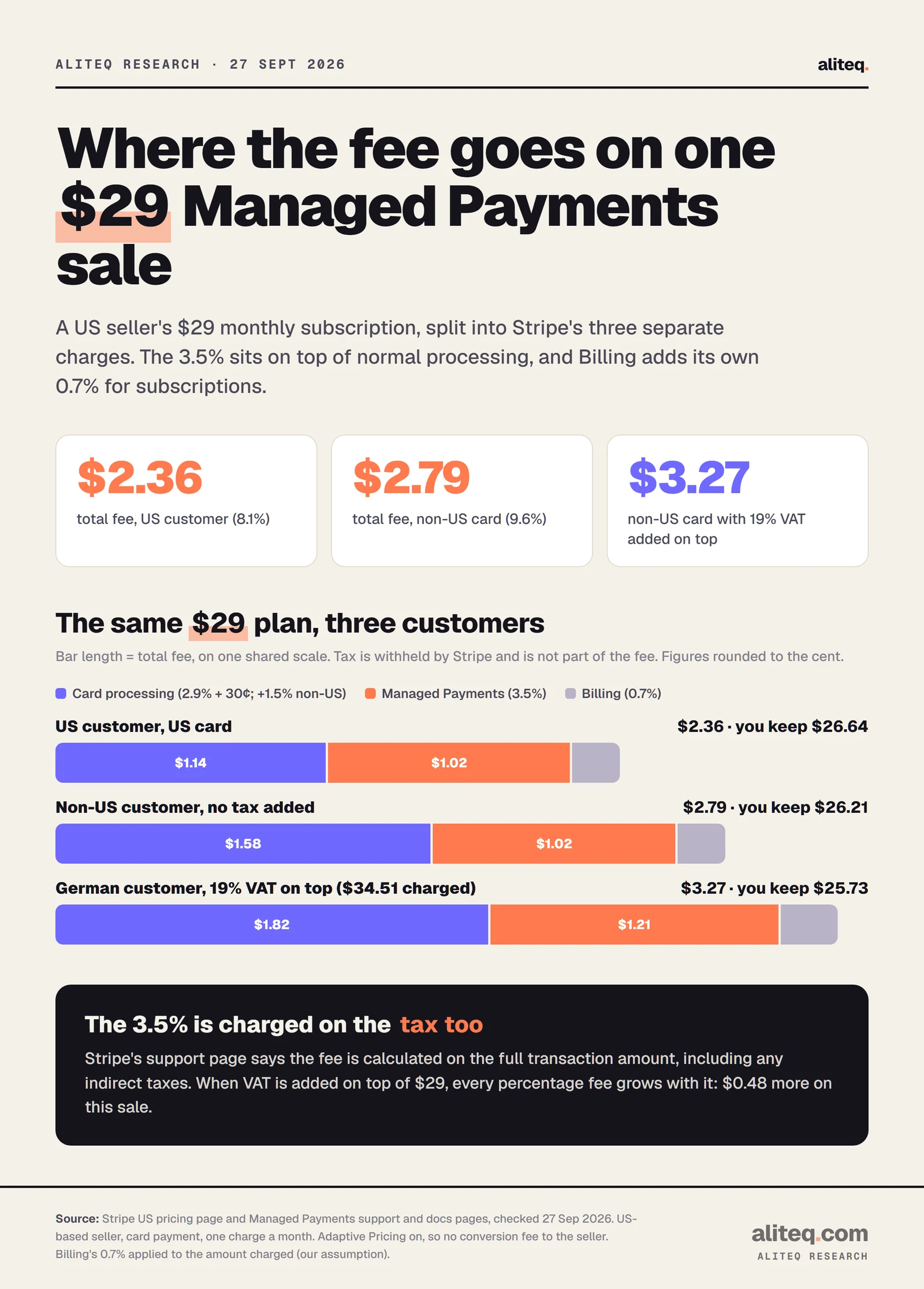
Managed Payments is three separate Stripe charges, not one. For a US seller, a US card and a monthly subscription, they add up to 7.1% of the amount charged plus 30¢.
One $29 plan, three customers. The Managed Payments slice grows when tax is added on top. · aliteq research
The three layers, as Stripe's pages state them:
Card processing. Stripe's US page lists "2.9% + 30¢ per successful transaction for domestic cards", plus 1.5% for international cards. This is the normal Stripe fee, and Managed Payments doesn't replace it.
Managed Payments. The pricing page says "3.5% per successful Managed Payments transaction in addition to Payments fees". Stripe's support article says what that buys: tax calculation and collection (and filing and remittance in supported countries), fraud prevention, dispute handling for eligible card disputes, and customer support through Link.
Billing, for subscriptions. The support article says "Additional charges apply for subscription payments" and points to Billing's pay-as-you-go price, which is 0.7% of Billing volume. One-off sales skip it.
On a $29 sale to a US customer, that's $1.14 for processing, $1.02 for Managed Payments and $0.20 for Billing: $2.36, or 8.1%. You keep $26.64.
The 3.5% is charged on the tax too
This is the detail most fee tables miss. Stripe's support article is explicit:
This fee is calculated based on the full transaction amount, including any indirect taxes (for example, the VAT or sales tax assessed on the transaction).
Stripe support, Managed Payments pricing
So if your $29 price has tax added on top at checkout, you pay 3.5% of the price plus the tax. Take a customer in Germany, where the standard VAT rate is 19%. The charge becomes $34.51. Processing is 4.4% of that plus 30¢ ($1.82), Managed Payments is $1.21 and Billing $0.24, if Billing's 0.7% is also counted on the full charge, which Stripe's pricing page doesn't spell out. Stripe withholds the $5.51 of VAT and pays it to the tax office. You keep $25.73, and the fees are $0.48 higher than on the same sale with no tax added.
If you set tax-inclusive prices instead, the customer pays $29 flat and the tax comes out of your side, so the fee base stays at $29 but your net drops by the tax. Either way, the fee never shrinks because tax is involved.
Try your own price and customer mix:
What each option takes from one sale
Cheapest per sale
Stripe + Billing
$1.34 a sale · you file the tax
Cheapest that files tax for you
Creem
$1.53 a sale · 5.3%
Price of not filing yourself
$19/mo
Creem vs Stripe + Billing, at 100 sales a month
Option
Per sale
Take rate
You keep a month
Files tax
Stripe + Billing
$1.34
4.6%
$2,766
You
Stripe + Billing + Tax BasicTax Basic only calculates where you're registered
$1.49
5.1%
$2,751
You
Creem
$1.53
5.3%
$2,747
Provider
Dodo Payments
$1.71
5.9%
$2,730
Provider
Paddle
$1.95
6.7%
$2,705
Provider
Polar (free plan)
$1.95
6.7%
$2,705
Provider
Lemon Squeezy
$2.09
7.2%
$2,691
Provider
Stripe Managed Payments + Billing3.5% is charged on the total including tax
$2.36
8.1%
$2,664
Provider
US sales tax: you only register in a state once your sales there pass its threshold ($100,000 in most states, $500,000 in California, Texas and New York), and not every state taxes software.
Rates from Stripe (US and Denmark pricing pages), Paddle, Lemon Squeezy, Polar, Dodo Payments and Creem, and Lovable's payments docs, all read 27 Sep 2026. Card payments; fee on the amount charged, before disputes, payouts and currency conversion. Stripe Denmark's 1.80 kr fixed fee converted at the ECB rate of 25 Sep 2026. “You keep” is before VAT or sales tax and before income tax. Not tax advice.
Worked examples at $9, $29 and $99
Managed Payments costs a US seller between 7.4% and 11.9% of a sale, depending on the price and where the card is from. The fixed 30¢ makes cheap plans pay the most.
Stripe Managed Payments fee per sale, US-based seller (27 Sep 2026)
$9
Subscription, US card
$0.94 (10.4%)
Subscription, non-US card
$1.07 (11.9%)
One-off sale, US card
$0.88 (9.7%)
Paddle, any card
Quoted privately (Lovable says $0.90)
$29
Subscription, US card
$2.36 (8.1%)
Subscription, non-US card
$2.79 (9.6%)
One-off sale, US card
$2.16 (7.4%)
Paddle, any card
$1.95 (6.7%)
$99
Subscription, US card
$7.33 (7.4%)
Subscription, non-US card
$8.81 (8.9%)
One-off sale, US card
$6.64 (6.7%)
Paddle, any card
$5.45 (5.5%)
Subscription, US card
Subscription, non-US card
One-off sale, US card
Paddle, any card
$9
$0.94 (10.4%)
$1.07 (11.9%)
$0.88 (9.7%)
Quoted privately (Lovable says $0.90)
$29
$2.36 (8.1%)
$2.79 (9.6%)
$2.16 (7.4%)
$1.95 (6.7%)
$99
$7.33 (7.4%)
$8.81 (8.9%)
$6.64 (6.7%)
$5.45 (5.5%)
How each column is built, with fee = price × percentage + fixed fee:
Subscription, non-US card: add Stripe's 1.5% international card fee, so 8.6% + 30¢.
One-off sale, US card: no Billing, so 6.4% + 30¢.
Paddle: 5% + 50¢ for any buyer, subscriptions included. Under $10, Paddle's pricing page says to contact it for custom pricing; Lovable's payments docs say Paddle charges a flat 10% there.
None of these include sales tax. Where tax is added on top, the percentages apply to the larger total, as shown above.
When Paddle is cheaper: the break-even price
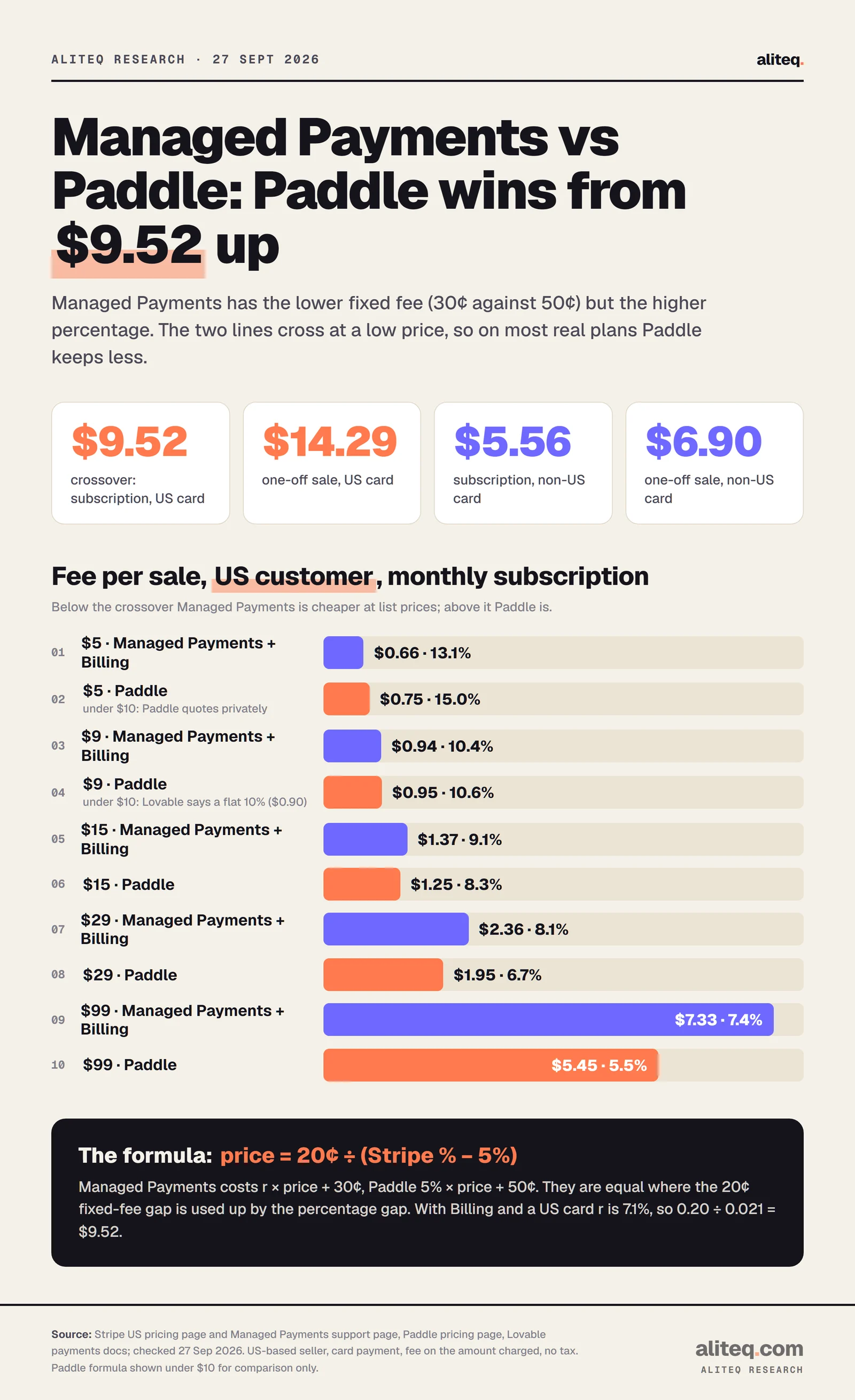
Paddle becomes the cheaper merchant of record once your price passes a point you can work out in one line. For a subscription with a US card, that point is $9.52.
Lower fixed fee, higher percentage: Managed Payments wins only on very cheap sales. · aliteq research
Written as formulas, the two fees per sale are:
Managed Payments: r × price + 30¢, where r is Stripe's total percentage for that sale.
Below that price, Managed Payments costs less at list rates. Above it, Paddle does.
Subscription, US card
Stripe total (r)
7.1%
Break-even price
0.20 ÷ 0.021 = $9.52
One-off sale, US card
Stripe total (r)
6.4%
Break-even price
0.20 ÷ 0.014 = $14.29
Subscription, non-US card
Stripe total (r)
8.6%
Break-even price
0.20 ÷ 0.036 = $5.56
One-off sale, non-US card
Stripe total (r)
7.9%
Break-even price
0.20 ÷ 0.029 = $6.90
Stripe total (r)
Break-even price
Subscription, US card
7.1%
0.20 ÷ 0.021 = $9.52
One-off sale, US card
6.4%
0.20 ÷ 0.014 = $14.29
Subscription, non-US card
8.6%
0.20 ÷ 0.036 = $5.56
One-off sale, non-US card
7.9%
0.20 ÷ 0.029 = $6.90
Three of the four crossovers sit below $10, which is exactly where Paddle stops publishing a price. So in practice, on almost any plan a small SaaS or AI app charges, Paddle's list price is lower. At $29 the gap is $0.41 a sale with a US card and $0.84 with a non-US card.
Two limits on that conclusion. First, we couldn't confirm on Paddle's pricing page whether its 5% is also counted on tax, so we compare pre-tax prices only. Second, fees are one input. Stripe's own support article argues that other merchants of record end up at "7-9%" all-in once currency margins, payouts and disputes are counted. That's Stripe's claim about its rivals, and we haven't checked it, but it's a fair reminder to price disputes and payouts too (below).
Adaptive Pricing: who pays the currency conversion
With Managed Payments, the seller doesn't pay a currency conversion fee; the customer does, inside the exchange rate. Stripe's docs say Adaptive Pricing is "enabled by default" on Managed Payments checkouts, so customers see prices in their own currency.
Stripe's Adaptive Pricing page puts it plainly: "You pay 0%" and "Your customers pay 2–4%". The exchange rate shown to the customer "includes a 2–4% conversion fee, increasing their purchase price by a corresponding amount". A customer who chooses to pay in your currency avoids that fee.
For comparison, on plain Stripe a US seller pays 1% extra when Stripe converts the currency. Under Managed Payments that cost moves to your customer's price. The international card fee of 1.5% still applies to you either way.
Who can use it: five checks
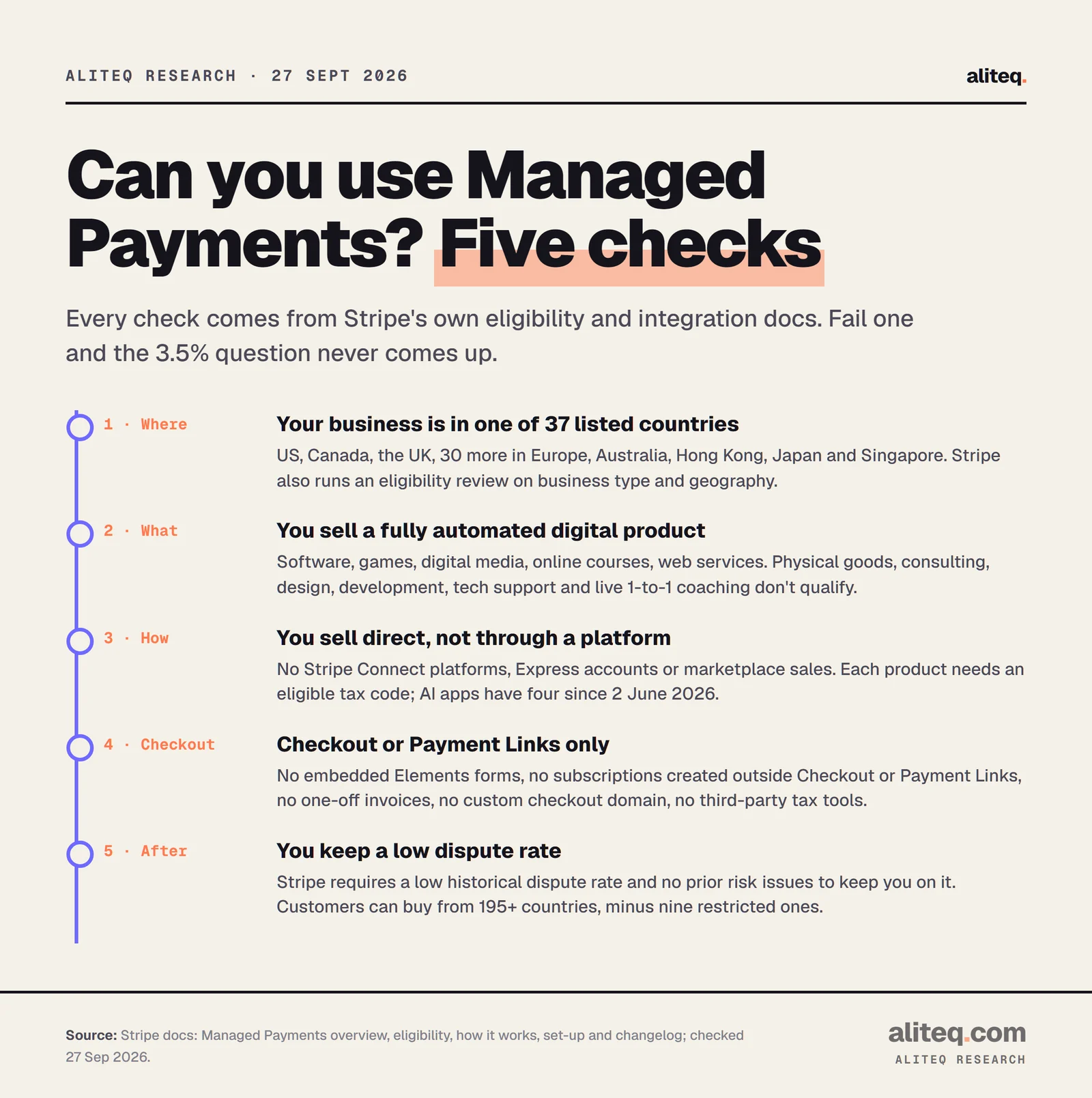
Managed Payments has a narrower door than normal Stripe. You need to pass all five of these, according to Stripe's eligibility and integration docs.
Fail any one of these and Managed Payments isn't an option for that product. · aliteq research
Your business is in a supported country. Stripe's docs list 37 business locations on 27 September 2026: the US, Canada, the UK and 30 more European countries, plus Australia, Hong Kong, Japan and Singapore. Access also goes through "an eligibility review that considers factors such as business type and geography".
You sell a fully automated digital product. Software, games, digital media, online courses and "electronically supplied business and web services" qualify. Physical goods, live events and professional services such as consulting, design, development or tech support don't. Stripe's line: "If your service involves human intervention (such as live 1-1 coaching), it doesn't qualify".
You sell directly. No Stripe Connect platforms, no Express accounts, no accounts controlled by a platform, and no sales "through a platform or marketplace".
You use Checkout or Payment Links. Stripe doesn't support "embeddable web components or other advanced integrations", which rules out an Elements form inside your page. Subscriptions must be created through Checkout or Payment Links, one-off invoices aren't supported, third-party tax tools aren't compatible, and custom domains aren't supported on Managed Payments checkouts.
You keep a clean record. To stay on it, "Stripe requires a low historical dispute rate and no prior risk issues".
Your customers can be almost anywhere: Stripe says buyers from more than 195 countries and territories, except nine restricted ones including China, Russia and Iran.
Managed Payments has been generally available since 22 April 2026, so articles calling it a preview are out of date. On tax coverage, Stripe's pricing page says "more than 75 countries" and its docs say "more than 80". In countries it doesn't cover, you stay responsible for the tax, and Stripe says it won't charge Stripe Tax calculation fees on those Managed Payments transactions.
AI apps have their own tax codes
Every product sold through Managed Payments needs an eligible tax code, and since 2 June 2026 four of them are for AI products. txcd_10105001 covers "Access to artificial intelligence tools (such as LLMs, image generators, or chatbots) hosted entirely on the provider's servers", for personal use. The other three cover business use and hybrid products with a downloaded part, such as "an AI-powered IDE plugin". Stripe notes the business versus personal split only matters if you have US sales.
That makes a hosted chatbot, writing tool or image generator an explicit fit. An AI product that includes human review or done-for-you work is a different case, because of the fully automated rule in check 2.
What your customer sees
Your customer buys from Link, Stripe's checkout brand, not from you. Stripe's docs say the customer "sees Link as the merchant of record, and sees purchases as Sold through Link".
Card statement: it shows LINK.COM* [Your statement descriptor]. Put your product name in the descriptor so the charge is recognizable; an unrecognized charge is a common cause of disputes.
Receipts and invoices: sent "from Link", with PDFs attached. Your own receipt settings don't change them. Since April 2026, your business name appears on the invoice, which is issued by Sold through Link.
Order management: customers can view orders, cancel or change subscriptions and update cards on the Link website, even if you don't build a portal.
Renewal reminders: Stripe always sends one before a subscription's 12-month anniversary, and at 6 and 12 months for customers in Australia and the UK, even if you switch renewal emails off.
Refunds and disputes
Stripe handles the customer side of refunds and disputes, and it can act without waiting for you.
The 48-hour rule. Link handles support requests and may ask you for product input. "If you don't respond within 48 hours, Stripe might issue a refund without your approval." Keep the support email in your Stripe settings current and watched.
Refunds within 60 days. Stripe "can issue refunds within 60 days of the original transaction in certain cases", including to head off chargebacks.
Tax is kept on some refunds. The customer gets the full amount back, including tax. But "Stripe is required to retain and remit the original sales tax amount on refunded transactions in certain jurisdictions", and in those places your balance is reduced by that tax. A refund can cost you more than the sale earned.
Disputes. Stripe decides whether to fight a dispute and submits the evidence itself, covering the evidence fee. If it thinks you're unlikely to win, it "might accept it instead of countering it". The dispute received fee still applies, which is $15 on Stripe's US page. Paddle's chargeback fee is $20 and isn't refunded even when you win.
Stripe's own reports also count withheld tax inside the fee column by default. Use the fee_net_of_withheld_tax column if you want to see what Stripe actually charged you.
Mixing managed and unmanaged sales
You don't have to put every sale through Managed Payments. Stripe's pricing page says you can use it "for all your transactions or just for specific markets and products", and its support article suggests doing so to manage your overall cost.
The switch is per Checkout Session. Stripe's set-up guide says to set managed_payments[enabled] to true to turn it on, and to false to turn it off for a specific session. Your server decides before the customer pays, for example by product or by a country the customer picks in your app.
A common pattern for a US seller:
Plain Stripe for US customers while you're under state sales tax thresholds, which are $100,000 in most states. Our business payments hub lists them.
Managed Payments for customers in the EU, UK and Australia, where a US business owes VAT or GST registration early. For EU consumers, a non-EU seller owes VAT from the first sale.
Two cautions. The eligibility and checkout rules above still apply to every managed sale. And whoever builds your checkout has to handle both paths safely: the secret key stays on the server and the webhook checks Stripe's signature. We showed the safe and unsafe way to prompt for that in add a Stripe checkout button to your vibe-coded app.
If you built on Lovable, its built-in Stripe checkout is embedded, and neither Lovable nor Stripe documents whether Managed Payments can be switched on there. We cover that choice in Lovable asks Stripe or Paddle.
Should you use it?
Managed Payments makes sense when staying inside Stripe is worth paying more per sale than Paddle: on a $29 plan, 1.4 points more with a US card and 2.9 points with a non-US card.
Pass the five checks first. If you sell services, use Elements, run a marketplace or are outside the 37 countries, the decision is made for you.
Work out your break-even. Divide 20¢ by your Stripe total minus 5%. On a normal $19 to $99 plan, Paddle's list price is lower.
Look at where your customers are. If most are in the US and under state thresholds, plain Stripe is cheaper still, and you can turn Managed Payments on only for foreign sales.
Price the rules, not just the fee. Stripe can refund within 48 hours of an unanswered request and can keep tax on refunds. Staff your support inbox.
Keep one integration. The real advantage over Paddle is staying on your existing Stripe account, dashboard and Checkout code.
Quick answers
How much does Stripe Managed Payments cost?
3.5% per successful transaction on top of Stripe's normal processing fee, calculated on the full amount including tax. Subscriptions also pay Stripe Billing's 0.7%. For a US seller, US card and $29 monthly plan, that is about $2.36 a sale.
Is the Managed Payments fee charged on sales tax and VAT?
Yes. Stripe's support article says the 3.5% is calculated on the full transaction amount, including any indirect taxes such as VAT or sales tax.
Is Stripe Managed Payments cheaper than Paddle?
Only on very cheap sales. For a subscription with a US card, Paddle's 5% + 50¢ becomes cheaper above about $9.52. For one-off sales the crossover is about $14.29. Paddle quotes prices under $10 privately.
Which countries can use Stripe Managed Payments?
Stripe's docs listed 37 business locations on 27 September 2026, including the US, Canada, the UK, most of Europe, Australia, Hong Kong, Japan and Singapore, subject to an eligibility review.
Can I use Managed Payments with Stripe Connect or Elements?
No. It doesn't support Connect platforms or marketplaces, Express accounts, or embedded Elements checkouts. You need Stripe Checkout or Payment Links.
Can Stripe refund my customers without asking me?
Yes. If Link support contacts you and you don't reply within 48 hours, Stripe may refund without your approval, and it can refund within 60 days in certain cases.
Use this in your own page
Teaching this? Paste the live version into your course, blog or answer. Free, no sign-up; the credit line links back here.