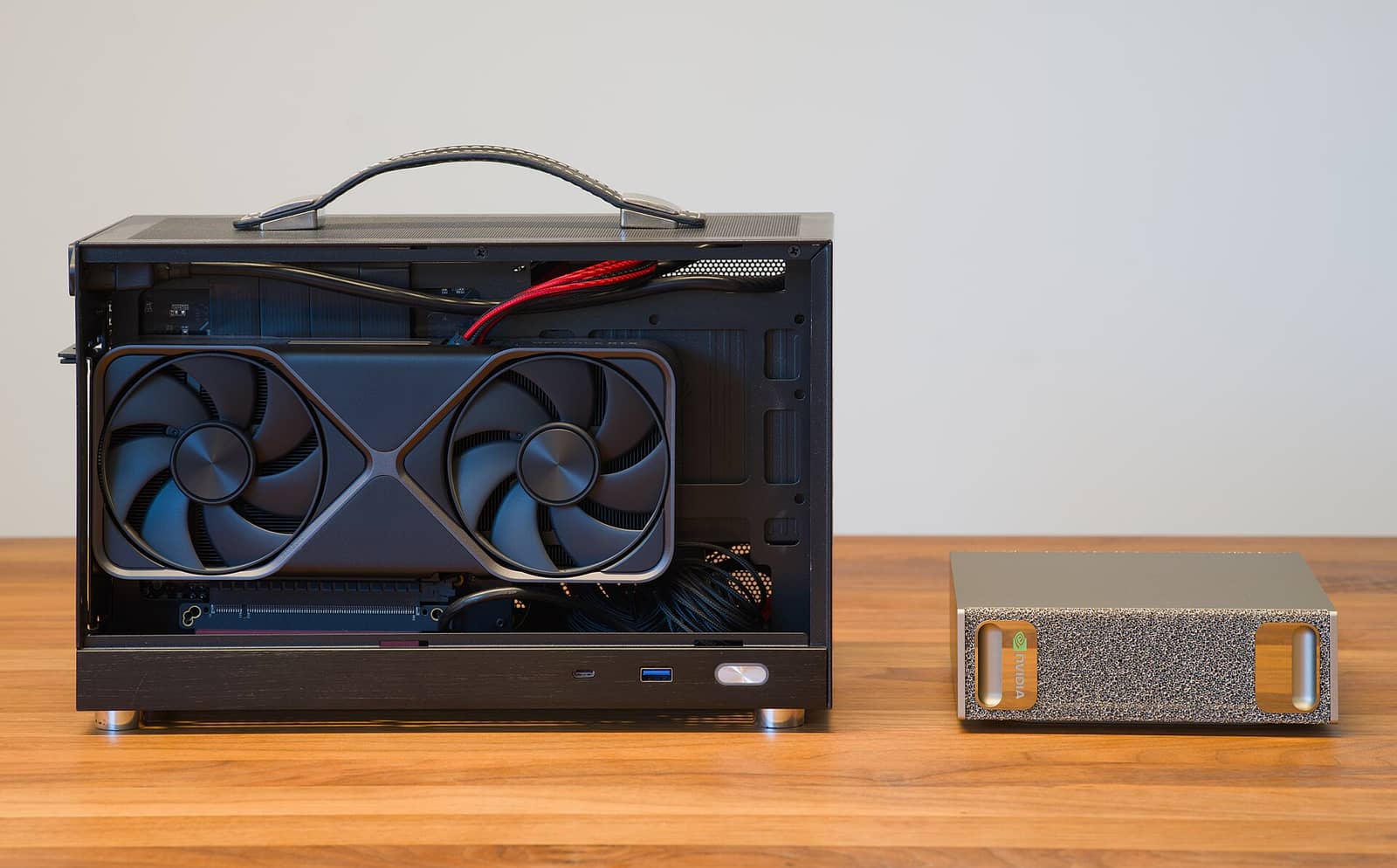
Perplexity spent Monday announcing something genuinely unusual for an AI company in 2026: a way to stop paying it per token. Portable Computer, built with Nvidia, runs Perplexity's agentic "Computer" product entirely on hardware you own, and the company's own VP of infrastructure says billing credits stay at zero the entire time it's running. The catch, and it's a real one, is what "hardware you own" has to actually be.
What Portable Computer actually is
It's the same interface as Perplexity's cloud "Computer" agent product, but every task defaults to running on-device on a local Qwen 3.8 27B model or Perplexity's own fine-tuned PPLX 27B, only reaching the cloud and a bigger frontier model when a task genuinely needs it — and asking permission first. It's available now to Perplexity Pro, Max, Enterprise Pro and Enterprise Max subscribers.
Portable Computer (local) vs Perplexity cloud
Portable Computer
on-device
vs
Perplexity cloud (API / Comet)
cloud
$0 once hardware is owned
Per-task cost
Billed per token/task
27B (Qwen 3.8 27B / PPLX 27B)
Model size
Full frontier models (e.g. Claude Opus 5)
$700+ (used RTX 3090) to $4,699 (DGX Spark)
Upfront hardware cost
$0
Only when you approve an escalation
Data leaves your machine?
Always
High, sustained agent use
Best for
Occasional or bursty use
Computer wins 2wins 3 Comet)
What the DGX Spark actually costs you
Nvidia's DGX Spark pairs a 20-core Arm CPU with a Blackwell GPU on a single GB10 chip, with 128GB of LPDDR5x memory shared between CPU and GPU and 4TB of storage. It launched at $3,999; Nvidia raised the Founders Edition price to $4,699 in February 2026 — the same memory-market pressure that's pushed up GPU prices across the board this year hit Nvidia's own hardware too.
A Linux machine — Windows support isn't out until September 2026
An Nvidia RTX GPU with 24GB+ VRAM (RTX 3090/4090 or newer), or a DGX Spark
A Perplexity Pro ($20/mo), Max ($200/mo), or Enterprise plan to unlock the feature
Acceptance of 27B-model quality for anything that isn't escalated to the cloud
Does the math actually work out
A used RTX 3090 with 24GB of VRAM currently runs roughly $700–900 on the secondhand market — the cheapest entry point. A new DGX Spark is $4,699. Compare that against Perplexity Max at $200/month — $2,400 a year — or Pro at $20/month, $240 a year. A used-3090 setup pays for itself against a Max subscription in under four months of continuous heavy use. Against a Pro subscription, it takes years, and only makes sense if the actual requirement is that nothing leaves the building, not that it saves money.
Who should actually buy in
6/ 10
Verdict
Is Portable Computer worth setting up?
If you already own a 24GB+ VRAM Nvidia GPU and run agentic tasks daily, install it — the marginal cost really is zero and you give up little beyond frontier-model polish on the hardest tasks. If you'd need to buy the hardware specifically for this, the math only clears for genuinely heavy, sustained use or a hard privacy requirement; casual users should stay on a subscription.
Best for: people already GPU-equipped and running agents constantly, not casual chat users
A used RTX 3090 with 24GB of VRAM is the cheapest GPU that clears Portable Computer's minimum requirement. · Unsplash
What GPUs does Perplexity's Portable Computer support?
Any Nvidia RTX GPU with at least 24GB of VRAM, such as the RTX 3090 or RTX 4090, plus newer workstation cards. Nvidia's DGX Spark is also supported and is the officially bundled hardware option.
Is Portable Computer really free to use?
Tasks that run entirely on your local hardware don't consume Perplexity billing credits. You still need an eligible Pro, Max, Enterprise Pro or Enterprise Max subscription to access the feature, and tasks escalated to the cloud cost roughly $0.415 each.
Does Portable Computer work on Windows?
Not yet. It launched August 25, 2026 for Linux machines only; Perplexity says Windows support is coming in September 2026.
Is a used RTX 3090 good enough for this?
Yes. 24GB of VRAM is Perplexity's stated minimum, and the RTX 3090 meets it. It won't be as fast as an RTX 4090 or a DGX Spark, but it clears the requirement at a fraction of the cost.
The bigger trend matters more than this one product: Nvidia keeps showing up as the infrastructure partner every time an AI company tries to move work off its own cloud bill, because the VRAM floor for anything decent keeps landing right around 24GB — the same number our own coverage of running AI without a dedicated GPU keeps converging on. Expect more agent products to ship a "local mode" this way before the year is out, and expect all of them to have the same hardware gate.