The email just landed and you have no report. What to send the buyer this week, the questions that buy you time, a week-by-week plan to a Type 1 audit start in about 90 days, and what it costs. Including the one document founders reach for that doesn't exist yet.
The email says something like "Please send your SOC 2 Type 2 report as part of our vendor review." You have a product the buyer wants, a few engineers, and no report. That moment is what this page is for.
It is not a cost guide or an auditor comparison. Those live on sister pages. This is the action plan: what to send in the next five days, what to say about timing, and the order of work for the next thirteen weeks. I read the auditor, directory and standards-body pages behind every claim on 2 October 2026. aliteq has never been through a SOC 2 audit or received an enterprise SOC 2 request, so nothing here is a war story. It is what the published guidance says, put in the order you'll need it.
What to send an enterprise customer this week
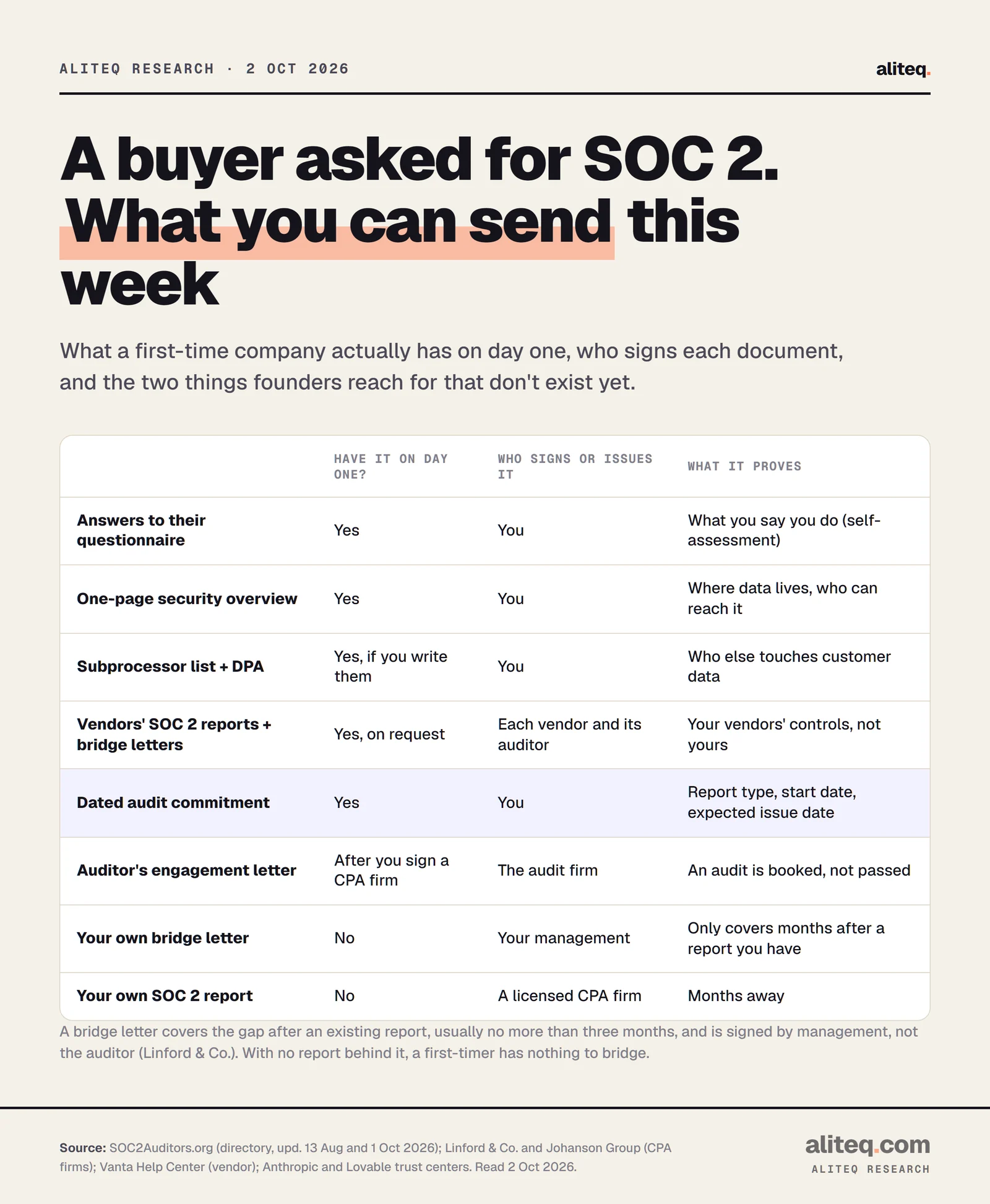
Send a packet, not a promise. Your answers to their security questionnaire, a one-page security overview, your subprocessor list and data processing agreement, your vendors' SOC 2 reports, and a dated plan for your own audit. Do not send your cloud provider's report as if it were yours.
That list follows the "what to send before you have a report" advice from SOC2Auditors.org, an ad-supported directory of audit firms. Its point is blunt: deals that die in the months before a report usually die from a vague answer, not from the missing report.
What exists on day one, and what doesn't yet. Checked 2 Oct 2026. · aliteq research
Item by item:
Their questionnaire, answered. Most buyers have one. Answer it fully, even if they asked for a report. Specific answers are what make a self-assessment believable.
A one-page security overview. What the product does, where customer data lives, how it is encrypted, how long you keep it, who on your team can reach it, and how code gets reviewed and deployed. If your app was built with AI tools, say how AI-written code is reviewed.
Your subprocessor list and DPA. SOC2Auditors.org calls these the two documents a reviewer asks for immediately, and the two most startups cannot produce on demand.
Your vendors' evidence. Request each vendor's SOC 2 report and, where they publish one, its bridge letter. Anthropic's trust center lists a 2026 SOC 2 bridge letter, and Lovable's lists one too. Label them clearly as your vendors' reports. Which plan unlocks which platform's report is covered in is your vibe-coding stack SOC 2 ready.
A pen test summary, if you have one. It is not required for SOC 2, but enterprise reviewers ask for it.
A dated commitment. The report type, the audit start date, the auditor if you have one, and the expected issue date. A date is something your champion can defend inside their company. "We're working on it" is not.
The bridge letter you can't send yet
Founders often reach for a "bridge letter" here. It doesn't fit. A bridge letter, also called a gap letter, covers the months between the end of a SOC report you already have and the buyer's own year end. Linford & Co., a CPA firm, says it is "signed by the service organization, not the service auditor" and that "most bridge letters typically cover a period of no more than three months."
So it needs a report to bridge from. SOC2Auditors.org adds that a bridge letter "does not extend the CPA firm's opinion." For a first-time company the directory is direct: "It cannot substitute for a report you have never had." Your vendors' bridge letters are fine to attach. Writing your own, with no report behind it, would mislead the buyer.
The letter you can send once you sign an auditor
An engagement letter is different. It is the contract you sign with a CPA firm before an audit, and Linford describes it as "a legally binding document." Some firms will give you a version to show customers. Johanson Group, a CPA firm, writes: "If your organization would like a letter of engagement to share with your customers, we would happily provide one."
Compliance platforms offer a similar document. Vanta generates an "engagement letter" PDF that confirms your compliance program "to prospects and stakeholders before your audit is complete." That is a vendor's letter, not an auditor's opinion. Present either one for what it is: proof that an audit is booked, not proof that you passed one.
How to negotiate the timeline with the buyer
Ask before you promise. Find out in writing what the buyer will accept and by when: a Type 1 or a Type 2, which criteria, and whether a completed questionnaire plus a dated audit plan is enough to sign now. Then offer a date you can hit, not the date they asked for.
SOC2Auditors.org advises getting that answer "in writing before you scope anything," because teams routinely buy a Type 2 when the buyer would have taken a Type 1. Founders on a 2026 Hacker News thread said the same thing from experience: some buyers accept a security policy and a filled-in questionnaire for now, and a "we need SOC 2" can turn out to be a polite no.
The questions to send back the same day:
Which report? Type 1 checks your controls on one date. Type 2 checks they worked over months. If they need a Type 2, ask whether a Type 1 now, with the Type 2 window starting right after, can carry the first contract.
Which criteria? Security is required in every SOC 2. The other four add cost, so add them only if the buyer asks.
By when, and for what? Is the report a condition of signing, of go-live, or of the first renewal? Those are three very different deadlines.
Their questionnaire. Ask for it now, whatever the answer to the first three.
Then make the offer concrete. Something like: completed questionnaire this week, security overview and vendor reports attached, auditor signed by a named date, Type 1 report expected by a named month, Type 2 window starting the day the Type 1 is issued. Whether they accept that is the buyer's call, and some regulated buyers won't. If they will, it may be worth putting in the contract, so the commitment is written down on both sides.
Be honest about the floor. Cherry Bekaert, a CPA firm, puts a Type 2 observation window at three to twelve months, and three is the shortest typically seen. Nobody can hand over a Type 2 in 60 days. If a buyer insists on one by then, it is better to know now.
The 90-day plan to a Type 1 audit start
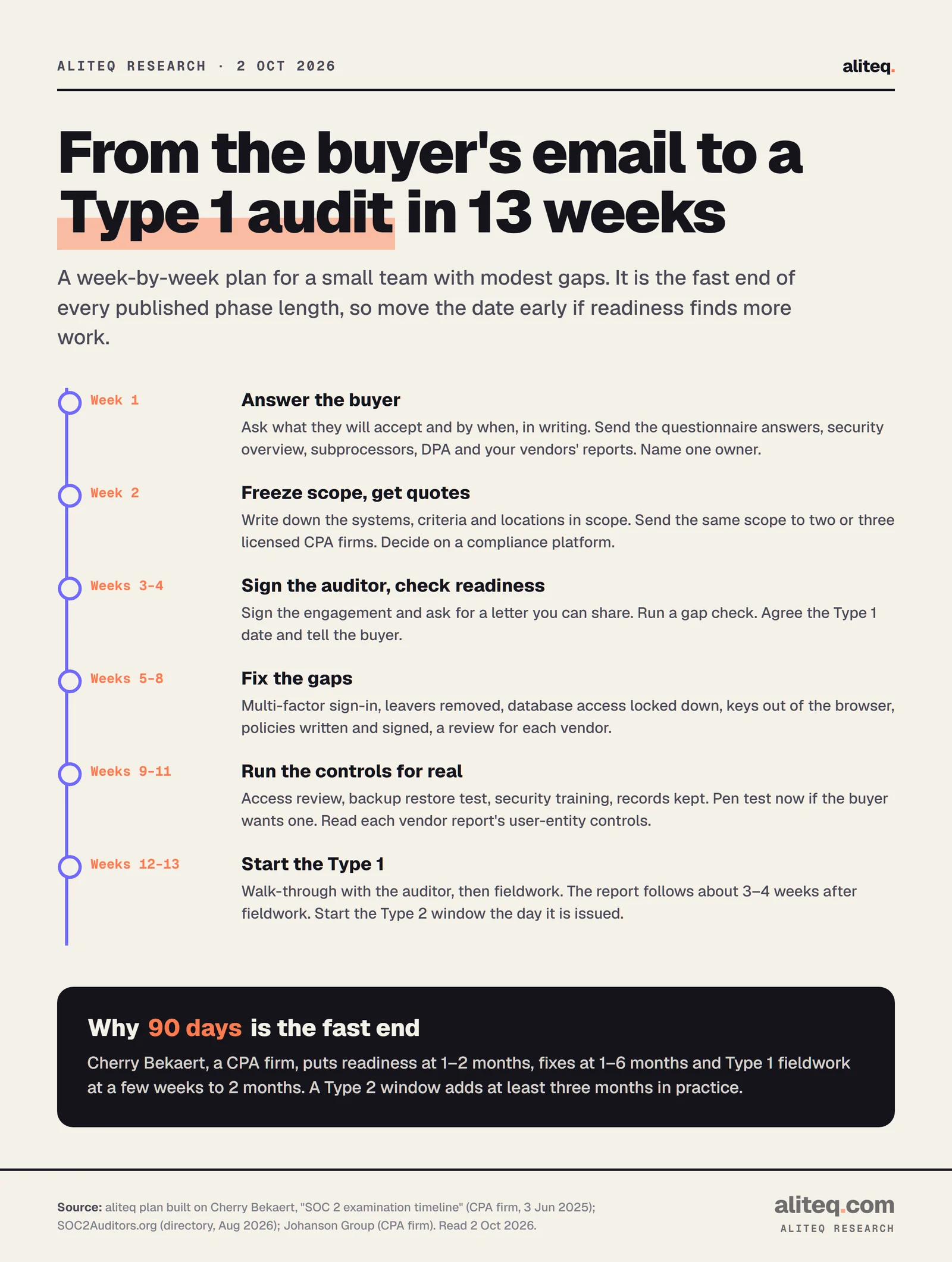
In about 13 weeks a small team with modest gaps can go from "they asked" to Type 1 fieldwork. Week 1 is the buyer. Weeks 2 to 4 are scope, auditor and readiness. Weeks 5 to 11 are fixes and evidence. Weeks 12 and 13 are the audit start. The report itself arrives a few weeks later.
That shape is our plan, built on Cherry Bekaert's phase lengths: one to two months of readiness, one to six months of policy and control fixes, then a few weeks to two months of Type 1 fieldwork, and about three to four weeks to issue the report. Ninety days only works at the fast end of every range. If readiness finds big gaps, the fix phase stretches, and you should move the date you gave the buyer early rather than late.
Our plan, built on Cherry Bekaert's published phase lengths. It assumes small gaps. · aliteq research
Week 1: answer the buyer. Send the questions above and the packet. Name one person who owns SOC 2. Without one owner, the project stalls.
Week 2: freeze the scope and ask for quotes. Write down the systems, the criteria and the locations in scope. Send that same written scope to two or three licensed CPA firms. Decide whether a compliance platform will save more hours than it costs. The SOC 2 audit cost guide has the questions that make quotes comparable.
Weeks 3 to 4: sign the auditor and check readiness. Sign the engagement, ask whether the firm provides a letter you can share, and send it to the buyer. Run a readiness assessment or gap check. Pick the Type 1 "as of" date with the auditor, and tell the buyer.
Weeks 5 to 8: fix the gaps. Start with access, because it is what a reviewer looks at first. Turn on multi-factor sign-in everywhere, remove people who left, lock down your database with Row Level Security, and move any secret keys out of the browser. Write the policies your platform or auditor lists and have the team sign them. Record a vendor review for each provider you rely on. The six checks before you share an app are a good first pass.
Weeks 9 to 11: run the controls for real and collect evidence. Do the access review, test a backup restore, run security awareness training, and keep the records. If the buyer wants a pen test, this is when to run it, so the findings are fixed before fieldwork. Read each vendor report's complementary user entity controls, the controls the vendor expects you to run.
Weeks 12 to 13: start the Type 1. Do a last walk-through with the auditor, then let fieldwork begin. Send the buyer a dated update. When the Type 1 is issued, start the Type 2 observation window that day. SOC2Auditors.org's advice is plain: every month of delay moves the Type 2 date by a month.
If you build on an AI API, expect AI questions in the same review. Our SOC 2 for AI startups guide lists what auditors ask about LLM features, and how long the whole program takes after the Type 1.
What the first 90 days cost
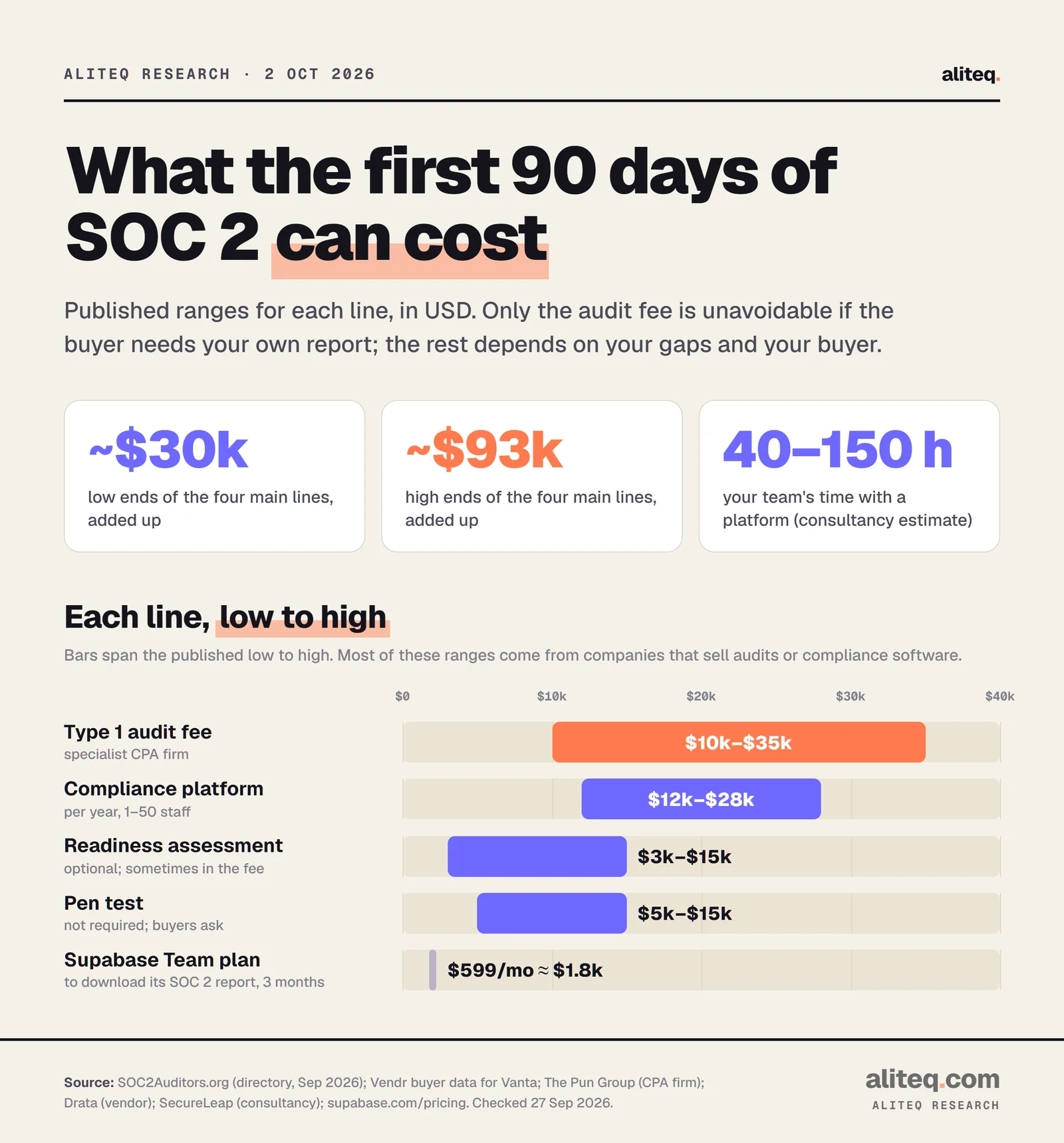
Plan on four lines plus your team's time: a Type 1 audit fee of about $10,000 to $35,000 with a specialist firm, a compliance platform at $12,000 to $28,000 a year, a readiness check at $3,000 to $15,000, and a pen test at $5,000 to $15,000 if the buyer wants one. Low ends sum to about $30,000, high ends to about $93,000.
Published ranges, reused from our sister guides (checked 27 Sep 2026). Most come from sellers. · aliteq research
Type 1 audit fee, specialist CPA firm
Range (USD)
$10,000–$35,000
Do you need it in the first 90 days?
Yes, if the buyer needs your own report
Compliance platform
Range (USD)
$12,000–$28,000 a year (1–50 staff)
Do you need it in the first 90 days?
Optional; trades money for hours
Readiness assessment
Range (USD)
$3,000–$15,000
Do you need it in the first 90 days?
Optional; some firms fold it into the fee
Pen test
Range (USD)
$5,000–$15,000
Do you need it in the first 90 days?
Not required by SOC 2; buyers often ask
Plan upgrades to get vendor reports
Range (USD)
Supabase Team $599/month; Vercel Pro $20/month
Do you need it in the first 90 days?
Only where a report sits behind a plan
Your team's time
Range (USD)
About 40–150 hours with a platform
Do you need it in the first 90 days?
Always
Range (USD)
Do you need it in the first 90 days?
Type 1 audit fee, specialist CPA firm
$10,000–$35,000
Yes, if the buyer needs your own report
Compliance platform
$12,000–$28,000 a year (1–50 staff)
Optional; trades money for hours
Readiness assessment
$3,000–$15,000
Optional; some firms fold it into the fee
Pen test
$5,000–$15,000
Not required by SOC 2; buyers often ask
Plan upgrades to get vendor reports
Supabase Team $599/month; Vercel Pro $20/month
Only where a report sits behind a plan
Your team's time
About 40–150 hours with a platform
Always
Where each number comes from: the audit fee bands are SOC2Auditors.org's directory estimates. The platform range is Vendr's buyer data for Vanta. Readiness is from The Pun Group, a CPA firm, and the pen test range from Drata, which sells a platform. The hours estimate is from SecureLeap, a consultancy. Drata puts a whole first year at about $28,000 for a 25-person startup, which suggests most small teams land toward the low end. That is still a seller's estimate.
A Type 1 is not the last bill. If the buyer needs a Type 2, that is a second audit at a higher fee. The full first-year picture is in SOC 2 for AI startups, and the fee by firm tier and company size is in what a SOC 2 audit costs. Build your own number here; the only input that is yours is what an hour of your team costs.
SOC 2 cost + timeline estimator
Year one
$34.9k–$102k
Year two and later: roughly 40–70% of year one (vendor-reported).
Time to report
9–15 months
Includes the 6-month window. There is no AICPA minimum; 3 months is the practical floor.
Audit fee
specialist CPA, Type 2
$15.5k–$50k
Compliance platform
Vanta/Drata-class, per year
$12k–$28k
Pen test
basic
$5k–$15k
Readiness assessment
skipped
—
Stack upgrades
none selected
—
Your team's time
40–150 h × $60/h
$2.4k–$9k
Ranges from SOC2Auditors.org (directory), Vendr (buyer data), Drata, The Pun Group (CPA firm), Fractional CISO, SecureLeap and Cherry Bekaert (CPA firm); stack prices from Supabase, Vercel and Lovable pricing pages. Checked 27 Sep 2026. Most are published by companies that sell audits or compliance software. An estimate, not a quote.
Questionnaires you can offer instead of a report
If the buyer will take a questionnaire for now, offer a standard one. The common ones are the SIG from Shared Assessments (in Lite, Core and Detail tiers), the CAIQ from the Cloud Security Alliance, and the VSA-Full and VSA-Core from the Vendor Security Alliance. Answer one once, keep the answers current, and reuse them.
Here is what each issuer says its questionnaire is, read on their own pages:
SIG Lite / SIG Core / SIG Detail
Issuer
Shared Assessments
What it is
Three tiers of the Standardized Information Gathering questionnaire buyers use to assess vendors; 21 risk domains, including AI
Cost to you
Licensing the SIG is $7,000 a year; answering one a buyer sends you is not
CAIQ (v4.1, combined with the CCM)
Issuer
Cloud Security Alliance
What it is
Yes/no questions mapped to the Cloud Controls Matrix: 197 control objectives in 17 domains; a CAIQ Lite exists for SMEs and startups
Cost to you
No license needed for internal use, per the CSA
CSA STAR Level 1
Issuer
Cloud Security Alliance
What it is
Your completed CAIQ, published on the public STAR Registry as a self-assessment, updated annually
Cost to you
Complimentary; optional AI scoring $595
VSA-Full / VSA-Core
Issuer
Vendor Security Alliance
What it is
Two free vendor-security questionnaires; Core adds US and EU privacy sections
Cost to you
Free
Issuer
What it is
Cost to you
SIG Lite / SIG Core / SIG Detail
Shared Assessments
Three tiers of the Standardized Information Gathering questionnaire buyers use to assess vendors; 21 risk domains, including AI
Licensing the SIG is $7,000 a year; answering one a buyer sends you is not
CAIQ (v4.1, combined with the CCM)
Cloud Security Alliance
Yes/no questions mapped to the Cloud Controls Matrix: 197 control objectives in 17 domains; a CAIQ Lite exists for SMEs and startups
No license needed for internal use, per the CSA
CSA STAR Level 1
Cloud Security Alliance
Your completed CAIQ, published on the public STAR Registry as a self-assessment, updated annually
Complimentary; optional AI scoring $595
VSA-Full / VSA-Core
Vendor Security Alliance
Two free vendor-security questionnaires; Core adds US and EU privacy sections
Free
Shared Assessments describes the SIG as a questionnaire "used to evaluate the risk controls of an organization's vendors and service providers," and its product page says that for service providers "the SIG demonstrates your security posture to your customers and prospects." The CAIQ is, in the CSA's words, "a set of Yes/No questions" a cloud customer may ask "of a cloud provider." The STAR Registry is where you can publish your answers once instead of resending them. The VSA says it "issues two free questionnaires."
Why bother? Because questionnaires are long and every buyer's is a little different. CBIZ, a CPA firm, notes that many exceed 100 questions, "in some cases, even exceeding 1,000." Founders on an older Hacker News thread suggested standardizing on the CAIQ and keeping an answer bank. A self-assessment carries no auditor opinion, so say plainly that it is one. Some buyers will still insist on their own form; your answer bank makes that faster too.
What to put on a simple trust page
A trust page is one place a buyer can find your security documents without emailing you. For a company with no report yet, it lists what exists today, what is available on request, and the dated plan for your audit. It should never imply a report you don't have.
This outline is our suggestion, modeled on how vendors like Anthropic and Lovable lay out their own trust centers, with documents listed and access granted on request:
Status line. "SOC 2 Type 1 audit with [firm], fieldwork starting [month]." Only once it is true.
Security overview. The one-pager from your packet.
Subprocessors. Every vendor that touches customer data, with what it does and where.
DPA. Your standard data processing agreement.
Policies on request. Access control, incident response, vendor management.
Completed questionnaire. Your CAIQ or SIG Lite answers, or a link to your STAR Registry entry.
Contact. One security email that someone reads.
Update it the day anything changes. A stale date on a trust page reads worse than no date.
Quick answers
What should I send a customer who asks for SOC 2 if I don't have it?
A packet: your answers to their security questionnaire, a one-page security overview, your subprocessor list and DPA, your vendors' SOC 2 reports, and a dated commitment for your own audit with the report type and expected issue date. Never send your cloud provider's report as if it were your own.
Can I send a SOC 2 bridge letter instead of a report?
Not as a first-timer. A bridge letter covers the months after a SOC report you already have, usually no more than three, and is signed by your management, not the auditor. With no report behind it, there is nothing to bridge. You can attach your vendors' bridge letters.
Can I get SOC 2 in 90 days?
A small team with modest gaps can reach the start of Type 1 fieldwork in about 90 days, with the report a few weeks after. A Type 2 takes longer, because its observation window runs at least three months in practice, and most cover twelve.
Will an enterprise customer accept a Type 1 instead of a Type 2?
Some do for a first contract and many want a Type 2 at renewal, but it is the buyer's decision. Ask in writing before you scope. If they accept a Type 1, start the Type 2 window the day the Type 1 is issued.
What is the difference between SIG Lite and CAIQ?
SIG Lite is the shortest tier of Shared Assessments' SIG questionnaire, which covers 21 risk domains. The CAIQ is the Cloud Security Alliance's yes/no questionnaire mapped to its Cloud Controls Matrix. Both are self-assessments; neither is an audit.
How much does a first SOC 2 cost a small company?
By published ranges, a Type 1 audit fee with a specialist firm runs about $10,000 to $35,000. A compliance platform, readiness check and pen test can bring the first stretch to roughly $30,000 to $93,000 before your team's time. Most of these figures come from companies that sell audits or software.
The buyer's email is the start of a sales conversation, not a pass-or-fail test. Answer fast, be exact about what exists, and give a date you can keep. Everything else on compliance, from audit fees to questionnaires, is on the Security & Compliance hub.
Use this in your own page
Teaching this? Paste the live version into your course, blog or answer. Free, no sign-up; the credit line links back here.