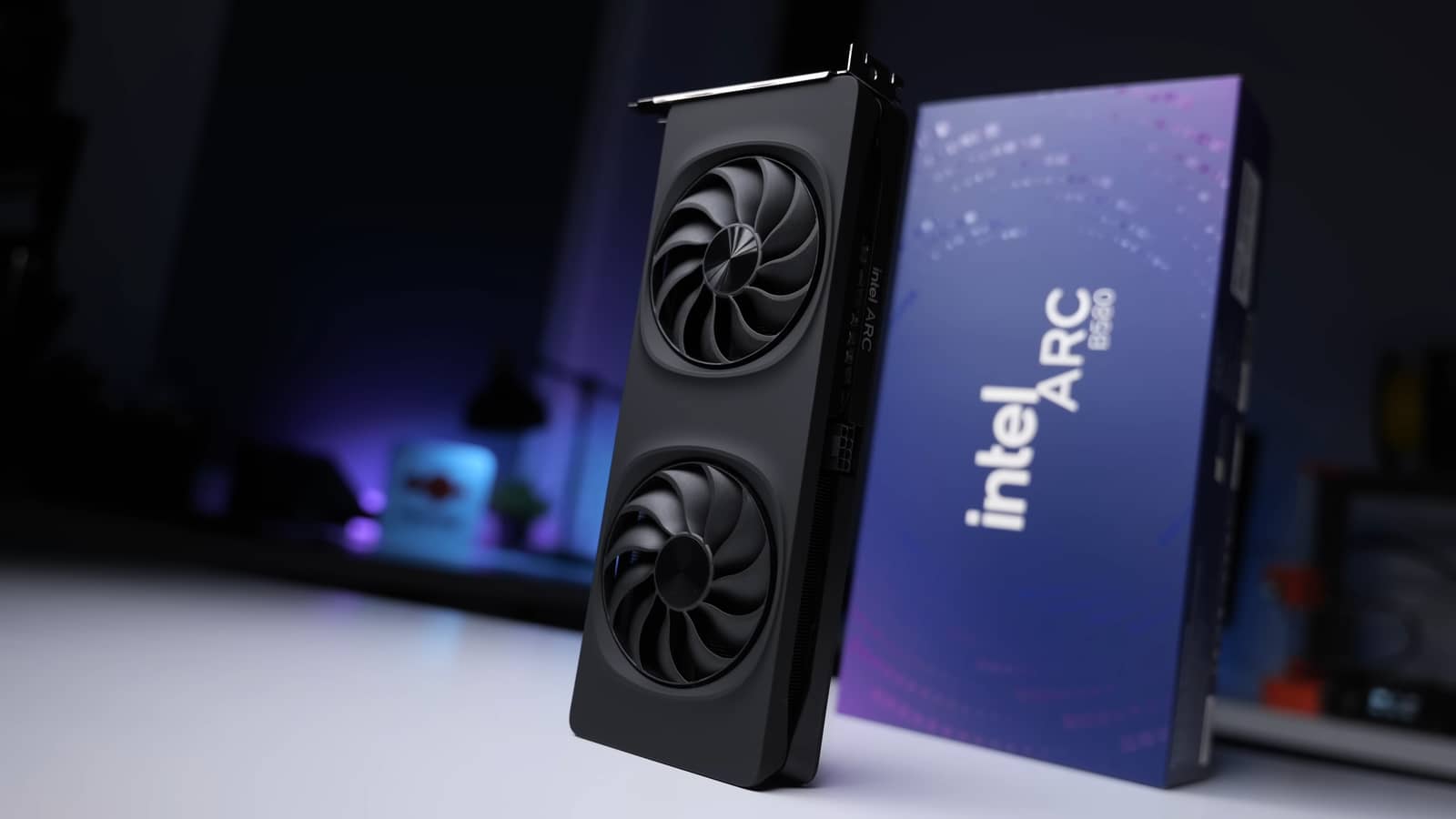
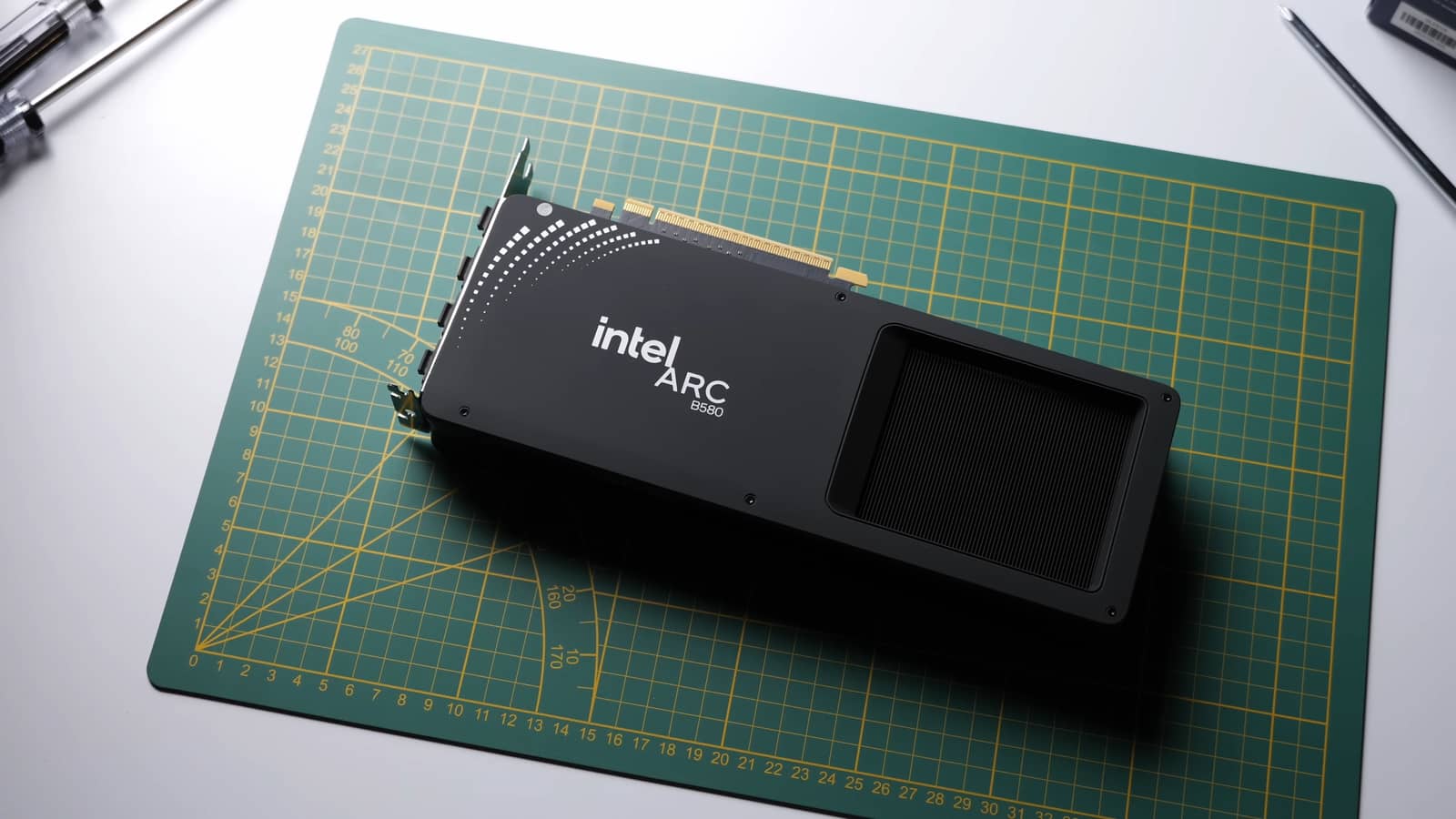
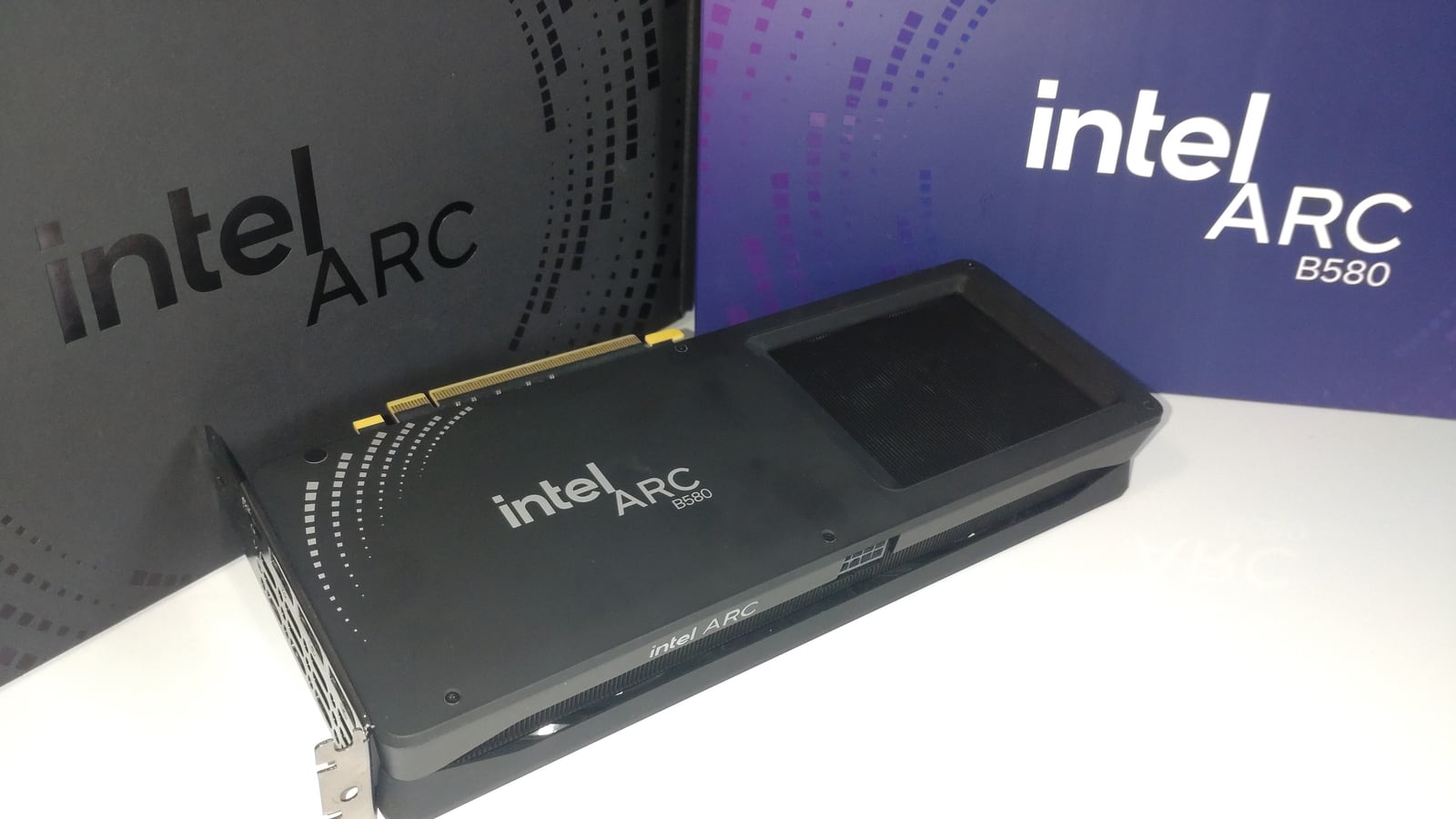
Intel's Arc B580 launched at $249 in December 2024 and, as of August 2026, is selling for roughly $290 to $310 — a real increase, but a mild one next to what's happening to Nvidia's lineup. Nvidia's RTX 5070 jumped 36% to roughly $900 this month alone; the B580 has moved maybe 20% total in almost two years. For around $300 you get 12GB of GDDR6 and, per TechPowerUp's review, 456 GB/s of memory bandwidth — respectable numbers on paper for a card that costs a third of what Nvidia wants for similar VRAM right now. The part nobody puts in the spec sheet is what it takes to actually get that performance out of it.
The performance case: what 12GB and XMX actually deliver
On paper the B580 is a legitimate local-AI card. Its XMX matrix engines are purpose-built for the INT8 and FP16 math that dominates transformer inference, and reviewers consistently put it around 85-90% of an RTX 4060 Ti's inference throughput — comparable to what you'd get from today's RTX 5060 Ti 16GB, at a fraction of the price. On 8B models like Llama 3 or Qwen2.5-Coder, users report 60-plus tokens per second, with some optimized 8B runs pushing past 80 tok/s. That's genuinely competitive with cards costing two to three times as much right now.
~60-80 tok/s
Llama 3 8B
With optimized quantization
40-55W
Power draw
Typical inference/transcode load
12GB
VRAM ceiling
7B comfortable; 13B+ needs a 16GB card
~20-30%
CUDA gap
Rough inference penalty vs. an equivalent Nvidia card
Intel's Xe2 (Battlemage) architecture adds dedicated XMX matrix engines aimed at the INT8/FP16 math local LLM inference runs on. · Unsplash
The software tax: what the spec sheet doesn't tell you
Here's the part that turns a great spec sheet into a real decision. Ollama — the tool most people reach for first — doesn't run on Arc GPUs out of the box. You need Intel's IPEX-LLM project, a patched fork that redirects the standard Ollama build to Intel's oneAPI/SYCL backend. That's an extra install step most Nvidia and even AMD users never think about. And then there's the twist nobody expects: on the B580, plain llama.cpp compiled with the Vulkan backend frequently beats Intel's own IPEX-LLM Portable ZIP on raw tokens per second, because the SYCL runtime's overhead eats more of the XMX advantage than Vulkan loses by not using it directly. Flash Attention — which matters a lot once you push context length up — only partially works on SYCL and isn't supported on Vulkan at all.
Skip the vendor-recommended path first — install plain llama.cpp with the Vulkan backend, not Intel's IPEX-LLM Ollama fork, and benchmark that before anything else.
If you specifically need Ollama's ergonomics, install IPEX-LLM's patched build, but expect a slower setup and occasional driver-version pinning.
Keep context windows conservative — Flash Attention gaps mean long-context runs lose more performance on Arc than on an equivalent Nvidia card.
Stick to 7-9B models. That's where the B580 is genuinely competitive; push into 13B+ territory and you're out of VRAM and fighting software at the same time.
How it stacks up against paying Nvidia's markup
August 2026 street price vs. launch MSRP
RTX 5070+64%
$549 → $899.99
RTX 5060 Ti 16GB+88%
~$429 → $804.99
Arc B580~+20%
$249 → ~$300
That's the honest comparison. You're not choosing between "good" and "bad" hardware — the B580's XMX engines are real and the 456 GB/s of bandwidth is real. You're choosing between paying Intel's smaller, steadier price increase and doing some driver work, or paying Nvidia's 36-88% price spikes for a setup experience that mostly just works. For hobbyists chasing the cheapest real way into local AI right now, and wondering whether 12GB is even enough in 2026, that trade is worth taking.
7/ 10
Verdict
Intel Arc B580 for local AI
A genuinely strong 12GB card at a price that hasn't moved much while Nvidia's lineup spiked — but budget an evening for driver and backend setup, and stick to 7-9B models where its XMX engines actually shine.
Best for: Hobbyists comfortable with some terminal work who want the cheapest real 12GB local-AI card in August 2026
Intel Arc B580 for local AI — FAQ
Does Ollama work on the Intel Arc B580?
Not the standard build. You need Intel's IPEX-LLM fork, which patches Ollama to use the oneAPI/SYCL backend instead of CUDA. It works, but it's an extra setup step most Nvidia users never deal with.
Is the Arc B580 faster than an RTX 5060 Ti for local AI?
No — the RTX 5060 Ti 16GB has more VRAM and, on Nvidia's CUDA stack, generally faster real-world inference. The B580's case is price, not raw speed: it costs roughly a third as much per GB of VRAM at August 2026 street prices.
Can the Arc B580 run 13B parameter models?
Not comfortably. 12GB handles 7B models unquantized and some 10B models at INT4, but 13B+ dense models exceed its VRAM — you'd need a 16GB card from Intel or another vendor entirely.
Is Vulkan or IPEX-LLM better for the B580?
Counterintuitively, plain llama.cpp with the Vulkan backend often beats Intel's own IPEX-LLM SYCL path on raw tokens per second, because the SYCL runtime's overhead outweighs the XMX advantage it's supposed to unlock. Benchmark both on your own workload before committing.
I don't think the B580 replaces a 5070 or 5060 Ti for someone who wants a plug-and-play setup — Nvidia's CUDA ecosystem is still the path of least resistance, price spike or not. But at roughly 20% over a $249 launch price, against Nvidia cards now 64-88% over theirs, it's the most honest budget option in local AI right now, if you're willing to do a little work for it.