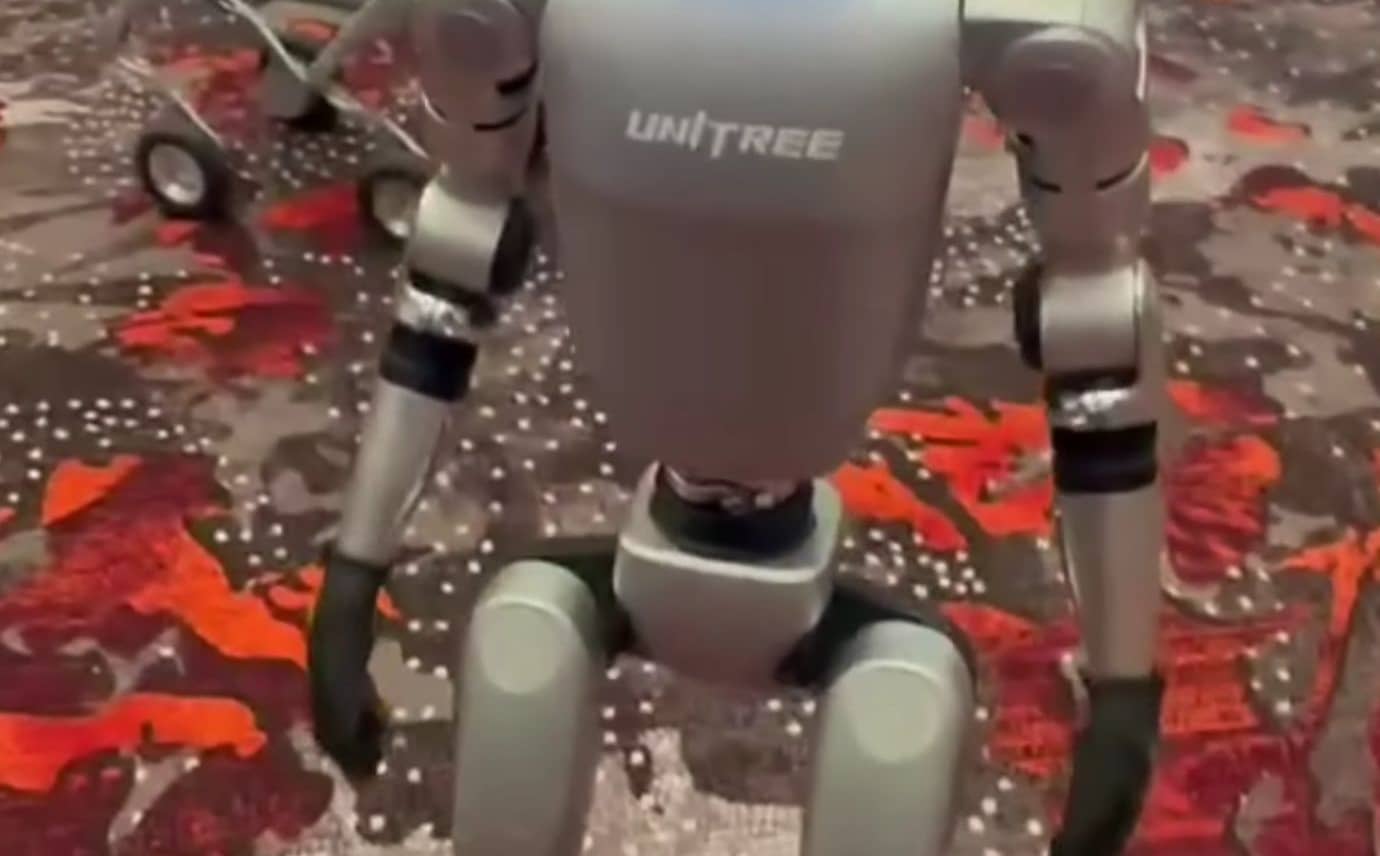
Wang Xingxing's humanoid robot company just had China's hottest stock debut of 2026. His own read on when robots get actually smart is a lot more sober than the stock price.
Unitree Robotics just gave China's tech market its biggest debut of 2026: shares in the humanoid robot maker rocketed as much as 629% above their IPO price on Shanghai's STAR Market this week, before settling into a 460% close that valued the company at roughly $50 billion. Founder Wang Xingxing, who owns about a fifth of the company, is on paper more than $12 billion richer than he was on Monday. Then, two days later, he told reporters that robots capable of actually thinking for themselves are still two to ten years away.
The number that should worry the hype cycle: 80%
Wang didn't frame the breakthrough he's waiting for as robots becoming godlike. He framed it as a robot walking into a house it has never seen, understanding a spoken or typed instruction, and getting the job done about four times out of five. That's the bar. Not perfection — 80%, the same rough threshold engineers use to describe when a system stops being a novelty and starts being something you'd actually trust unsupervised.
We hope that in the future, we can see a robot be introduced into an unfamiliar household and it can achieve approximately 80% of tasks successfully through voice or text commands.
Wang Xingxing, Unitree CEO
What $50 billion actually bought
$904M
IPO raised
6.1B yuan, Shanghai STAR Market
8,000x+
Oversubscription
record for the STAR Market
+460%
Debut close
peaked as high as 629% intraday
$12B+
Wang's paper wealth
owns roughly 20% of the company
Unitree isn't even China's biggest humanoid maker by shipments — it's second, behind the world's largest producer of robot dogs, which happens to also be Unitree. That double identity is part of why investors piled in: it's the rare company with actual product-market fit in a category everyone else is still prototyping. China as a whole shipped over 40,000 humanoid robots in the first half of 2026, roughly 97% of the global total, a dominance that reads very differently from Nvidia's $500 billion GPU collateral bet on AI infrastructure — one is chips underwriting a promise, the other is hardware already shipping in volume.
How the week actually played out
Tue Aug 18
Unitree prices its Shanghai IPO at 150.8 yuan a share after raising $904M — mainland China's first listing from a humanoid robot maker.
Wed Aug 19
Shares open and spike as high as 629% intraday before closing up 460% at 845 yuan, valuing Unitree near $50 billion.
Thu Aug 20
The stock falls 11% as early buyers take profit. The same day, Wang tells reporters robots are still years from real autonomy.
Why 'retrained from scratch' is the tell
Here's the part that got buried under the stock chart: Wang himself says Unitree's robots remain less efficient than human workers at most jobs, and each new task currently requires retraining rather than the kind of one-shot generalization that made ChatGPT feel like magic in 2022. That's a meaningfully different problem than the one language models solved. A chatbot only ever has to manipulate text. A robot has to manipulate gravity, friction, and a kitchen it's never stood in before — which is closer to the challenge edge-AI models like Liquid AI's LFM2.5 are chipping away at on tiny hardware, and further still from what open text models like Meta's Muse Glimmer already do out of the box.
Did Unitree's IPO actually raise $904 million?
Yes — the company raised 6.1 billion yuan ($904 million) on Shanghai's STAR Market, China's tech-focused exchange, pricing shares at 150.8 yuan each.
What is Unitree's 'ChatGPT moment' for robots?
CEO Wang Xingxing's term for the point where a humanoid robot can walk into an unfamiliar home and complete about 80% of tasks from voice or text commands alone, without task-specific retraining. He estimates that's 2 to 10 years away.
Do Unitree's robots work like that today?
No. Wang says today's robots, including Unitree's own, must be retrained for each new task and remain less efficient than human workers in most jobs.
How big is China's humanoid robot market right now?
China shipped over 40,000 humanoid robots in the first half of 2026 alone — about 97% of global humanoid robot shipments, according to market data cited in coverage of the IPO.
Unitree's listing was the most oversubscribed IPO in STAR Market history. · Unsplash
What to actually watch next: Unitree's first earnings call as a public company, which will show whether revenue is diversifying beyond robot dogs into the humanoid line the market just bet $50 billion on. And watch Wang's own 2-to-3-year optimistic window against rivals like Tesla's Optimus program — because right now, the AI capital markets are pricing in a breakthrough that even the man selling it says isn't guaranteed.