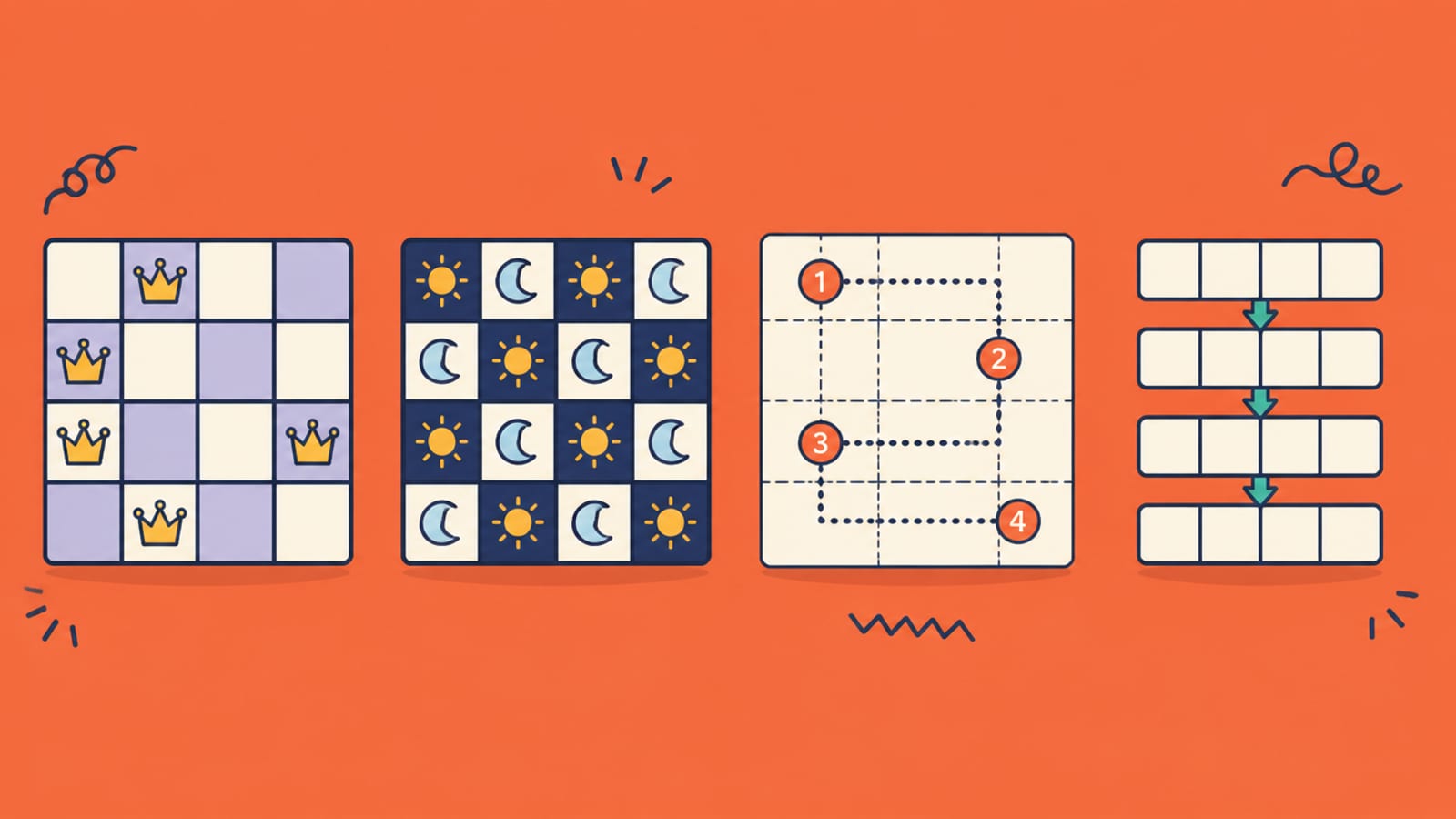
Yes, LinkedIn has daily puzzles now — Queens, Tango, Zip, Pinpoint and more. What each game is, how it plays, and why a professional network decided to run the Wordle playbook.
The first time a colleague messaged me their Queens time, I did a double-take — puzzle scores, on LinkedIn, the place for job titles and "I'm humbled to announce"? But that's exactly the point. LinkedIn quietly built a suite of quick daily puzzles, and it turns out a two-minute logic game is a surprisingly clever fit for a professional network: it's a low-stakes reason to open the app, a gentle bit of competition with people you actually work with, and a daily habit that has nothing to do with doomscrolling. Here's the full lineup, how each game actually works, and why LinkedIn — of all places — decided to become a games company.
LinkedIn's games are quick daily puzzles built to give professionals a two-minute reason to come back. Illustration by Aliteq. · Illustration by Aliteq / generated with Higgsfield
The lineup, and how each one works
There are several games, and they split neatly into logic-grid puzzles and word/trivia puzzles. Here's what you're actually playing.
LinkedIn's daily games
Queens
Type
Logic grid
The goal
Place one crown in every row, column and coloured region — no two crowns touching
Tango
Type
Logic grid
The goal
Fill a 6×6 grid with suns and moons: no three-in-a-row, equal counts per line, obey the = and × clues
Zip
Type
Path logic
The goal
Draw one unbroken path through every cell, hitting the numbered waypoints in order
Pinpoint
Type
Deduction
The goal
Guess the category linking five clues — the fewer clues you need, the better your score
Crossclimb
Type
Word ladder
The goal
Solve trivia clues, then order the words so one letter changes between each rung
Mini Sudoku (+ more)
Type
Logic grid
The goal
Compact number puzzles and newer additions rounding out the suite
Type
The goal
Queens
Logic grid
Place one crown in every row, column and coloured region — no two crowns touching
Tango
Logic grid
Fill a 6×6 grid with suns and moons: no three-in-a-row, equal counts per line, obey the = and × clues
Zip
Path logic
Draw one unbroken path through every cell, hitting the numbered waypoints in order
Pinpoint
Deduction
Guess the category linking five clues — the fewer clues you need, the better your score
Crossclimb
Word ladder
Solve trivia clues, then order the words so one letter changes between each rung
Mini Sudoku (+ more)
Logic grid
Compact number puzzles and newer additions rounding out the suite
My personal on-ramp is Queens — it's the most approachable, and the "one crown per region, none touching" rule clicks fast. Tango is the one that hooks people who like a tighter constraint puzzle, Zip scratches the single-line-path itch, and Pinpoint and Crossclimb are for the word-and-trivia crowd. All of them reset at midnight Pacific Time, every day including weekends, so it's genuinely one-and-done: solve it, see how you did, move on.
The suite mixes logic grids (Queens, Tango, Zip) with word and deduction games (Pinpoint, Crossclimb). Illustration by Aliteq. · Illustration by Aliteq / generated with Higgsfield
Why a professional network is doing this
It looks like a curveball; it's actually a well-worn playbook. The New York Times turned Wordle and its puzzle suite into a daily-habit engine that drives enormous, sticky engagement — people return every single day for a two-minute ritual. LinkedIn is running the same play, tuned for its context: the games are quick, the scores are shareable with your actual professional network, and there's a leaderboard-style nudge to see how connections did. For a platform whose whole business depends on how often you open it, a reason to return daily that isn't work-anxiety is strategically smart.
There's a softer angle too, and I think it's real: the games create a friendly, low-pressure touchpoint between colleagues. Comparing puzzle times is a lighter way to stay on someone's radar than yet another congratulatory comment. Whether that makes LinkedIn more pleasant or just more sticky probably depends on your mood — but as product design, it's genuinely clever.
Quick answers
Are LinkedIn games free?
Yes — all of them are free to play for members and guests, in the app or on the web. There's no premium tier or paywall for the puzzles.
How many are there and how often do they change?
There are several (Queens, Tango, Zip, Pinpoint, Crossclimb, plus newer additions like Mini Sudoku), and each serves one fresh puzzle per day, resetting at midnight Pacific Time — including weekends and holidays.
Which LinkedIn game should I start with?
Queens is the most beginner-friendly: place one crown in each row, column and coloured region without any two touching. Once that clicks, Tango and Zip are the natural next steps.
Why did LinkedIn add games?
To build a daily-return habit and light social engagement — the same loop the NYT proved with Wordle. For a platform that lives on how often you open it, a fun two-minute reason to come back is good business.
It's a small feature with a big strategy behind it — a reminder that the "daily habit" is the most valuable real estate in software right now, and everyone from news apps to professional networks is chasing it. For more on the tools and platform shifts shaping how we work, browse our software coverage — and since these are games at heart, our gaming section too.
Beyond software features like this, the other big beat we cover is people using AI to earn a living — our AI Money hub collects the honest, receipts-first playbooks.