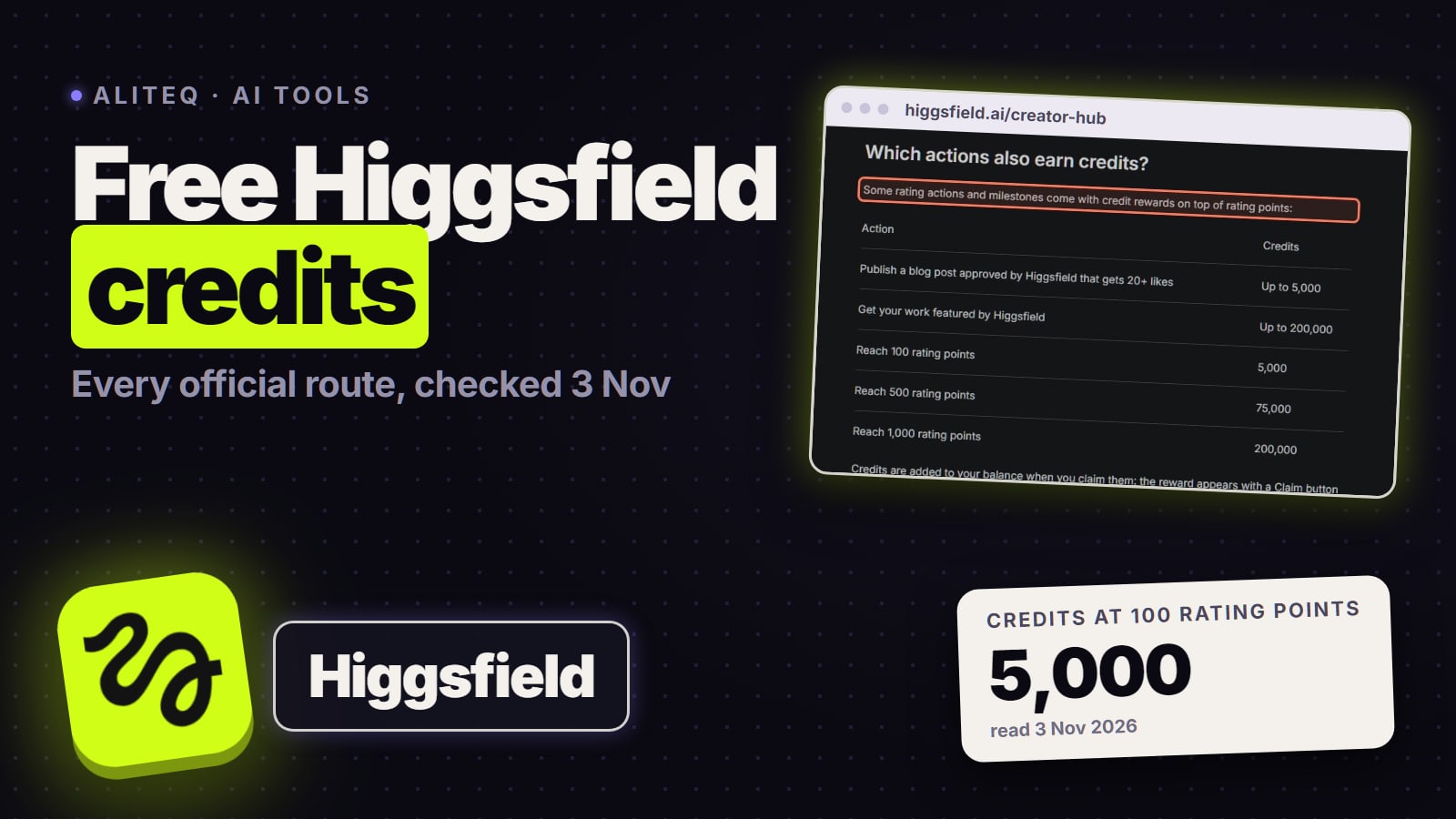
A 5-second clip ran from about 3 to 110 credits on Higgsfield's pricing table (Oct 4, 2026), and a Seedance 2.5 clip was 15 to 80 on the Generate button on 3 Nov. Your plan's credits vanish at every reset. Here's the per-model table, the expiry rules for each kind of credit, and the fine print on "Unlimited", all from Higgsfield's own pages.
This post contains affiliate links. If you buy through them, Aliteq may earn a commission — at no extra cost to you. Prices change; check the seller’s own page for today’s price.
Share
Higgsfield sells everything in credits. That's tidy for them and confusing for you. The plan card says 1,200 credits. What you want to know is how many videos that is, and whether the leftovers survive the month.
So we read Higgsfield's pricing page and nine of its help-center articles on October 4, 2026, and re-checked the key rows and rules on October 29, 2026, with every FAQ expanded and both billing toggles checked. On November 3, 2026 we read the credit cost on the Generate button for the main video models, logged in on an Ultra account. Every number below comes from those pages. Where Higgsfield doesn't publish a number, we say so instead of guessing. We didn't run generations to measure costs. If you're still deciding whether to pay at all, start with is Higgsfield worth it and is Higgsfield free.
What is a Higgsfield credit?
A credit is Higgsfield's spending unit for images and videos. Each generation costs a set number of credits based on the model, resolution and clip length. Higgsfield's help center says "the exact cost is shown on the Generate button before you confirm", so that button is the final word, not any table.
A few rules from the help center decide how fast a balance drains:
Batch size multiplies the cost. Set the batch to 2, 3 or 4 outputs and "each output is charged separately."
Re-rolls and upscales cost credits too. Higgsfield lists "images, videos, re-rolls, and upscaling" as things that deduct.
Failed generations usually come back. "Failed generations return credits automatically," says one help article. Another, re-read October 29, 2026, adds that "specific models might not refund credits for failed generations." If one doesn't come back, Higgsfield points you to Manage Account, then Usage, which logs every deduction.
Your balance is in the top bar. Higgsfield shows it in the top navigation bar on higgsfield.ai. Manage Account, then Subscription, splits it into your monthly balance and Auto-Refill credits.
The free plan has no credits. Higgsfield says free use is "limited to a small set of models and doesn't include credits."
How many credits does a Higgsfield video cost?
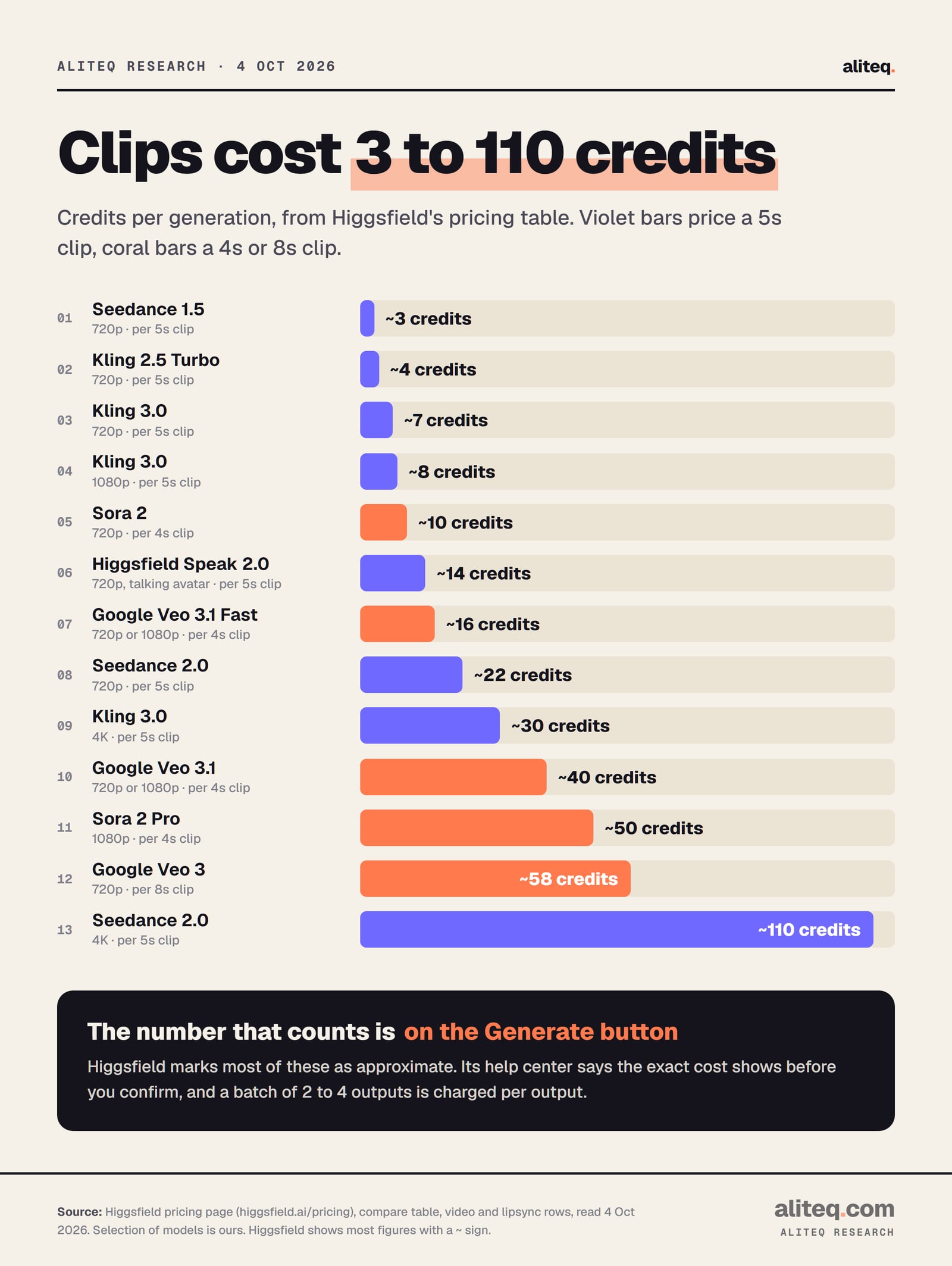
On October 4, 2026 one short clip cost from about 3 credits (Seedance 1.5, 720p) to about 110 (Seedance 2.0, 4K). Most popular models sit between 7 and 50. Watch the length unit: Kling and Seedance are priced per 5 seconds, Veo 3.1 per 4 seconds, and Veo 3 per 8 seconds.
Credits per clip from Higgsfield's pricing table, read October 4, 2026. The model selection is ours. The two Sora 2 bars are history. OpenAI shut Sora down in 2026 and Higgsfield no longer lists it. · aliteq research
Seedance 1.5, 720p
Clip length
5 s
Credits per clip
~3
Kling 2.5 Turbo, 720p
Clip length
5 s
Credits per clip
~4
Kling 3.0, 720p
Clip length
5 s
Credits per clip
7.5 sound off, 10 sound on (3 Nov)
Kling 3.0, 1080p
Clip length
5 s
Credits per clip
~8
Wan 3.0, 720p (added 29 Oct)
Clip length
5 s
Credits per clip
8.75
Kling 3.0 Motion Control, 1080p
Clip length
5 s
Credits per clip
~12
Seedance 2.0 Fast, 720p
Clip length
5 s
Credits per clip
~12
Higgsfield Speak 2.0 (talking avatar), 720p
Clip length
5 s
Credits per clip
~14
Wan 3.0 Prime, 720p (added 29 Oct)
Clip length
5 s
Credits per clip
15
Wan 3.0, 1080p (added 29 Oct)
Clip length
5 s
Credits per clip
17.5
Seedance 2.0, 720p
Clip length
5 s
Credits per clip
22.5, discounted from 30 (3 Nov)
Seedance 2.0 Mini, 720p (not in the US)
Clip length
8 s
Credits per clip
8, discounted from 20 (3 Nov)
Seedance 2.5, 480p / 720p / 1080p
Clip length
5 s
Credits per clip
15 / 35 / 80 (3 Nov)
Kling 4.0, 1080p
Clip length
10 s
Credits per clip
32.5, discounted from 40 (3 Nov)
Wan 3.0 Prime, 1080p (added 29 Oct)
Clip length
5 s
Credits per clip
30
Kling 3.0, 4K, sound on
Clip length
5 s
Credits per clip
30 (3 Nov)
Seedance 2.0, 4K
Clip length
5 s
Credits per clip
~110
Google Veo 3.1 Fast, 720p or 1080p
Clip length
4 s
Credits per clip
~16
Google Veo 3.1, 720p or 1080p
Clip length
4 s
Credits per clip
~40
Google Veo 3, 720p
Clip length
8 s
Credits per clip
~58
Clip length
Credits per clip
Seedance 1.5, 720p
5 s
~3
Kling 2.5 Turbo, 720p
5 s
~4
Kling 3.0, 720p
5 s
7.5 sound off, 10 sound on (3 Nov)
Kling 3.0, 1080p
5 s
~8
Wan 3.0, 720p (added 29 Oct)
5 s
8.75
Kling 3.0 Motion Control, 1080p
5 s
~12
Seedance 2.0 Fast, 720p
5 s
~12
Higgsfield Speak 2.0 (talking avatar), 720p
5 s
~14
Wan 3.0 Prime, 720p (added 29 Oct)
5 s
15
Wan 3.0, 1080p (added 29 Oct)
5 s
17.5
Seedance 2.0, 720p
5 s
22.5, discounted from 30 (3 Nov)
Seedance 2.0 Mini, 720p (not in the US)
8 s
8, discounted from 20 (3 Nov)
Seedance 2.5, 480p / 720p / 1080p
5 s
15 / 35 / 80 (3 Nov)
Kling 4.0, 1080p
10 s
32.5, discounted from 40 (3 Nov)
Wan 3.0 Prime, 1080p (added 29 Oct)
5 s
30
Kling 3.0, 4K, sound on
5 s
30 (3 Nov)
Seedance 2.0, 4K
5 s
~110
Google Veo 3.1 Fast, 720p or 1080p
4 s
~16
Google Veo 3.1, 720p or 1080p
4 s
~40
Google Veo 3, 720p
8 s
~58
Rows marked "(3 Nov)" were read on the Generate button on November 3, 2026. "Discounted from" means the button showed a temporary price with the list price crossed out: Seedance 2.0 showed 36 credits for 8 seconds (48 listed), which is 22.5 for 5 seconds by our arithmetic, and Higgsfield shows "Seedance 2.0 Mini is not available in US". Rows with "~" are from the pricing table, read 4 October and re-checked October 29, 2026.
Wan 3.0 is Alibaba's newest Wan video model, and we added its rows on October 29, 2026. That day Higgsfield's pricing table listed Wan 3.0 at 8.75 credits per 5 seconds at 720p and 17.5 at 1080p, and Wan 3.0 Prime at 15 and 30. Those rows carry no "~", and Higgsfield's own cost check quoted the same 8.75 and 17.5 for a 5-second clip. For comparison, the same check quoted 35 credits for Seedance 2.5 at 720p and 80 at 1080p, and the Generate button showed the same on 3 November. No individual or business plan card listed Wan 3.0 under Unlimited on 29 October, so every Wan 3.0 clip spends credits. Our Seedance cost guide sets the two side by side.
One honest wrinkle. The plan picker on the same pricing page says a Kling 3.0 generation at "8s, 720p" is "≈ 14 credits". On 3 November the Generate button showed 7.5 credits per 5 seconds with sound off and 10 with sound on, which would put 8 seconds at 12 to 16 if the price scales with length. Higgsfield doesn't publish a per-second rate for Kling 3.0, so we can't tell you which one your clip lands on. Check the Generate button.
The plan cards also give rough counts. Plus says "~ 80 Seedance 2.5 videos" from 1,200 credits and Ultra says "~ 200" from 3,000. Seedance 2.5 has no row in the pricing table, but its Generate button showed 15 credits for 5 seconds at 480p on 3 November, and 1,200 ÷ 15 = 80, 3,000 ÷ 15 = 200. At 720p (35 credits) the same plans buy about 34 and 85 clips.
Images are cheap next to video. Higgsfield's own Soul 2.0 costs 0.12 credits an image and Nano Banana Pro costs 2. Most other image models land between 0.25 and 4 credits. The 4K version of Nano Banana Pro doubles the price to 4 credits.
Higgsfield Soul 2.0
Credits per image
0.12
Higgsfield Soul
Credits per image
0.25
Nano Banana
Credits per image
1
GPT Image
Credits per image
1
Seedream
Credits per image
1
FLUX.2 Pro
Credits per image
1
Higgsfield Popcorn
Credits per image
1.5
Nano Banana Pro
Credits per image
2
Nano Banana 2
Credits per image
2
Higgsfield Face Swap
Credits per image
~2
Nano Banana Pro 4K
Credits per image
4
FLUX.2 Max
Credits per image
4
Credits per image
Higgsfield Soul 2.0
0.12
Higgsfield Soul
0.25
Nano Banana
1
GPT Image
1
Seedream
1
FLUX.2 Pro
1
Higgsfield Popcorn
1.5
Nano Banana Pro
2
Nano Banana 2
2
Higgsfield Face Swap
~2
Nano Banana Pro 4K
4
FLUX.2 Max
4
The plan cards do this math for you on one model. Starter's 270 credits "= 135 Nano Banana Pro Generations", which is exactly 2 credits each. For prompts that waste fewer re-rolls, see Higgsfield prompts that work.
What does one Higgsfield credit cost in dollars?
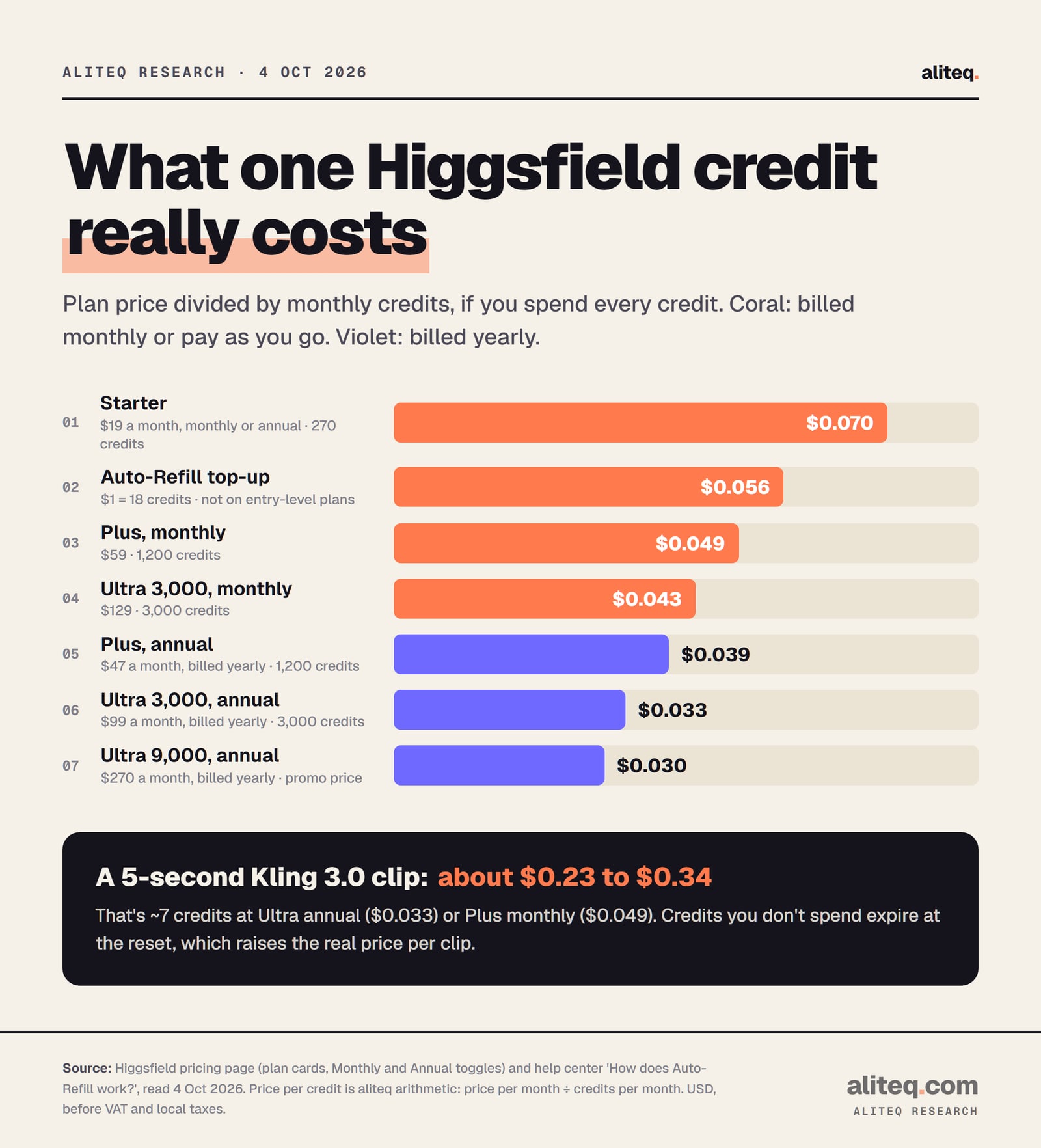
One credit costs about $0.030 to $0.070, depending on the plan and how you pay. Starter is the most expensive per credit at $19 for 270. Ultra billed yearly is the cheapest. These figures assume you spend every credit, because unspent plan credits expire at the reset.
Price per month divided by credits per month. Plan prices from Higgsfield's pricing page, read October 4, 2026. · aliteq research
Starter
Price
$19 a month (same on monthly or annual)
Credits a month
270
Cost per credit
$0.070
Credit Pack, 500 to 4,000 credits (3 Nov)
Price
$29.41 to $210.53, one-off
Credits a month
n/a
Cost per credit
$0.053 to $0.059
Auto-Refill top-up
Price
$1 = 18 credits
Credits a month
n/a
Cost per credit
$0.056
Plus, monthly
Price
$59 a month
Credits a month
1,200
Cost per credit
$0.049
Ultra 3,000, monthly
Price
$129 a month
Credits a month
3,000
Cost per credit
$0.043
Plus, annual
Price
$47 a month, billed yearly
Credits a month
1,200
Cost per credit
$0.039
Ultra 3,000, annual
Price
$99 a month, billed yearly
Credits a month
3,000
Cost per credit
$0.033
Ultra 9,000, annual
Price
$270 a month, billed yearly (promo)
Credits a month
9,000
Cost per credit
$0.030
Price
Credits a month
Cost per credit
Starter
$19 a month (same on monthly or annual)
270
$0.070
Credit Pack, 500 to 4,000 credits (3 Nov)
$29.41 to $210.53, one-off
n/a
$0.053 to $0.059
Auto-Refill top-up
$1 = 18 credits
n/a
$0.056
Plus, monthly
$59 a month
1,200
$0.049
Ultra 3,000, monthly
$129 a month
3,000
$0.043
Plus, annual
$47 a month, billed yearly
1,200
$0.039
Ultra 3,000, annual
$99 a month, billed yearly
3,000
$0.033
Ultra 9,000, annual
$270 a month, billed yearly (promo)
9,000
$0.030
The formula is cost per credit = monthly price ÷ monthly credits. Then cost per clip = credits per clip × cost per credit. Some worked examples:
A 5-second Kling 3.0 720p clip (7.5 credits, sound off): about $0.37 on Plus monthly, $0.25 on Ultra annual.
A 5-second Seedance 2.0 720p clip (22.5 credits at the 3 Nov discount, 30 listed): about $1.11 on Plus monthly, $0.74 on Ultra annual ($1.48 and $0.99 at the list price).
A Nano Banana Pro image (2 credits): about $0.10 on Plus monthly, $0.07 on Ultra annual.
Ultra also comes in 6,000 and 9,000 credit sizes. On 4 October the 6,000 size showed $194 a month billed yearly, and the 9,000 size $270. Both carried promo labels, and the monthly versions said "renews at $250" and "renews at $375". Treat those as moving targets.
Credit Pack prices aren't on the pricing page. Its help center lists the sizes (100, 200, 500, 1,000, 2,000 and 4,000 credits, or 5,000 to 25,000 in steps of 1,000) and says "current prices and any active discounts are shown at checkout." On November 3, 2026 Higgsfield's own pricing data, read through its official MCP connection, listed 500 credits at $29.41, 1,000 at $55.56, 2,000 at $105.26 and 4,000 at $210.53, shown as 31 to 38% off, each valid 90 days. That's about $0.059, $0.056, $0.053 and $0.053 a credit by our arithmetic. Pack discounts move, so check the price at checkout. The Higgsfield API is billed separately again, in dollars from its own balance; our API guide works out when it beats a plan.
Do Higgsfield credits expire or roll over?
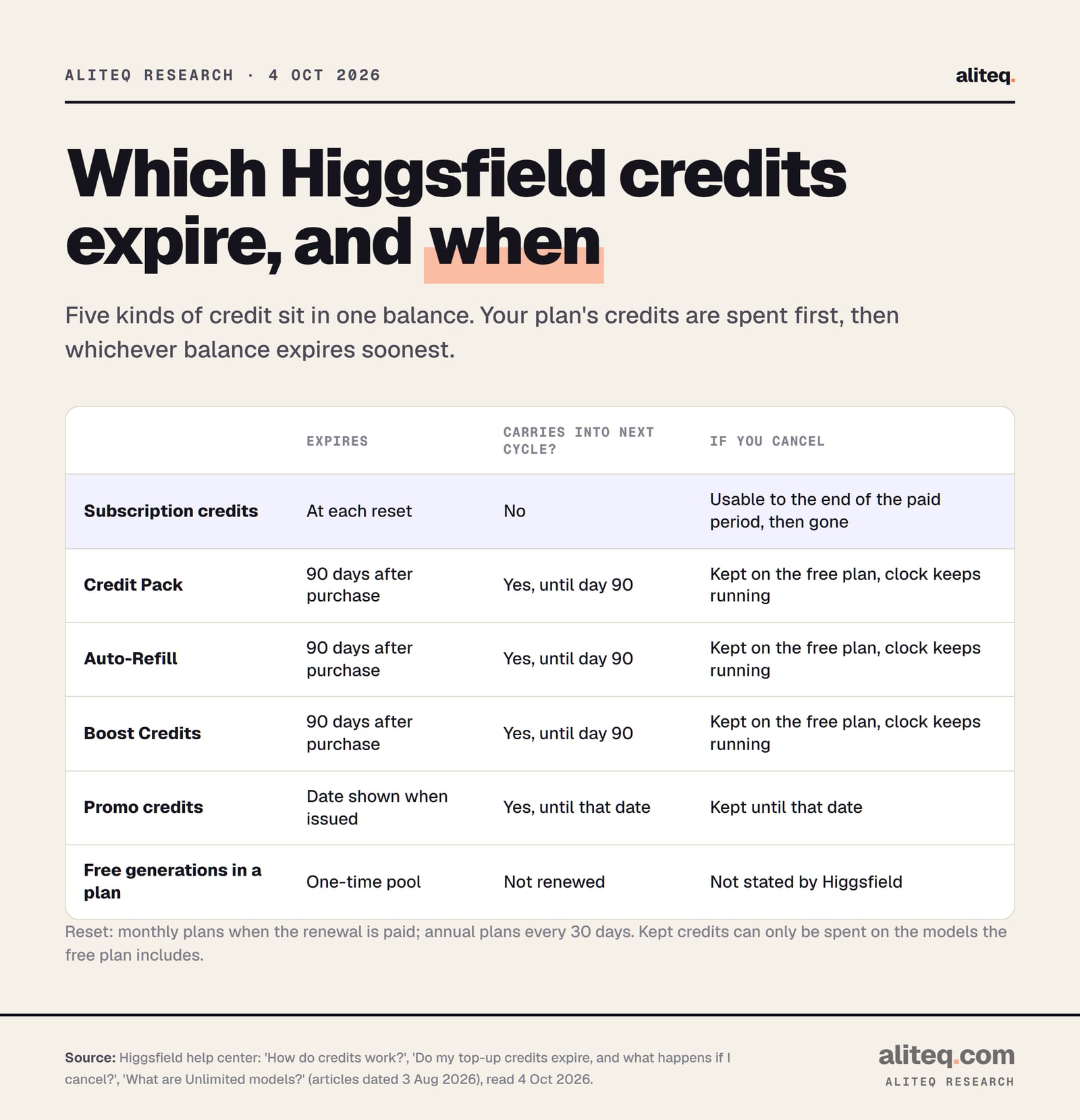
Yes, all of them expire, on different clocks. Your plan's subscription credits don't roll over and expire at each reset. Credit Pack, Auto-Refill and Boost credits last 90 days from purchase and do carry across billing cycles. Promo credits expire on the date shown when Higgsfield issued them.
Five credit types, one balance. From Higgsfield's help center, read October 4, 2026. · aliteq research
Higgsfield's pricing FAQ puts the main rule bluntly: "Subscription credits do not roll over and expire at the end of each credit cycle." The help center confirms individual plans never roll over. "Enterprise is the exception, with volume rollover credits."
The spending order works in your favor. "Subscription credits are always spent first." After that, Higgsfield spends whichever other balance expires soonest. So a Credit Pack bought mid-month waits until your plan credits run out, and its 90-day clock keeps running the whole time.
Free generations are their own thing. Some plans include a pool of free generations on specific models, for example Soul 2.0. The help center calls it "a one-time pool granted when you purchase the plan" and says it does not renew when your subscription renews.
When do Higgsfield credits reset?
Monthly plans reset when the monthly renewal is paid, on the same calendar date as your first purchase. Annual plans reset every 30 days, not on a calendar date, so the day drifts. Higgsfield's example: subscribe on May 11, and the next reset lands on June 10.
The help center lists the three usual reasons a reset seems late:
The date hasn't arrived. On annual plans the reset day shifts each cycle. Your date is under Manage Account, then Subscription.
The payment failed. The account goes "past due" and no new credits arrive until a payment succeeds. Higgsfield says you "typically have 14 days" to fix the card before the subscription may be canceled.
You canceled. Then credits don't renew at all.
Two moves change the clock. Upgrading takes effect immediately, resets your billing date to that moment, and counts your unused credits' value toward the new price. Switching from monthly to annual does the same. Going back from annual to monthly is "not available": the annual plan runs to the end of its paid year.
What does Higgsfield "Unlimited" actually cover?
Unlimited means generations on specific models don't use credits, for a set period, only on higgsfield.ai. It never covers every model. It doesn't work through MCP, the CLI, Canvas or Supercomputer. Unlimited jobs also run in the standard queue, while credit jobs get the priority queue.
The help center spells out the limits:
Model by model. "Unlimited access is model-specific." Each plan card's "Unlimited & Free Gens" section lists the models and the period for each.
Time-limited. (Update Oct 27, 2026: the plan cards no longer list any 365-day models; individual plans now show only 7-day windows, and business plans add a 30-day Seedance 2.5 Unlimited.) "Most included models come with 365-day Unlimited access, the newest flagship models may have shorter windows (for example, 7 days)." On 4 October the cards we read showed 7-day windows: Nano Banana 2 and Kling 3.0 on Plus, and Nano Banana Pro, Nano Banana 2 and Kling 3.0 on Ultra (annual view). Starter showed "No unlimited."
Website only. "Unlimited access applies only on higgsfield.ai." Anything generated outside it "always deducts credits, regardless of your Unlimited status."
Slower when busy. Speed and concurrency "may temporarily vary" at peak times. Switching to Credit Mode moves a job to the priority queue and spends credits.
Tied to your subscription. If the subscription ends, Unlimited "stops working, even if its period hasn't finished yet."
Human use only. "Automation tools, scripting, credential sharing, and reselling access are strictly prohibited." Unusual activity can pause Unlimited for a manual review.
You can also buy Unlimited for a single model in Higgsfield's Unlimited Models Marketplace. Video bundles run "1 generation at a time, up to 15 seconds." A Credit Pack never unlocks Unlimited. Higgsfield calls that "a separate purchase."
What happens to your credits if you cancel?
Canceling ends renewals, not your access right away. Subscription credits stay usable until the end of the paid period, then "expire permanently." Credit Pack, Auto-Refill, promo and Boost credits are kept, but you can only spend them on the free plan's smaller set of models, and their own clocks keep running.
Higgsfield's suggestion, if you're sitting on unspent pack credits, is to downgrade to the cheapest plan instead of canceling. That keeps the full model lineup open while you use them up. A downgrade takes effect at your next billing date.
One contradiction to know about. The same help article that says pack credits "stay available on the free plan" also answers "I canceled. Are my Credit Pack credits gone?" with "the credits are unavailable until you reactivate." Higgsfield's own pages disagree, so if those credits matter, ask support before you cancel. Our Higgsfield cancel and refund guide walks through the cancel and refund steps.
Where credits go faster than you expect
The usual surprise is a generation made outside the website. Higgsfield's MCP connector, its CLI, Canvas and Supercomputer always spend credits, even on models you have Unlimited for. So do its plugins for apps such as Premiere Pro and Photoshop, at web rates. Supercomputer also spends credits on text requests, and Higgsfield says the amount varies with the prompt and the language model you pick.
Read the Generate button before every run. It shows the exact credit cost, including the batch size.
Keep the batch at 1 while you test a prompt. A batch of 4 is charged as 4 generations.
Use Unlimited models on higgsfield.ai only. The same model through MCP, the CLI or Canvas spends credits.
Note your reset date under Manage Account, then Subscription. Annual plans reset every 30 days, so it drifts.
Spend pack and Auto-Refill credits within 90 days. Your plan credits are always used first.
Check Manage Account, then Usage, if your balance drops. Failed generations should show a refund line.
Auto-Refill is the other quiet drain. It's off by default. Once you switch it on, it charges your saved card $20, $40, $90, $150 or $300 each time your balance drops below your plan's threshold, at $1 for 18 credits. Higgsfield doesn't publish the threshold; it shows in the set-up window. It's "not available on entry-level plans."
What isn't on Higgsfield's pages
A few numbers people search for aren't published, so you won't find them here. Credit Pack prices aren't on the pricing page (we list the 3 November prices above). The Auto-Refill threshold appears only in your account. There's no per-second rate for longer clips, and no list of the free plan's models.
If a third-party page quotes those, it's guessing or quoting an old checkout screen. Higgsfield's pages are the only place a credit number is current. For how Higgsfield stacks up against other tools on output, our best AI video generators roundup is the wider view, and the AI Money hub collects the rest of this lane.
Wondering whether renting a GPU and running open models yourself would be cheaper than credits? We priced one 5-second clip three ways, in an app, through an API and on a rented RTX 4090, in AI video cost per clip: app, API or rented GPU.
Quick answers
How many credits does a Higgsfield video cost?
It depends on the model, resolution and length. On November 3, 2026 the Generate button showed 7.5 credits for a 5-second Kling 3.0 clip at 720p and 15 to 80 for a 5-second Seedance 2.5 clip (480p to 1080p). On 4 October Higgsfield's table showed about 40 for a 4-second Veo 3.1 clip and about 110 for Seedance 2.0 at 4K. The Generate button shows the exact cost.
Do Higgsfield credits roll over to the next month?
Subscription credits don't. They expire at each reset. Credit Pack, Auto-Refill and Boost credits do carry across billing cycles, but only until 90 days after you bought them. Enterprise plans are the one exception, with volume rollover credits.
When do Higgsfield credits reset?
On a monthly plan, when the monthly renewal is paid, on the same calendar date you first subscribed. On an annual plan, every 30 days from the start date, so the day drifts. Higgsfield's example is a May 11 start with the next reset on June 10.
Do Higgsfield credits expire if I cancel?
Subscription credits last until the end of the paid period, then expire. Credit Pack, Auto-Refill, promo and Boost credits stay usable on the free plan's models until their own expiry dates. One help-center answer contradicts this, so ask support before canceling if those credits matter.
What does Higgsfield Unlimited include?
Credit-free generations on specific models listed on your plan's card, for a set period such as 7 days (30 for Seedance 2.5 on business plans), only on higgsfield.ai. It doesn't cover MCP, the CLI, Canvas or Supercomputer, runs in the standard queue, and stops if your subscription ends.
What is a Higgsfield credit?
It's Higgsfield's spending unit for images and videos. Every generation costs a set number of credits based on the model, resolution and clip length, and the exact cost is shown on the Generate button before you confirm. Re-rolls and upscales cost credits too, and a batch of 4 is charged as 4 generations.
Do I get Higgsfield credits back if a generation fails?
Usually. Higgsfield says failed generations return credits automatically, but one help article adds that specific models might not refund credits for failed generations. Check Manage Account, then Usage, for the return line, and contact Support if it's missing.
How do I check my Higgsfield credit balance?
It's in the top navigation bar on higgsfield.ai. For a breakdown, click your avatar, open Manage Account, then Subscription: the Credits card shows your monthly balance and Auto-Refill credits separately. Manage Account, then Usage, logs every deduction.
How much is one Higgsfield credit in dollars?
About $0.030 to $0.070 by our arithmetic, if you spend every credit. Starter works out to $0.070 ($19 for 270), Plus monthly $0.049, Ultra monthly $0.043 and Ultra billed yearly $0.033. Auto-Refill is $1 for 18 credits, about $0.056. Credit Packs worked out to about $0.053 to $0.059 a credit on November 3, 2026, at a discount Higgsfield showed as 31 to 38% off.