The $50 single-server colo deals include a fraction of the power a GPU box needs. What hosting a 1, 2 or 4 GPU machine really costs a month, per kilowatt, from providers' own price pages, and when an office closet or a rented GPU beats it.
I spent five years building, repairing and selling PCs at Aliteq's shop in Kathmandu, from 2019 to 2024. Aliteq is now a US-based company and I build AI apps. I have never colocated a server myself, so everything below comes from providers' own price pages, read on 27 September 2026, plus our own GPU price tracker. What the shop years did teach me is how much heat and noise a multi-GPU box puts out, and that is usually why a company starts asking about colocation.
This piece picks up where cloud GPU vs your own AI server leaves off. That article decides whether to own at all. This one assumes you own the box, or are about to, and asks where it should live.
What colocating a 1–4 GPU box costs a month
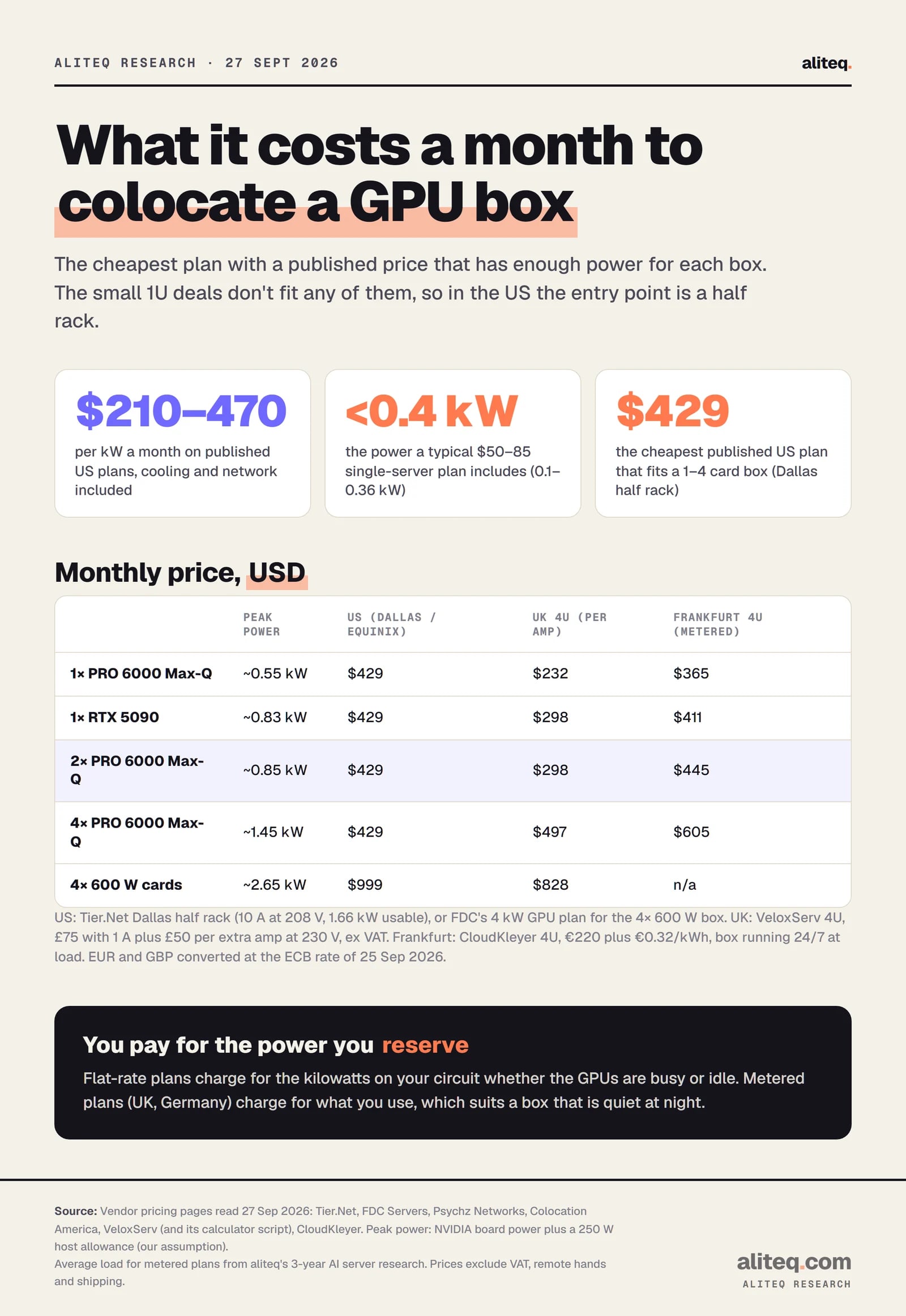
In the US, the cheapest plan with a published price and enough power for a one, two or four card box is a $429 Dallas half rack. A four-card box with 600 W GPUs needs more, and FDC Servers' $999 plan with 4 kW included fits it. In the UK, per-amp pricing puts a 4U box at about $232 to $828 a month.
Cheapest published plan with enough power for each box. Peak power is NVIDIA's board power plus a 250 W allowance for the rest of the machine, which is my assumption. · aliteq research
The US column is flat for a reason. Tier.Net's Dallas half rack costs $429 a month with 10 amps at 208 volts, 30 TB of traffic and no setup fee. That's 2.08 kW on paper and about 1.66 kW you can use continuously, which covers everything up to a four-card RTX PRO 6000 Max-Q box. Nothing cheaper with a printed price has enough power.
The UK and German columns work differently, and they suit a box that isn't busy all day:
Per amp (UK). VeloxServ's 4U plan is £75 a month with 1 amp included. Its own pricing calculator adds £50 a month for each extra amp. At the UK's 230 volts, which is my assumption since the page doesn't say, that's about $288 per kW a month.
Metered (UK, Germany). HA Hosting in Sheffield charges £52.50 a month with 84 kWh included, then £0.40 per kWh. CloudKleyer in Frankfurt charges €220 a month for 4U plus €0.32 per kWh. The Frankfurt figures in the chart assume the box runs at load 24/7; a box that idles at night pays less.
Two of Europe's best-known budget options are closed to new customers. Hetzner's page says "we are unable to provide data center space for colocation until further notice", and HOSTKEY's Amsterdam colocation says it is "temporarily unavailable for new customers".
Why the $50 colo deals don't work for a GPU server
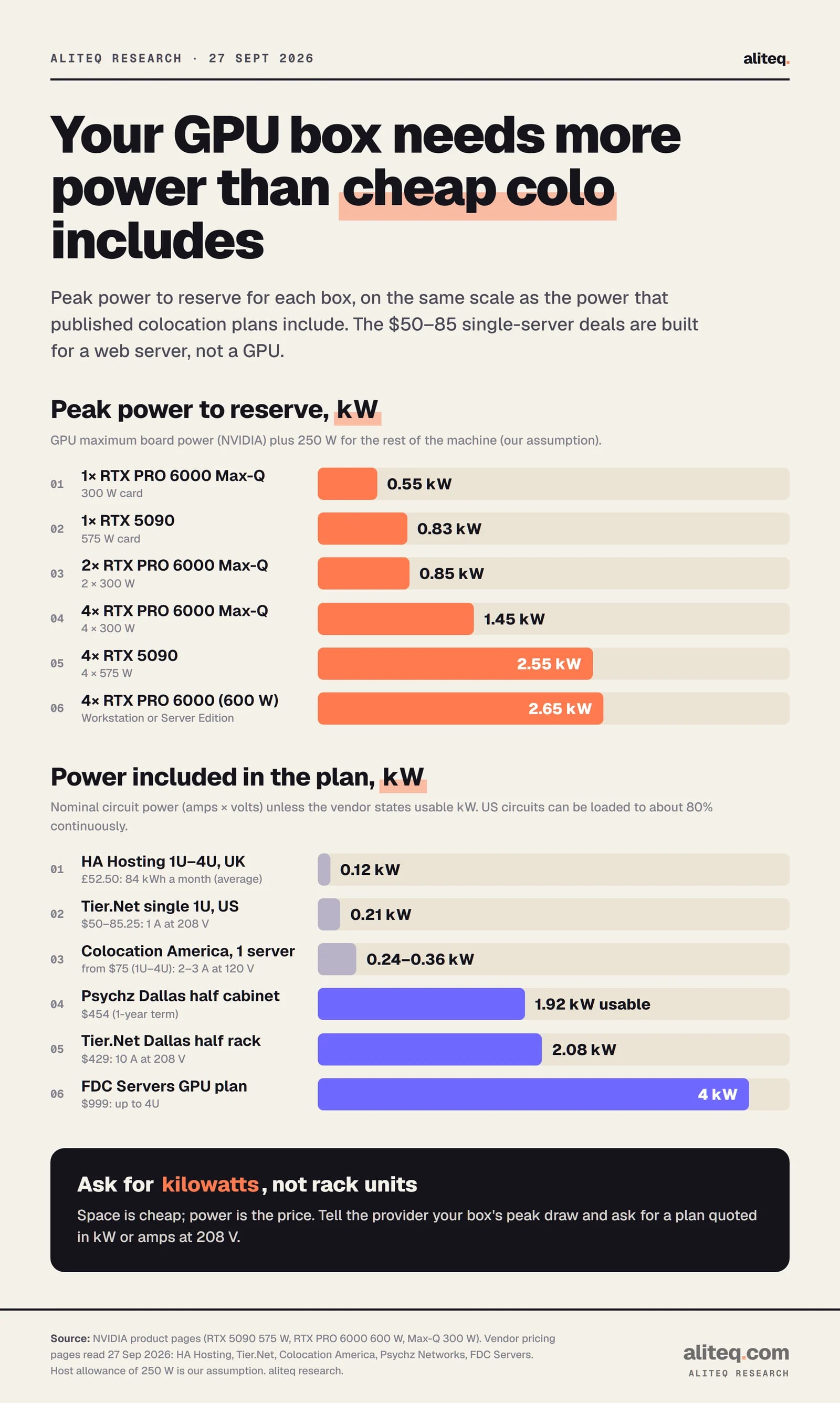
Single-server deals include 0.1 to 0.4 kW, and a GPU box needs 0.55 kW or more at peak. Tier.Net's $50 to $85.25 1U plans come with 1 amp at 208 volts, about 0.21 kW. Colocation America's single-server plan starts at $75 with 2 to 3 amps at 120 volts. HA Hosting's 84 kWh a month averages about 0.12 kW.
Peak power to reserve, on the same scale as the power each plan includes. · aliteq research
Here is how I sized each box. NVIDIA lists the RTX 5090 at 575 W total graphics power and 1,000 W required system power, the RTX PRO 6000 Workstation Edition at 600 W and the Max-Q at 300 W. I add 250 W for the CPU, board, memory, fans and power-supply losses:
1× RTX PRO 6000 Max-Q
GPU power
300 W
Peak to reserve
~0.55 kW
Fits
half rack or 4U with extra amps
1× RTX 5090
GPU power
575 W
Peak to reserve
~0.83 kW
Fits
half rack or 4U with extra amps
2× RTX PRO 6000 Max-Q
GPU power
600 W
Peak to reserve
~0.85 kW
Fits
half rack or 4U with extra amps
4× RTX PRO 6000 Max-Q
GPU power
1,200 W
Peak to reserve
~1.45 kW
Fits
half rack (1.66 kW usable)
4× RTX 5090
GPU power
2,300 W
Peak to reserve
~2.55 kW
Fits
FDC's 4 kW plan or a full cabinet
4× RTX PRO 6000 (600 W)
GPU power
2,400 W
Peak to reserve
~2.65 kW
Fits
FDC's 4 kW plan or a full cabinet
GPU power
Peak to reserve
Fits
1× RTX PRO 6000 Max-Q
300 W
~0.55 kW
half rack or 4U with extra amps
1× RTX 5090
575 W
~0.83 kW
half rack or 4U with extra amps
2× RTX PRO 6000 Max-Q
600 W
~0.85 kW
half rack or 4U with extra amps
4× RTX PRO 6000 Max-Q
1,200 W
~1.45 kW
half rack (1.66 kW usable)
4× RTX 5090
2,300 W
~2.55 kW
FDC's 4 kW plan or a full cabinet
4× RTX PRO 6000 (600 W)
2,400 W
~2.65 kW
FDC's 4 kW plan or a full cabinet
Some plans look close but don't say enough. WebNX sells a 4U slot for $129 a month on a "208V / 20A shared (metered)" circuit without saying how much of it is yours. Sharktech's 1U to 6U plans list 200 to 1,200 W "starting at" $65 to $99 a month by city, but the starting price doesn't say which wattage it buys. Ask both for a written power allowance before you count on them.
Run your chosen model through the cost to run pages first. A model that fits on one card saves you a lot of kilowatts.
What a kilowatt costs in colocation
On published US plans, a kilowatt of colocation power costs about $210 to $470 a month, with cooling, backup power and a network port included. Wholesale buyers pay less: CBRE put Northern Virginia at $190 to $235 per kW a month in early 2026, but that's for 250 to 500 kW deals.
Tier.Net Dallas half rack
Price
$429
Power
10 A at 208 V (2.08 kW)
Per kW a month
$206 nominal, $258 usable
Psychz Dallas full cabinet (1-year term)
Price
$1,058 + $500 setup
Power
4.99 kW
Per kW a month
$212
Psychz Dallas half cabinet (1-year term)
Price
$454
Power
1.92 kW usable
Per kW a month
$236
FDC Servers GPU plan, up to 4U
Price
$999
Power
4 kW
Per kW a month
$250
VeloxServ extra amp, UK
Price
£50 = $66
Power
~0.23 kW (at 230 V)
Per kW a month
~$288
Psychz Ashburn full cabinet
Price
$907 to $2,332 + $2,250 setup
Power
1.92 to 4.99 kW
Per kW a month
$467 to $472
Price
Power
Per kW a month
Tier.Net Dallas half rack
$429
10 A at 208 V (2.08 kW)
$206 nominal, $258 usable
Psychz Dallas full cabinet (1-year term)
$1,058 + $500 setup
4.99 kW
$212
Psychz Dallas half cabinet (1-year term)
$454
1.92 kW usable
$236
FDC Servers GPU plan, up to 4U
$999
4 kW
$250
VeloxServ extra amp, UK
£50 = $66
~0.23 kW (at 230 V)
~$288
Psychz Ashburn full cabinet
$907 to $2,332 + $2,250 setup
1.92 to 4.99 kW
$467 to $472
If you used the whole allowance around the clock, that's about $0.28 to $0.65 per kWh. The US commercial average is 13.85 cents per kWh, according to the EIA. So colo power costs two to five times what your office pays for the same electricity. You're paying for the cooling, the generator, the security and the network that come with it.
Why amps and usable kW differ. US data centers sell circuits in amps and volts, but you can only load a circuit to about 80% continuously. Psychz prints this on its page: a 20 A, 120 V circuit is "1.92kW Usable", and a 30 A, 208 V circuit is "5kW Usable". Always compare plans on usable kW.
Other published per-kWh prices for reference: HA Hosting £0.40 ($0.53) and CloudKleyer €0.32 ($0.36), against UK business electricity of about 46 cents and German of about 37 cents per kWh (government statistics, converted at the ECB rate of 25 Sep 2026).
Setup fees, remote hands, cross-connects and bandwidth
For one small box, the extras are mostly modest, but read them before you sign. Most plans above have no setup fee. Remote hands is where the surprise bills come from.
Setup. Free at FDC, Colocation America and on Tier.Net's shared plans. Tier.Net's private racks charge $199 to $350; CloudKleyer charges €50 ($57); Psychz charges nothing on its Dallas half cabinet and $2,250 on an Ashburn full cabinet.
Remote hands. Someone in the building reboots, re-cables or swaps a drive for you. HA Hosting includes "a daily 15-minute allowance". Colocation America includes free basic remote hands and reboots, and WebNX lists "Included support". FDC gives an hourly rate once you pick a location. No US provider in this set publishes that hourly rate. One colo operator, 515 Engine, says it has seen $100 to $200 an hour, billed in 15 or 30 minute increments.
Cross-connects. A cable to another network in the same building. A single AI server that just needs the internet doesn't need one. If you do, 515 Engine has seen anything from $50 once to $350 a month. NOCIX in Kansas City includes a free fiber cross-connect to the local internet exchange.
Bandwidth. Usually included: 30 TB on Tier.Net's half rack, unmetered 10 Gbps at FDC, 25 TB at HA Hosting (then £0.01 per GB), 10 TB on VeloxServ's 4U (then £5 per TB). An internal AI tool uses very little.
Contract length. FDC and HA Hosting are monthly. Psychz's Dallas prices need a one-year agreement.
Form factor. A tower workstation needs a plan that takes towers, as HA Hosting's does, or a rackmount chassis. FDC's GPU plan is "Up to 4U".
Colo vs office closet vs renting over three years
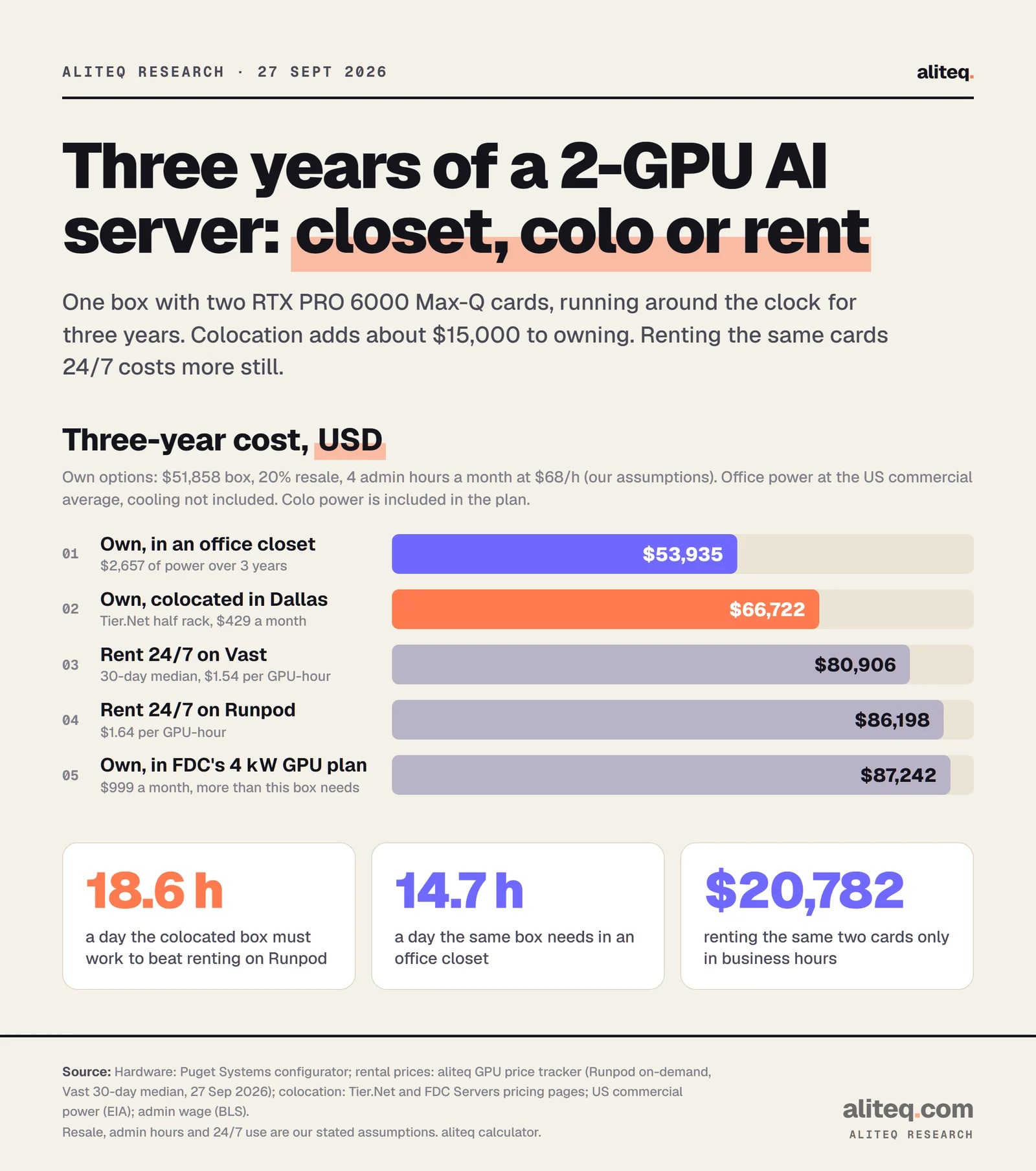
For a two-GPU RTX PRO 6000 box running around the clock, an office closet costs about $53,900 over three years, a colocated half rack about $66,700, and renting the same two cards 24/7 about $80,900 to $86,200. Colocation adds about $15,400 to owning. It buys you cooling, clean power and a fast network, not a lower bill.
Same box, same three years, four places to run it. Box price, admin time and resale match the calculator below. · aliteq research
The same sum for three boxes, all running 24/7, with a 20% resale value, four admin hours a month at $68 an hour, and US commercial power for the office:
DIY 1× RTX 5090 ($7,300)
Office closet
$17,816
Colocated (cheapest US fit)
$31,076
Rent 24/7 (Vast median / Runpod)
$14,112 / $18,133
2× RTX PRO 6000 Max-Q ($51,858)
Office closet
$53,935
Colocated (cheapest US fit)
$66,722
Rent 24/7 (Vast median / Runpod)
$80,906 / $86,198
4× RTX PRO 6000 Max-Q (~$84,600)
Office closet
$82,313
Colocated (cheapest US fit)
$92,916
Rent 24/7 (Vast median / Runpod)
$161,811 / $172,397
Office closet
Colocated (cheapest US fit)
Rent 24/7 (Vast median / Runpod)
DIY 1× RTX 5090 ($7,300)
$17,816
$31,076
$14,112 / $18,133
2× RTX PRO 6000 Max-Q ($51,858)
$53,935
$66,722
$80,906 / $86,198
4× RTX PRO 6000 Max-Q (~$84,600)
$82,313
$92,916
$161,811 / $172,397
Rental prices are from aliteq's own GPU price tracker, 27 September 2026. The resale value, admin time and 24/7 use are my assumptions. The closet column doesn't include any electrician or air-conditioning work, which I couldn't price because it's quote-only.
Three things stand out:
Colo raises the bar for owning. Against renting on Runpod, the two-GPU box has to work 14.7 hours a day in a closet but 18.6 hours a day in colocation. The four-GPU box goes from 11.1 to 12.9 hours a day.
A single RTX 5090 shouldn't be colocated. $31,076 over three years is more than renting the same card around the clock on Vast or Runpod. It never breaks even.
Bigger boxes spread the rack cost. A $429 half rack is half of a single RTX 5090 box's three-year bill in colocation, but 17% of a four-GPU box's.
Change the box, the power price, the hours and the admin time here. The calculator covers owning in an office; to add colocation, add $15,444 for a $429 plan over 36 months and drop the power line:
$1.64/h × 2 GPU for the same hours · Vast median: $19,506
Break-even
14.7 h/day
Hours a day, every day for 3 years, before owning beats renting the same card.
For comparison: 25 staff using an internal document chat through an API costs about $356 (hosted open model) to $5,148 (Claude Sonnet 5 / gpt-6-sol) over the same three years, on our stated token assumptions.
Hardware: Bizon, Puget, NVIDIA and GMKtec pages; rental: aliteq GPU tracker (Runpod on-demand, Vast 30-day median); power: EIA, Eurostat (excl. VAT and recoverable taxes), DESNZ; admin wage: BLS. All checked 27 Sep 2026. Admin time, resale, usage and the 4-GPU price scaling are our assumptions. Power excludes cooling; colocation not included. An estimate, not a quote.
When colocation is the right call
Colocate when the box is busy most of the day and the office can't host it. That usually means one of three things: it's too loud or hot for the room, the office circuit can't carry it, or people outside the office depend on it being up.
Heat. Every kilowatt a server draws becomes about 3,412 BTU an hour of heat, according to the EIA. A two-GPU box at 730 W puts out about 2,500 BTU an hour. A four-card box with 600 W GPUs at full load puts out about 2.6 kW of heat, around the clock, in whatever room it's in.
Power. One ordinary 15 A, 120 V office circuit can carry about 1.44 kW continuously, if nothing else is on it. That covers a one or two GPU box; a four-card Max-Q box at 1.45 kW is right at the limit, so give it a 20 A circuit. A four-card box with 600 W GPUs needs about 2.65 kW, which means a 208 or 240 V circuit or two circuits, so an electrician first.
Uptime and bandwidth. A data center gives you backup generators, redundant cooling and a fast connection. That matters if customers or remote staff use the model, and much less if it's an internal tool used in office hours.
If none of those apply, keep the box in the office. If the box wouldn't be busy most of the day, the three-year cost comparison usually points to renting or an API instead.
How to buy colocation for one GPU server
Ask for power first and space second. The rack units are cheap; the kilowatts are the price.
Know your peak draw. Add up the GPUs' board power and about 250 W for the rest, or read the power supply label. Ask for a plan with at least that much usable kW.
Ask for per-kW pricing. Psychz's page says it plainly: "If you are deploying one GPU server, ask about power-based (per-kW) options". Don't buy a full cabinet you won't fill.
Get the power terms in writing. Volts, amps, whether the figure is usable or nominal, and what happens if you go over.
Price remote hands before you need them. Ask for the hourly rate and the billing increment.
Check the contract length and setup fee. Monthly terms matter for a first box.
Plan the shipping. A GPU tower in a courier box needs proper packing, and some plans only take rackmount servers.
Quick answers
How much does it cost to colocate a GPU server?
About $430 to $1,000 a month in the US for a one to four GPU box, on plans with published prices. The cheapest that fits most boxes is a $429 Dallas half rack with 2.08 kW; a four-card box with 600 W GPUs needs a plan like FDC's $999 with 4 kW included.
How much power does a 4-GPU AI server need?
About 1.45 kW at peak with four 300 W RTX PRO 6000 Max-Q cards, and about 2.55 to 2.65 kW with four RTX 5090s or 600 W RTX PRO 6000s. That's GPU board power plus about 250 W for the rest of the machine.
What does colocation cost per kW?
About $210 to $470 per kW a month on published US plans, including cooling and a network port. Wholesale deals of 250 kW and up were $190 to $235 per kW in Northern Virginia in early 2026, according to CBRE.
Can I colocate a GPU server on a cheap 1U plan?
No. Single-server plans at $50 to $85 a month include about 0.1 to 0.4 kW, and even a one-GPU box needs about 0.55 to 0.85 kW at peak. You need a plan sold by the amp or the kilowatt.
Is colocation cheaper than keeping an AI server in the office?
No, it costs more. A two-GPU RTX PRO 6000 box running 24/7 costs about $53,900 over three years in an office closet and about $66,700 colocated. You pay for cooling, backup power and bandwidth, which matter when the office can't host the box.
Is colocating cheaper than renting a cloud GPU?
Only for a box that's busy most of the day. A colocated two-GPU box must work about 18.6 hours a day to beat renting the same cards on Runpod. A single colocated RTX 5090 costs more than renting one around the clock.