Late 2026 flipped the usual math: two RTX 5090s now cost more than one 96GB RTX PRO 6000 and give you less memory. Buying still only beats renting if you'd keep the card busy for years. The prices, the break-even hours and which models need 96GB, checked Nov 6, 2026.
Some links on this page are referral links: we may earn a commission, at no cost to you.
Share
Is the RTX PRO 6000 worth it for local AI? Yes, if you need more than 64GB of VRAM on one card and will run it most days for two years or more. Otherwise, rent it. The usual alternative changed in late 2026. Nvidia listed the 96GB card at $16,000 in August (Tom's Hardware, Aug 12, 2026), and CDW advertised it at $17,135.99 on Nov 6, 2026. In October TechSpot found the cheapest in-stock US RTX 5090 at $9,400, so two of them cost about $18,800 for 64GB. Renting the same 96GB card cost $2.49 an hour on Runpod on Nov 6, 2026. At that rate the $16,000 list price buys about 6,400 rented hours.
The 96GB decision in four numbers (Nov 6, 2026)
$16000
RTX PRO 6000, list
NVIDIA US list price, Tom's Hardware Aug 12, 2026
$18800
Two RTX 5090s
TechSpot, cheapest in-stock US RTX 5090 x2, Oct 2026
$2.49
Rent the 96GB card, per hour
Runpod pricing page, Nov 6, 2026
6426
Rented hours the list price buys
$16,000 divided by $2.49 an hour
How much does the RTX PRO 6000 cost right now?
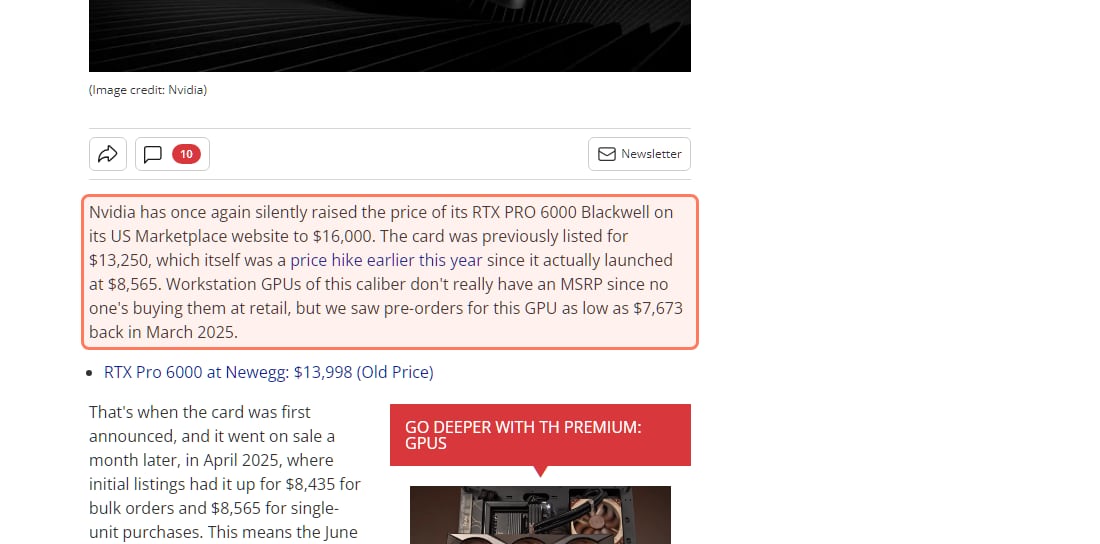
$16,000 at NVIDIA's list price, and more at most resellers. Tom's Hardware reported on Aug 12, 2026 that "Nvidia has once again silently raised the price of its RTX PRO 6000 Blackwell on its US Marketplace website to $16,000", after a previous listing at $13,250 and a launch price of $8,565. NVIDIA's own product page doesn't show a price; it sends buyers to the NVIDIA Marketplace or a partner.
Tom's Hardware, Aug 12, 2026, read Nov 6, 2026. The price-history paragraph is outlined. · Screenshot of tomshardware.com by aliteq
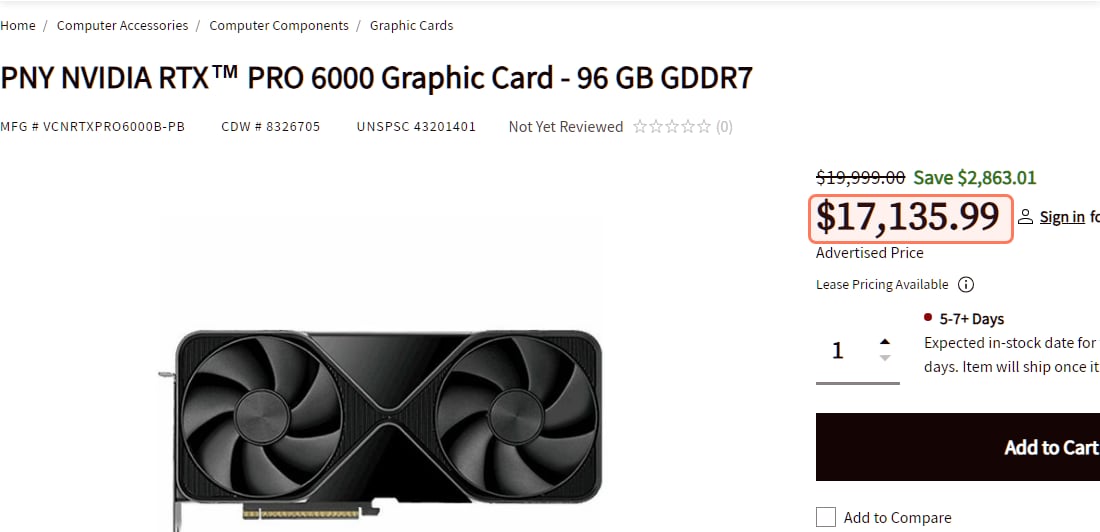
On Nov 6, 2026 CDW listed the PNY-built card at $19,999.00 crossed out, with an advertised price of $17,135.99. The listing showed an expected in-stock date of "5-7+ Days", so it wasn't on the shelf that day.
CDW's RTX PRO 6000 listing, read Nov 6, 2026. The advertised price is outlined. · Screenshot of cdw.com by aliteq
Workstation cards sell through business resellers, so prices vary a lot from one seller to the next. Get a quote from two or three of them before you buy. Price rises like this have hit every GPU with a lot of memory in 2026 (see our GPU price surge tracker).
RTX PRO 6000 or two RTX 5090s?
In November 2026 the single RTX PRO 6000 wins on price, memory and simplicity. That's the reverse of 2025, when two 5090s were the cheap way to get lots of VRAM. TechSpot's October 2026 data put the cheapest in-stock US RTX 5090 at $9,400 against a $1,999 launch price. TechSpot writes that "the United States is getting stung especially badly here, with 370% price inflation and a minimum cost of $9,400."
Price
RTX PRO 6000
$16,000 list; $17,135.99 at CDW
Two RTX 5090s
About $18,800 (2 x $9,400)
VRAM
RTX PRO 6000
96GB on one card
Two RTX 5090s
64GB, split 32GB + 32GB
Price per GB of VRAM
RTX PRO 6000
About $167 (list)
Two RTX 5090s
About $294
Memory bandwidth
RTX PRO 6000
1,792 GB/s
Two RTX 5090s
1,792 GB/s per card
Power
RTX PRO 6000
600W
Two RTX 5090s
575W per card, 1,150W total
Links the cards together
RTX PRO 6000
Not needed
Two RTX 5090s
No NVLink; tensor-parallel software over PCIe
RTX PRO 6000
Two RTX 5090s
Price
$16,000 list; $17,135.99 at CDW
About $18,800 (2 x $9,400)
VRAM
96GB on one card
64GB, split 32GB + 32GB
Price per GB of VRAM
About $167 (list)
About $294
Memory bandwidth
1,792 GB/s
1,792 GB/s per card
Power
600W
575W per card, 1,150W total
Links the cards together
Not needed
No NVLink; tensor-parallel software over PCIe
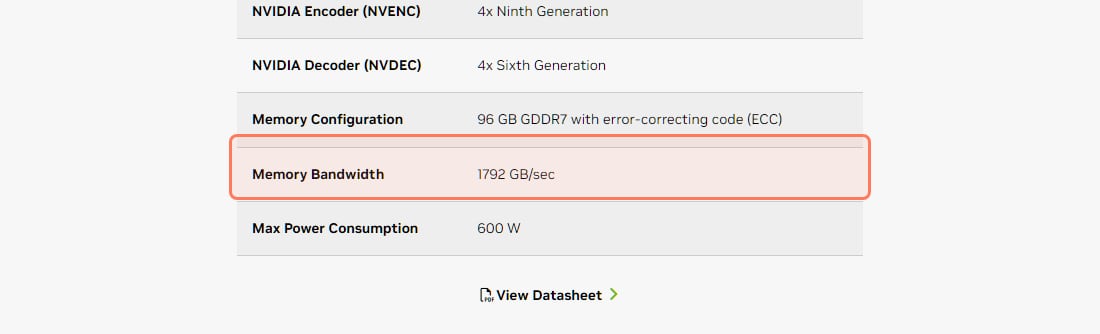
Specs from NVIDIA's RTX PRO 6000 page, RTX 5090 page and GeForce comparison page, read Nov 6, 2026. Prices as dated above.
NVIDIA's RTX PRO 6000 spec table, read Nov 6, 2026. Memory bandwidth is outlined. · Screenshot of nvidia.com by aliteq
What the table means in practice:
Same bandwidth per card. NVIDIA lists 1,792 GB/s for both cards. On a model that fits on one card, a single 5090 and the PRO 6000 generate text at about the same speed. The PRO 6000 is a 5090-class chip with three times the memory.
Two cards can be faster, if the model fits in 64GB. With tensor parallelism (vLLM, for example) each card reads half the weights, so a pair can beat one card on speed. You pay for that with a more complex setup. NVIDIA's RTX 5090 spec page lists NVLink as "No", so the cards talk over PCIe. Our multi-GPU guide covers what that involves.
Power and the rest of the build. Two 575W cards need a much bigger power supply, a board with two full-speed slots and a case that can get rid of the heat. NVIDIA recommends a 1,000W system power supply for a single RTX 5090.
When two 5090s still make sense: you already own one, you find them close to their $1,999 launch price, or your models fit in 64GB and you want the extra speed from splitting them. If you're weighing a single 5090 on its own, read is the RTX 5090 worth it for local AI.
Which models actually need 96GB?
Models whose weights come to between about 60GB and 90GB. Those load on one RTX PRO 6000 but not on 64GB spread over two 5090s. These are estimates from the formula behind our VRAM calculator, at 8K context with a 16-bit KV cache:
Llama 3.3 70B, Q4_K_M
Estimated VRAM
About 46GB
One RTX PRO 6000 (96GB)
Fits
Two RTX 5090s (64GB)
Fits
Llama 3.3 70B, Q8_0
Estimated VRAM
About 79GB
One RTX PRO 6000 (96GB)
Fits
Two RTX 5090s (64GB)
Doesn't fit
gpt-oss-120b, 4-bit
Estimated VRAM
About 72GB
One RTX PRO 6000 (96GB)
Fits
Two RTX 5090s (64GB)
Doesn't fit
GLM-4.5-Air, Q4_K_M
Estimated VRAM
About 67GB
One RTX PRO 6000 (96GB)
Fits
Two RTX 5090s (64GB)
Doesn't fit
Qwen3 235B-A22B, Q4_K_M
Estimated VRAM
About 145GB
One RTX PRO 6000 (96GB)
Doesn't fit
Two RTX 5090s (64GB)
Doesn't fit
Estimated VRAM
One RTX PRO 6000 (96GB)
Two RTX 5090s (64GB)
Llama 3.3 70B, Q4_K_M
About 46GB
Fits
Fits
Llama 3.3 70B, Q8_0
About 79GB
Fits
Doesn't fit
gpt-oss-120b, 4-bit
About 72GB
Fits
Doesn't fit
GLM-4.5-Air, Q4_K_M
About 67GB
Fits
Doesn't fit
Qwen3 235B-A22B, Q4_K_M
About 145GB
Doesn't fit
Doesn't fit
Estimates from our VRAM engine (weights + KV cache + about 0.8GB overhead), Nov 6, 2026. Longer context needs more. Two cards also lose some memory to per-card overhead.
Is it cheaper to rent an RTX PRO 6000 than to buy one?
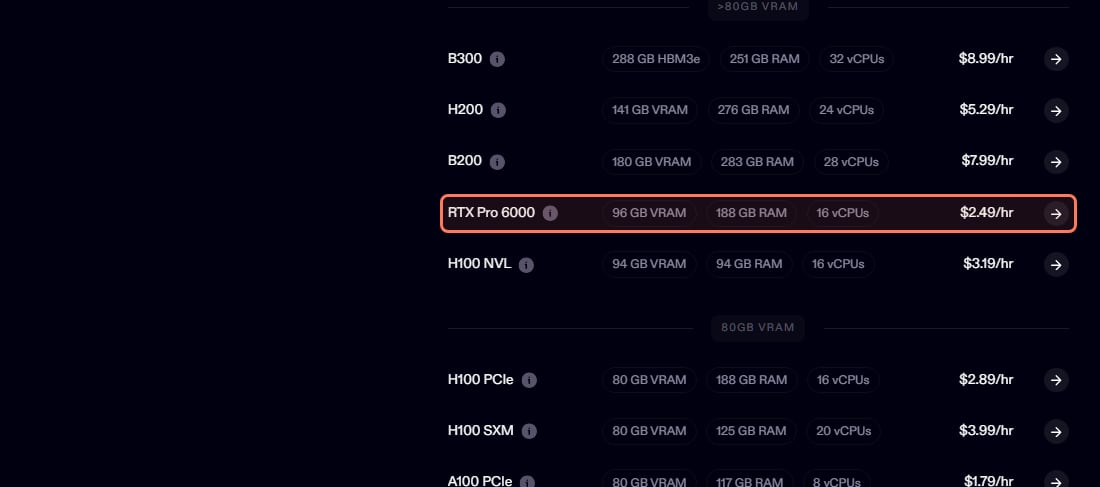
For most people, yes. On Nov 6, 2026, Runpod's pricing page listed the RTX Pro 6000 (96GB VRAM, 188GB RAM, 16 vCPUs) at $2.49 an hour. That is its Secure Cloud rate; the same page lists a Community Cloud rate of $1.69 an hour. Our tracker's 21:20 UTC reading had the cheapest on-demand Vast.ai offer for the Workstation Edition at $1.47 an hour, and the lower-power Max-Q version from $1.07 an hour.
Runpod's GPU pricing page, read Nov 6, 2026. The RTX Pro 6000 row is outlined. · Screenshot of runpod.io by aliteq
How many rented hours the purchase price buys (card only, at the $16,000 list price):
Runpod Secure Cloud, $2.49/hr
Hours to match $16,000
About 6,400
At 8 hours a day
About 2.2 years
Running 24/7
About 9 months
Runpod Community Cloud, $1.69/hr
Hours to match $16,000
About 9,500
At 8 hours a day
About 3.2 years
Running 24/7
About 13 months
Vast.ai cheapest on-demand, $1.47/hr
Hours to match $16,000
About 10,900
At 8 hours a day
About 3.7 years
Running 24/7
About 15 months
Hours to match $16,000
At 8 hours a day
Running 24/7
Runpod Secure Cloud, $2.49/hr
About 6,400
About 2.2 years
About 9 months
Runpod Community Cloud, $1.69/hr
About 9,500
About 3.2 years
About 13 months
Vast.ai cheapest on-demand, $1.47/hr
About 10,900
About 3.7 years
About 15 months
This math leaves out several things, and they mostly favour renting:
The rest of the PC. A 600W workstation card needs a capable host PC, and that costs extra on top of the card.
Electricity. You pay for the power and cooling. A rental price already includes them.
Resale value. You get some money back when you sell. With 2026's memory prices that could be a lot, but it isn't guaranteed.
Idle time. You only pay for rented hours you use. A card you own costs the same whether it's busy or not.
It has more memory per dollar but is much slower. NVIDIA's spec page lists the DGX Spark with 64GB or 128GB of unified LPDDR5x memory at 273 GB/s, about a sixth of the RTX PRO 6000's 1,792 GB/s. The price has risen too. NVIDIA raised the Founders Edition from $3,999 to $4,699 in February 2026. HotHardware reported on Oct 2, 2026 that the new 64GB model costs $4,999 and the 128GB model "has increased significantly to $6,995."
Generating text is mostly limited by memory bandwidth. Our engine's rough upper-bound estimate for Llama 3.3 70B at Q4_K_M is about 31 tokens a second at 1,792 GB/s and about 5 at 273 GB/s. These are estimates, not benchmarks. The Spark makes sense if you need a large model to load at all and can accept slow replies. It doesn't if you want quick answers. More detail in is the DGX Spark worth it.
Who should buy the RTX PRO 6000?
7/ 10
Verdict
Worth it for a specific buyer
Buy it if you need more than 64GB on one card, use it most days for two years or more, and want your data and models on your own machine. In November 2026 it costs less than two RTX 5090s and avoids a multi-GPU setup. Rent it if your use comes in bursts, if you're still deciding which model to run, or if a 32GB card covers your models.
Best for: ML engineers, small AI teams and studios running 70B to 120B models every day. Not hobbyists who use local AI a few hours a week.
Buy, pair or rent: a quick check
Do your models need more than 32GB?
If not, one 32GB card or a rented one is enough
Do they need more than 64GB?
70B at 8-bit, gpt-oss-120b and GLM-4.5-Air at 4-bit do
Will you use it 6,400+ hours?
That's the break-even at Runpod's $2.49 an hour
Yes to both, buy the PRO 6000
Get quotes from two or three resellers
Otherwise, rent
Pay by the hour and stop when you're done
Based on prices and specs read Nov 6, 2026. Check today's rental prices on /cloud-gpu.
Is the RTX PRO 6000 worth it for local AI?
If you need more than 64GB of VRAM on one card and will use it most days for two years or more, yes. Otherwise renting is cheaper. NVIDIA listed it at $16,000 in August 2026, and at Runpod's $2.49 an hour (Nov 6, 2026) that price buys about 6,400 rented hours.
How much does the RTX PRO 6000 cost in November 2026?
NVIDIA's US Marketplace listed it at $16,000 (Tom's Hardware, Aug 12, 2026), up from a $8,565 launch price. CDW advertised the PNY card at $17,135.99 on Nov 6, 2026, with a $19,999 list price.
Is one RTX PRO 6000 better than two RTX 5090s?
In November 2026, usually yes. Two 5090s cost about $18,800 at TechSpot's cheapest in-stock US price for October and give you 64GB split over two cards, with no NVLink. The PRO 6000 has 96GB on one card at the same 1,792 GB/s bandwidth and draws 600W against 1,150W for the pair.
How much does it cost to rent an RTX PRO 6000?
On Nov 6, 2026, Runpod charged $2.49 an hour on Secure Cloud ($1.69 on Community Cloud) and the cheapest on-demand Vast.ai offer we tracked was $1.47 an hour. The Max-Q version started at $1.07 on Vast.ai. Prices change hourly; see /cloud-gpu for today's.
What can you run on 96GB of VRAM?
Llama 3.3 70B at 8-bit (about 79GB), gpt-oss-120b at its native 4-bit (OpenAI says it fits on an 80GB GPU) and GLM-4.5-Air at Q4_K_M (about 67GB) all fit on one card. Qwen3 235B at 4-bit needs about 145GB and doesn't fit.
Is the RTX PRO 6000 faster than an RTX 5090?
Not on models that fit in 32GB. NVIDIA lists the same 1,792 GB/s memory bandwidth for both, and that sets the speed of text generation. The PRO 6000's advantage is capacity: it runs models that don't fit on a 5090 at all.
Prices in this guide were read on Nov 6, 2026, unless another date is given. Workstation card prices have risen several times in 2026, so check a current reseller quote and today's rental prices before you decide.