Amazon's own rule splits AI-generated from AI-assisted, and only one needs a yes on the form. Here is the exact wording, the weekly title cap, and what the US Copyright Office says you actually own.
People keep asking me the same thing about AI coloring books. Do I have to tell Amazon? Will it get my book pulled? Can somebody just copy my pages?
Good news: KDP answers the first question in plain words on its own help page. The US Copyright Office answers the last one, also in writing. So I read both on 4 October 2026, along with KDP's limits and coloring-book rules, and quoted them below. If you want the step-by-step build first, start with our AI coloring book workflow for KDP. This page is the rulebook that sits next to it.
Do you have to tell Amazon you used AI?
Yes, if the AI made the content. KDP's Content Guidelines say: "We require you to inform us of AI-generated content (text, images, or translations) when you publish a new book or make edits to and republish an existing book through KDP." For a coloring book, that covers your pages and your cover.
The next sentence settles the coloring-book question directly: "AI-generated images include cover and interior images and artwork."
So the line-art pages count. The cover counts. It also applies again when you republish. If you go back and swap in new AI pages, the rule covers that edit too.
What KDP does not ask about is AI that only helped. The page says it plainly: "You are not required to disclose AI-assisted content."
AI-generated or AI-assisted: where your book lands
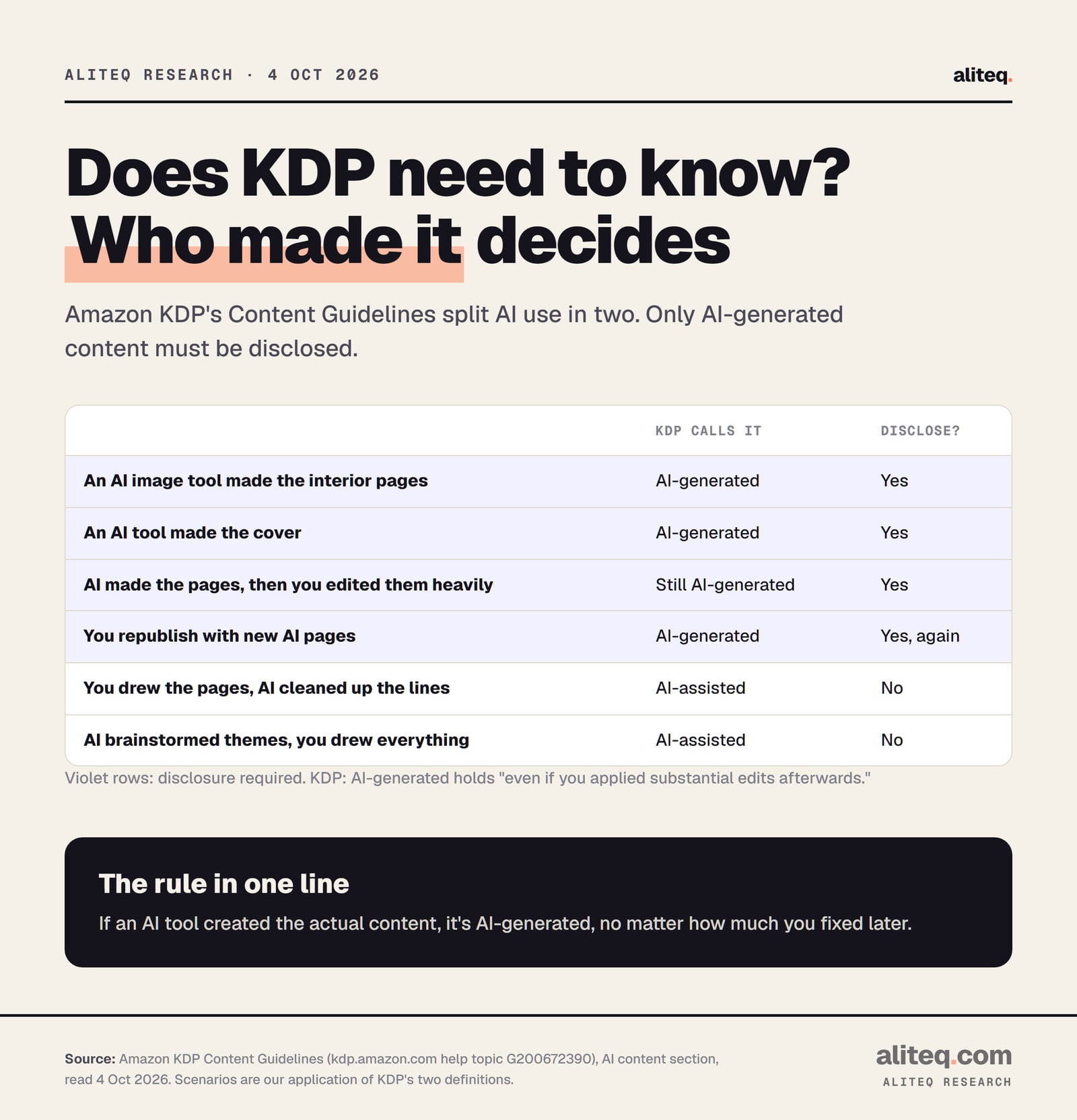
KDP draws the line at who created the content in the first place. If an AI tool made it, it's AI-generated, no matter how much you fixed later. If you made it and AI polished it, it's AI-assisted. Your editing effort doesn't move a book from one side to the other.
Here is KDP's AI-generated definition, word for word: "If you used an AI-based tool to create the actual content (whether text, images, or translations), it is considered "AI-generated," even if you applied substantial edits afterwards."
That last clause is the one people miss. Say you generate 40 pages, redraw the wonky hands, thicken every outline and delete the junk. In KDP's terms, those pages are still AI-generated.
AI-assisted is the other direction. KDP says: "If you created the content yourself, and used AI-based tools to edit, refine, error-check, or otherwise improve that content (whether text or images), then it is considered "AI-assisted" and not "AI-generated."" Brainstorming counts as assisted too, if you "ultimately created the text or images yourself."
How KDP's two definitions apply to common coloring book setups. Wording from KDP's Content Guidelines, read 4 October 2026. · aliteq research
One more sentence applies to both sides: "You are responsible for verifying that all AI-generated and/or AI-assisted content adheres to all content guidelines, including by complying with all applicable intellectual property rights." Disclosing doesn't make a page safe. A disclosed AI page of a famous cartoon character is still someone else's character.
What KDP's page doesn't tell you
The guidelines say what to disclose. They don't say what Amazon does with the answer. The page I read doesn't say whether shoppers see it on the product page. It doesn't say a yes slows review either. I won't guess at either one.
What the page does say is how enforcement works in general. Amazon uses "a combination of machine learning, automation, and dedicated teams of human reviewers" and will "reject or remove content that does not adhere to these guidelines." If a title is removed, KDP says it tells you, and "they can appeal our decision."
How many books can you publish a week?
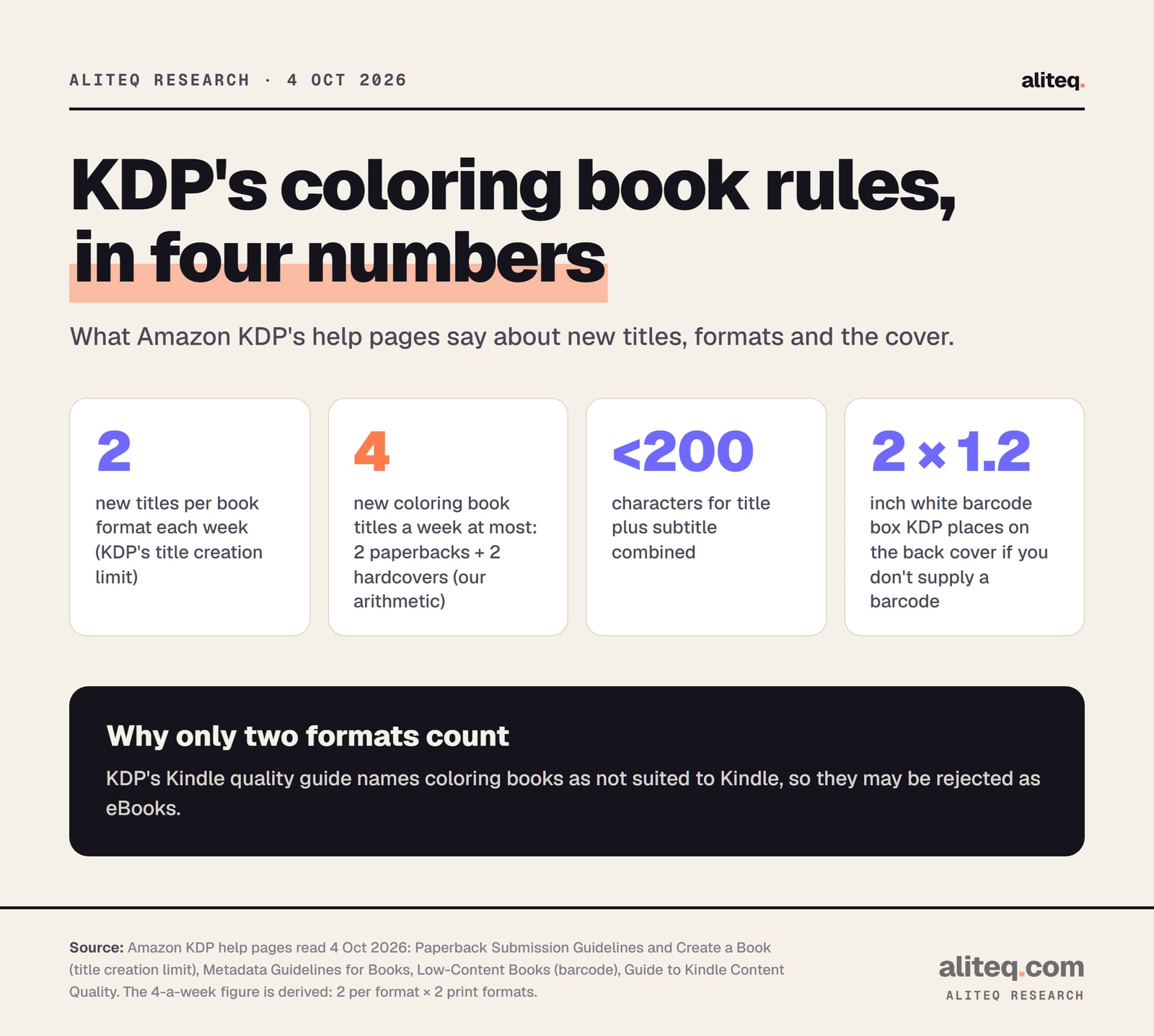
Two new titles per book format, per week. That's the current wording on KDP's Paperback Submission Guidelines and its Create a Book page: "we limit the number of titles you can create at the same time to 2 per book format each week." It's weekly, not daily, and it's counted per format.
You'll still see a "3 books a day" number in old forum threads. I couldn't find that figure on any KDP help page today, so treat it as history. The help pages I read now say 2 per format, per week.
For a coloring book, the formats that matter are paperback and hardcover. That's because KDP's Kindle quality guide says books meant for coloring "may be rejected upon submission or removed from sale" as eBooks. It lists coloring books by name. So the practical ceiling is 2 new paperbacks plus 2 new hardcovers a week.
The 4-a-week figure is our arithmetic: 2 paperbacks + 2 hardcovers, since KDP's quality guide steers coloring books away from Kindle. · aliteq research
Is a coloring book a low-content book on KDP?
Usually not, and that surprises a lot of people. KDP's Low-Content Books page says low-content books are "generally repetitive, and designed to be filled in by the user." Then it adds that this "does not typically include activity books, such as puzzle books or coloring books." Its own table lists coloring books under "Not Generally Low-Content."
That matters for setup. Low-content books "do not require an ISBN" and "are not eligible for the free KDP ISBN," and you have to tick a Low-content box under Categories. KDP warns that ticking the wrong box means "your book will be rejected." The page also notes "there can be exceptions to these examples," so a book of 100 identical blank grids is a different animal.
Two more rules hit AI coloring books hard.
Titles. KDP's Metadata Guidelines ban "Repeating generic keywords like "notebook," "journal," "gifts," "books," etc." in the title field. They also ban "Unauthorized reference to a trademarked term." Title plus subtitle "must be fewer than 200 characters."
Repetition. KDP's Kindle quality guide lists "Content that is excessively reused, recycled, or repeated within or across books" as disappointing content. That guide is written for Kindle eBooks. Still, it shows how Amazon thinks about recycled pages. Ten books built from the same batch of generations is the pattern it describes.
If your pages come from an AI image generator, keep every subject original. A disclosed AI page doesn't change who owns a character.
Can you copyright AI coloring book pages?
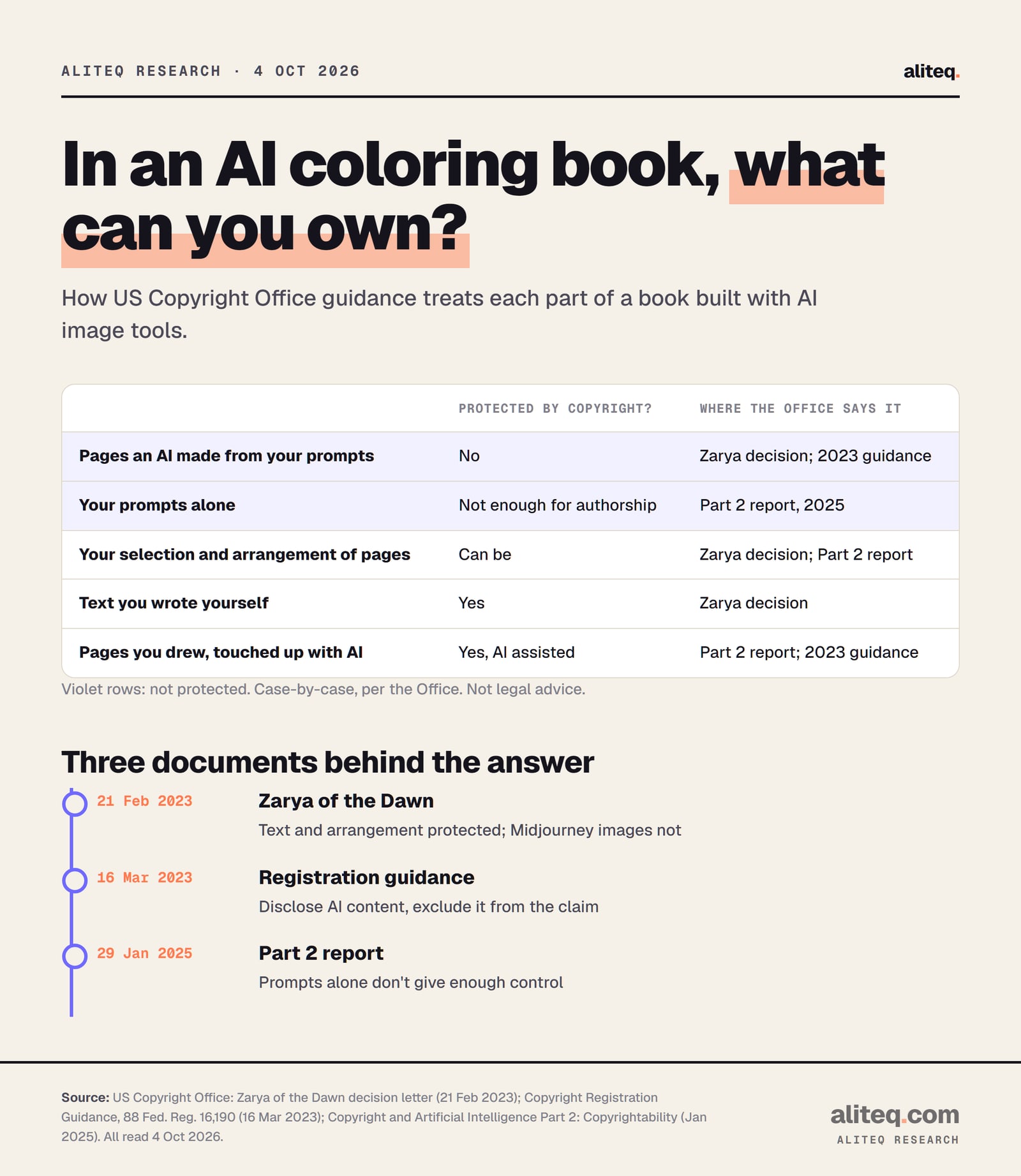
Mostly not the pictures themselves, under current US guidance. The US Copyright Office says images an AI produces from your prompt aren't human authorship, so they aren't protected. What you can protect is your own text and your creative selection and arrangement of the pages. That's the outcome in its best-known AI comic book decision.
The case is Zarya of the Dawn, an 18-page comic book with Midjourney images. In its 21 February 2023 letter, the Office wrote that the author owns "the Work's text as well as the selection, coordination, and arrangement of the Work's written and visual elements." It then said "the images in the Work that were generated by the Midjourney technology are not the product of human authorship."
Its March 2023 registration guidance explains why. When an AI "receives solely a prompt from a human," the guidance says the "traditional elements of authorship" are "determined and executed by the technology--not the human user." Prompts, it says, "function more like instructions to a commissioned artist."
The January 2025 report, Copyright and Artificial Intelligence Part 2, kept that line. Two of its conclusions:
Copyright does not extend to purely AI-generated material, or material where there is insufficient human control over the expressive elements.
US Copyright Office, Part 2 report
Based on the functioning of current generally available technology, prompts do not alone provide sufficient control.
US Copyright Office, Part 2 report
It also says "the use of AI tools to assist rather than stand in for human creativity does not affect the availability of copyright protection." The guidance gives a familiar example. A visual artist who edits an image in Adobe Photoshop "remains the author of the modified image."
Summary of the Zarya of the Dawn decision (Feb 2023), the March 2023 registration guidance and the Part 2 report (Jan 2025). Not legal advice. · aliteq research
What does this mean for a seller? Someone who copies your AI pages may be copying material nobody owns. Your arrangement and your own writing are a different story. Note also that an AI tool's license to sell its output is not the same as a copyright. We covered that split in whether you can sell Higgsfield AI images.
If you register a copyright anyway
The Office says you must tell it about the AI. Its guidance reads: "applicants have a duty to disclose the inclusion of AI-generated content in a work submitted for registration." It adds that "AI-generated content that is more than de minimis should be explicitly excluded from the application." You claim only the human part, and you don't list the AI as an author.
A pre-publish checklist for an AI coloring book
Four checks cover what KDP's pages ask of you. Answer the AI question honestly, keep titles clean, plan around the weekly cap, and stay away from anyone else's characters. None of these needs a lawyer. Each one comes straight from a KDP help page or the Copyright Office.
**Decide generated or assisted.** If an AI tool made any page or the cover, it's AI-generated. Heavy edits don't change that.
**Answer KDP's AI question.** Disclose AI-generated content at publish, and again whenever you republish with edits.
**Pick the right category box.** Coloring books are "Not Generally Low-Content" on KDP's own table, so read that page before you tick anything.
**Plan around the cap.** 2 new titles per format each week. Paperback and hardcover are separate formats.
**Keep it original.** No characters, brands or trademarked terms in the art or the title. Disclosure doesn't fix an IP problem.
This rulebook applies to anything you print through Amazon. If you're also selling AI designs on shirts and mugs, our AI print-on-demand guide covers that side.
Quick answers
Does KDP require AI disclosure for coloring books?
Yes, if an AI tool made the pages or the cover. KDP's Content Guidelines say "AI-generated images include cover and interior images and artwork," and you must disclose AI-generated content when you publish or republish.
What if I edited the AI pages a lot?
They still count as AI-generated. KDP's definition holds "even if you applied substantial edits afterwards." Only content you created yourself, then improved with AI, counts as AI-assisted.
Do I have to disclose that I used AI for ideas?
No. KDP calls brainstorming with AI "AI-assisted" when you "ultimately created the text or images yourself," and says "it is not necessary to inform us" about it.
How many books can I publish on KDP per day?
KDP's help pages don't set a daily number today. They say "2 per book format each week." For a coloring book, that means up to 2 new paperbacks and 2 new hardcovers a week.
Is a coloring book a low-content book on KDP?
Not usually. KDP's Low-Content Books page lists coloring books under "Not Generally Low-Content," though it says there can be exceptions.
Can I copyright AI-generated coloring pages?
Under current US Copyright Office guidance, purely AI-generated images aren't protected, and prompts alone aren't enough. Your own text and your creative selection and arrangement of the pages can be. This isn't legal advice.