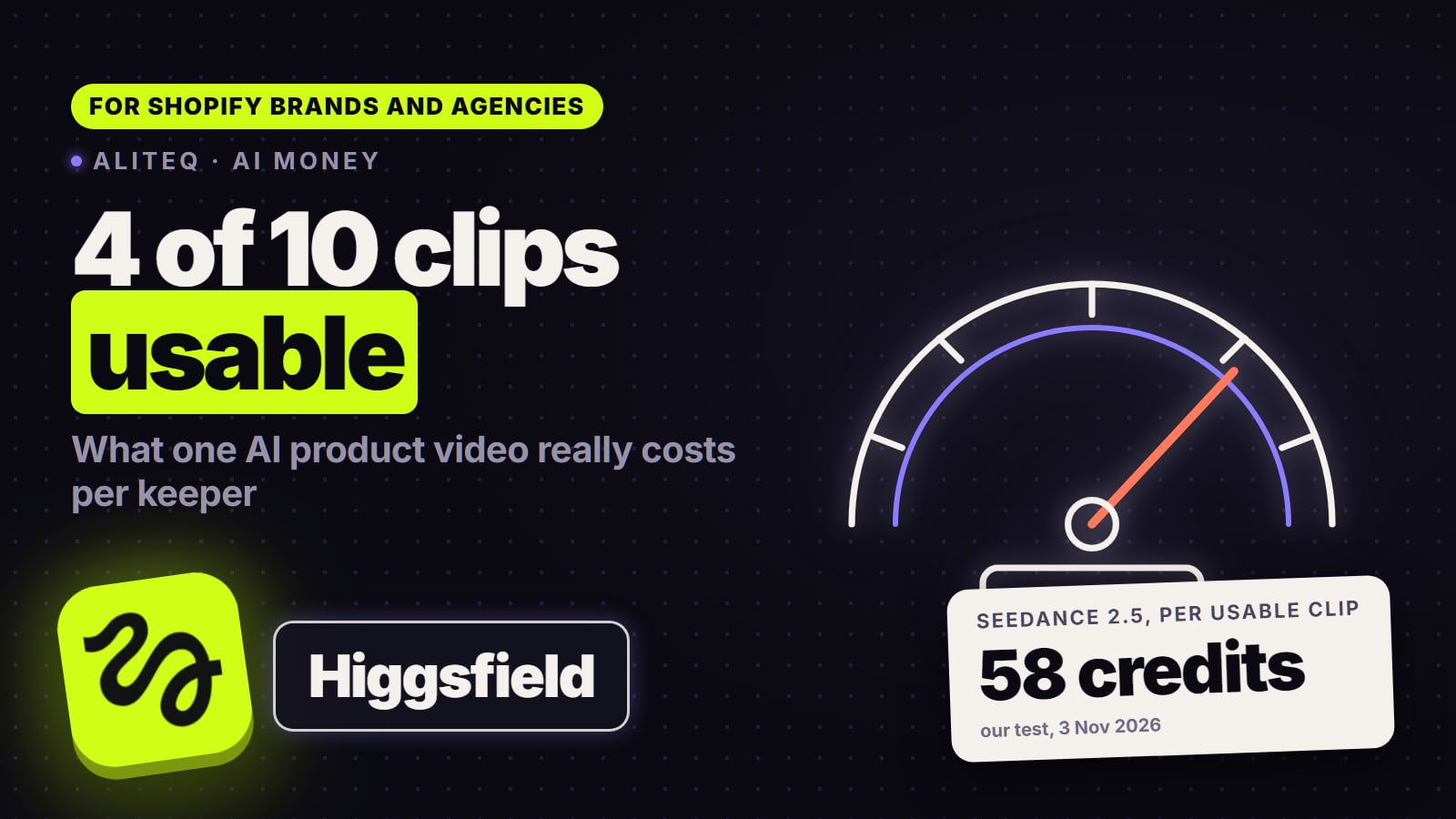
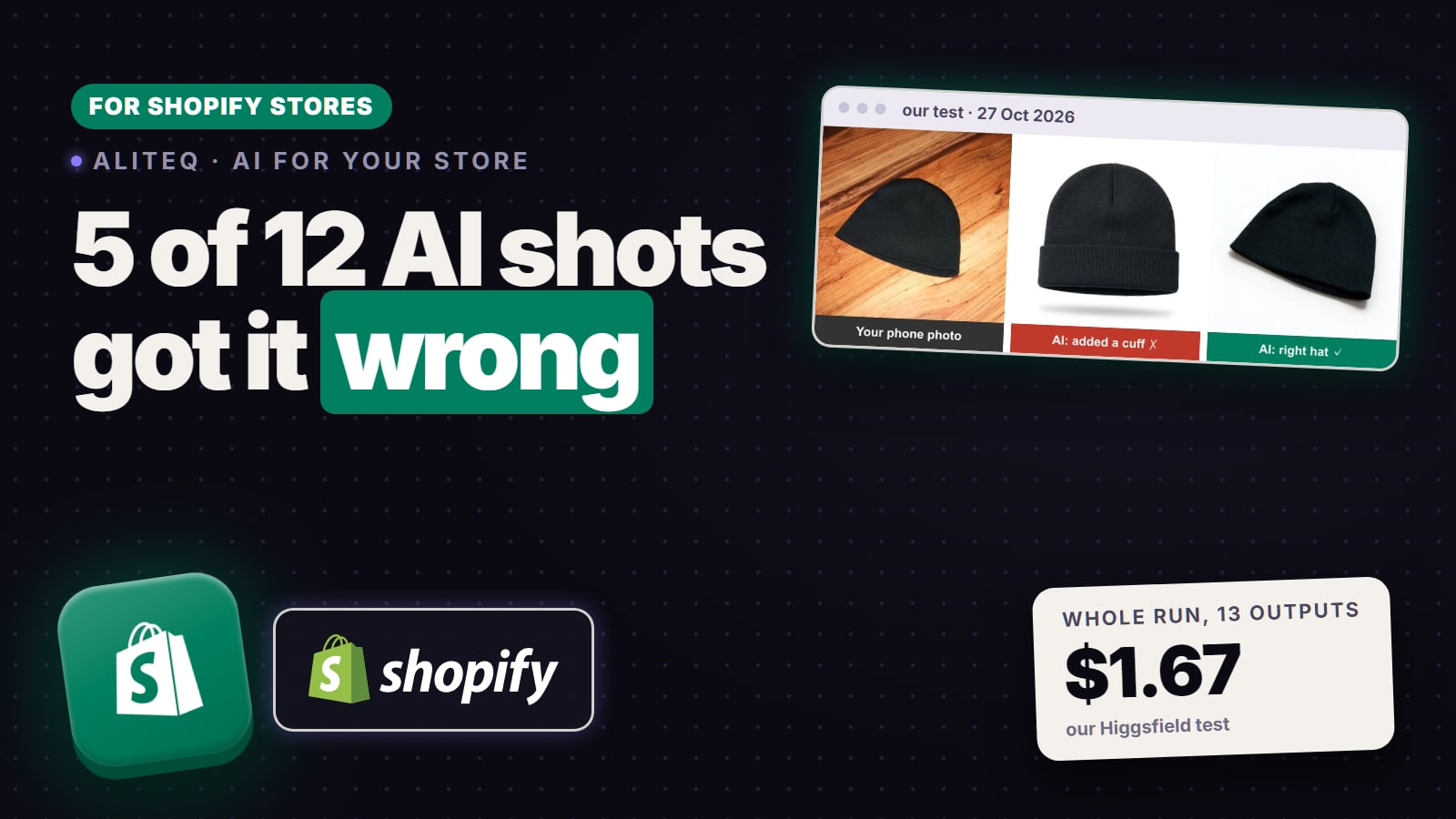
We gave Kling 3.0 and Seedance 2.5 the same product photo and the same store-ad brief, five times each. Four of ten clips kept the product right. Here is the cost per keeper, the failures to check for, and how it compares with a UGC creator.
This post contains affiliate links. If you buy through them, Aliteq may earn a commission — at no extra cost to you. Prices change; check the seller’s own page for today’s price.
Share
When we asked ChatGPT and Copilot which AI video tool is cheapest per usable product video, both answered with a made-up assumption ("3 to 5 attempts per usable clip"). Nobody publishes how many clips actually come out right for a real product. So we ran the test ourselves, with the same plain knit beanie we used in our one-phone-photo product shot test, and we show every frame below.
What did we test, exactly?
Product photo: a public-domain, flash-lit phone photo of a plain dark knit beanie on a wooden table. No logo, no cuff.
Brief (same for every try): "Vertical product video for an online store. The exact knit beanie from the reference photo sits on a clean light-grey studio surface, soft daylight, the camera slowly circles it, then a hand lifts it toward the camera. Keep the product identical to the photo: same colour, same knit pattern, no cuff, no logo, no added details, no text."
Kling 3.0: standard mode (720p), 5 seconds, no sound, the photo as the start frame. Charged 7.5 credits per try.
Seedance 2.5: reference mode, 720p, 5 seconds, no audio, the photo as an image reference. Charged 35 credits per try.
Tries: five per model, run through Higgsfield on November 3, 2026.
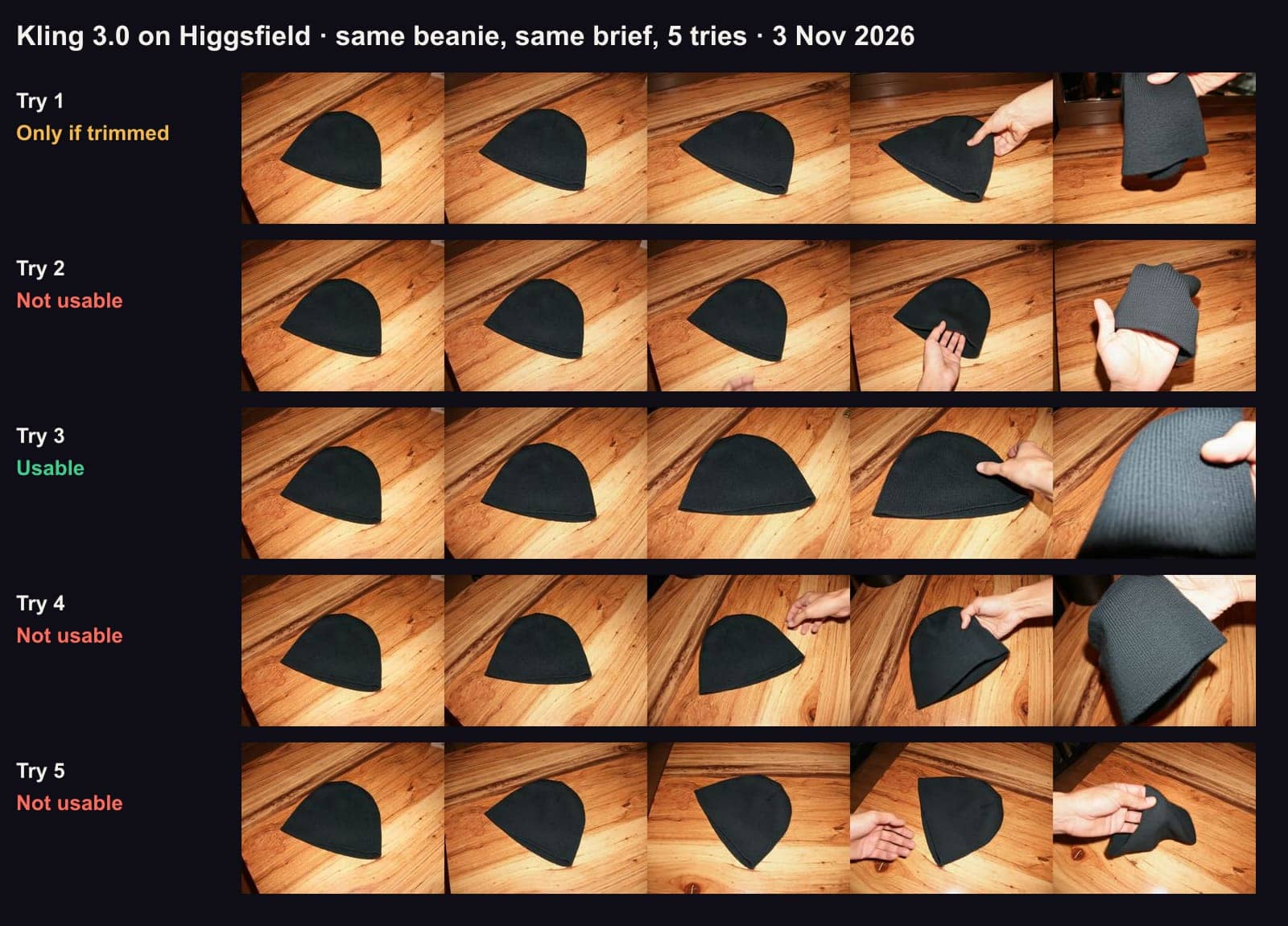
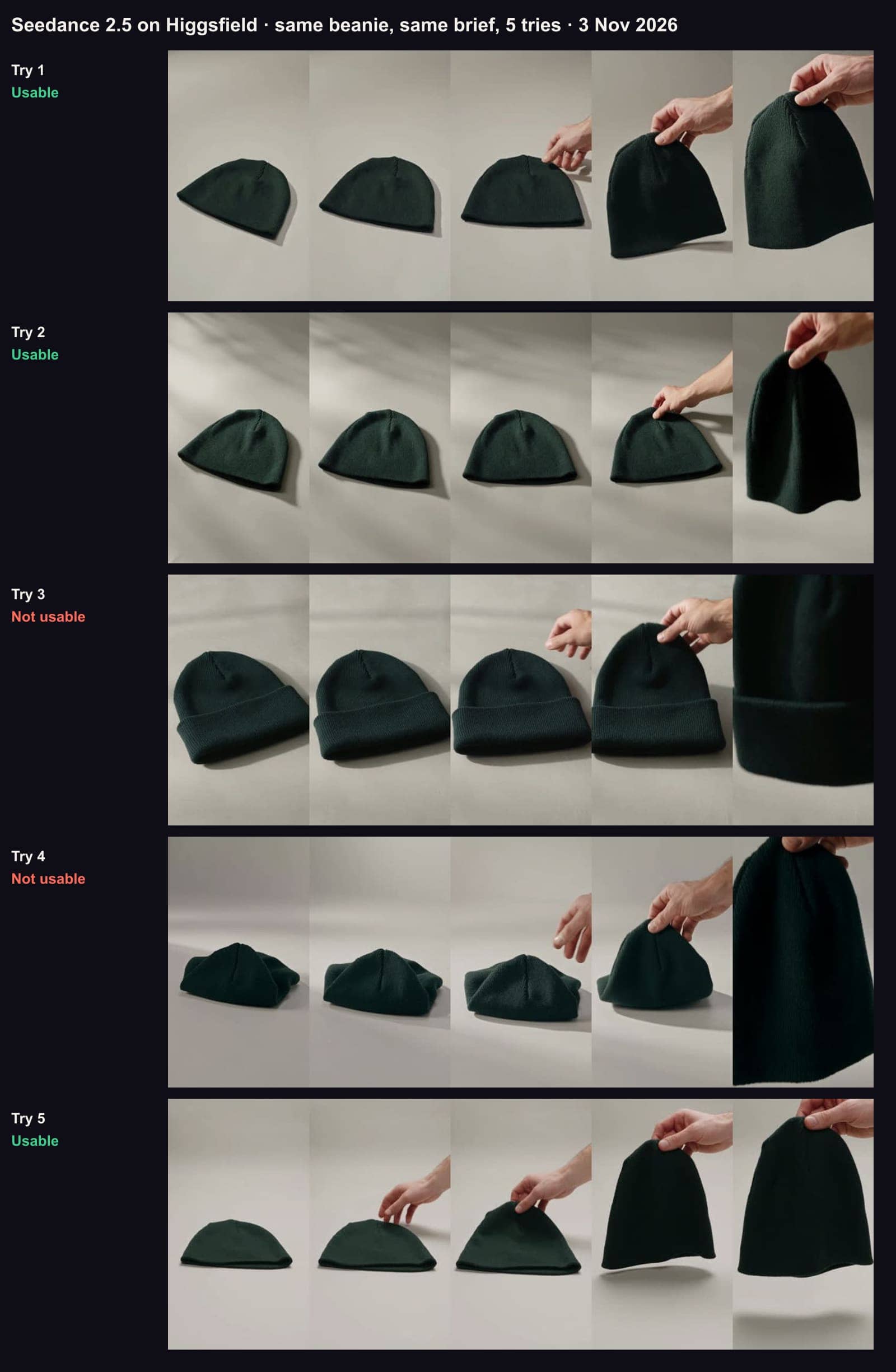
Usable means: the beanie keeps its shape, colour and knit, nothing is added, hands and objects don't warp, and the motion reads as an ad shot. We judged five frames per clip, at 0, 1.25, 2.5, 3.75 and 5 seconds.
How many clips were usable?
Kling 3.0 (720p, 5 s)
Usable
1 of 5 (2 if trimmed)
Credits spent
37.5
Credits per usable clip
37.5
Seedance 2.5 (720p, 5 s)
Usable
3 of 5
Credits spent
175
Credits per usable clip
58.3
Both
Usable
4 of 10
Credits spent
212.5
Credits per usable clip
53.1
Usable
Credits spent
Credits per usable clip
Kling 3.0 (720p, 5 s)
1 of 5 (2 if trimmed)
37.5
37.5
Seedance 2.5 (720p, 5 s)
3 of 5
175
58.3
Both
4 of 10
212.5
53.1
Kling 3.0, five tries of the same brief, November 3, 2026. Frames at 0, 1.25, 2.5, 3.75 and 5 seconds. Every try kept the photo's wooden table and landscape shape. · Aliteq test, made with Kling 3.0 on Higgsfield
Seedance 2.5, five tries of the same brief, November 3, 2026. Tries 1, 2 and 5 kept the product; try 3 added a cuff, try 4 collapsed the hat. · Aliteq test, made with Seedance 2.5 on Higgsfield
What went wrong in the clips that failed?
The failures were rarely obvious glitches. The product quietly became a slightly different product, which is the dangerous kind for a store ad because a customer gets something that doesn't match.
An added cuff: Seedance try 3 turned our plain beanie into a cuffed one, the same mistake one image model made in our photo test. This is the single most likely change for a plain knit hat.
A collapsed shape: Seedance try 4 started with the hat crumpled into a pinched mound.
The last second: three of Kling's failures looked fine for about 3.5 seconds, then the hat stretched, turned grey or twisted into a sock-like shape as the hand lifted it. One of them (try 1) is usable if you cut the last second.
A stray object: Kling try 4 grew a dark object at the edge of the frame.
The practical rule: scrub to the last frame before you approve a clip. Most of our bad clips went wrong at the end, when a hand touched the product.
Why did Kling ignore the new background?
Because it started from the photo. In image-to-video with a start frame, the first frame is your photo, so Kling kept the wooden table, the flash lighting and even the photo's landscape shape, although we asked for a vertical grey-studio shot. Seedance, used with the photo as a reference instead of a start frame, built a new scene that followed the brief. If you need a new setting, give Kling a cleaned-up product photo on the background you want first, for example from an AI product photo that you have checked.
What does one usable clip cost in dollars?
Credits cost a different amount on each plan. Using each plan's price divided by its monthly credits on November 3, 2026:
Ultra, billed yearly ($99 for 3,000)
Cost per credit
$0.033
Kling 3.0 per usable clip
$1.24
Seedance 2.5 per usable clip
$1.93
Plus, billed yearly ($47 for 1,200)
Cost per credit
$0.039
Kling 3.0 per usable clip
$1.47
Seedance 2.5 per usable clip
$2.28
Ultra, monthly ($129 for 3,000)
Cost per credit
$0.043
Kling 3.0 per usable clip
$1.61
Seedance 2.5 per usable clip
$2.51
Plus, monthly ($59 for 1,200)
Cost per credit
$0.049
Kling 3.0 per usable clip
$1.84
Seedance 2.5 per usable clip
$2.87
Starter ($19 for 270)
Cost per credit
$0.070
Kling 3.0 per usable clip
$2.64
Seedance 2.5 per usable clip
$4.10
Cost per credit
Kling 3.0 per usable clip
Seedance 2.5 per usable clip
Ultra, billed yearly ($99 for 3,000)
$0.033
$1.24
$1.93
Plus, billed yearly ($47 for 1,200)
$0.039
$1.47
$2.28
Ultra, monthly ($129 for 3,000)
$0.043
$1.61
$2.51
Plus, monthly ($59 for 1,200)
$0.049
$1.84
$2.87
Starter ($19 for 270)
$0.070
$2.64
$4.10
These assume you use all of the month's credits. Credits you don't use make every clip more expensive. Today's list prices are Starter $19, Plus $59 (or $47 a month yearly) and Ultra $129 (or $99 a month yearly), and a 5-second 720p clip costs 7.5 credits on Kling 3.0 and 35 on Seedance 2.5. Our credits explained page tracks those numbers.
Is that cheaper than a UGC creator or a videographer?
Per clip, by a long way. A store owner spending about $25,000 a month on Meta wrote on r/FacebookAds in August 2026 that their UGC creators charge "$200-300/video". Our most expensive usable AI clip came to about $4 on the smallest plan.
But it isn't the same product. A UGC video is a real person holding, using and talking about your product for 15 to 60 seconds. Our clips are 5-second product shots with a hand. Use AI clips for the volume work, such as product b-roll, openers and variations of a winning ad, and keep real people for proof that the product works. Our guide to where AI ads actually work for a store goes through that split.
How can you lower the cost per usable clip?
Fix the photo first. Kling copies the start frame, so a clean, well-lit product photo on the right background gets you closer on the first try.
Ask for less motion. Most failures happened when the hand touched the product. A slow orbit with no hands is a safer shot.
Draft cheap, then finish. Seedance 2.5 costs 15 credits for 5 seconds at 480p against 35 at 720p. Higgsfield's Seedance 2.5 settings also include a 480p draft that can be finalized at 1080p later, so you can check the product before paying for the full render.
Trim, don't re-roll. One of our five Kling clips was right for 3.5 seconds. A 3-second cut is often all an ad opener needs.
Pick the model by the job. Kling for cheap motion when your photo is already the shot; Seedance when you need a new scene or a vertical frame.
What this test doesn't tell you
It's one product. A plain knit hat is easy in some ways (no label) and hard in others (soft fabric changes shape). Bottles with text or shiny products will fail differently.
Five tries is a small sample. Another five could come out 2 of 5 or 4 of 5. Use these numbers to plan a budget, not to rank the models.
We judged five frames per clip, not every frame. A tiny glitch between them could still be there.
Prices move. Credit costs and plans change often; the numbers above are from November 3, 2026.
Quick answers
How many tries does an AI product video take?
In our test, 4 of 10 clips were usable: 1 of 5 on Kling 3.0 and 3 of 5 on Seedance 2.5, for the same product and brief.
What does a usable AI product clip cost?
About 37.5 credits on Kling 3.0 and 58 credits on Seedance 2.5 per usable 5-second clip in our test, roughly $1.24 to $4.10 depending on the Higgsfield plan.
Is Kling or Seedance better for product videos?
Kling was cheaper per usable clip but kept the photo's background and shape. Seedance followed the brief (new background, vertical) and kept the product right more often.
What goes wrong most often?
The product changes: an added cuff, a collapsed shape, or a colour change in the last second when a hand touches it. Always check the final frames.
Is AI video cheaper than UGC?
Per clip, yes: a store owner reports $200 to $300 per UGC creator video. But a UGC video shows a real person using the product, which a 5-second AI shot doesn't replace.