LangGraph for durable production agents, CrewAI for the fastest multi-agent start, the OpenAI, Claude and Google SDKs if you're tied to one model family, Microsoft Agent Framework instead of AutoGen (archived), and n8n if you don't want to code. Versions and facts checked on each project's own pages, Nov 3, 2026.
Some links on this page are referral links: we may earn a commission, at no cost to you.
Share
Which AI agent framework should you use? Pick by the job, not by popularity. For a durable, auditable production agent with human approval steps, use LangGraph. For the fastest multi-agent prototype, use CrewAI. If you build around one model vendor, use that vendor's kit: the OpenAI Agents SDK, the Claude Agent SDK or Google ADK. If you were on AutoGen, move: Microsoft archived it and points new users to Microsoft Agent Framework. If you'd rather not code, use n8n. Every version and fact below was read on the project's own docs and GitHub pages on November 3, 2026.
Which framework fits my job?
Find the row that matches what you're building. The versions are each project's latest GitHub release as of November 3, 2026, so you can see which ones are actively shipping.
AI agent frameworks by job (GitHub releases and docs read Nov 3, 2026)
LangGraph
Best for
Durable, stateful production agents with human review
Trade-off
Low-level; you design the graph yourself
Latest release
1.2.19 (Oct 30, 2026), MIT
CrewAI
Best for
Fastest multi-agent start (Crews), Flows for control
AutoGen and Semantic Kernel successor; .NET, Python, Go
Azure-first examples; Go is in preview
python-1.24.0 (Oct 30, 2026), MIT
Pydantic AI
Typed Python agents, easy model swaps and fallback
Python only
v2.65.0 (Nov 3, 2026), MIT
n8n
No-code agents across 2,000+ integrations
Visual workflows; less fine-grained agent control
2.46.4 (Nov 2, 2026), Sustainable Use License
AutoGen (Microsoft)
Archived; kept for reference only
No bug or security fixes from Microsoft
python-v0.7.5 (Sep 30, 2025)
You need it in production, with an audit trail and a human approving risky steps: LangGraph. Its own docs list durable execution, streaming and human-in-the-loop as the point of the framework.
You want a multi-agent demo working this afternoon: CrewAI. You describe agents by role and give them tasks; Flows add the structured control for when it goes live.
You're all-in on GPT models: the OpenAI Agents SDK, which OpenAI describes as having "very few abstractions".
You want an agent that reads files, runs commands and edits code on Claude: the Claude Agent SDK, which gives you "the same tools, agent loop, and context management that power Claude Code".
You need Go, Java or Kotlin, or you're on Google Cloud: Google ADK.
You're on AutoGen, Semantic Kernel, Azure or .NET: Microsoft Agent Framework.
The logic is simple but it touches a dozen SaaS apps, and you don't want to code: n8n.
What happened to AutoGen?
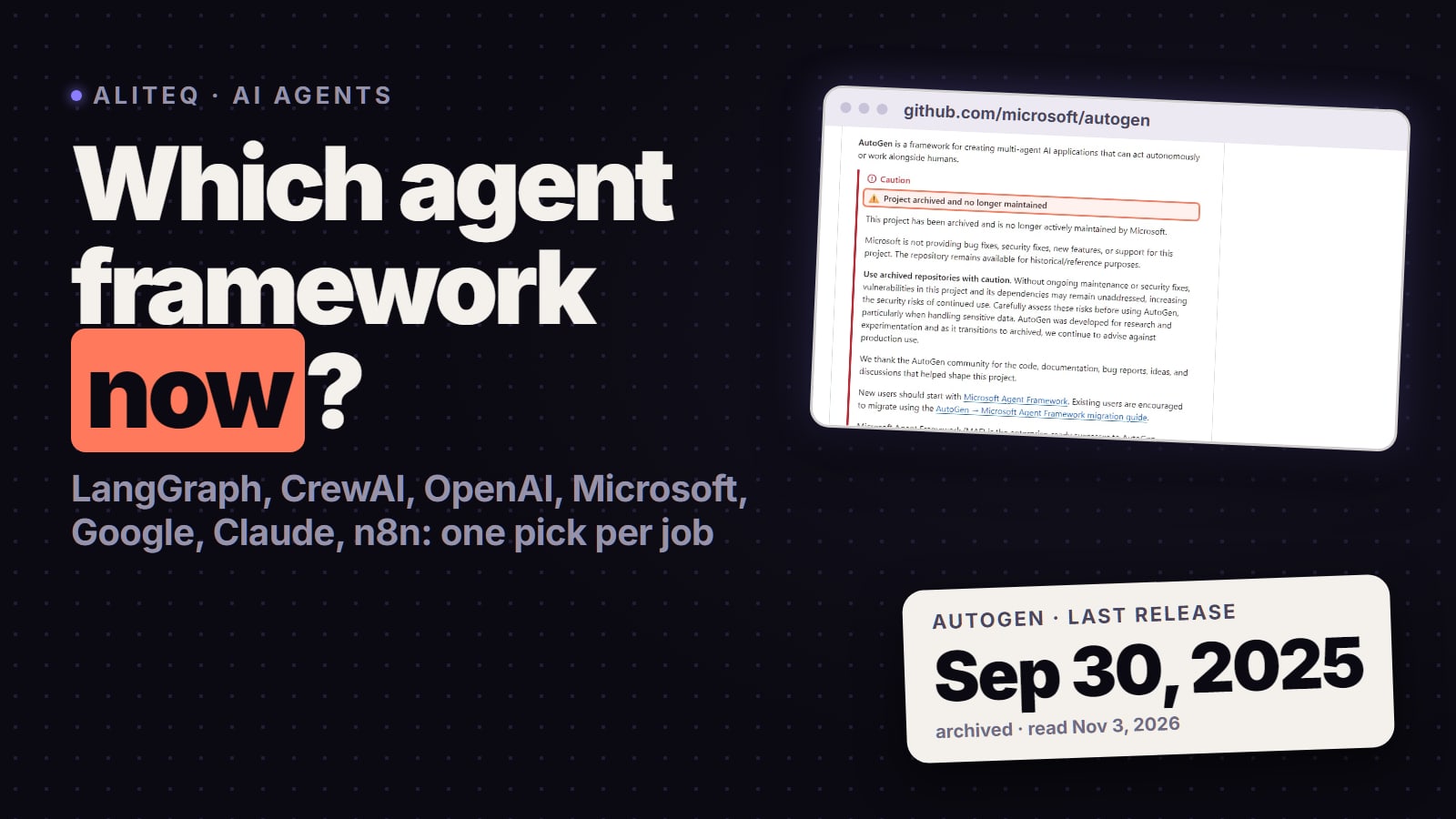
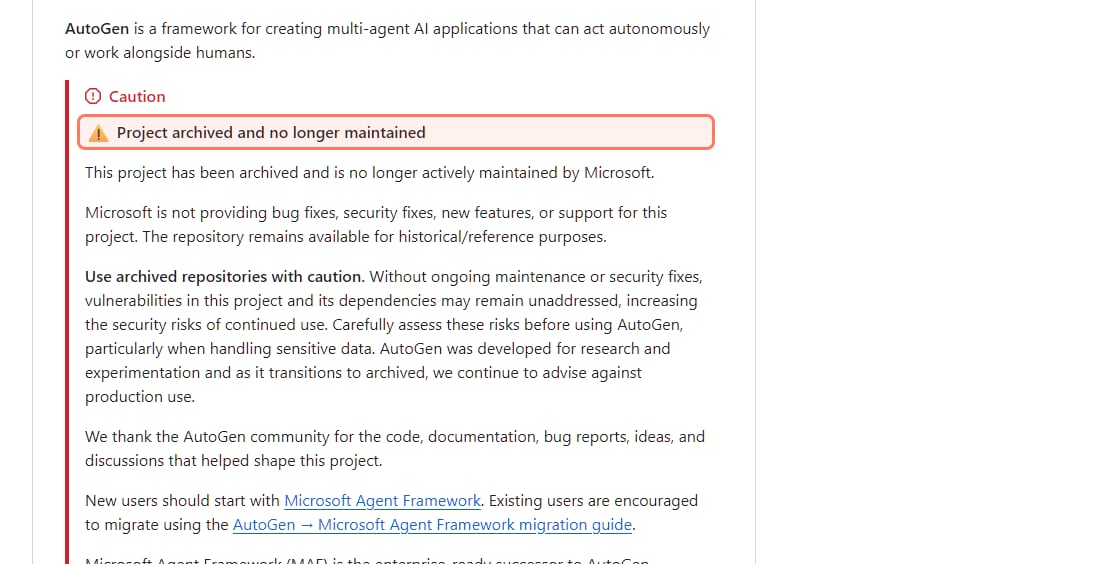
Microsoft archived it. The README on Microsoft's AutoGen GitHub page now opens with a caution box: "Project archived and no longer maintained". It says Microsoft "is not providing bug fixes, security fixes, new features, or support for this project" and tells new users to start with Microsoft Agent Framework. The last AutoGen release on GitHub is python-v0.7.5, published September 30, 2025.
Microsoft's AutoGen README, github.com/microsoft/autogen, read November 3, 2026. The archive notice is outlined. · Screenshot of github.com/microsoft/autogen by aliteq
Microsoft's docs call Agent Framework "the direct successor, created by the same teams" behind Semantic Kernel and AutoGen. It works in .NET, Python and Go (Go is a public preview), and Microsoft lists Foundry, Anthropic, Azure OpenAI, OpenAI and Ollama among its model providers. Microsoft publishes a migration guide from AutoGen.
AG2 is a different project. It's the community continuation of the original AutoGen code, it's still releasing (v1.2.2 on October 27, 2026, Apache-2.0), and it's what you want if you like the classic conversational style. When a tutorial says "AutoGen", check which one it means.
Is LangGraph still the safe pick for production?
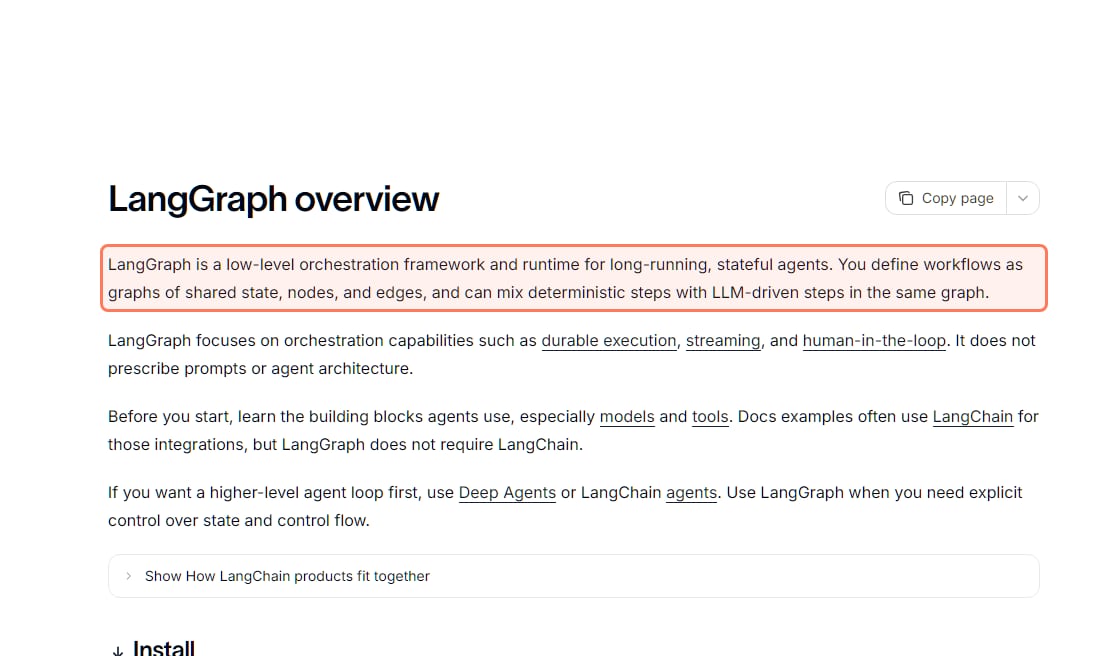
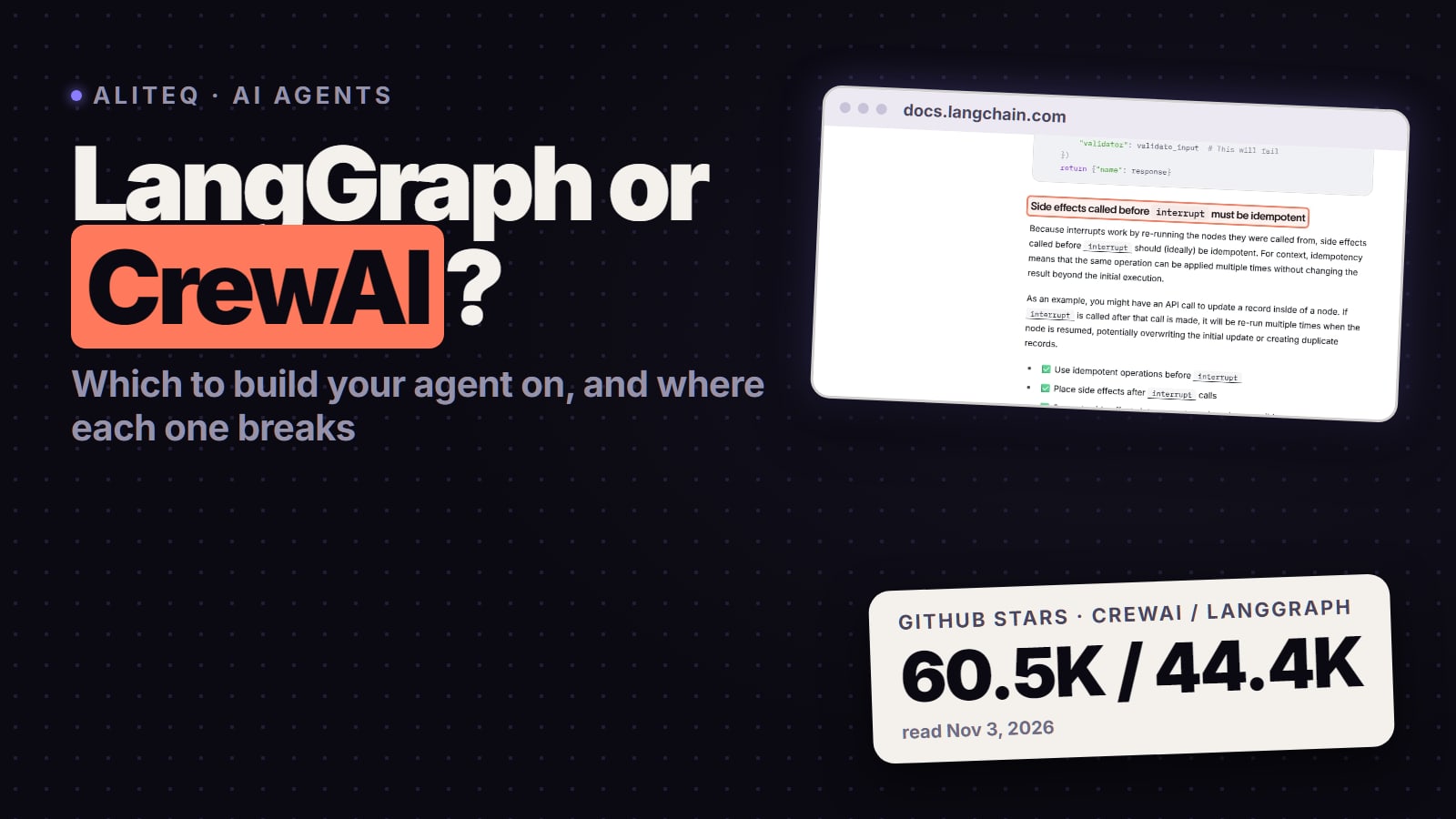
Yes, if you're willing to design the flow yourself. LangChain's docs describe LangGraph as "a low-level orchestration framework and runtime for long-running, stateful agents". You define the work as a graph of shared state, nodes and edges, and you can mix fixed steps with LLM-driven ones in the same graph.
LangGraph's own description, docs.langchain.com, read November 3, 2026. · Screenshot of docs.langchain.com by aliteq
What you get: durable execution (a run can pick up after a crash or a pause), human-in-the-loop (pause, inspect, change state, resume), memory across sessions and streaming.
What it costs you: the same page says LangGraph "does not prescribe prompts or agent architecture". That's freedom, and it's also work.
You don't need LangChain: the docs say "LangGraph does not require LangChain". If you want a ready-made agent loop first, LangChain points you to its Deep Agents or LangChain agents and says to use LangGraph "when you need explicit control over state and control flow".
Is CrewAI good enough for production now?
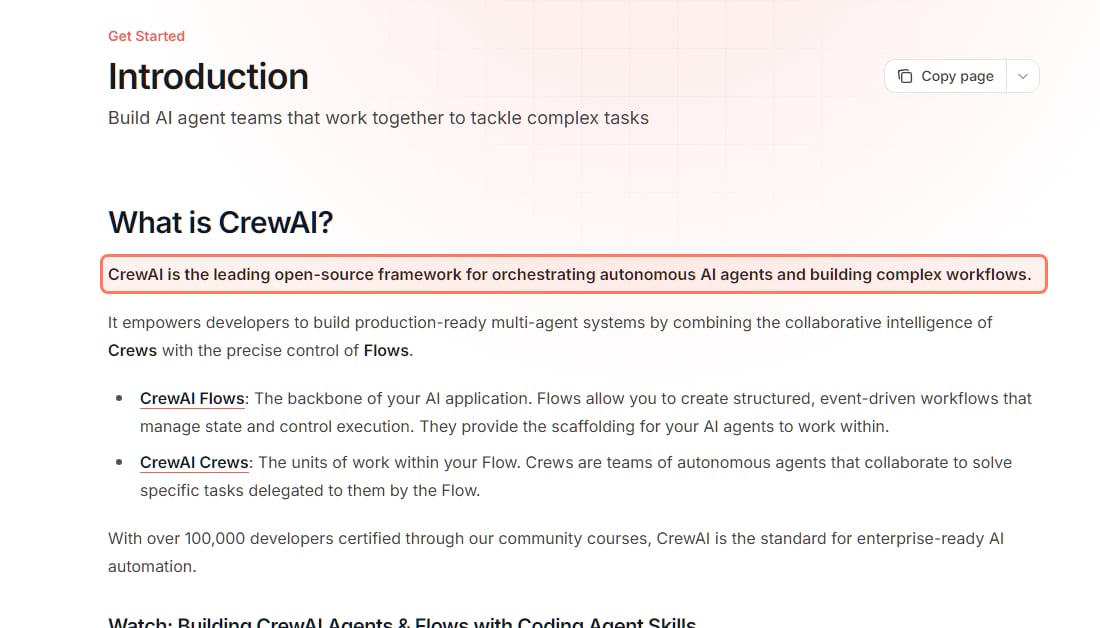
For a lot of jobs, yes. The quick "crew" of role-playing agents is still the fastest start, but CrewAI's own docs now tell you to build production apps around Flows: structured, event-driven workflows that "manage state and control execution", with a Crew handling a step that needs agents working together.
CrewAI's introduction page, docs.crewai.com, read November 3, 2026. "Leading" is CrewAI's own word. · Screenshot of docs.crewai.com by aliteq
A common path is to prototype in CrewAI and move the parts that need tight control to LangGraph once the requirements settle. Our LangGraph vs CrewAI comparison goes through that choice in detail.
Can I use the OpenAI Agents SDK with Claude, Gemini or a local model?
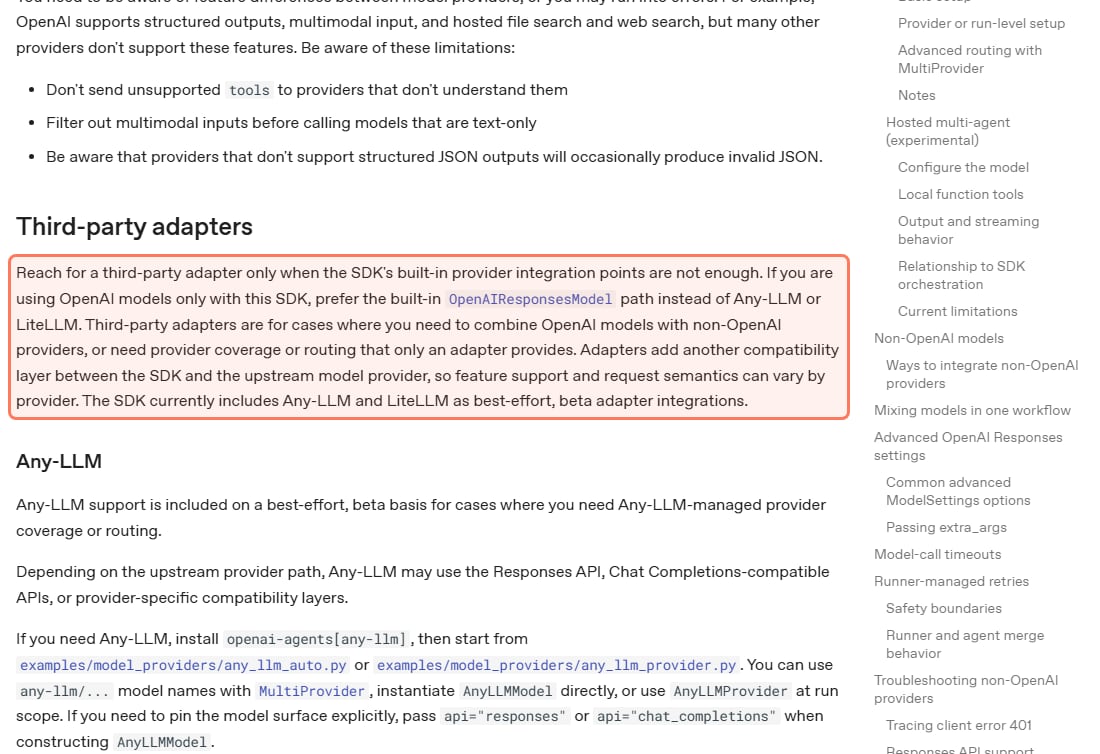
You can, but it's built for OpenAI first. The SDK's model docs say it "currently includes Any-LLM and LiteLLM as best-effort, beta adapter integrations", and that some tool features "are supported only with OpenAI Responses models". They also suggest turning tracing off if you don't have an OpenAI platform key.
OpenAI Agents SDK model docs, read November 3, 2026. Non-OpenAI adapters are labeled best-effort and beta. · Screenshot of openai.github.io/openai-agents-python by aliteq
So if you plan to switch between model vendors, a model-neutral framework (LangGraph, CrewAI, Pydantic AI, Microsoft Agent Framework or Google ADK) will fight you less. If you're on GPT models anyway, the OpenAI SDK is the shortest path. Its core pieces are agents with instructions and tools, handoffs that delegate to other agents, and guardrails that check inputs and outputs.
What about the Claude Agent SDK, Google ADK and Pydantic AI?
Claude Agent SDK (Anthropic): "Build production AI agents with Claude Code as a library." It comes with built-in tools to read, write and edit files, run commands and search the web, plus hooks, subagents, MCP, permissions and sessions, in Python and TypeScript. It's built around Claude, and its use falls under Anthropic's Commercial Terms of Service. Pick it for coding and file-heavy agents on Claude.
Google ADK: "the open-source agent development framework that lets you build, debug, and deploy reliable AI agents", in Python, TypeScript, Go, Java and Kotlin. Google says it "can work with almost any generative AI model", though its examples use Gemini.
Pydantic AI: "the Python AI SDK: a typed, extensible agent loop with every model a string swap away", with a fallback model for when a provider fails. A good fit if your team already writes typed Python.
Do I need to code to build an agent?
No. n8n's AI Agent node lets you "connect a chat model and one or more tools, and the agent decides which tools to call". You must connect at least one tool. n8n's integrations directory lists 2,000+ integrations, which is the real reason to use it: the hard part of most business agents is the glue, not the reasoning.
Two things to know before you commit. n8n's code is under its Sustainable Use License, a source-available license with limits, not a standard open-source license, so read it if you plan to resell n8n as a service. And there's a self-hosted Community Edition on GitHub alongside the paid cloud plans on n8n's pricing page. More in our n8n for AI agents guide.
Can I run my agent on an open model I control?
Yes. The model-neutral frameworks don't tie you to one vendor: Google's ADK docs mention adapters for locally run models, Microsoft lists Ollama among Agent Framework's model providers, and the OpenAI SDK can reach other providers through its beta adapters. The question becomes hardware: whether the model fits in your GPU's memory. Check a model against your card with the VRAM calculator, and see how to run a local AI agent for the setup.
If your own card is too small, renting one by the hour is the cheap way to test before you buy. Today's per-GPU prices from Vast and Runpod are on /cloud-gpu.
Quick answers
What is the best AI agent framework in November 2026?
There isn't one overall. LangGraph for durable production agents, CrewAI for the fastest multi-agent prototype, the OpenAI Agents SDK, Claude Agent SDK or Google ADK when you build around one vendor's models, Microsoft Agent Framework if you came from AutoGen, and n8n for no-code automation. All were actively releasing as of Nov 3, 2026.
Is AutoGen dead?
Microsoft's AutoGen is archived. Its GitHub README says "Project archived and no longer maintained", Microsoft isn't shipping bug or security fixes, and its last release was python-v0.7.5 on Sep 30, 2025. Microsoft points new users to Microsoft Agent Framework. The community fork AG2 is still releasing.
LangGraph or CrewAI?
CrewAI to get a multi-agent prototype running with the least code; LangGraph when you need durable, auditable, tightly controlled agents in production. Many teams prototype in CrewAI and move the critical parts to LangGraph later.
Are these frameworks free?
The libraries are. LangGraph, CrewAI, the OpenAI Agents SDK, Microsoft Agent Framework and Pydantic AI are MIT-licensed, Google ADK is Apache-2.0, and n8n has a self-hosted Community Edition under its Sustainable Use License. You still pay for the model calls, or for the GPU if you host the model yourself.
Which framework works best with local models?
The model-neutral ones (LangGraph, CrewAI, Pydantic AI, Google ADK, Microsoft Agent Framework), which don't tie you to one vendor; Google's ADK docs mention locally run models and Microsoft lists Ollama. The OpenAI Agents SDK supports other providers through adapters it labels best-effort and beta. Check first that the model fits your GPU with our VRAM calculator.