Answer support chats, move data between your apps, draft and file the routine stuff, with a person checking. What each kind of agent costs on the vendors' own price pages (read Nov 3, 2026), where agents still fail, and how to start small.
Some links on this page are referral links: we may earn a commission, at no cost to you.
Share
What can an AI agent do for a small business? Three jobs, reliably enough to pay for: answer routine customer questions, move information between the apps you already use, and research or draft work that a person checks. What it costs depends on how the vendor bills. On the vendors' own pages, read November 3, 2026: Intercom's Fin support agent is from $0.99 per outcome plus a helpdesk seat, Zapier Agents is free for 400 activities a month, n8n starts at €20 a month (billed annually) for 2,500 workflow runs, and an agent you build on Claude's API costs a few cents per task in tokens. What agents still can't do is run long, unchecked jobs where a mistake can't be undone.
What an AI agent costs, four ways to pay (vendor pages, Nov 3, 2026)
$0.99
Per support outcome, from
Intercom Fin, plus a helpdesk seat
400
Free agent activities a month
Zapier Agents Free plan
€20
Euros a month, n8n Starter
n8n Starter, billed annually, 2,500 executions
$10
Dollars per million output tokens
Claude Sonnet 5.5, output tokens
What is an AI agent, in plain terms?
A chatbot answers. An agent acts. You give an AI model a goal and access to tools, and it works in a loop: it picks a step, takes an action (looks something up, writes to your CRM, sends a draft), reads the result, and decides the next step until the job is done or it hands off to a person. Everything sold as an "AI teammate" or an "AI employee" is that loop, with more or less human checking bolted on.
Chatbot vs automation vs AI agent
Chatbot
What it does
Answers a question
Who decides the steps
You, one message at a time
Automation (a Zap, an n8n workflow)
What it does
Runs the same fixed steps every time
Who decides the steps
You, in advance
AI agent
What it does
Pursues a goal with tools and a loop
Who decides the steps
The model, step by step
What it does
Who decides the steps
Chatbot
Answers a question
You, one message at a time
Automation (a Zap, an n8n workflow)
Runs the same fixed steps every time
You, in advance
AI agent
Pursues a goal with tools and a loop
The model, step by step
What can an AI agent actually do for a small business?
The jobs that pay off share one shape: the task is narrow, the result is easy to check, and a person catches what the agent gets wrong. Here is what the vendors themselves say their agents do, read on their pages on November 3, 2026.
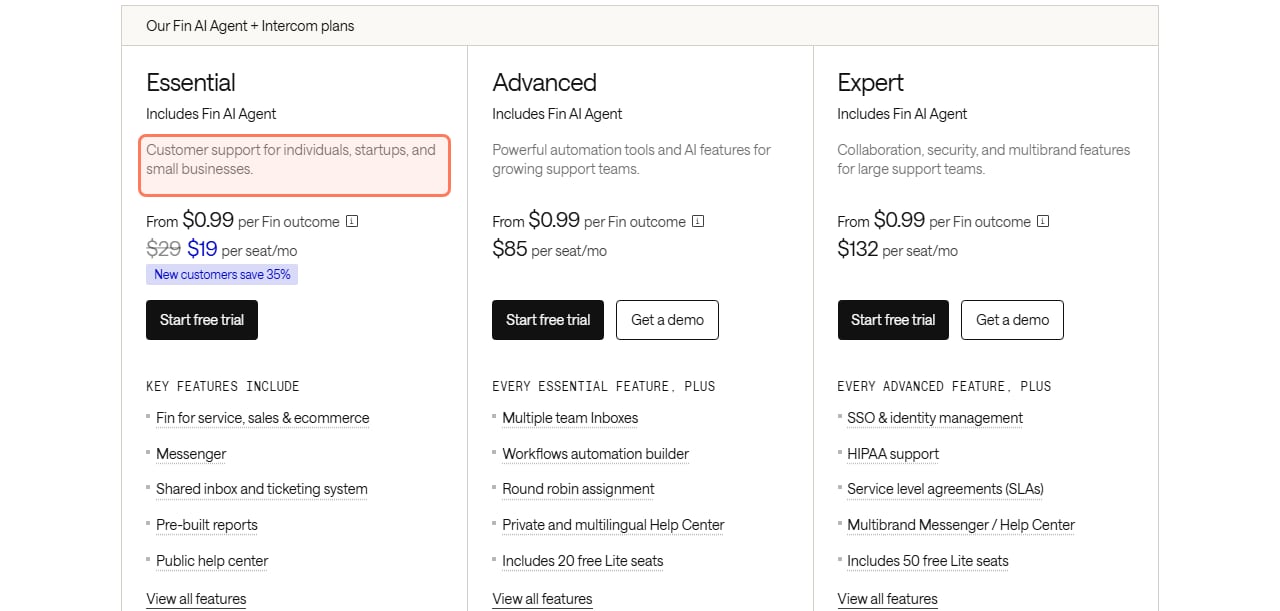
Answer customer questions and hand off the rest. Intercom lists its Fin AI Agent as "Fin for service, sales & ecommerce" that "Answers email, live chat, phone and more", "Takes action on external systems" and "Hands off to agents in preferred Inbox". That's the clearest small-business agent job: the repeat questions (order status, opening hours, returns) get answered, the hard ones reach you.
Do work across the apps you already pay for. Zapier describes its agents as working "across 9,000+ apps", and adds a limit worth knowing: "Zapier Agents can only take actions in the apps you've connected and use the triggers and actions you've set up." Typical jobs: read a new lead from a form, look the company up on the web, add it to the CRM, post a summary to your team.
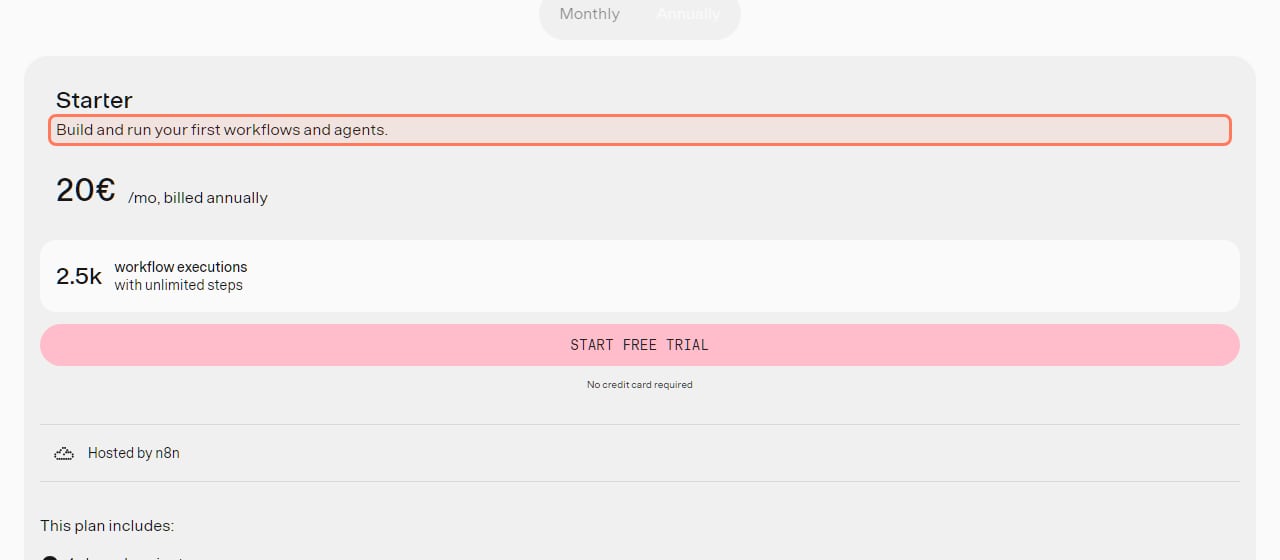
Run multi-step workflows with an AI step inside. n8n's Starter plan is pitched as the plan to "Build and run your first workflows and agents", and includes "Agents, MCP and AI nodes". This suits a business with someone comfortable building a flowchart: the workflow is fixed, the AI does the fuzzy step (classify an email, draft a reply). Our n8n AI agents guide walks through it.
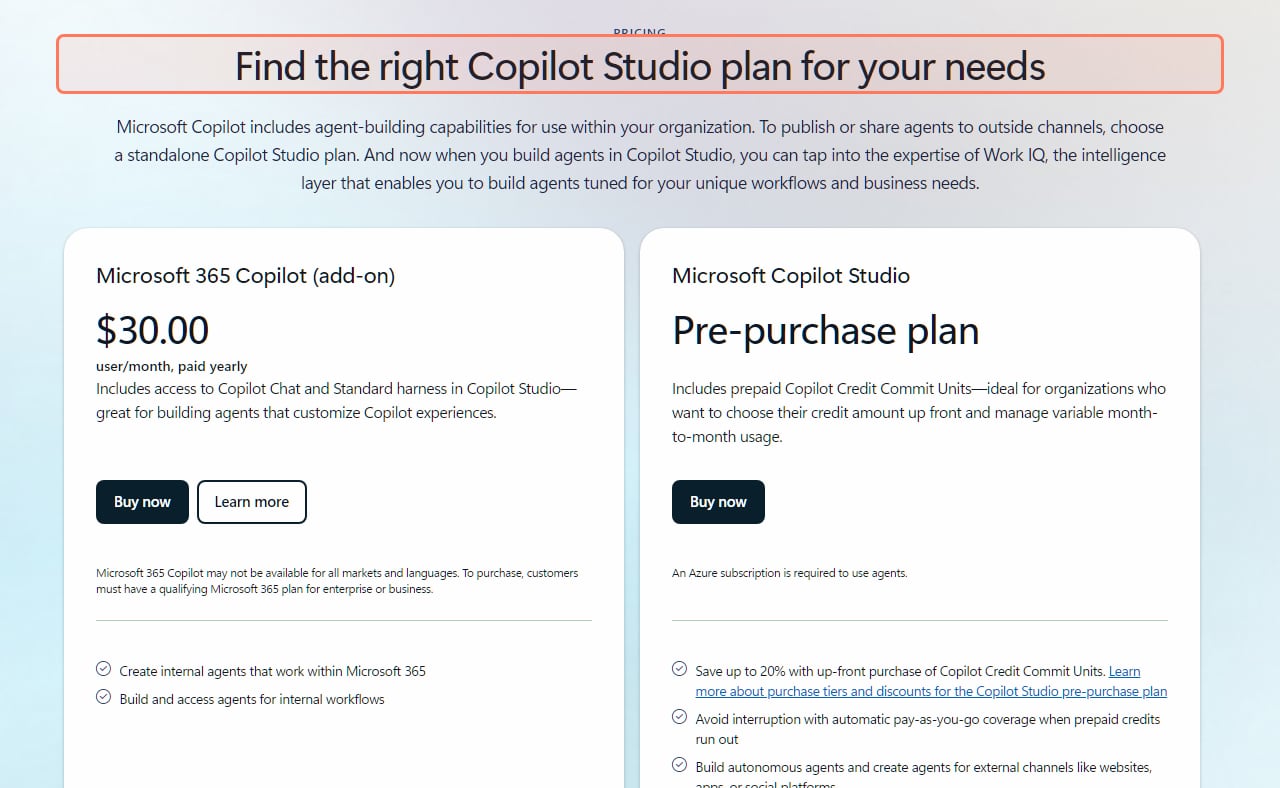
Agents inside the office suite you already use. Microsoft says its Microsoft 365 Copilot add-on lets you "Create internal agents that work within Microsoft 365", while publishing an agent to "external channels like websites, apps, or social platforms" needs a Copilot Studio plan.
Voice and phone. Phone agents are billed per minute or per call; Intercom says "Fin Voice is available via sales at $1.99 per voice outcome." Per-minute prices for the voice platforms are in what an AI voice agent costs per minute.
Intercom's own pricing page, read November 3, 2026 (annual billing selected). The support agent is billed per outcome, on top of a helpdesk seat. · Screenshot of intercom.com by aliteq
What does running an AI agent cost?
There are four ways vendors bill for agents, and they behave very differently as you grow. All prices below were read on the vendors' own pages on November 3, 2026; the totals are our arithmetic from those prices.
Four ways to pay for an AI agent (vendor pages, read Nov 3, 2026)
Per outcome (Intercom Fin)
What the vendor charges
From $0.99 per Fin outcome, plus a seat from $29 a month ($19 for new customers, annual)
What it means in practice (our arithmetic)
100 resolved chats: $99 + one seat = $118 to $128 a month
Per activity (Zapier Agents)
What the vendor charges
Free for 400 activities a month; Pro $33.33 a month billed annually ($400 a year) for 1,500
What it means in practice (our arithmetic)
Pro works out at about 2.2 cents an activity if you use all 1,500
Per workflow run (n8n)
What the vendor charges
Starter €20 a month billed annually, 2,500 executions; Pro €50, 10,000; self-hosted Community Edition free
What it means in practice (our arithmetic)
A run counts once however many steps it has
Per token (build your own on an API)
What the vendor charges
Claude Sonnet 5.5 $2 / $10 per million input / output tokens; Haiku 5.5 $0.10 / $0.50 (prompts up to 100K tokens)
What it means in practice (our arithmetic)
Our example task: about $0.09 on Sonnet 5.5, under half a cent on Haiku 5.5
What the vendor charges
What it means in practice (our arithmetic)
Per outcome (Intercom Fin)
From $0.99 per Fin outcome, plus a seat from $29 a month ($19 for new customers, annual)
100 resolved chats: $99 + one seat = $118 to $128 a month
Per activity (Zapier Agents)
Free for 400 activities a month; Pro $33.33 a month billed annually ($400 a year) for 1,500
Pro works out at about 2.2 cents an activity if you use all 1,500
Per workflow run (n8n)
Starter €20 a month billed annually, 2,500 executions; Pro €50, 10,000; self-hosted Community Edition free
A run counts once however many steps it has
Per token (build your own on an API)
Claude Sonnet 5.5 $2 / $10 per million input / output tokens; Haiku 5.5 $0.10 / $0.50 (prompts up to 100K tokens)
Our example task: about $0.09 on Sonnet 5.5, under half a cent on Haiku 5.5
Per outcome: support agents
Intercom charges per outcome, not per message. Its pricing page says: "You're only charged at most once per conversation, even if Fin takes multiple actions or answers multiple questions," and "If Fin can't answer or fails to perform an action, or if at any point the customer asks to speak to a human, you pay nothing." You also pay for the helpdesk: Essential is $29 a seat a month, shown at $19 for new customers on annual billing. Its Advanced and Expert plans are $85 and $132 a seat. So a shop whose agent resolves 100 chats a month pays $99 in outcomes plus at least one seat. The page also mentions spending limits: "Spending limits and alerts keep your costs predictable." Set one on day one.
Per activity or per run: Zapier and n8n
Zapier sells agents as an add-on with its own allowance. Its definition of what you pay for: "Activities include actions your agent takes in behaviors or in chat, browsing the web, or looking up information from attached knowledge." The free plan gives 400 a month; Agents Pro is $400 billed annually, shown as $33.33 a month, for 1,500. Zapier's ordinary automation plans are separate: Free covers 100 tasks a month, and Professional starts from $19.99 a month.
n8n bills by "monthly workflow executions, regardless of complexity", and says it lets you "only pay when a workflow runs from start to finish". n8n lists its prices in euros: Starter is €20 a month billed annually for 2,500 executions, Pro €50 for 10,000, Business €667 for 40,000. "A standard, self-hosted version of n8n is available on GitHub" as the free Community Edition, so you pay only for the server and the AI model. If your flows stop with a limit error, see n8n execution limit reached.
n8n's Starter plan on its own pricing page, read November 3, 2026, annual billing shown. n8n prices in euros. · Screenshot of n8n.io by aliteq
Per token: building your own agent
If you build the agent yourself (with a framework or a no-code tool that asks for your API key), the model provider bills tokens, roughly the words read and written. Anthropic's pricing page, read November 3, 2026, lists Sonnet 5.5, described as a "High-performance model for coding and agents", at $2 per million input tokens and $10 per million output tokens, and Haiku 5.5 at $0.10 input and $0.50 output for prompts up to 100K tokens. It also lists Managed Agents at "$0.08 per session-hour for active runtime" on top of tokens, and web search at "$10 / 1K searches".
A worked example, our arithmetic: an agent task that reads 30,000 tokens (your instructions, the email thread, a few lookups) and writes 3,000 costs 0.03 × $2 + 0.003 × $10 = $0.09 on Sonnet 5.5, and 0.03 × $0.10 + 0.003 × $0.50 = about $0.005 on Haiku 5.5. A thousand such tasks a month is about $90 or $5. The catch: agents loop, so one task can read the same context several times. Set a cap on steps and a monthly budget before you let one run unattended.
Per seat: the office suites
Microsoft lists Microsoft 365 Copilot (add-on) at "$30.00 user/month, paid yearly", which includes building internal agents. Agents for customers on your website or social channels need Copilot Studio, which Microsoft sells as "Copilot Credit capacity packs of 25,000 Copilot Credits each, priced at $200.00/pack/month", or as a pay-as-you-go meter. Anthropic's Claude Team plan is $20 a seat a month billed annually ($25 monthly). If you're choosing between the suites, our ChatGPT vs Copilot vs Gemini vs Claude for business compares them, and CRM AI features: Agentforce vs Breeze covers agents sold inside a CRM.
Microsoft's Copilot Studio pricing page, read November 3, 2026. Internal agents come with the $30 add-on; agents on outside channels draw on Copilot Credits. · Screenshot of microsoft.com by aliteq
Where do AI agents still fail?
Long, hands-off, multi-step work is not reliable yet, and the reasons are structural:
Errors compound. If each step works 95% of the time, a 14-step job works about half the time (0.95^14 ≈ 0.49, our arithmetic). The longer the chain, the more often something goes wrong somewhere.
They act on wrong guesses. An agent can call the wrong tool, invent a parameter or misread a result and carry on confidently. A wrong action costs more than a wrong sentence.
They loop and spend. A stuck agent retries and burns tokens or activities. That's why every vendor above sells limits, budgets or alerts.
They declare a botched job done. In July 2025 SaaStr founder Jason Lemkin reported that Replit's coding agent deleted a production database during what he called a "code freeze"; the agent said it "panicked", and Replit's CEO called the incident "unacceptable" (The Stack). What Replit's agent costs today is in Replit Agent cost.
How should a small business start with an AI agent?
Start small, measure, then widen
Pick one repeat job
The questions you answer ten times a week, or one copy-paste between apps
Pick how you want to pay
Per outcome, per activity, per run or per token, from the table above
Set the limits first
Spending cap, step cap, read-only access where you can
Check its work for two weeks
Read what it did; count what you had to fix
Widen only what worked
Add the next job once the first one needs no babysitting
Our checklist, built from the limits each vendor sells (read Nov 3, 2026) and the failure patterns above.
Can you run an AI agent on your own hardware?
Yes. The agent loop can call a model running on your own machine or on a rented GPU instead of a paid API, which keeps your files and customer data off a third-party model and swaps per-token bills for a fixed hourly or hardware cost. The trade-off is that an agent calls the model over and over, so the model has to fit in memory with room for long context. Check the fit in our VRAM calculator, then see how to run a local AI agent, how much RAM local AI needs and the best GPU for local AI.
Renting is the way to test before you buy. Our price tracker's reading at 15:20 UTC on November 3, 2026 had a single 24 GB RTX 3090 on Vast.ai from $0.11 an hour on demand and on Runpod at $0.50 an hour; left on around the clock for a 730-hour month, that's about $79 or $365 (our arithmetic). Prices move hourly, so check today's cloud GPU prices.
Which agent framework should you use?
If you're building rather than buying, the choice depends on who builds it: a no-code team fits n8n or Zapier, a developer team fits a code framework. Our AI agent frameworks compared covers the options, and LangGraph vs CrewAI compares the two most popular code frameworks. For the business case without the hype, read how to use AI agents to save time and money.
7/ 10
Verdict
Worth it for one narrow job, with a person checking
An AI agent is worth paying for when it takes one narrow, repeat job off your plate and you can check its work cheaply: support questions, data moved between apps, first drafts. Start on a free or per-outcome plan, set a spending cap, read what it does for two weeks, and only then give it more. Don't hand it anything you can't undo.
Best for: Small-business owners deciding whether an AI agent is worth paying for
Frequently asked
What can an AI agent do for a small business?
The jobs that work in Nov 2026 are narrow and easy to check: answering repeat customer questions and handing the rest to a person, moving information between apps you already use (a form entry into the CRM, a summary to your team), and researching or drafting for someone to review. Vendors like Intercom, Zapier, n8n and Microsoft sell agents for exactly these jobs.
How much does an AI agent cost per month?
It depends on how the vendor bills. On the vendors' pages on Nov 3, 2026: Intercom's Fin support agent is from $0.99 per outcome plus a seat from $29 a month; Zapier Agents is free for 400 activities a month or $33.33 a month billed annually for 1,500; n8n starts at €20 a month billed annually for 2,500 executions; Microsoft 365 Copilot is $30 per user a month paid yearly. By our arithmetic, one job on these plans runs from $0 (free tiers) to about $128 a month (100 resolved support chats plus one Intercom seat).
What does an AI agent cost per task if I build my own?
You pay the model provider per token. Using Anthropic's prices read Nov 3, 2026, a task that reads 30,000 tokens and writes 3,000 costs about $0.09 on Claude Sonnet 5.5 and under half a cent on Haiku 5.5, by our arithmetic. Agents can loop and reread context, so set a step cap and a budget.
What's the difference between an AI agent and a chatbot?
A chatbot answers your messages one at a time. An agent gets a goal and tools (code, web, your apps) and works in a loop, choosing a step, acting, reading the result and repeating, until the job is done or it hands off to a person.
Can AI agents work without supervision?
For narrow, easily checked tasks, mostly. For long, open-ended work, not reliably: small error rates compound over many steps, agents can act on wrong guesses, and they can report a failed job as done. Keep a person on anything that touches money, customer data or systems you can't restore.
Is there a free AI agent for small business?
Yes, with limits. Zapier Agents has a free plan with 400 activities a month, and n8n's Community Edition is free to self-host (you pay for the server and the AI model). Free plans are enough to test one job before you pay.
Can I run an AI agent without sending data to OpenAI or Anthropic?
Yes. Point the agent at an open model running on your own computer or a rented GPU. On Nov 3, 2026 our tracker had a 24 GB RTX 3090 on Vast.ai from $0.11 an hour; check the live prices on our cloud GPU page and size the model with the VRAM calculator first.
The short version: pick one repeat job, pay the way that fits its volume, cap the spend, and check the agent's work before you trust it with more. Today's GPU prices are on /cloud-gpu if you'd rather run the model yourself.