Most people's first drone is a waste of money. There's exactly one worth buying — it's sub-250g so you skip registration entirely, with a 1-inch-class sensor on board. The honest buyer's guide.
This post contains affiliate links. If you buy through them, Aliteq may earn a commission — at no extra cost to you. Prices verified at publish time.
Share
Most people's first drone is a waste of money, and the way it goes wrong is predictable. The $89 "4K" toy with no real GPS flies like a plastic bag in a hurricane. The bargain mid-tier one with a weak radio link can lose signal and just… leave. So here's the thing I'd grab every first-time buyer by the collar and say: there is exactly one drone worth buying first in 2026, and it weighs less than a can of soda.
That weight — under 250 grams — is the whole game. Cross that line and, flown recreationally, you don't register the thing with the FAA. No paperwork, no sticker, you unbox it and fly. Stay under it and you skip the single most annoying part of drone ownership. So the real question isn't "which drone." It's "which sub-250g DJI," because DJI quietly won this category and everyone else is playing for second. There are three worth your money. Let me save you the crashes.
Why your first drone is probably a mistake
The trap is the cheap end. You see a $99 drone with "4K UHD" plastered on the box and think, it's my first one, why spend real money. I get it — it's the classic first-drone mistake. Here's what typically happens: the camera is a wobbly phone sensor from 2016, there's no real GPS so it drifts the second you let go of the sticks, and the first gust of wind sends it somewhere over the neighbor's fence. You don't learn to fly a drone on those. You learn to fear flying a drone, then you leave it in a drawer. A cheap drone isn't a cheaper version of a good drone. It's a different, worse hobby that happens to share a name.
The good news is the floor for "actually good" has dropped to the sub-250g class, and that class is where the no-registration magic lives anyway. So the smart first buy and the legally-easiest first buy are the same drone. You don't have to choose between "good" and "simple" — DJI put them in the same box.
The one I'd buy first: DJI Mini 5 Pro
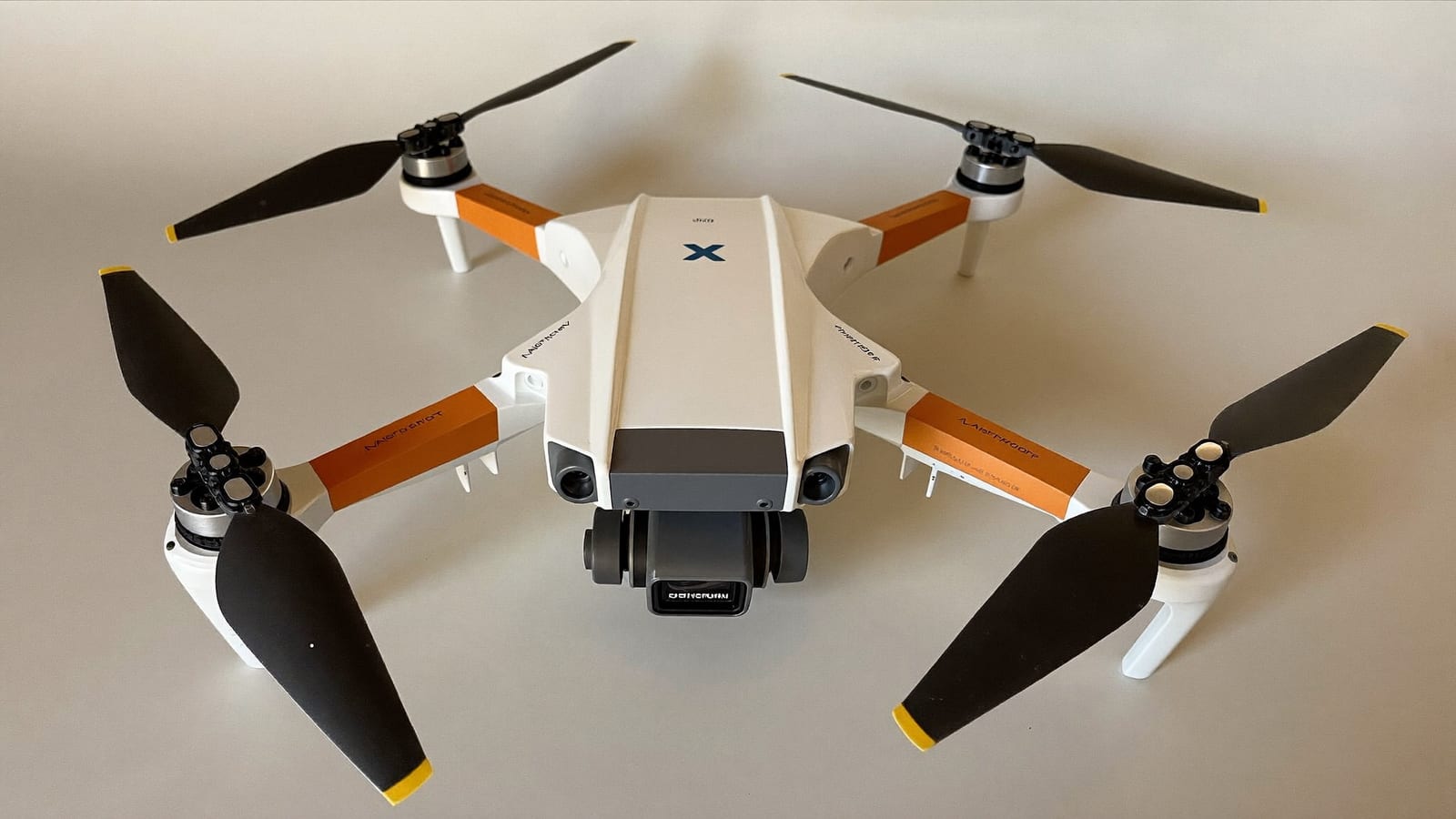
The one thing the Mini line needed was a bigger sensor without breaking the weight limit, and with the Mini 5 Pro DJI did it. It's got a 1-inch-class sensor in a body that still slips into a jacket pocket, and on paper that pays off the moment the light gets tricky — sunset, blue hour, that annoying window right after golden hour where cheap drones turn everything to mud. Reviewers back that up: Tom's Guide found its 1-inch sensor captures lots of detail to produce bright images, even in low-light conditions (Tom's Guide, Oct 2025).
But the feature I'd actually pay for isn't the camera — it's the obstacle avoidance. The shots beginners want live in tight spots: tree lines, alleys, the gap between two buildings. The Mini 5 Pro pairs omnidirectional sensing with forward-facing LiDAR, and Tom's Guide says that makes the drone highly capable of either braking in front of or bypassing obstacles, even in low light (Tom's Guide, Oct 2025). On a toy drone, the same mistake is a $99 pancake against a wall. If you're new, that safety net is worth the price by itself; it's the thing that lets you fly boldly instead of white-knuckling every launch.
The honest bit, because I promised: it's ~$900, which is real money, and the battery — like every drone battery ever advertised — does not hit the box number in the real world. Figure on comfortably less once you're fighting wind or shooting in the cold. And that sub-250g rating is with the standard battery; some of the bigger-battery options push the takeoff weight up toward the line, so if the registration-free status is why you're buying, check which battery you're flying. None of that stops me calling it the best travel drone on paper right now. It just means buy it with eyes open.
DJI Mini 5 Pro
The one I'd hand a friend on their way to the airport. Sub-250g so you skip registration, a 1-inch-class sensor that eats low light, and obstacle avoidance that reviewers rate highly. The best travel drone, full stop.
+ Sub-250g — no FAA registration for recreational flying
+ Big 1-inch-class sensor; genuinely good in low light
+ Obstacle avoidance that actively stops you crashing
+ Pocketable enough to actually bring it everywhere
+ The current best-in-class travel drone
Cons
− ~$900 is real money for a first drone
− Real-world battery life falls short of the advertised number
− Bigger-battery configs can nudge takeoff weight toward the 250g line
The smart-money pick, now that the 5 exists: DJI Mini 4 Pro
Here's the move nobody tells you about a product cycle: when the new flagship lands, last year's champ gets good and cheap while still being, you know, last year's champ. The DJI Mini 4 Pro was the drone I recommended to everyone for a solid year, and it did not suddenly get worse because the 5 came out. It's still sub-250g, still has omnidirectional obstacle sensing (sensors looking every direction, not just forward), still shoots 4K/60 HDR that looks legitimately cinematic. If you want a great travel drone today rather than the newest one, it's still that.
The gap versus the Mini 5 is real but narrow: a little less low-light muscle, a slightly smaller sensor, a bit less range. TechRadar's Mini 5 Pro review found less of an image quality difference with the Mini 4 Pro unless you're working in low light (TechRadar, Sep 2025) — so on a phone screen, in daylight, the gap is small. So the calculus is simple — if the extra ~$140 for the 5 makes you wince, buy the 4 Pro without a shred of guilt. It's not the compromise pick. It's the same great drone, on sale because it's not the newest toy anymore. Do get the Fly More combo, though; one battery and this thing will end every flight before you're ready to land.
DJI Mini 4 Pro
Last year's champ, now discounted — and it did not get worse. Sub-250g, omnidirectional sensors, cinematic 4K/60 HDR. If the Mini 5's price stings, this is the smart-money buy with zero shame attached.
At some point — maybe six months in, maybe a year — a certain kind of person outgrows the Mini. You start wanting a second focal length for those compressed, cinematic close-ups. You get sick of landing to swap batteries. You want footage that holds up on a big screen, not just a phone. That's the DJI Air 3S. It's got dual cameras — a wide and a 70mm telephoto, both feeding a proper 1-inch main sensor — and flight times up around 45 minutes, which on paper is a big jump over the Mini. It's heavier, too, and TechRadar notes the Air 3S has better battery life and wind resistance than the Mini 5 Pro (TechRadar, Sep 2025).
The catch is the whole reason the Minis exist: the Air 3S is ~724g, well over the line, so you register it and you carry a bit more setup discipline. It's not a beginner's first drone — it's a beginner's third, once you actually know you love this and you know exactly what the Mini couldn't do for you. Buy it when you have a specific reason, not because bigger sounds better. But when you're ready, this is where the road goes.
DJI Air 3S
The step-up, for when you've outgrown the Mini and know why. Dual camera (wide + 70mm tele) on a real 1-inch sensor, ~45-minute flights, steady in wind. Heavier, so you'll register it — but it's the real upgrade.
Buy the DJI Mini 5 Pro. On the specs and the reviews it's the best mix going: a 1-inch-class sensor, obstacle avoidance reviewers rate highly, and a sub-250g body — all without a single line of registration paperwork for recreational flying. If ~$900 is a stretch, the Mini 4 Pro gets you most of the way, in my view, for meaningfully less. Skip the cheap ones entirely; they're the reason people think they hate flying drones.
Best for: Anyone buying their first serious drone who wants travel-ready footage without the registration hassle — beginners very much included.
If you want the full breakdown of where these land against everything else I'd actually put in the air, I keep a running beginner drones shortlist — the honest "buy this, skip that" version — and the whole drones buying guide if you're weighing the step-up options too. No 50-drone mega-lists. Just the ones worth the crash risk.
Quick answers
Do I need to register a sub-250g drone?
If you're flying purely for fun, no — recreational drones under 250g are exempt from FAA registration and Remote ID in the US, which is the whole appeal of the Mini line. Two catches: you still need to take the free TRUST test (it's a 10-minute online quiz, no matter the weight), and if you monetize your footage — think brand deals, or arguably a TikTok/YouTube channel that earns money — the FAA treats that as commercial, which means Part 107 plus registration even on a 249g drone. Rules also differ abroad; the UK, for instance, dropped its registration threshold to 100g in 2026.
Mini 5 Pro or Mini 4 Pro — which should I actually buy?
Buy the Mini 5 Pro if you want the best low-light camera and the newest obstacle avoidance and the price doesn't scare you. Buy the Mini 4 Pro if you want to save ~$140 and don't mind having last year's still-excellent champ. On a phone screen, in daylight, you honestly won't see the difference. There's no wrong answer here — only a budget answer.
Are these hard to fly for a total beginner?
On paper, no. GPS holds them rock-steady when you let go of the sticks, so they hover in place instead of drifting into a wall like cheap drones do. The obstacle sensors slow or stop the drone before you hit things. There's an auto-return-home button if you panic. My honest advice: fly the first few flights in a big open field, high up, to build confidence — then get bold.
Is the advertised battery life real?
Not quite — no drone's is. The box number is a best-case, dead-calm, cruising-at-a-fixed-speed figure. In real life, fighting wind, hovering for shots, or flying in the cold, expect noticeably less. It's not DJI being dishonest so much as physics; every brand does it. The fix is boring but works: buy the Fly More combo so you've got two or three batteries and you never end a session because of one dead cell.