Yes, as long as the Open WebUI name and logo stay exactly as shipped. The 50-user number in its license only limits rebranding. Here's what Open WebUI's own license and docs say about logos, white-labeling, client hosting and what does need a paid license, read Nov 3, 2026.
Can your company use Open WebUI with more than 50 users without buying an enterprise license? Yes, if you leave the Open WebUI name and logo exactly as they ship. The 50-user number in Open WebUI's license is not a seat cap. It only limits who may remove or change the branding. Open WebUI's own docs say you can "Deploy to any number of internal users within your own organization (with all official branding kept)". What does need an enterprise license: rebranding or white-labeling above 50 users, adding your company logo anywhere in the app, and production use of the enterprise-only add-ons Terminals and Tether. Read on Open WebUI's license file and docs on Nov 3, 2026 (enterprise page re-checked Nov 6, 2026). This is a close reading of their text, not legal advice.
Do you need an Open WebUI enterprise license? (Open WebUI's license and docs, read Nov 3, 2026)
Internal rollout to 500 staff, Open WebUI name and logo unchanged
Enterprise license needed?
No. Docs: "Deploy to any number of internal users" with branding kept
Plain-text "Managed by YourOrg" notice, smaller than text-xs
No. Allowed, text only, no logo
Your company logo in the footer or a "Managed by" notice
Yes. Docs: a logo "remains co-branding even at 20 pixels high"
Rename it or swap the logo for a team of 50 or fewer people
No. Clause 4 exception (i), counted per rolling 30 days
Rename it or swap the logo for 51+ people
Yes, or prior written permission from Open WebUI
White-label it as your own SaaS product
Yes
Run the Terminals orchestrator (per-user workspaces) in production
Yes. Terminals ships under the Open WebUI Enterprise License
Use Tether (the desktop agent) commercially or across an organization
Yes. Enterprise page, re-checked Nov 6, 2026
Can we roll Open WebUI out to our whole company for free?
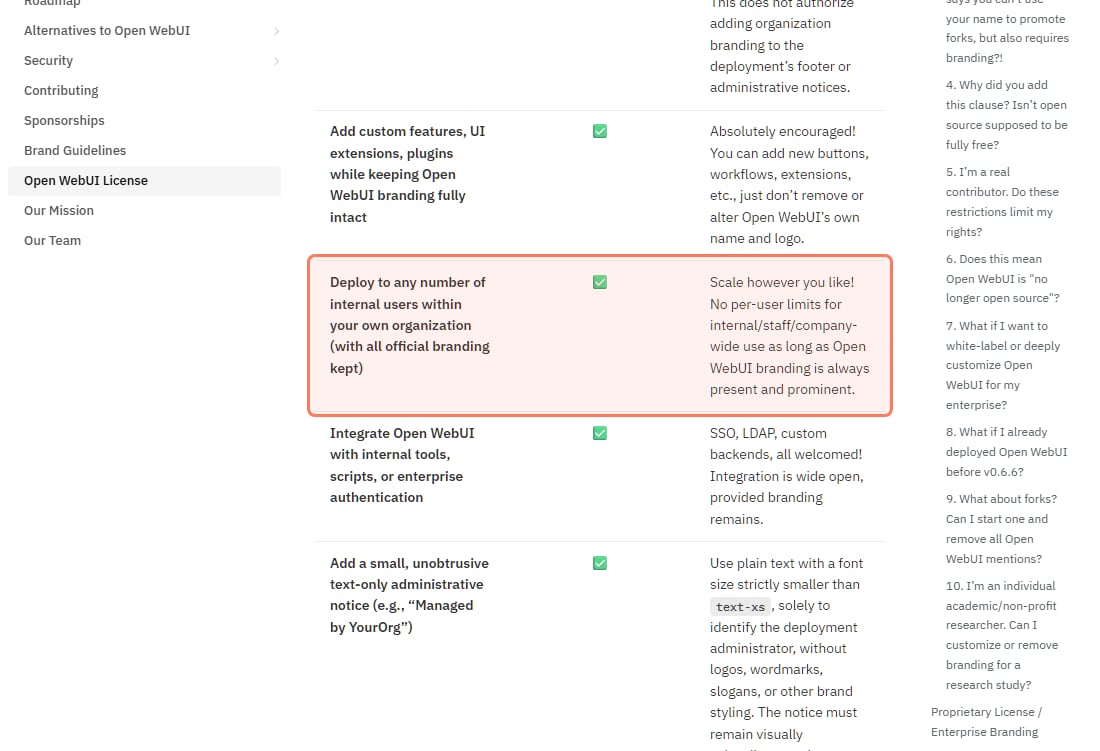
Yes. Open WebUI's license page in its docs has a table of what is "Typically" allowed without a license. One row covers exactly this case.
Open WebUI's own docs, docs.openwebui.com/license, read Nov 3, 2026. The outline is ours. · Screenshot of docs.openwebui.com by aliteq
The row reads "Deploy to any number of internal users within your own organization (with all official branding kept)", with the note "Scale however you like! No per-user limits for internal/staff/company-wide use as long as Open WebUI branding is always present and prominent." The enterprise page says the same in its license table: "Standard Use (Internal use with original branding exactly intact.)" is "Free", and it adds that "Open WebUI is free to use as-is for everyone. You can deploy it today without an enterprise agreement."
So the user count only matters if you change the branding. A 2,000-person company running the stock interface needs no license under this text. Open WebUI's enterprise page says Astellas Pharma "enabled 3,000+ employees" on it; big customers like that may buy licenses for support or branding, which is a different question from whether you must.
If you're sizing the hardware for a company-wide rollout, that's a separate problem: our VRAM calculator shows which models fit on which GPU.
What exactly does the 50-user limit apply to?
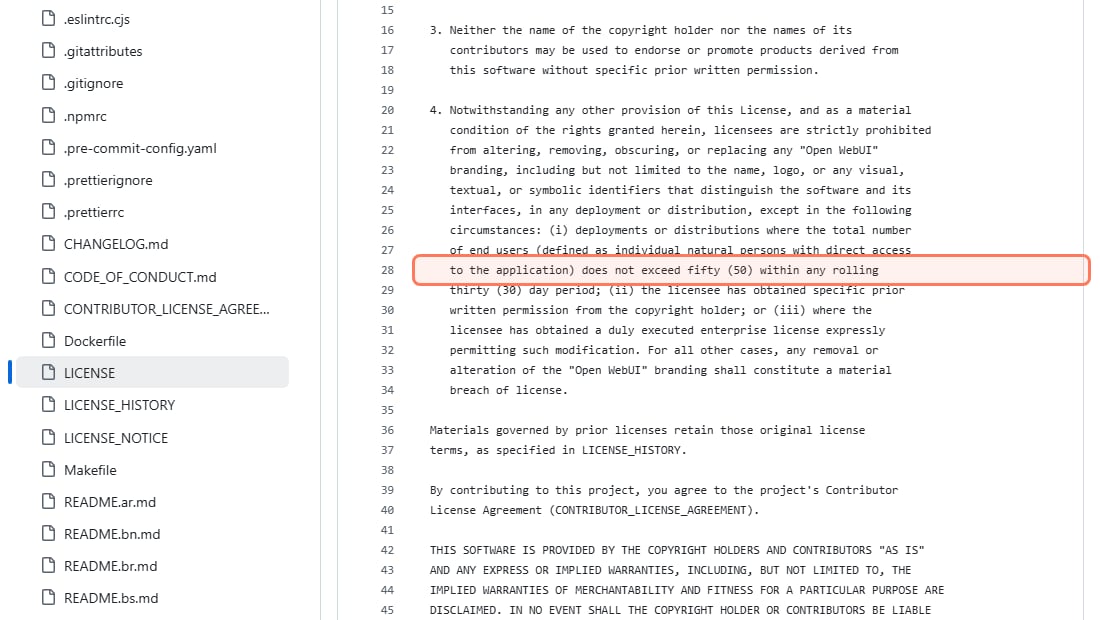
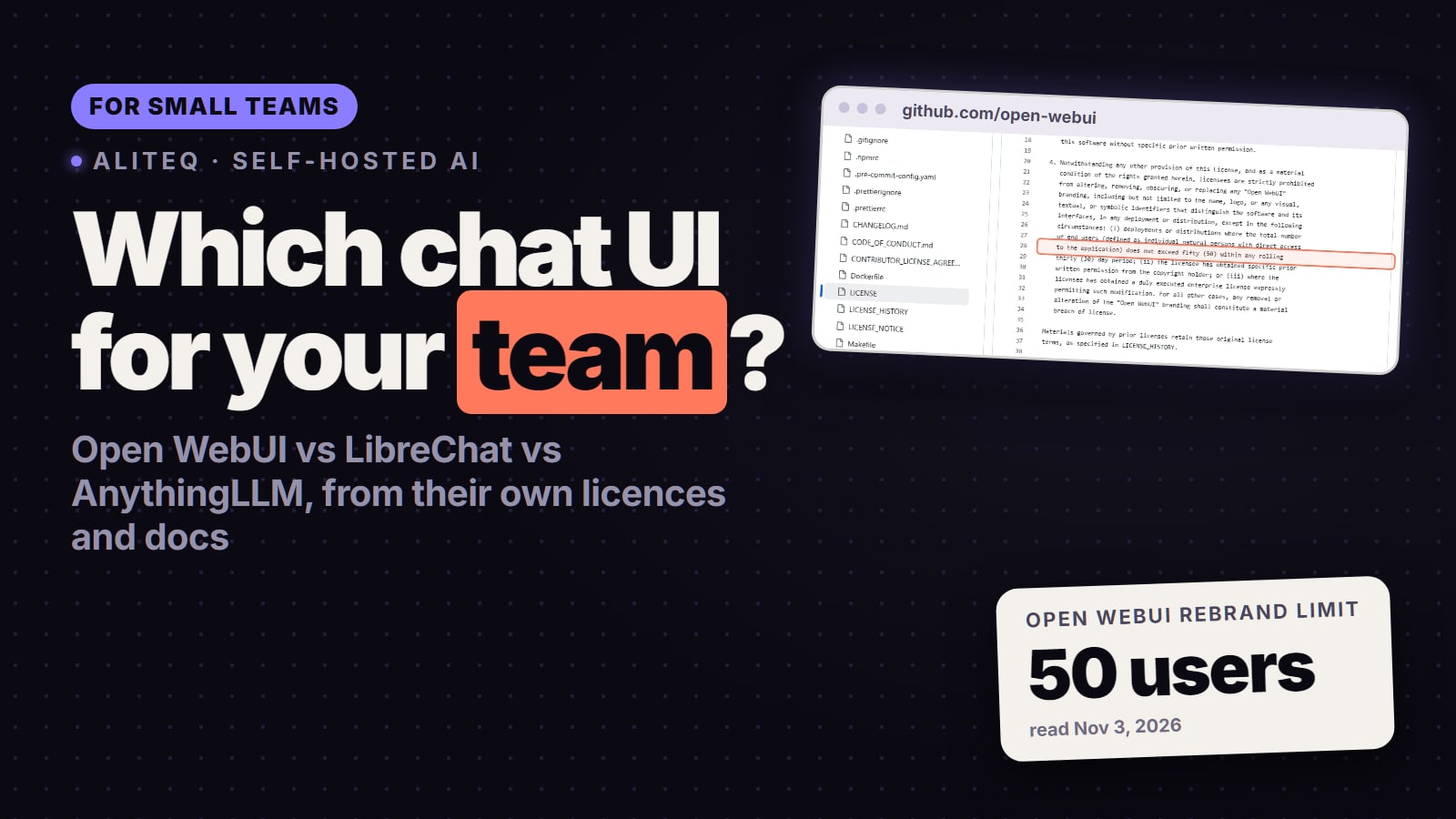
Only to changing the branding. Here is clause 4 of the license, word for word, from the LICENSE file as it stood on Nov 3, 2026 (unchanged since commit 26a645f on Apr 14, 2026):
4. Notwithstanding any other provision of this License, and as a material condition of the rights granted herein, licensees are strictly prohibited from altering, removing, obscuring, or replacing any "Open WebUI" branding, including but not limited to the name, logo, or any visual, textual, or symbolic identifiers that distinguish the software and its interfaces, in any deployment or distribution, except in the following circumstances: (i) deployments or distributions where the total number of end users (defined as individual natural persons with direct access to the application) does not exceed fifty (50) within any rolling thirty (30) day period; (ii) the licensee has obtained specific prior written permission from the copyright holder; or (iii) where the licensee has obtained a duly executed enterprise license expressly permitting such modification. For all other cases, any removal or alteration of the "Open WebUI" branding shall constitute a material breach of license.
Open WebUI License, clause 4. LICENSE file, read Nov 3, 2026
Clause 4 in Open WebUI's LICENSE file on GitHub, read Nov 3, 2026. The outline is ours. · Screenshot of github.com/open-webui/open-webui by aliteq
Three details decide most real cases:
People, not seats. End users are "individual natural persons with direct access to the application." Ten API keys used by one person is one end user; a shared login used by 60 staff is 60.
A rolling window. "Within any rolling thirty (30) day period", not a calendar month. A team that touches 51 different people over any 30 days is over the line.
Branding is wide. "The name, logo, or any visual, textual, or symbolic identifiers that distinguish the software and its interfaces." Renaming the app in the browser tab counts, not just swapping the logo file.
Clauses 1 to 3 are the familiar BSD terms: keep the copyright notice in source and binary redistributions, and don't use the copyright holder's name to endorse derived products. Clause 4 starts "Notwithstanding any other provision of this License", so it overrides the BSD freedoms where they conflict.
Can we put our company logo on Open WebUI?
Not without an enterprise license, at any size. This is the part most companies trip on, because it feels like a small thing. The docs say: "Co-branding in any form is not permitted, regardless of size, placement, separation, or visual prominence. This includes adding your organization’s logo to a footer or “Managed by” notice." The not-allowed table adds that "A logo remains co-branding even at 20 pixels high, at the bottom of the chat area, or when used only to identify the deployment administrator."
What you can add without a license, per the same docs page:
A text-only admin notice. A "Managed by YourOrg" line in plain text "with a font size strictly smaller than text-xs", with no logos, wordmarks, slogans or brand styling.
A text-only legal or contact link in the About dialog or footer, under the same size rule. "Never replace or remove Open WebUI credits."
Model icons and chat backgrounds set through Open WebUI's built-in settings. The docs call that "permitted customization, not deployment co-branding."
Your own features, plugins, SSO, LDAP and backends, as long as the branding stays where it was.
The docs also say "Always show us a screenshot before launch!" If your design team has a mockup, sending it to Open WebUI first costs nothing.
When do you need an Open WebUI enterprise license?
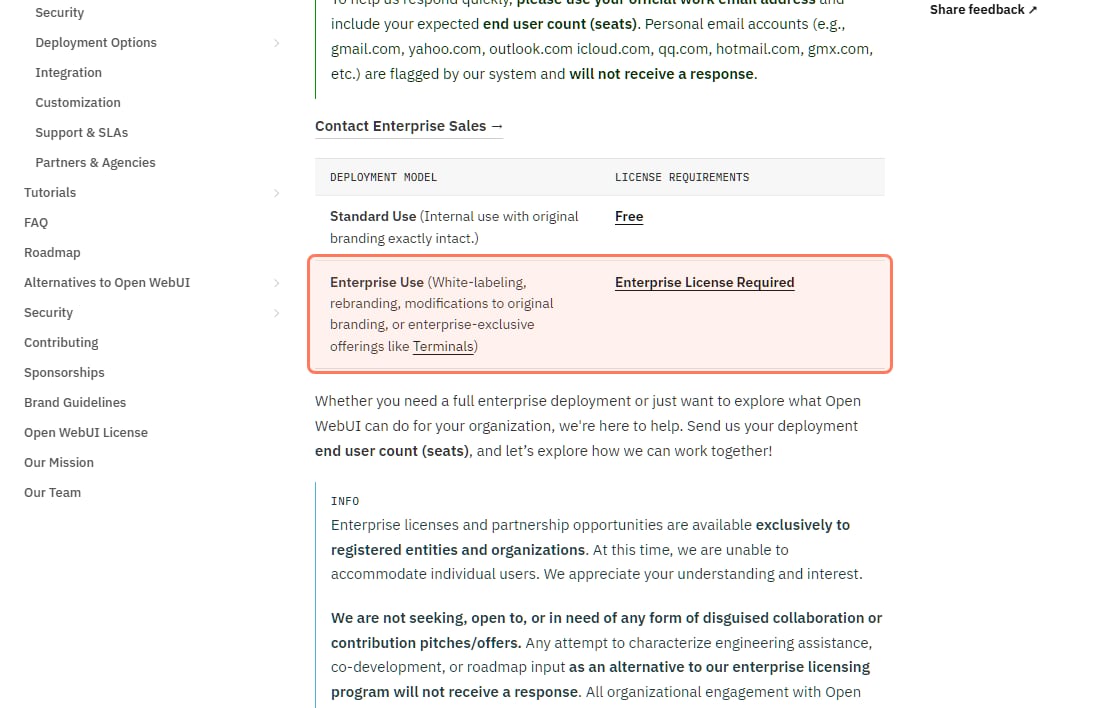
Open WebUI's enterprise page puts it in one table: anything that changes the branding, plus enterprise-only products.
The license table on docs.openwebui.com/enterprise, read Nov 3, 2026. The outline is ours. · Screenshot of docs.openwebui.com by aliteq
You need one if any of these is true:
You rebrand for more than 50 end users in a rolling 30 days, and don't have written permission instead.
You white-label it for customers. The docs: "You MUST get an enterprise or proprietary license before removing our branding for mass redistribution or resale."
You add any logo of your own (co-branding, above).
You run Terminals in production. Terminals is the orchestrator that gives every user their own Open Terminal workspace. Its docs say "Terminals requires an Open WebUI Enterprise License for production use," and its repository ships under "The Open WebUI Enterprise License", which allows free use only "for development and testing purposes." The single-user Open Terminal repository itself is MIT-licensed (read on GitHub, Nov 3, 2026).
You use Tether for work. Tether is a newer add-on that brings Open WebUI to the desktop and lets the AI work on your computer. When we re-checked the enterprise page on Nov 6, 2026, it had added Tether to the "enterprise-exclusive offerings" in the table above and said: "Commercial or organizational production use requires an Open WebUI Enterprise License with Tether access." (Our screenshot is from Nov 3, before Tether was listed.)
The newest release, v0.13.0 (published Nov 3, 2026), leans on Open Terminal for its new desktop, browser and terminal tabs, so check which piece you're deploying before you assume everything is free.
How much does an Open WebUI enterprise license cost?
There's no published price. On Nov 3, 2026 neither the enterprise docs nor the sales page listed one. The sales form at openwebui.com/contact/sales asks for "Expected users" in ranges from "1–50" to "5,000+" and your deployment type, and the enterprise page asks you to "include your expected end user count (seats)." Two conditions are on that page:
Work email only. It says personal addresses such as gmail.com "are flagged by our system and will not receive a response."
Companies only. "Enterprise licenses and partnership opportunities are available exclusively to registered entities and organizations." Individuals can't buy one.
Agencies and resellers are routed elsewhere: the Partners & Agencies page asks them to "please do not contact enterprise sales directly" and to use a partnership form instead, unless a client is ready to buy a license right away.
Can we host Open WebUI for clients or charge for access?
Yes, with the branding kept. The docs FAQ says you can "host it for your team or business, and even charge for access, as long as you follow the simple, clearly-scoped branding condition." If you run a public fork or a paid service with the branding kept, the docs ask you to say clearly, in the About section or landing page, that it's a customized fork of Open WebUI not affiliated with the official team. Removing the branding for customers is white-labeling, which needs the enterprise license.
Does the old BSD version get around the clause?
Legally, yes; practically, it's a trap. Open WebUI's LICENSE_NOTICE file says the code went MIT, then BSD-3, then the Open WebUI License after commit 60d84a3 (Apr 18, 2025, message "chore: license \"branding\" clause"). The docs say "The Open WebUI codebase up to and including v0.6.5 is BSD-3-Clause" and invite anyone to fork from there. v0.6.5 was published on Apr 14, 2025.
The catch is everything since. A v0.6.5 fork misses a year and a half of releases, and v0.13.0 alone says it "contains security fixes" that Open WebUI recommends installing "as soon as possible." Freezing a company chat server on an April 2025 build to avoid a branding rule means owning every patch yourself.
What if the branding rule is a deal-breaker?
Pick an MIT-licensed front end instead. LibreChat and AnythingLLM are both MIT, per their LICENSE files on GitHub (read Nov 3, 2026), so you can rebrand them for any number of users as long as you keep the MIT notice. We compare all three in Open WebUI vs LibreChat vs AnythingLLM, and if you're choosing between a browser UI and a desktop app, see Open WebUI vs LM Studio.
Quick answers
Can a company use Open WebUI with more than 50 users for free?
Yes, if the Open WebUI branding stays exactly as shipped. Open WebUI's docs (read Nov 3, 2026) allow "any number of internal users within your own organization (with all official branding kept)". The 50-user limit only applies to removing or changing the branding.
What is the Open WebUI 50-user limit?
Clause 4 of the Open WebUI License lets you alter or remove the branding only if the deployment has no more than 50 end users ("individual natural persons with direct access") in any rolling 30-day period, or with written permission, or with an enterprise license. It isn't a cap on users.
Can I add my company logo to Open WebUI?
Not without an enterprise license. The docs say co-branding "in any form is not permitted", and a logo "remains co-branding even at 20 pixels high". A plain-text "Managed by" notice smaller than text-xs is allowed.
How much does an Open WebUI enterprise license cost?
Open WebUI doesn't publish a price (checked Nov 3, 2026). Its sales form asks for your expected user count and deployment type, accepts work email only, and licenses are sold only to registered organizations.
Did Open WebUI change its license?
Yes. Commit 60d84a3 on Apr 18, 2025 added the branding clause; code up to v0.6.5 stays BSD-3, per LICENSE_HISTORY. The license text was last reworded on Apr 14, 2026 and was unchanged on Nov 3, 2026.
Is Open WebUI still open source?
Its source is public, but Open WebUI's own docs say the v0.6.6+ license "is not an OSI-approved \"open source\" license" because of the branding clause. LibreChat and AnythingLLM are MIT-licensed alternatives.
Does Open Terminal need an enterprise license?
The single-user Open Terminal repository is MIT-licensed. The Terminals orchestrator, which provisions a workspace per user, "requires an Open WebUI Enterprise License for production use" per its docs; development and testing are free.