Every chip inside a current Retroid, AYN, Anbernic or AYANEO handheld, read off the makers' own spec pages, set against what the PS2, 3DS and Switch emulator projects say they need. No benchmarks, no guesses: just the parts list and the fine print.
Every retro handheld spec sheet leads with the screen. I read the chip line first. In shooters I learned that the part you can't see decides the frame you lose, and handhelds are the same: the chip sets the ceiling, and no setting raises it.
So this is the parts list for every handheld on sale from Retroid, AYN, Anbernic and AYANEO, chip by chip, taken from the makers' own pages. Next to it is what the emulator projects themselves say they need. If you're choosing between two models already, our comparisons go deeper: Retroid Pocket Duo vs AYN Thor, Pocket Duo vs Duo Lite and the single-screen Retroid vs Odin vs Anbernic guide.
Which chip is in which handheld?
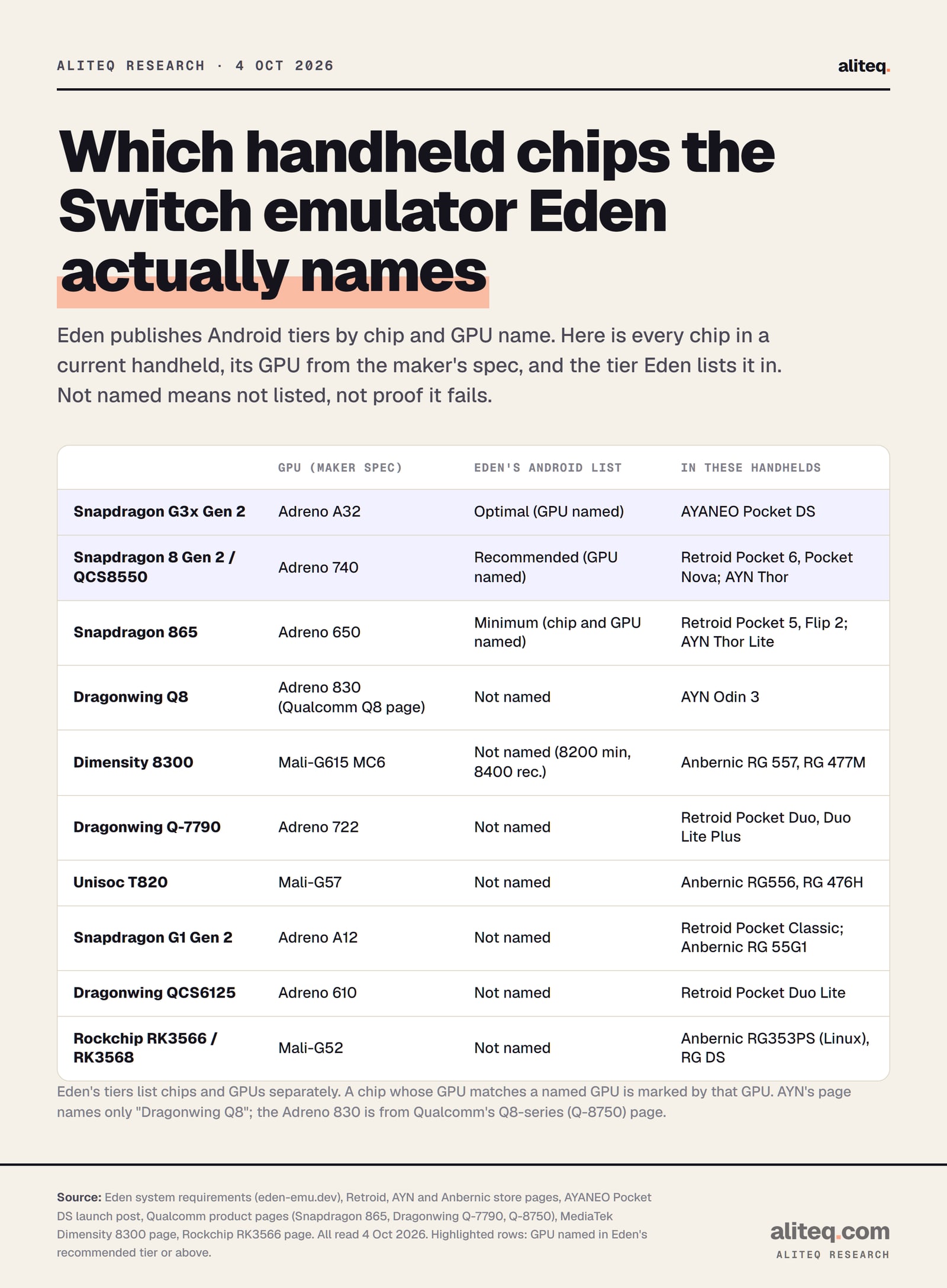
Ten chip families cover every handheld on sale from these four makers today. Qualcomm parts dominate: Snapdragon 865, 8 Gen 2, G3x Gen 2 and G1 Gen 2, plus the newer Dragonwing names. MediaTek, Unisoc and Rockchip fill out Anbernic's range. The GPU column matters most, because that is what emulator projects name.
Dragonwing Q8
GPU (maker spec)
Adreno 830 (Qualcomm's Q8 page)
Handhelds (maker price, 4 Oct 2026)
AYN Odin 3, from $369
Snapdragon G3x Gen 2
GPU (maker spec)
Adreno A32, 1 GHz
Handhelds (maker price, 4 Oct 2026)
AYANEO Pocket DS
Snapdragon 8 Gen 2
GPU (maker spec)
Adreno 740
Handhelds (maker price, 4 Oct 2026)
Retroid Pocket 6, from $244; AYN Thor Base to Max, $329 to $579
The Pocket 5's page never names its chip. It lists one Cortex-A77 core at 2.8 GHz, three at 2.4 GHz, four A55 cores at 1.8 GHz, and an Adreno 650. Retroid's Pocket Flip 2 page prints the same CPU and GPU lines under a variant labeled "SD865," and Qualcomm's own page lists the Adreno 650 as the Snapdragon 865's GPU. That is why I call it an 865.
QCS8550 is the 8 Gen 2's sibling. Retroid's Pocket Nova page lists the same CPU clocks (3.2, 2.8 and 2.0 GHz) and the same "Adreno 740@680MHz" as the Pocket 6's "8 Gen 2." Same parts list, different label.
The Odin 3's chip changed names. AYN's page now says only "Qualcomm Dragonwing Q8." Android Authority reported in April 2026 that the handheld was first marketed with a Snapdragon 8 Elite and that AYN removed that wording. AYN gives no part number. Qualcomm's Q8-series page lists the Q-8750 with an Oryon CPU up to 4.32 GHz and an Adreno 830 on a 3nm process.
Retroid's Duo family splits in two. The $149 and $169 Duo Lite use the QCS6125, with Cortex-A73 and A53 cores. The $219 Duo Lite Plus and $269 Duo use the much newer Q-7790. The full breakdown is in Pocket Duo vs Duo Lite.
What does the Switch emulator Eden say you need?
Eden publishes Android tiers by name. Minimum: Snapdragon 865, Adreno 650 or Mali G78, and 8 GB of RAM. Recommended: Snapdragon 8 Gen 1, Adreno 740 or Mali G715, and 12 GB. Optimal: Snapdragon 8 Gen 3 or G3 Gen 3, "Adreno A32/750," and 16 GB. It also requires Vulkan 1.1 on Android.
That makes Eden the rare project you can check a spec sheet against. Its page says: "Android has no OpenGL support, so your GPU must support Vulkan 1.1. Most PowerVR and Xclipse GPUs are unsupported." Its handbook adds the line that explains why the GPU column matters: "When NCE is enabled, do note that the GPU will almost always be the limiting factor. This is especially the case for Android." NCE (native code execution) runs the game's ARM code directly instead of translating it, and Eden says it is currently available on Android and, experimentally, Linux.
Where each handheld chip sits on Eden's own Android list. Read 4 Oct 2026. · aliteq research
Matched against the makers' GPU lines, three groups fall out:
GPU named as recommended or better: the Adreno 740 in the Snapdragon 8 Gen 2 and QCS8550 handhelds, and the Adreno A32 in the AYANEO Pocket DS's G3x Gen 2.
Named as the minimum: the Snapdragon 865 and its Adreno 650, in the Pocket 5, Flip 2 and Thor Lite.
Not named at all: the Dragonwing Q8, Q-7790 and QCS6125, the Dimensity 8300, the Unisoc T820, the G1 Gen 2 and the Rockchip parts. Eden lists the Dimensity 8200 as a minimum and the 8400 as recommended, but not the 8300 in between.
Read "not named" carefully. Eden's list tops out at the Snapdragon 8 Gen 3 and the Adreno 750, and the Dragonwing Q8 and its Adreno 830 simply aren't on it. That says nothing either way. For the Unisoc T820, the Rockchip parts and the QCS6125, there's no named tier anywhere near them to lean on.
Does your handheld have enough RAM for Eden?
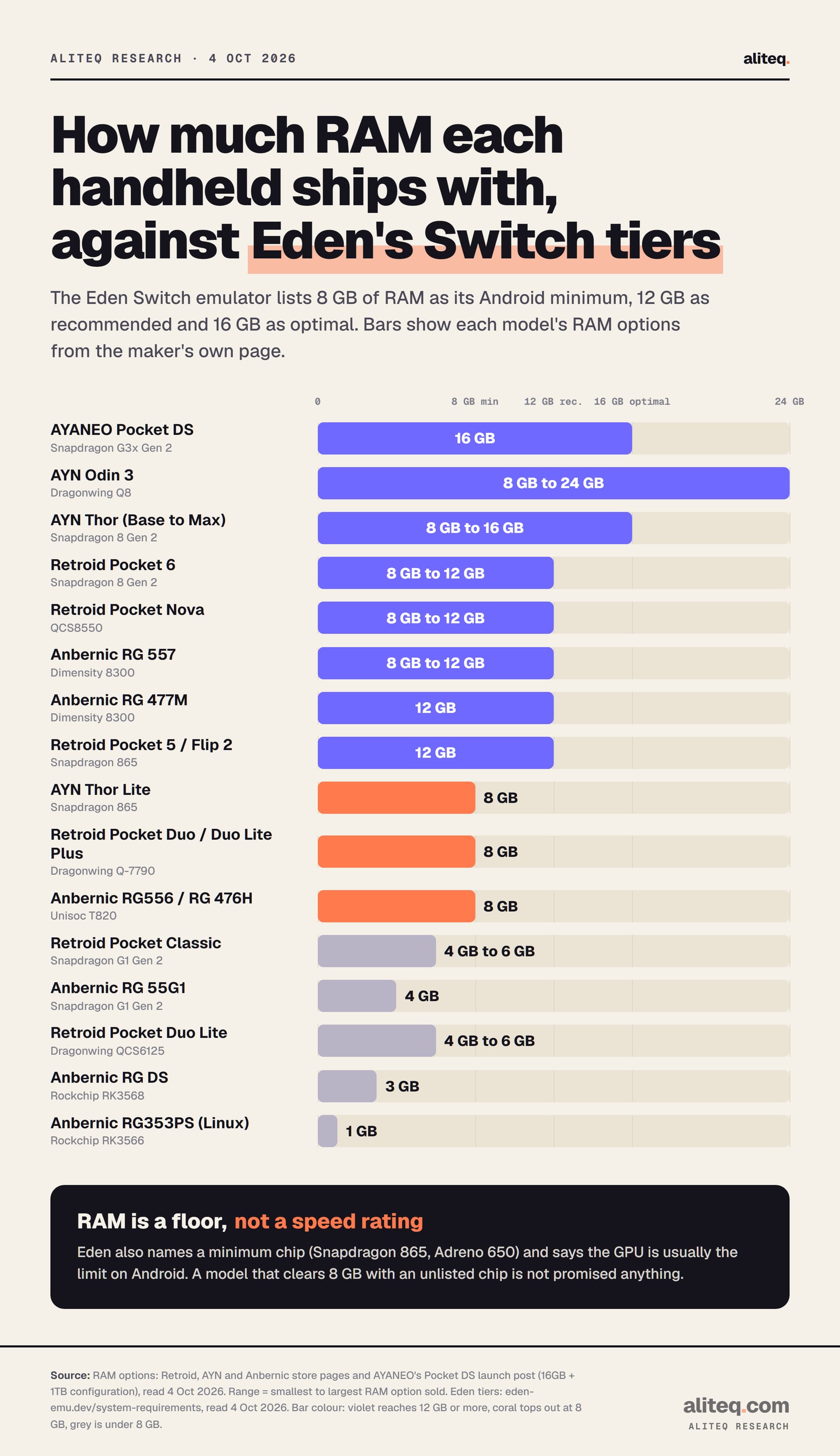
RAM is the one requirement you can check without any interpretation. Eden asks for 8 GB on Android, recommends 12 GB and calls 16 GB optimal. Most current mid-range and flagship handhelds ship with 8 GB or more, while the budget DS-style and Linux models ship with 1 to 6 GB.
RAM options on the makers' pages, against Eden's own tiers. Read 4 Oct 2026. · aliteq research
If you're buying with Switch in mind, the RAM choice inside one model matters. The Retroid Pocket 6 is $244 with 8 GB and $279 with 12 GB on Retroid's store. The AYN Thor runs from 8 GB on the $329 Base to 16 GB on the Max. The Retroid Pocket 5 and Flip 2 ship with 12 GB, more than the newer Pocket Duo's 8 GB, even though their chip is older.
Which handhelds can run PS2 emulation, by what the projects say?
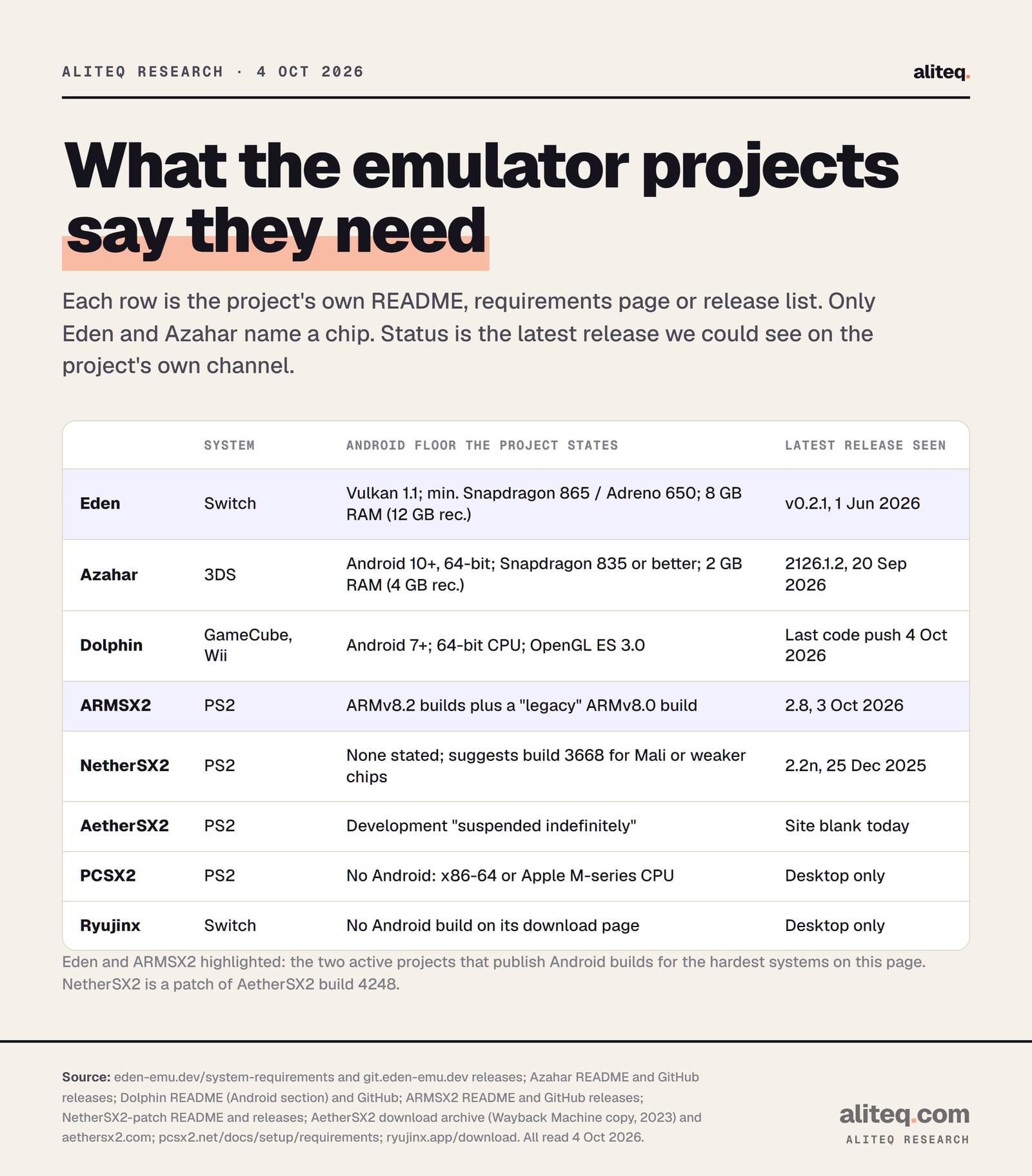
No PS2 project for Android prints a minimum chip. PCSX2, the main PS2 emulator, lists only x86-64 or Apple M-series processors. On Android the options are ARMSX2, a PCSX2 fork with ARM64 builds, and NetherSX2, a patch of the discontinued AetherSX2. The chip question stays open by design.
Here's where each project stands, from its own pages:
AetherSX2. The archived download page says "Active development is suspended indefinitely." The live site at aethersx2.com returned a blank page when I checked on 4 October 2026.
NetherSX2. Its README calls it a "Continuation of NetherSX2 based on AetherSX2 4248." It offers two variants and gives the only chip advice any PS2 project prints: "It's recommended to use 3668 with Mali or less powerful devices to get the best performance. For more powerful or Adreno devices, 4248 is the recommended variant to use." The latest release on its repo is 2.2n, from 25 December 2025.
ARMSX2. It describes itself as "The Playstation 2 Emulator for ARM64 Platforms." Its README explains that PCSX2's fast recompilers "are x86-64 only" and that the fork exists "to close that gap." Release 2.8 (3 October 2026) ships Android builds for ARMv8.2 plus a "legacy" ARMv8.0 build. The README says "a BIOS dump from a legitimately-owned PS2 console is required."
So the honest chip reading for PS2 is narrow. NetherSX2 splits the field into Adreno devices and "Mali or less powerful" ones. That puts the Anbernic Dimensity 8300 and Unisoc T820 models, which use Mali GPUs, on its slower-build side. ARMSX2 is moving fast, with release 2.7.2 on 30 September and 2.8 on 3 October, so check its release notes rather than any article, including this one.
What each emulator project states on its own pages. Read 4 Oct 2026. · aliteq research
What about 3DS, GameCube and Wii?
Their floors are lower and easier to clear. Azahar, the 3DS emulator, asks for Android 10 on a 64-bit device, "Snapdragon 835 SoC or better," and 2 GB of RAM, with 4 GB recommended. Dolphin, for GameCube and Wii, asks for Android 7, a 64-bit processor and OpenGL ES 3.0.
Dolphin adds a warning worth reading twice: "Performance varies heavily with driver quality." It also says it "can only be installed on devices that satisfy the above requirements." Azahar names only Qualcomm's 835 and doesn't rank MediaTek, Unisoc or Rockchip chips against it, so I won't either. For the 3DS setup itself, including dual-screen layouts, see how to set up Azahar. For the full emulator list by console, see the best emulator for every console.
Which Switch emulators are still active?
Eden is the one I could verify end to end: its site, its requirements page and its own release server, where v0.2.1 (1 June 2026) ships four Android builds. Ryujinx, now maintained at ryujinx.app, is active but lists only Windows, macOS and Linux downloads. Citron and Sudachi I could not verify from their own sites today.
Details, from each project's own channel on 4 October 2026:
Eden. Its README calls it "a free and open-source (FOSS) Switch 1 emulator." The release page lists standard, optimized, legacy and ChromeOS Android builds.
Ryujinx. The homepage says it "has been tested on approximately 4,300 titles," with "roughly 3,550 of those being considered playable." Its download page offers no Android build, so it is not an option on these handhelds.
Citron. Its official domain did not resolve when I checked, and lookalike sites are in search results. I've left it out rather than point you at the wrong one.
Sudachi. Its site loaded only a "Loading..." page, so I couldn't read a status or requirements.
Eden's thanks list names Yuzu, Ryujinx, Sudachi, Citron, Torzu, Suyu and Ryubing, which tells you how many forks this scene has been through. Stick to a project's own site and repo.
How do you check a handheld before you buy?
Read three lines on the maker's spec page: the chip, the GPU and the RAM. Then compare them with the emulator project's own requirements, not a forum post. If the chip isn't named anywhere, treat performance as unknown until someone publishes a test with that exact model and variant.
Find the chip and GPU on the maker's page. If the chip isn't named (like the Pocket 5), match the CPU and GPU lines to the chip maker's page.
Check the RAM variant you're actually buying. Eden wants 8 GB minimum and 12 GB recommended; several models sell both.
Compare against the project's own requirements: Eden's tiers for Switch, Azahar's Snapdragon 835 floor for 3DS, Dolphin's OpenGL ES 3.0 for GameCube.
Check the project's latest release date on its own repo. A project with no release in months may not support a newer chip yet.
The decision, by what you want to play:
Switch is the goal. On Eden's own list, the Adreno 740 handhelds (Retroid Pocket 6 and Pocket Nova, AYN Thor Base and up) and the Pocket DS's Adreno A32 are the named fits. Take the 12 GB variant where there is one.
PS2 is the goal. No project prints a floor. NetherSX2 points Mali and weaker devices to its older build, so the Adreno handhelds are the safer read.
DS, 3DS and older. Azahar's floor is a Snapdragon 835, and the dual-screen models are compared in Retroid Pocket Duo vs AYN Thor.
Quick answers
What chip do I need for Switch emulation on a handheld?
Eden, the Switch emulator with a published Android list, names a Snapdragon 865 with an Adreno 650 and 8 GB of RAM as its minimum. It recommends an Adreno 740 (or Snapdragon 8 Gen 1) with 12 GB, and calls an Adreno A32 or 750 with 16 GB optimal. It also requires Vulkan 1.1. Read on eden-emu.dev, 4 Oct 2026.
Can the Retroid Pocket 6 run Switch games?
Its Snapdragon 8 Gen 2 has an Adreno 740, the GPU Eden names in its recommended tier, and it ships with 8 GB or 12 GB of RAM ($244 or $279 at Retroid's store, 4 Oct 2026). That matches Eden's list on paper. We haven't tested it, and no project promises a specific game will run.
Is AetherSX2 still being developed?
No. Its archived download page says active development "is suspended indefinitely," and its site showed a blank page on 4 Oct 2026. NetherSX2 continues from AetherSX2 build 4248, and ARMSX2 is an actively updated PCSX2 fork with Android builds.
Does Snapdragon 865 run PS2 emulation?
No PS2 project names a minimum chip, so there's no official answer. NetherSX2's README recommends its newer 4248 build for "more powerful or Adreno devices," and the 865's GPU is an Adreno 650. Check ARMSX2's and NetherSX2's own release notes for current guidance.
Which chip is in the AYN Odin 3?
AYN's store page lists a "Qualcomm Dragonwing Q8" with no part number. Android Authority reported in April 2026 that it was first marketed as a Snapdragon 8 Elite. Qualcomm's Q8-series page lists the Q-8750 with an Oryon CPU and an Adreno 830 GPU.
Is a Unisoc T820 or RK3566 handheld good for Switch or PS2?
Neither chip appears on Eden's Android list, and Anbernic's RK3566-based RG353PS ships with 1 GB of RAM and Linux, far under Eden's 8 GB minimum. The T820 models ship with 8 GB but a Mali-G57 GPU, which NetherSX2 would point to its lighter build. They suit older systems better.
The chip line won't tell you how a game feels in your hands. It tells you which projects have said they'll even try. Read it first, then read the emulator's own page, then decide.