Apple charges $99 a year, Google $25 once, and Expo's build service has a free tier. What each vibe coding tool actually hands you, and the Google Play wait nobody mentions, from the price pages themselves.
You built something in Lovable, Bolt or Replit. It works in the browser. Now a friend asks, "Is it in the App Store?" and you find out it's a separate project with its own fees, accounts and waiting. I read each price and each rule on the vendor's own page on 3 October 2026. I did not build or submit an app for this piece, so there are no war stories here, just what the pages say.
What do the two stores charge you?
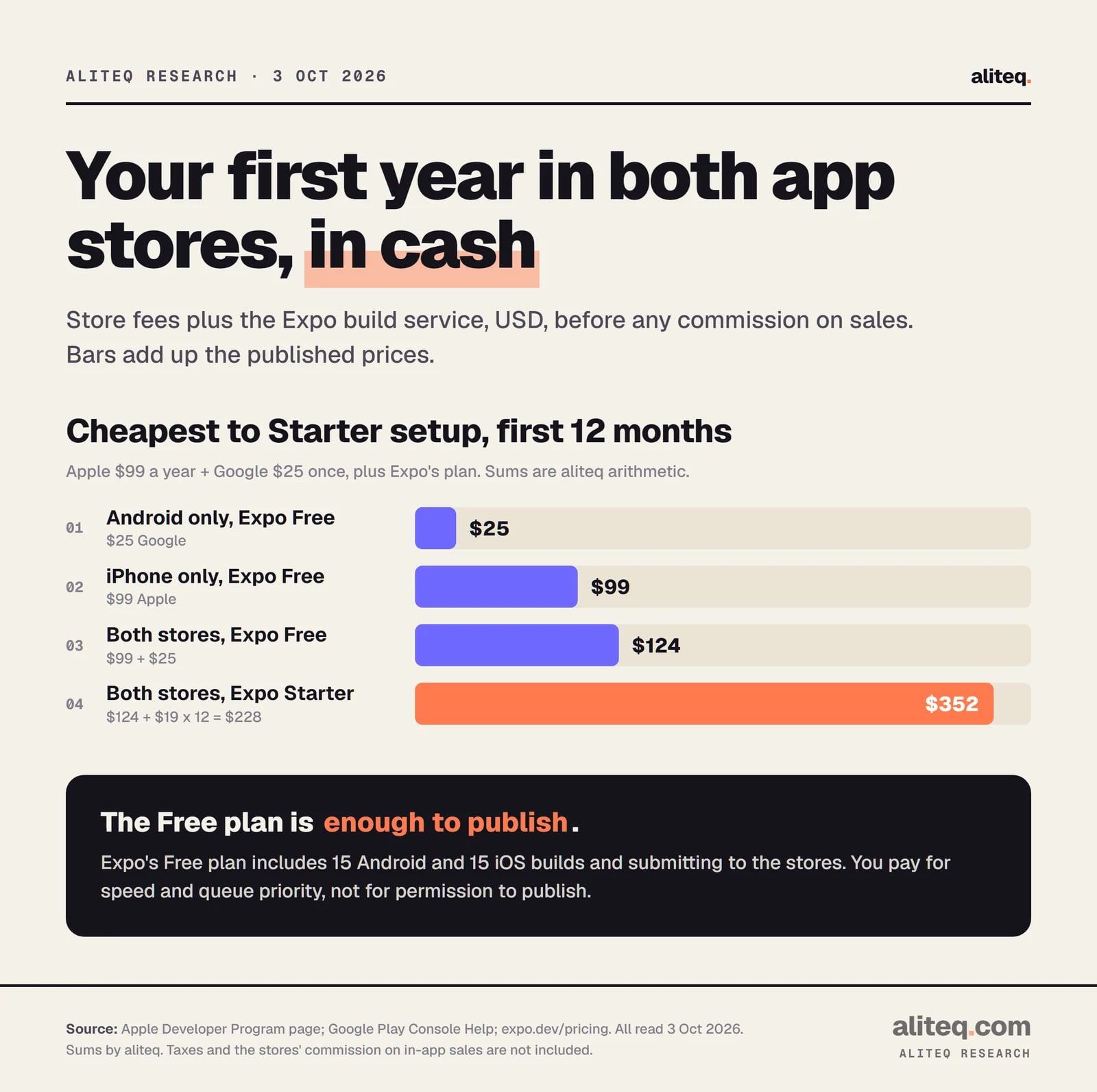
Apple charges $99 per membership year. Google charges a one-time $25 registration fee. Those are the entry tickets, and neither one pays for hosting, a database or the build itself. Apple's page says "99 USD per membership year, or in local currency where available."
Apple: $99 a year. Eligible nonprofits, schools and government entities can request a fee waiver. Membership also includes 25 Xcode Cloud compute hours a month, which is Apple's own build service for people who use Xcode on a Mac.
Google Play: $25 once. Prepaid cards are not accepted, you must be 18, and Google may ask for a government ID and a credit card in your legal name.
Commission, only if you sell inside the app: Apple takes 30%, or 15% under its Small Business Program and for qualifying subscriptions. Google says 97% of developers pay no service fee, and of those who do, 99% qualify for 15% or less. Rates differ by country.
Apple's pricing section lists the membership fee and the commission. I saw no separate fee for App Review on that page.
Fees read 3 Oct 2026. The sums are ours: $99 + $25 = $124; $124 + $19 x 12 = $352. · aliteq research
What does Expo charge for building the app?
Expo's software is free and open source, and its cloud service, EAS, is where the price is. The Free plan costs $0 and includes 15 Android and 15 iOS builds and the ability to submit to the stores. Starter is $19 a month, Production is $199 a month, and both add usage on top.
A "build" is the step that turns your code into the file a store accepts. Expo does it on its servers, so you don't need a Mac for the iPhone version. Here is what each plan says it includes:
Expo EAS plans (expo.dev/pricing, read 3 Oct 2026)
Free
Price
$0 a month
Builds
15 Android + 15 iOS builds, low-priority queue
Limit
45-minute build timeout
Starter
Price
$19 a month + usage
Builds
$45 of build credit, high-priority queue
Limit
2-hour build timeout
Production
Price
$199 a month + usage
Builds
$225 of build credit, 2 concurrent builds
Limit
2-hour build timeout
Enterprise
Price
Custom
Builds
From $1,000 of build credit
Limit
2-hour build timeout
Price
Builds
Limit
Free
$0 a month
15 Android + 15 iOS builds, low-priority queue
45-minute build timeout
Starter
$19 a month + usage
$45 of build credit, high-priority queue
2-hour build timeout
Production
$199 a month + usage
$225 of build credit, 2 concurrent builds
2-hour build timeout
Enterprise
Custom
From $1,000 of build credit
2-hour build timeout
Past the credit, builds are flat-priced: Android $1 on a medium worker and $2 on a large one, iOS $2 medium and $4 large. The Free plan's queue is the real cost. Expo says you "may experience wait times of 90+ minutes" at peak times on the low-priority queue. If you ship twice a week, that is tolerable. If you are fixing a rejection at midnight, $19 starts to look cheap.
What does each vibe coding tool actually give you?
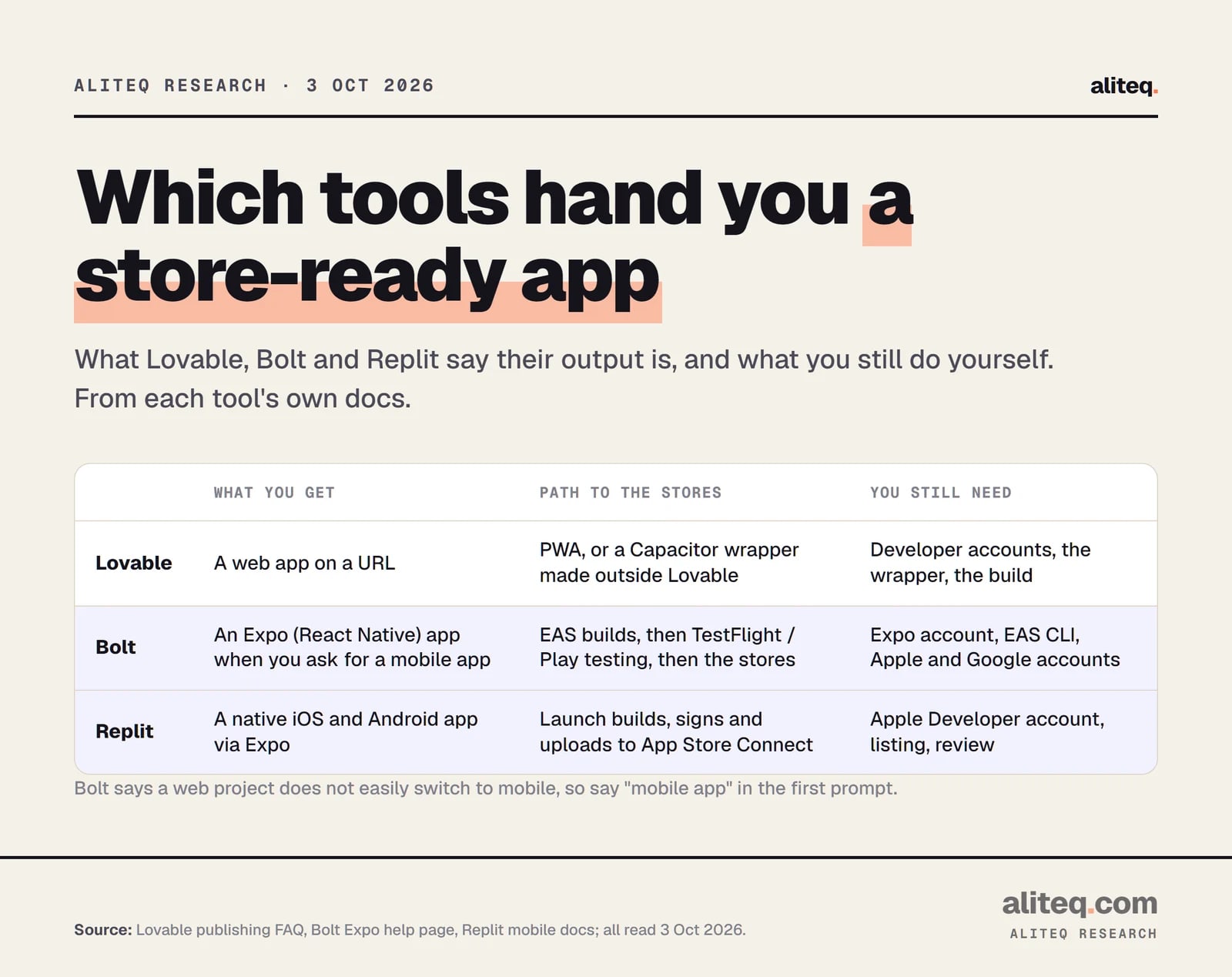
Only two of the three produce a mobile app. Lovable builds web apps. Bolt and Replit build Expo apps, which are real native apps. That decides how much work stands between you and the stores.
From each tool's own docs, read 3 Oct 2026. · aliteq research
Lovable: its publishing FAQ says it "builds web apps" and "there isn't a built-in flow that packages and submits your project to the App Store or Google Play." Its two suggestions are a Progressive Web App (people add your site to their home screen) or a Capacitor wrapper made outside Lovable. It adds that Lovable "does not generate projects in React Native." Its own iOS and Android app is for building projects from your phone, not for shipping yours. See what Lovable is for the basics.
Bolt: ask for a "mobile app" and Bolt uses Expo. Its docs list a path to TestFlight and the App Store, and to Google Play testing and the Play Store. You need the EAS command-line tool, an Expo account, and paid Apple and Google developer accounts. One warning from Bolt: "Projects created for web do not easily switch over to mobile," so say "mobile app" in the first prompt.
Replit: Agent builds native iOS and Android apps with Expo. Its Launch feature builds, signs and uploads the app to App Store Connect, with the build compiled "on Expo's servers." Replit says this can take up to 45 minutes. Its page states no price for that step, so I can't tell you one.
What is the wait nobody mentions?
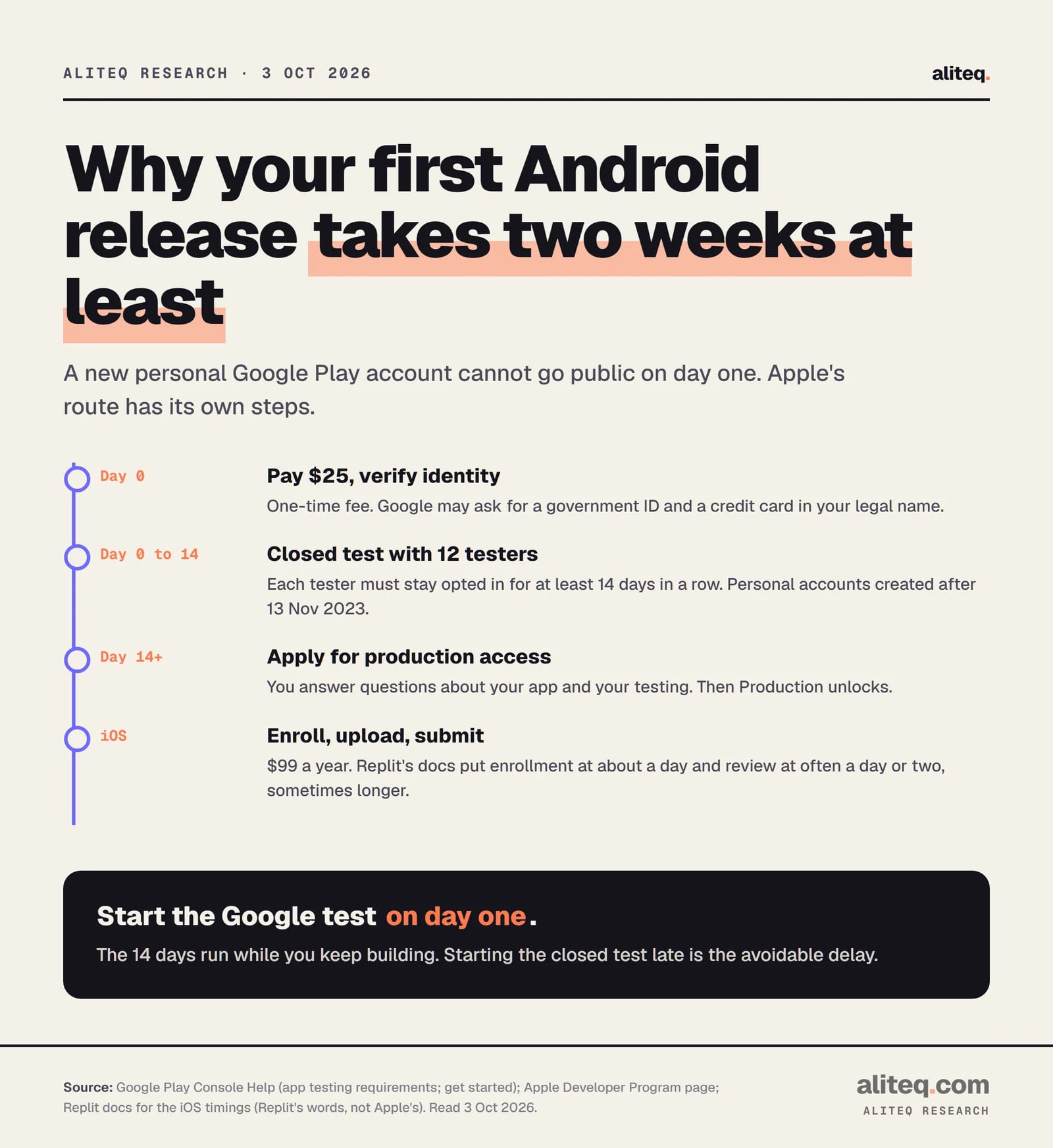
On Google Play, a new personal account can't go public on day one. Google requires accounts created after 13 November 2023 to run a closed test with at least 12 testers who stay opted in for at least 14 days. Only then can you apply for production access.
Google's rules, read 3 Oct 2026. iOS timings are Replit's words, not Apple's. · aliteq research
The practical move is to start the closed test as soon as you have a working build. The 14 days run while you keep improving the app. Organization accounts are a different type, so check which one you choose at sign-up.
Apple's wait is different. Replit's docs put enrollment at "about a day" and review at "often a day or two, and sometimes longer, especially the first time." Those are Replit's estimates, not Apple's. Replit also calls rejections "common."
What gets a simple app rejected?
Apple's Guideline 4.2 says your app "should include features, content, and UI that elevate it beyond a repackaged website." It also says apps shouldn't primarily be "marketing materials, advertisements, web clippings, content aggregators, or a collection of links."
That matters most for a wrapped web app, such as a Lovable site put in a Capacitor shell. A native Expo app isn't automatically safe either. It still has to be useful on its own. Replit adds that a mismatch between your App Privacy answers and what the app collects is a common rejection reason. If your app stores user data, run the security checks before you share it first, because a store listing puts it in front of strangers.
A watch item: Android developer verification
Google is rolling out developer verification for Android. Per Google's page, protections begin on 30 September 2026 for users installing from participating stores in Brazil, Indonesia, Singapore and Thailand on certified devices, with a global rollout in 2027. Google says Play "automatically registers 99% of apps," and hobbyists can share apps with up to 20 devices without a government ID or registration fee. If you only publish through Play, you are mostly covered. I did not see a price on that page.
So what should you budget?
For one app on both stores, plan for $124 in the first year if the Expo Free plan is enough, and $352 with Expo Starter all year (both are sums of the prices above). Then add your time. The money is small. The real cost is the two or three weeks of accounts, builds, testers, screenshots and review.
If you only want it on phones quickly, a PWA from a Lovable app costs nothing in store fees. Before you buy any plan, compare it with your other running costs in what hosting costs, and see the full path to going live in how to ship a vibe-coded app.
If a home-screen web app is enough, stop here and pay no store fees.
Bolt says web projects don't switch to mobile easily. Replit builds native apps with Expo.
Pay $25, recruit 12 testers, and keep them opted in for 14 days.
Fifteen builds of each type is plenty for a first release. Expect a queue.
$99 a year. Fill in the App Privacy answers carefully, then submit for review.
Quick answers
How much does it cost to put an app on the App Store and Google Play?
The store fees are $99 a year for Apple and a one-time $25 for Google, so $124 in the first year. Expo's build service has a free tier that includes 15 Android and 15 iOS builds. Paid Expo plans start at $19 a month. Prices read on 3 October 2026.
Can Lovable publish my app to the App Store?
Not directly. Lovable's docs say it builds web apps and has no built-in flow to submit to the App Store or Google Play. They suggest a Progressive Web App, or a Capacitor wrapper that you make outside Lovable.
Does Bolt or Replit make a real mobile app?
Yes, both use Expo to produce iOS and Android apps. Bolt documents a path through EAS builds to TestFlight and the stores. Replit's Launch feature builds, signs and uploads to App Store Connect. You still need the paid Apple and Google developer accounts.
Why can't I publish on Google Play right away?
Personal accounts created after 13 November 2023 must run a closed test with at least 12 testers opted in for at least 14 days, then apply for production access. Start the test early so the 14 days run while you keep building.
Is Expo free?
Expo and its SDK are free and open source. EAS, its cloud build and submit service, has a $0 plan with 15 Android and 15 iOS builds and a low-priority queue that can wait 90 minutes or more at peak times.
Do I pay Apple or Google a cut?
Only on sales made inside the app. Apple's commission is 30%, or 15% under its Small Business Program and for qualifying subscriptions. Google says 97% of developers pay no service fee. A free app with no in-app purchases pays neither.
This page has no affiliate links or sponsored placements. It is a price check, not legal or tax advice, and store rules change, so confirm on the linked pages before you pay.