Broadcom publishes no per-core price, so nobody can hand you a VMware total. We can price the Proxmox side to the dollar, count the 96 cores you would license on VMware, and show the one per-core quote that makes the two equal.
Most small businesses that run VMware have the same shape: two or three servers, one shared storage box, a handful of Windows and Linux VMs, and a renewal email that got a lot more expensive. The question is whether moving to Proxmox pays for itself before the next renewal.
I should say where I stand. From 2019 to 2024 I ran Aliteq, a PC hardware shop in Kathmandu where we built, repaired and sold machines. Today Aliteq is a US-based company and I build AI apps. I have never run VMware or Proxmox for a client, so none of this comes from doing a migration. What I did is read Broadcom's licensing documents and Proxmox's price pages today, and do the arithmetic for one concrete cluster so you can swap in your own numbers.
What did Broadcom change about VMware licensing?
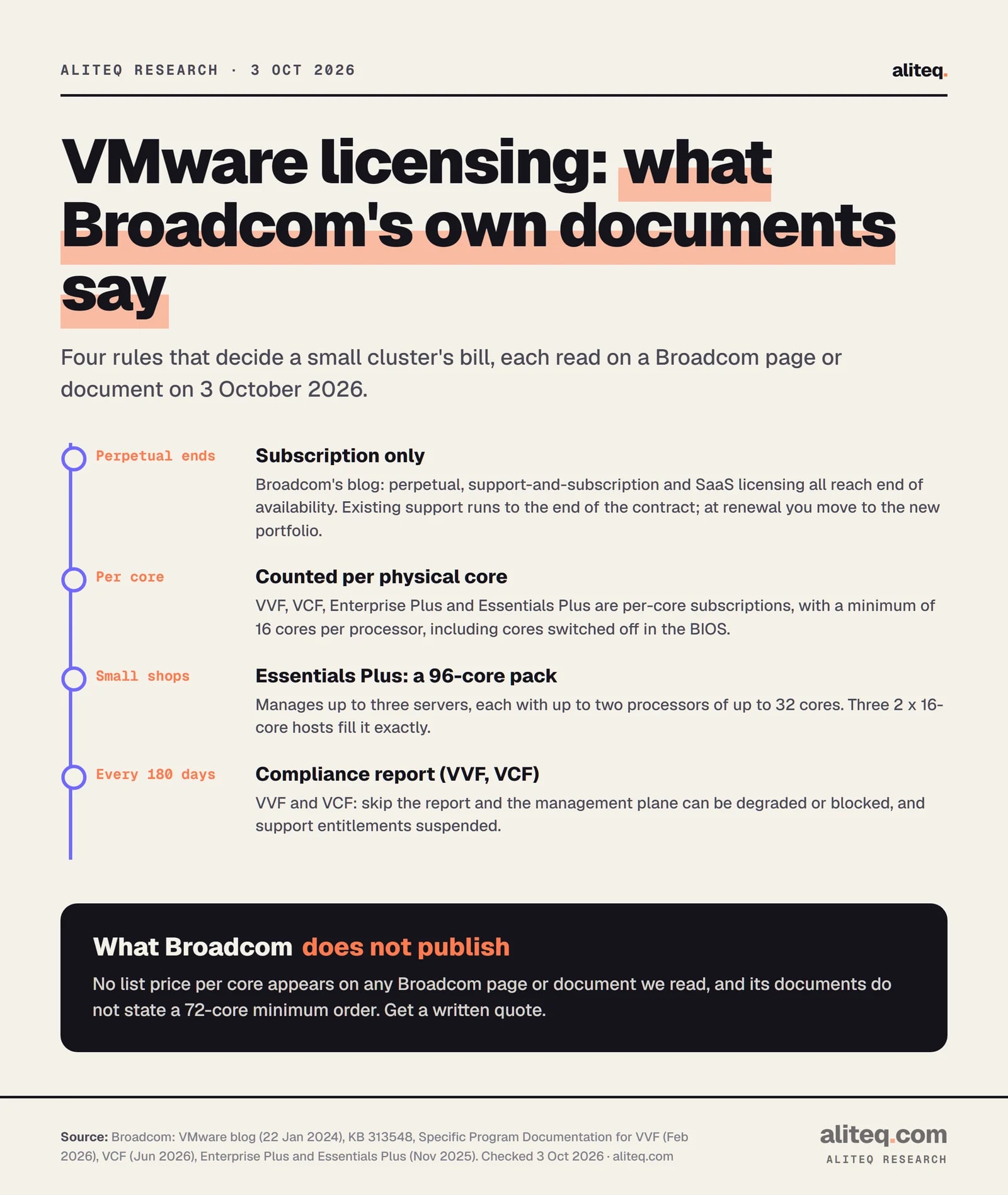
VMware is now subscription-only and licensed per physical core. Broadcom's January 2024 blog says VMware Cloud Foundation (VCF) and vSphere Foundation (VVF) are "available as subscription software only", and that the end of availability covers "Perpetual, Support & Subscription (SnS), SaaS/hosted and other subscription types."
If you own old perpetual licenses with active support, nothing changes immediately. The same blog says VMware "will continue to offer active support through the duration of your support contract." At renewal, you "align your go forward requirements to VMware's updated portfolio of offerings." That renewal is where small shops meet the new rules.
Each rule comes from a Broadcom page or document, read on 3 October 2026. · aliteq research
How do you count VMware cores for three hosts?
You license every physical core, with a floor of 16 per processor. Broadcom's KB 313548 says: "You must license a minimum of 16 physical cores for each CPU (physical processor) in your ESXi hosts, even if a CPU has fewer than 16 cores." The SPDs add that "each Core on the Server where Software is installed must be licensed, including Cores deactivated by the BIOS."
Our example cluster is three hosts, two sockets each, 16 cores per socket. The count is 3 x 2 x 16 = 96 cores. It sits exactly on the 16-core floor, so nothing is rounded up. If your sockets are smaller, say 8 cores, you still pay for 16. Broadcom's own example: two hosts, one with 2 x 8 cores and one with 2 x 24, comes to 80 cores to license.
Here is what the documents say about the editions a small shop sees:
vSphere Foundation (VVF) and Cloud Foundation (VCF): per-core subscriptions. The SPDs describe them as "subscription software licensed on a per Core license metric with a minimum licensing requirement of 16 Cores per Processor."
vSphere Enterprise Plus: same per-core metric and 16-core minimum, per its November 2025 SPD.
vSphere Essentials Plus: same metric, and "sold in a 96-core license pack." Its vCenter Server Essentials entitlement may be used "solely to manage up to three (3) Servers, with each Server having up to two (2) Processors, each Processor with up to thirty-two (32) Cores." Three hosts of 2 x 16 cores fill that pack to the core. It also must not be deployed on cloud services.
vSAN: VVF includes 0.25 TiB of vSAN capacity per licensed core, which is 24 TiB for 96 cores. VCF includes 1 TiB per core, or 96 TiB. More capacity is bought separately. This only matters if you replace your shared storage box with vSAN.
Does Broadcom have a 72-core minimum order?
Some resellers and licensing consultancies report a 72-core minimum order. I could not find it in KB 313548, the SPDs or the blog, so I don't treat it as a rule. It would not change this cluster either way, because 96 cores is above 72.
What does support look like?
Support comes bundled. The VVF SPD says the license "includes entitlement to support and maintenance services." One obligation is easy to miss. VVF and VCF must send Broadcom a compliance report 180 days after the license is registered and every 180 days after. If it is late, the SPD says the "management plane of the Software" can be "degraded and/or blocked in addition to support entitlements for this Software being suspended." If your hosts are offline or air-gapped, ask how that report works for you before you sign.
What does Proxmox cost for the same three hosts?
Proxmox charges per CPU socket, not per core. Six sockets cost €2,220 a year at Basic, which is $2,492, or $7,476 over three years. Proxmox's page says: "A subscription is required for every occupied physical CPU socket. The number of CPU cores does not affect the price." A 32-core socket costs the same as an 8-core one.
Community
Price
€120
Support
No ticket support, forum only
6 sockets, 3 years
$2,425
Basic
Price
€370
Support
3 tickets a year, 1 business day
6 sockets, 3 years
$7,476
Standard
Price
€550
Support
10 tickets a year, 4-hour response
6 sockets, 3 years
$11,113
Premium
Price
€1,100
Support
Unlimited tickets, 2-hour response
6 sockets, 3 years
$22,226
Price
Support
6 sockets, 3 years
Community
€120
No ticket support, forum only
$2,425
Basic
€370
3 tickets a year, 1 business day
$7,476
Standard
€550
10 tickets a year, 4-hour response
$11,113
Premium
€1,100
Unlimited tickets, 2-hour response
$22,226
Three details from Proxmox's page matter. First, features do not change by tier. It says: "High availability, live migration, clustering, backup, software-defined storage, networking, and all other Proxmox VE features are available at every level." Second, "all nodes in a cluster must use the same subscription level." Third, the Premium tier gets 24/7 support from 19 October 2026, and Standard 24/7 "by the end of 2026", so check what your tier covers on the day you buy.
Community is meant for labs and non-production. Proxmox says it "gives you access to the stable Enterprise Repository without an enterprise technical support entitlement." For a business that depends on these hosts, Basic is the realistic floor in my model.
What about backups?
Proxmox Backup Server (PBS) is priced per backup server, not per socket. Basic is €1,120 a year, $1,257, or $3,772 over three years for one server. Proxmox says each subscribed server "includes unlimited backup storage and unlimited backup clients." Standard is €2,240 and Premium €4,480. Like PVE, every feature is in every tier. PBS is open source, and the subscription buys the enterprise repository and support.
That is a real number to plan for. On the VMware side I have not priced a backup tool, because those prices are not in Broadcom's documents, so the VMware column below has no backup line. That makes my Proxmox total the cautious one. If you are budgeting backups across the business, our Microsoft 365 backup pricing guide shows what per-user backup costs on the SaaS side.
What is the 3-year cost table for 3 hosts?
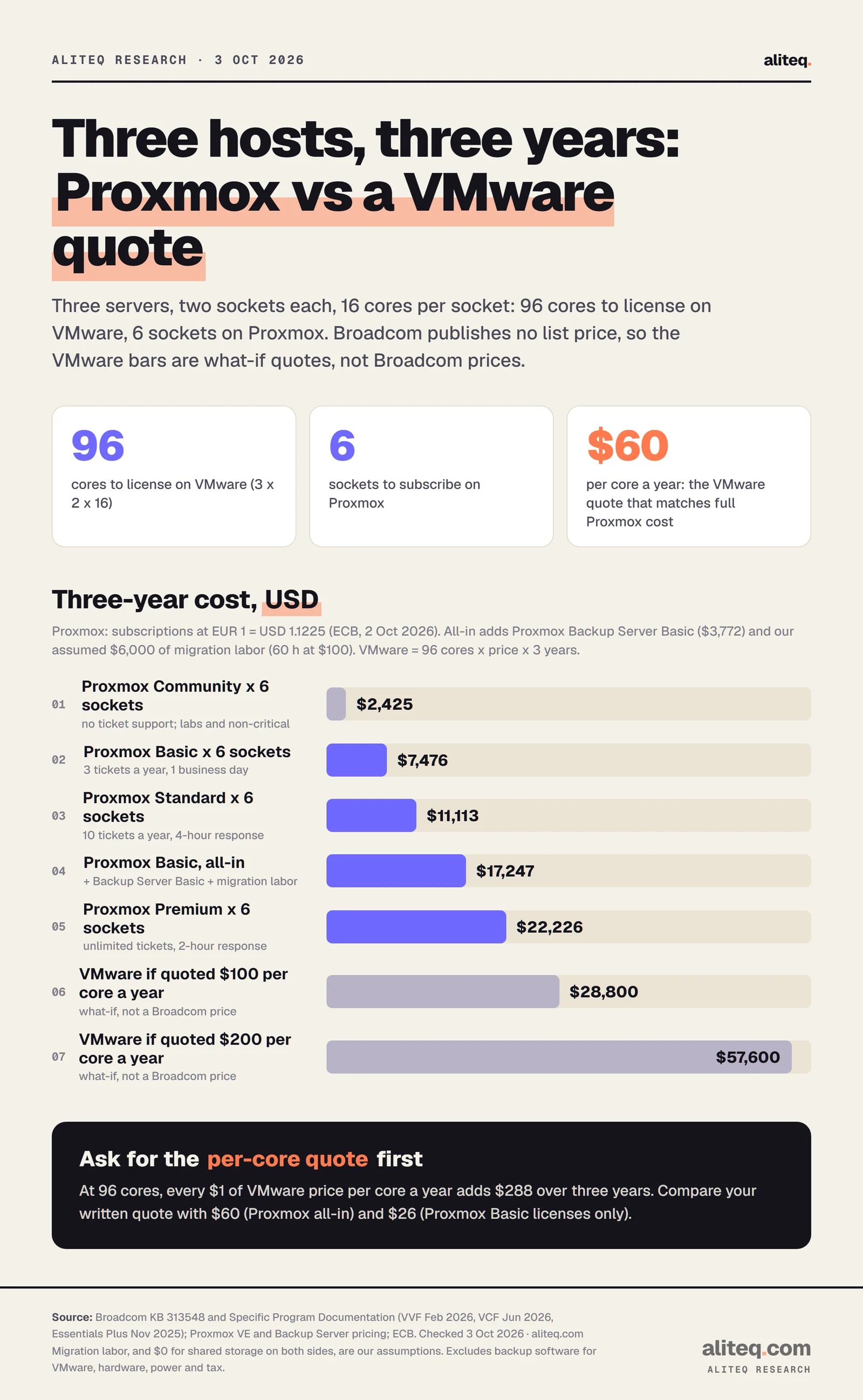
Over three years the Proxmox side comes to $7,476 for Basic subscriptions, or $17,247 once you add Backup Server and migration labor. VMware is 288 times your quoted price per core per year. The table shows every line and the formula behind it.
Three hosts, 2 sockets x 16 cores each, 3 years (USD, excl. tax)
VMware: licenses to buy
Formula
3 hosts x 2 CPUs x 16 cores = 96 cores
3-year cost
96 cores
VMware: your quote, per core per year
Formula
P (not published by Broadcom)
3-year cost
96 x P x 3 = 288 x P
What-if: P = $100
Formula
288 x $100
3-year cost
$28,800
What-if: P = $200
Formula
288 x $200
3-year cost
$57,600
Proxmox VE Community, 6 sockets
Formula
€120 x 6 x 3 x 1.1225
3-year cost
$2,425
Proxmox VE Basic, 6 sockets
Formula
€370 x 6 x 3 x 1.1225
3-year cost
$7,476
Proxmox VE Standard, 6 sockets
Formula
€550 x 6 x 3 x 1.1225
3-year cost
$11,113
Proxmox VE Premium, 6 sockets
Formula
€1,100 x 6 x 3 x 1.1225
3-year cost
$22,226
Proxmox Backup Server Basic, 1 server
Formula
€1,120 x 3 x 1.1225
3-year cost
$3,772
Migration labor (our assumption)
Formula
3 hosts x 20 h x $100 an hour
3-year cost
$6,000
Proxmox all-in, Basic
Formula
$7,476 + $3,772 + $6,000
3-year cost
$17,247
Proxmox all-in, Standard
Formula
$11,113 + $3,772 + $6,000
3-year cost
$20,884
Formula
3-year cost
VMware: licenses to buy
3 hosts x 2 CPUs x 16 cores = 96 cores
96 cores
VMware: your quote, per core per year
P (not published by Broadcom)
96 x P x 3 = 288 x P
What-if: P = $100
288 x $100
$28,800
What-if: P = $200
288 x $200
$57,600
Proxmox VE Community, 6 sockets
€120 x 6 x 3 x 1.1225
$2,425
Proxmox VE Basic, 6 sockets
€370 x 6 x 3 x 1.1225
$7,476
Proxmox VE Standard, 6 sockets
€550 x 6 x 3 x 1.1225
$11,113
Proxmox VE Premium, 6 sockets
€1,100 x 6 x 3 x 1.1225
$22,226
Proxmox Backup Server Basic, 1 server
€1,120 x 3 x 1.1225
$3,772
Migration labor (our assumption)
3 hosts x 20 h x $100 an hour
$6,000
Proxmox all-in, Basic
$7,476 + $3,772 + $6,000
$17,247
Proxmox all-in, Standard
$11,113 + $3,772 + $6,000
$20,884
The two "what-if" rows are not Broadcom prices. They show how the total scales, and you replace P with your own quote. Shared storage is $0 on both sides because I assumed you keep the NAS or SAN you already have. Hardware, power and tax are in neither column.
Proxmox figures are published prices at EUR 1 = USD 1.1225. The VMware bars are what-if quotes, not Broadcom prices. · aliteq research
What VMware quote makes Proxmox cheaper?
Divide the Proxmox total by 288 and you get the break-even price per core per year:
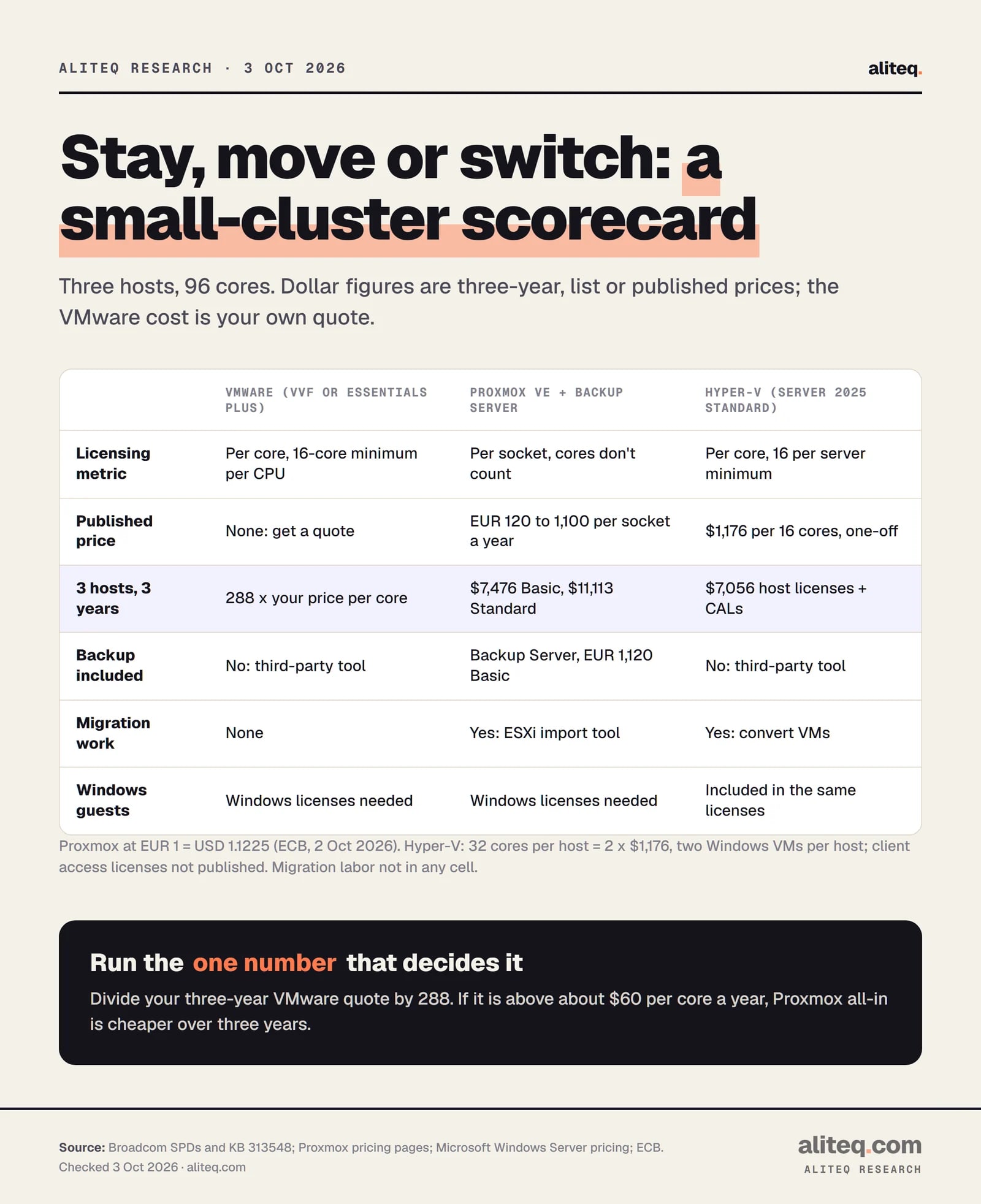
Take your VMware quote, divide the three-year total by 288, and compare. If you pay more than about $60 per core per year, the all-in Proxmox path wins within three years on these assumptions. If you pay less, the migration does not pay for itself in three years. After year three, the migration labor is behind you, so the gap widens in Proxmox's favor.
What does the migration cost?
I assumed $6,000: 20 hours per host at $100 an hour. That is our assumption, not a quote and not a benchmark. It covers inventory, importing the VMs, remapping networks and storage, a test restore, and a cut-over window per host. Your number depends on how many VMs you have, how clean the network is and who does the work. If you want an outside price, our managed IT services pricing guide shows what providers charge.
Proxmox makes the move easier than it used to be. Its pricing page lists "ESXi import and CPU controls — easier migration" among its features. It is a tool, not a guarantee, and every Windows guest needs testing, since drivers and licensing activation can surprise you.
What about shared storage: Ceph or the box you have?
Both clusters can use storage you already own. Proxmox lists iSCSI, Fibre Channel and multipath shared LVM support, plus Ceph, a built-in software-defined storage layer. I put $0 in both columns for the case where you keep your current NAS or SAN.
Ceph is not free of cost, even though the software is included. Proxmox's wiki says a hyper-converged Ceph cluster needs "at least three" nodes, and its requirements page notes that "neither ZFS nor Ceph are compatible with a hardware RAID controller." It advises roughly 1 GB of memory per TB of storage used for Ceph or ZFS, and lists 10 Gbit networking as supported. In practice that means disks, RAM and switch ports. I haven't priced them, because they depend entirely on your hardware.
On the VMware side, vSAN is the equivalent. VVF includes 0.25 TiB per core, so your 96 cores come with 24 TiB, and VCF includes 1 TiB per core. Any storage beyond that is an add-on.
Where does Hyper-V fit?
Hyper-V is the third path, and it is only worth a look if you already run Windows Server. Windows Server 2025 Standard is $1,176 per 16 cores, with a 16-core minimum per server. Our hosts have 32 cores each, so each costs two packs, $2,352, or $7,056 for three hosts, one-off. That license covers two Windows VMs per host, and client access licenses (CALs) are extra, with no price published by Microsoft.
The one-off price looks low next to a three-year subscription. But you still need a backup tool, a management layer and the same migration labor. Also, Windows guests need Windows licenses on VMware and Proxmox too. Moving the hypervisor does not change Microsoft's rules. I covered that trap in the Windows Server 2016 end of support cost guide.
Prices per three hosts, 96 cores. The VMware cost is your own written quote. · aliteq research
So should a 3-host business move?
Get the VMware quote first, then compare it with $60. Three questions settle most cases:
What does the written quote say per core per year? Ask for VVF, vSphere Standard and Essentials Plus, because Essentials Plus is the 96-core pack built for three small hosts. Ask for the term length, too.
Can you absorb the migration? If nobody on staff has time and an outside provider quotes far above $6,000, the break-even moves up.
How soon is your hardware refresh? A move to a new host fleet is a natural moment to switch. If Proxmox is where you land, start on the current release. Our Proxmox 8.4 end of support guide explains the 9.2 upgrade.
My read, from the arithmetic and not from running either platform: if your quote lands near or above $60 per core per year, Proxmox Basic with Backup Server pays back inside three years. If it lands well under, the saving is not worth the risk of a rushed migration. For the rest of the decisions in this series, see the Cloud & IT Infrastructure section.
Quick answers
How much does VMware cost per core after Broadcom?
Broadcom does not publish a list price on any page or document I read, so I can't give you a Broadcom number. Licensing is per physical core with a 16-core minimum per processor. Ask a Broadcom partner for a written quote for your exact core count and term.
Is there a 72-core minimum for VMware?
Resellers and consultancies report one, but Broadcom's knowledge-base article and SPDs I read do not state it. What Broadcom does state is a minimum of 16 cores per processor. For three hosts with two 16-core sockets, you license 96 cores either way.
How much does Proxmox cost for three servers?
Proxmox charges per CPU socket. Three dual-socket servers are 6 sockets. At Basic (€370 a socket) that is $2,492 a year, $7,476 over three years. Community is €120, Standard €550 and Premium €1,100 per socket per year, converted at EUR 1 = USD 1.1225.
Is Proxmox free?
The software is open source. Subscriptions buy access to the stable Enterprise Repository and, from Basic up, ticket support. The Community tier has the repository but no ticket support, and Proxmox positions it for labs and non-production use.
Does Proxmox Backup Server cost extra?
Its subscription is priced per backup server: €560 Community, €1,120 Basic, €2,240 Standard, €4,480 Premium a year. One Basic server is $3,772 over three years. Proxmox says each subscribed server includes unlimited backup storage and clients.
Do I still need Windows licenses if I move off VMware?
Yes. Windows Server guests need Windows Server licenses on any hypervisor, counted per physical core of the host. Changing from VMware to Proxmox saves hypervisor cost, not Microsoft licensing cost.