On a $29 plan the spread between the cheapest and priciest merchant of record is $1.87 a sale. Every published fee, what each one adds on top, and why the lowest headline rate isn't always the cheapest.
A merchant of record (MoR) is the company that legally sells your product to the buyer, so it collects and files VAT and sales tax for you. The price of that is a percentage of every sale. This piece lines up what each provider publishes, then shows what the number means at $9, $29 and $99.
We read each provider's own pricing page and fee docs on 3 October 2026. aliteq has not used any of them and none of them pays us. We make no claim about uptime, support or how fast any provider approves accounts, because we have no primary source for those. "Cheapest" here means the lowest published fee per card sale for a US seller.
Creem has the lowest published headline fee, 3.9% + 40¢ with no monthly fee. Dodo Payments is 4% + 40¢. Paddle, Lemon Squeezy and Polar's free plan are all 5% + 50¢ before extras. FastSpring publishes no rate.
What each page says today:
Creem
Published fee
3.9% + 40¢
What the page says
"No setup fees, no monthly fees". One rate for every sale
Dodo Payments
Published fee
4% + 40¢
What the page says
Standard plan; +1.5% for cards and payment methods outside the US; +0.5% on subscriptions; PayPal +3%
Paddle
Published fee
5% + 50¢
What the page says
"per Checkout transaction", "No monthly fees, migration fees, or hidden extras"; custom pricing for high volume
Free plan. Pro $20 a month at 3.8% + 40¢, Growth $100 at 3.6% + 35¢, Scale $400 at 3.4% + 30¢. +1.5% on non-US cards
Stripe Managed Payments
+3.5% on top of Stripe processing
Processing 2.9% + 30¢, plus Billing 0.7% for subscriptions
Gumroad
10% + 50¢
30% for sales through its Discover marketplace. Its page says it has been a merchant of record since 1 Jan 2025
FastSpring
Quote only
The page offers "Get your pricing quote". Tax collection and remittance listed as included
Two cautions on reading other sites. Some pricing pages print a competitor's rate next to their own; those are not that competitor's published fee, so we don't use them. And Polar's older 4% + 40¢ is the Early Member rate: it applies only to organizations created before 27 May 2026. An organization created on or after that date starts on Starter.
What does it cost per sale at $9, $29 and $99?
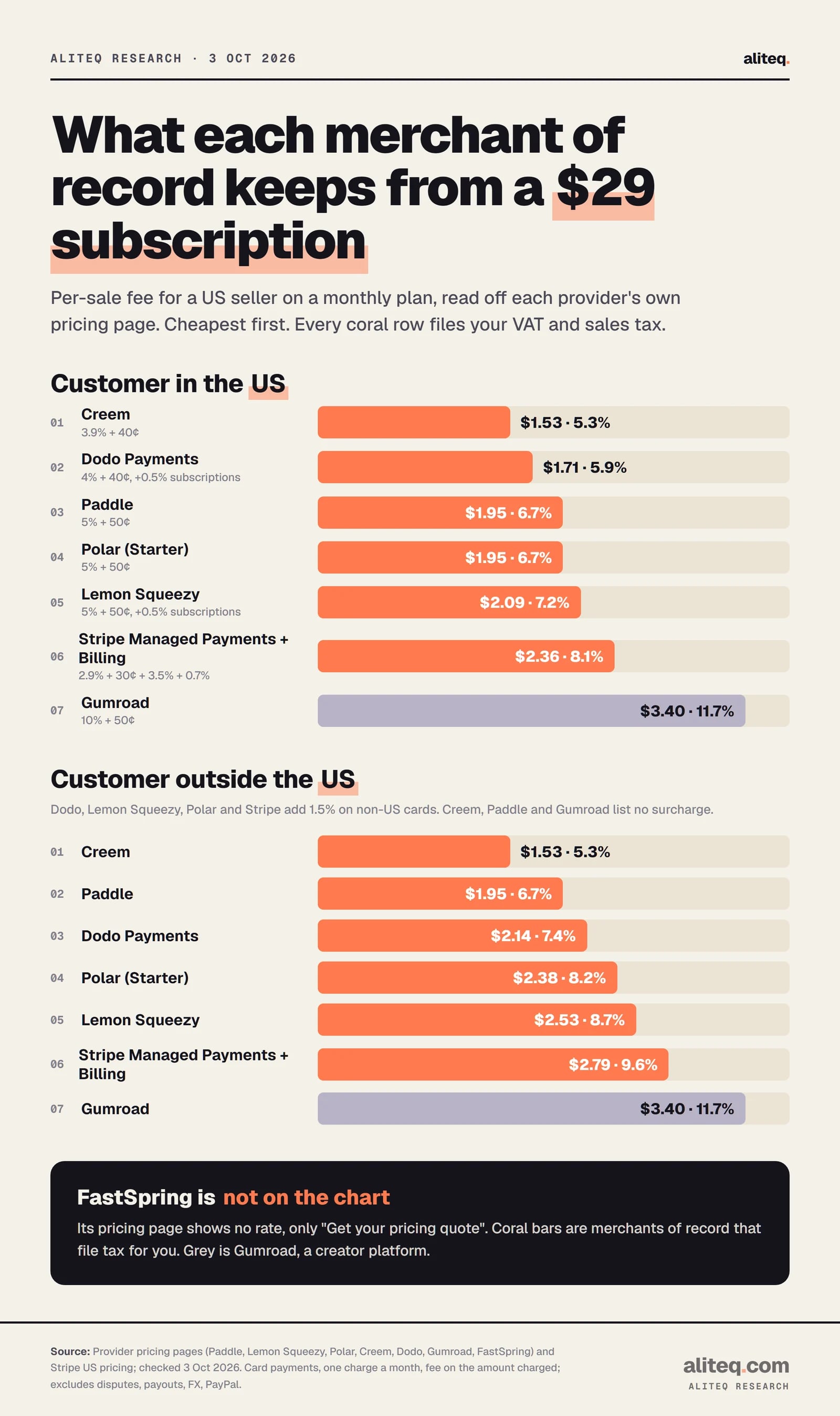
On a $29 plan a US seller pays $1.53 (Creem) to $3.40 (Gumroad) per US card sale. The gap grows for non-US customers, because four providers add 1.5% on those cards.
Fee on a $29 monthly subscription, US seller. Card payments, fee on the amount charged. · aliteq research
The formula is price × percentage + fixed fee, with surcharges added to the percentage. Here is the full table, a US customer first and a non-US customer second:
Creem
$9 US / non-US
$0.75 / $0.75
$29 US / non-US
$1.53 / $1.53
$99 US / non-US
$4.26 / $4.26
Dodo Payments (subscription)
$9 US / non-US
$0.80 / $0.94
$29 US / non-US
$1.71 / $2.14
$99 US / non-US
$4.86 / $6.34
Paddle
$9 US / non-US
quoted privately
$29 US / non-US
$1.95 / $1.95
$99 US / non-US
$5.45 / $5.45
Polar Starter
$9 US / non-US
$0.95 / $1.08
$29 US / non-US
$1.95 / $2.38
$99 US / non-US
$5.45 / $6.94
Lemon Squeezy (subscription)
$9 US / non-US
$0.99 / $1.13
$29 US / non-US
$2.09 / $2.53
$99 US / non-US
$5.95 / $7.43
Stripe Managed Payments + Billing
$9 US / non-US
$0.94 / $1.07
$29 US / non-US
$2.36 / $2.79
$99 US / non-US
$7.33 / $8.81
Gumroad
$9 US / non-US
$1.40 / $1.40
$29 US / non-US
$3.40 / $3.40
$99 US / non-US
$10.40 / $10.40
FastSpring
$9 US / non-US
quote
$29 US / non-US
quote
$99 US / non-US
quote
$9 US / non-US
$29 US / non-US
$99 US / non-US
Creem
$0.75 / $0.75
$1.53 / $1.53
$4.26 / $4.26
Dodo Payments (subscription)
$0.80 / $0.94
$1.71 / $2.14
$4.86 / $6.34
Paddle
quoted privately
$1.95 / $1.95
$5.45 / $5.45
Polar Starter
$0.95 / $1.08
$1.95 / $2.38
$5.45 / $6.94
Lemon Squeezy (subscription)
$0.99 / $1.13
$2.09 / $2.53
$5.95 / $7.43
Stripe Managed Payments + Billing
$0.94 / $1.07
$2.36 / $2.79
$7.33 / $8.81
Gumroad
$1.40 / $1.40
$3.40 / $3.40
$10.40 / $10.40
FastSpring
quote
quote
quote
How we built it, so you can check it:
Dodo and Lemon Squeezy include the +0.5% subscription fee. For a one-time purchase, subtract 0.5% of the price.
Polar Starter has no separate subscription fee on current plans, and +1.5% on non-US cards.
Stripe Managed Payments + Billing is 2.9% + 30¢ processing, 3.5% Managed Payments and 0.7% Billing, with +1.5% on international cards. We compute every fee on the amount charged.
Paddle at $9: we found no stated small-price rule on Paddle's page today, so we print no number. Ask Paddle for a quote before building a $9 plan on it.
Excluded: disputes, refunds, payout fees, currency conversion and PayPal.
Why low prices pay the most
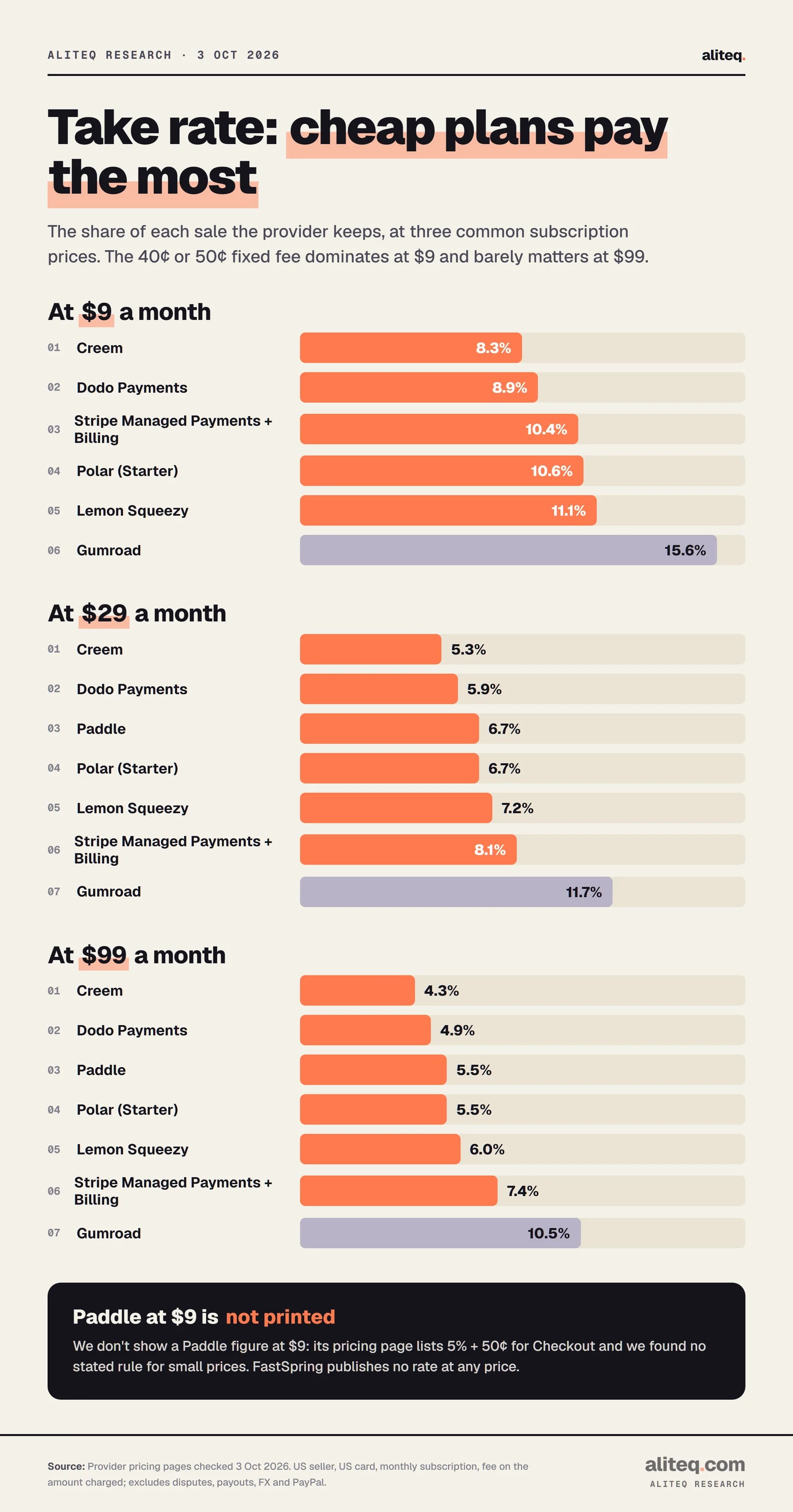
The fixed fee is the cost that bites at low prices. At $9 a month, Creem keeps 8.3% and Gumroad keeps 15.6%. At $99, the same two keep 4.3% and 10.5%.
Take rate by plan price, US seller and US card. · aliteq research
Try your own price and customer mix in the calculator.
What each option takes from one sale
Cheapest per sale
Stripe + Billing
$1.34 a sale · you file the tax
Cheapest that files tax for you
Creem
$1.53 a sale · 5.3%
Price of not filing yourself
$19/mo
Creem vs Stripe + Billing, at 100 sales a month
Option
Per sale
Take rate
You keep a month
Files tax
Stripe + Billing
$1.34
4.6%
$2,766
You
Stripe + Billing + Tax BasicTax Basic only calculates where you're registered
$1.49
5.1%
$2,751
You
Creem
$1.53
5.3%
$2,747
Provider
Dodo Payments
$1.71
5.9%
$2,730
Provider
Paddle
$1.95
6.7%
$2,705
Provider
Polar (free plan)
$1.95
6.7%
$2,705
Provider
Lemon Squeezy
$2.09
7.2%
$2,691
Provider
Stripe Managed Payments + Billing3.5% is charged on the total including tax
$2.36
8.1%
$2,664
Provider
US sales tax: you only register in a state once your sales there pass its threshold ($100,000 in most states, $500,000 in California, Texas and New York), and not every state taxes software.
Rates from Stripe (US and Denmark pricing pages), Paddle, Lemon Squeezy, Polar, Dodo Payments and Creem, and Lovable's payments docs, all read 27 Sep 2026. Card payments; fee on the amount charged, before disputes, payouts and currency conversion. Stripe Denmark's 1.80 kr fixed fee converted at the ECB rate of 25 Sep 2026. “You keep” is before VAT or sales tax and before income tax. Not tax advice.
When does a paid Polar plan beat the free one?
Polar's Pro plan costs $20 a month and cuts a $29 US sale from $1.95 to $1.50, a saving of 45¢. That pays for the plan after about 45 sales a month.
The paid tiers on Polar's page are Pro ($20 a month, 3.8% + 40¢), Growth ($100, 3.6% + 35¢) and Scale ($400, 3.4% + 30¢). At $29 a US sale costs $1.50, $1.39 and $1.29 on them. Our arithmetic: $20 ÷ $0.45 is 44.4, so 45 sales. Growth and Scale have higher break-evens; Polar's page says "When does a paid plan pay off?" and shows its own comparison, which is worth reading against your sales volume.
Below that volume the free plan is cheaper. Above it you are paying a monthly fee for a lower rate, the same trade a subscription to any tool makes.
What do they charge beyond the headline rate?
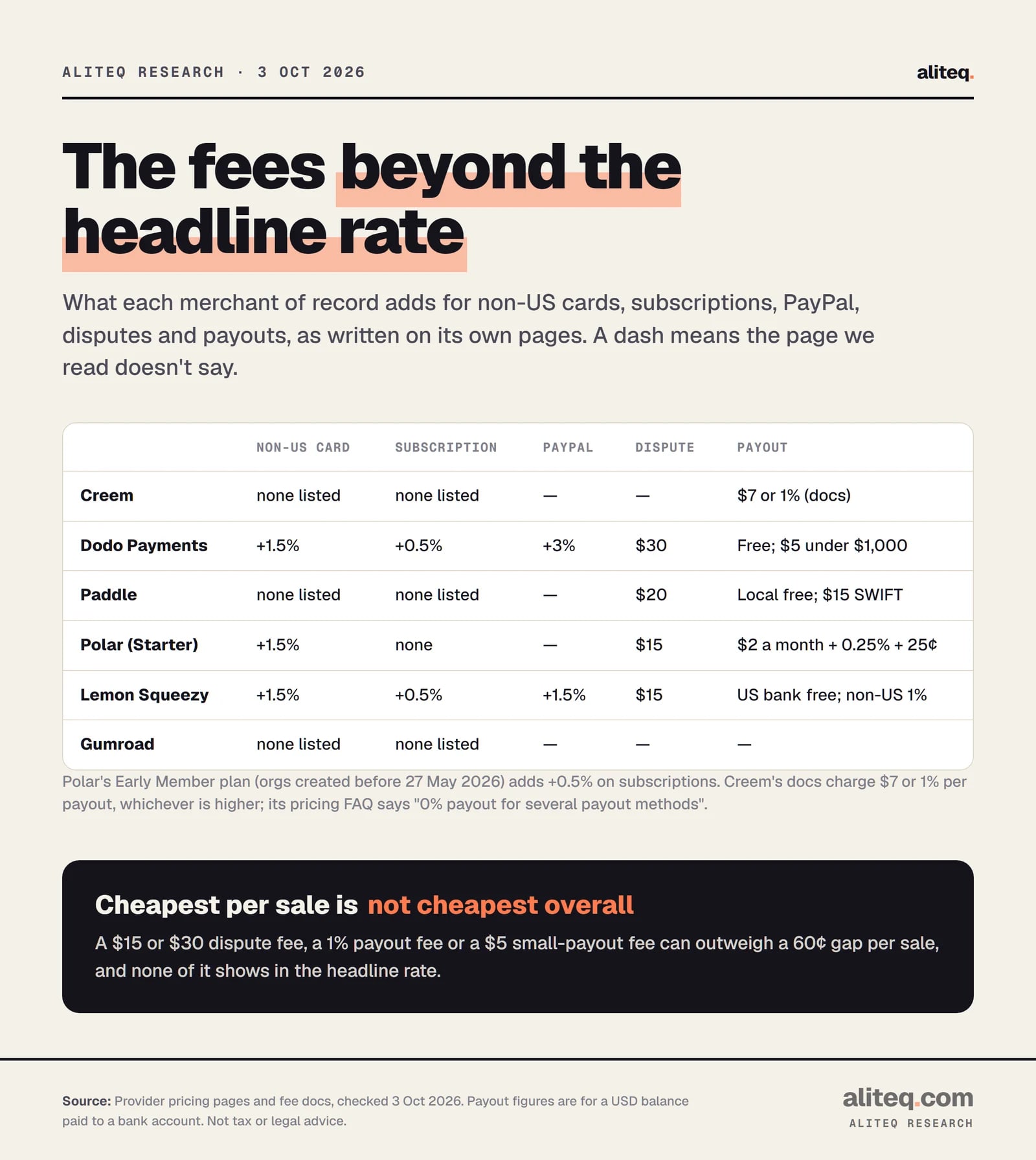
Beyond the headline you can pay for non-US cards, subscriptions, PayPal, disputes and payouts. These add-ons are why two providers with the same percentage can differ by dollars a month.
Fees beyond the headline rate. A dash means the page we read doesn't say. · aliteq research
What the pages and docs say, provider by provider:
Paddle: a chargeback fee of "20 USD/GBP/EUR or 40 CAD/AUD", not refunded when Paddle wins the dispute. Its payout page says it will not add fees beyond the Paddle fee, with local-currency transfers free and an international SWIFT wire carrying a $15 fee. Paddle's docs name an acceptable chargeback rate of below 0.65%.
Lemon Squeezy: a $15 dispute fee, deducted from your next payout. Payouts through Stripe are free for US bank accounts and 1% per payout for bank accounts outside the US.
Polar: disputes cost $15. Payouts through Stripe carry "$2 per month of active payout(s)" and "0.25% + $0.25 per payout", with cross-border currency conversion at 0.25% in the EU and up to 1% elsewhere.
Creem: its docs charge "7 USD/EUR or 1% of the payout amount, whichever is higher". Its pricing FAQ says "0% payout for several payout methods", so the two pages disagree and you should ask which applies to your payout method. Payouts are processed on the 1st and 15th of each month.
Dodo Payments: $30 per dispute, $1 per refund, payouts free but $5 if the payout is under $1,000, and $25 for USD SWIFT payouts for non-US businesses.
Gumroad: the page lists 10% + 50¢ and 30% for Discover sales; we found no separate dispute or payout schedule on it.
FastSpring: nothing is published. Its page offers a custom quote and says discounted rates are available for ACH and wire transfers.
On a $29 plan, one dispute at $15 to $30 equals the fee on roughly 8 to 20 US sales, depending on the provider. Our arithmetic, using the $1.53 to $1.95 range. Whether a given provider would see disputes on your product is not something a pricing page can tell you.
Which one will accept my product?
A low fee only helps if the account is approved and stays open. Each provider publishes what it won't sell, and AI products are the area where the wording differs most.
What the providers' own pages say about AI products:
Paddle's list of what you can't sell includes content generation featuring face swaps, deep fakes, voice impersonations or a person's likeness without explicit consent, and puts human-like faces in a restricted category.
Lemon Squeezy's prohibited products include "Sexually-oriented or pornographic content of any kind, including NSFW chatbots" and "Services of any kind", including consulting and design. We found no deepfake clause in the list.
Polar's acceptable use policy (effective 25 March 2026) prohibits content generation that "enables face swaps or deep fakes, or produces adult content". It also lists "AI Content Generation tools (text, image, video, voice)" among categories that "may not be accepted".
Creem publishes extra review requirements for AI image and video generation products, including a moderation API requirement.
Dodo Payments publishes a merchant acceptance policy. Read its AI section before you build.
Gumroad does not permit physical goods or obscene or adult content.
FastSpring has an AI use-case page. We found no rate or acceptance rule on its pricing page.
If you sell an AI image, video or voice tool, check your exact product against the policy of any provider you plan to use before you build on it. For a text-based SaaS the lists are less restrictive, but they are still the provider's call, not ours.
Do they cover my country and my customers' countries?
Coverage matters twice: where you, the seller, are based, and where your buyers are. Each provider publishes a supported-countries page, and some of them disagree with their own docs.
We don't print a country list, because we did not re-read each list in full today and a stale one is worse than none. One conflict we did find: Creem's docs say tax compliance covers 190+ countries, while its pricing page says 50+. Dodo's pricing page lists tax management in 190+ countries. A tax claim covers buyers' countries; whether you, the seller, can sign up and get paid out from your country is a separate list, so check both.
As a US seller you will almost always be on the supported side. The check matters if you have a business in another country, or customers in places a provider does not serve.
Is the cheapest per sale the cheapest overall?
No. A cheap headline rate can lose to a provider with a higher rate if payouts, disputes, currency conversion or an account closure cost you more than the gap. Per sale, the gap between neighbors on our list is usually between 18¢ and 60¢ on a $29 plan.
Four things the table can't show:
Payout fees. Creem's docs say $7 or 1% per payout. A seller who requests many small payouts pays that each time, so one monthly payout changes the maths. Dodo charges $5 on payouts under $1,000.
Disputes. The fees range from $15 to $30 per dispute on the pages we read. A product with more disputes feels a higher fee more.
Where your customers are. If most buyers are outside the US, the +1.5% on Dodo, Lemon Squeezy and Polar can decide the ranking. Paddle and Creem list no such surcharge. At $29 non-US, Paddle ($1.95) is cheaper than Dodo ($2.14).
Acceptance and continuity. A fee comparison cannot price what happens if an account is paused or a product is rejected. We have no primary source on how often that happens at any provider, and we don't print anecdotes as data. Read each provider's terms on holds, reserves and account review before you commit your revenue to one.
None of the providers here removes income tax. A merchant of record handles indirect tax, VAT and sales tax. You still report the payout as income.
Which should you pick?
Use the question that decides your case, and then check that provider's own page again before you sign up.
US customers, low price, text-based product: Creem and Dodo are the cheapest published rates. Check payout and dispute terms for your volume.
Mostly non-US customers: compare Paddle and Creem first, since they list no international surcharge. Dodo, Lemon Squeezy and Polar add 1.5%.
High volume on Polar: compare Pro, Growth and Scale against the free plan using your own monthly sales.
Sub-$10 pricing: the fixed 40¢ to 50¢ is most of your fee. Ask providers for small-price terms. Paddle's pricing-page FAQ says that for products under $10 you can contact it for bespoke pricing, and publishes no rate (read 3 October 2026). Lovable's docs describe a flat 10% there, which is Lovable's statement, not Paddle's.
Enterprise or complex needs: FastSpring and Paddle both offer custom pricing, so get quotes.
Already on Stripe:Stripe Managed Payments is the lowest-effort switch, at the highest per-sale cost on the chart.
Fees change. Every figure here was true on the date at the top, and pricing pages are the source of truth.
This is a summary of vendor pages and our own arithmetic, not tax, legal or financial advice.
Quick answers
Which merchant of record has the lowest fees?
Creem has the lowest published headline fee, 3.9% + 40¢, which is $1.53 on a $29 US card sale. Dodo Payments is next at 4% + 40¢. Paddle and Polar's free plan are 5% + 50¢, Lemon Squeezy adds subscription and international surcharges, and FastSpring publishes no rate. Fees read on 3 October 2026.
Is Paddle or Lemon Squeezy cheaper?
Paddle, for most sales. Both start at 5% + 50¢. Lemon Squeezy adds 0.5% on subscriptions and 1.5% on non-US cards, so a $29 subscription costs $2.09 US and $2.53 non-US, against $1.95 for Paddle either way.
Does Polar's lower rate apply to new accounts?
Not the Early Member rate. Polar's 4% + 40¢ applies only to organizations created before 27 May 2026. Newer organizations start on Starter at 5% + 50¢ and can move to Pro ($20 a month, 3.8% + 40¢), Growth or Scale.
What is FastSpring's fee?
FastSpring doesn't publish one. Its pricing page offers a custom quote and lists tax collection and remittance as included, so any percentage you see elsewhere is a third party's guess.
Does the cheapest merchant of record handle my taxes?
Each one on this list says it acts as the merchant of record or takes on VAT and sales tax collection. You still owe income tax on your payouts, and you should check each provider's supported countries for both you and your buyers.
Can I sell an AI app through any of them?
It depends on the product. Paddle, Polar and Creem publish restrictions on deepfake, face-swap and image or video generation tools, and Lemon Squeezy bans NSFW chatbots. Read the provider's policy against your exact product before you build on it.
Use this in your own page
Teaching this? Paste the live version into your course, blog or answer. Free, no sign-up; the credit line links back here.