One app is free forever. All apps cost €19.90 to €44.90 a user a month. Here is the three-year bill at 5, 20 and 50 users, with the self-hosted route priced honestly.
Every Odoo price and rule here comes from odoo.com, odoo.sh, Odoo's docs or its GitHub repository, read on 3 October 2026. Odoo changes plans often, so check the page before you buy.
aliteq is a US company, and we have not installed or run Odoo. This is a docs and price read, plus our own arithmetic. Where a number is our assumption, we say so. If you are choosing between open-source CRMs, our self-hosted CRM cost breakdown prices Twenty, SuiteCRM and EspoCRM on the same server model.
One note on currency. odoo.com showed euros when we read it, so the plan prices below are euros, converted to dollars at the European Central Bank rate of 25 September 2026 (EUR 1 = USD 1.1403). The page may show dollars to US visitors, so check the number on your screen. Odoo.sh showed dollars natively.
The three Odoo Online plans and what they cost
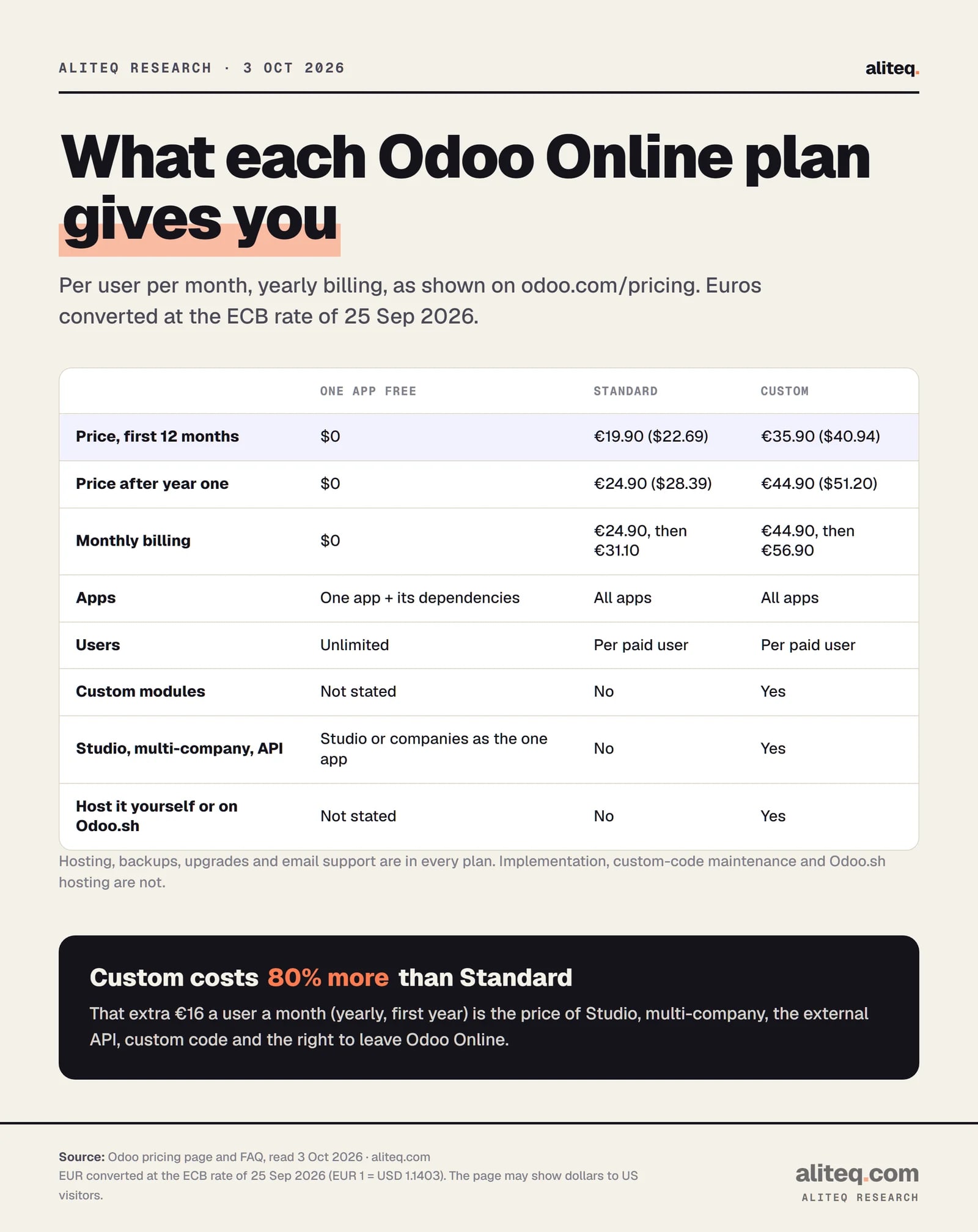
Odoo Online has three plans: One App Free, Standard and Custom. Prices are per user per month, and the Standard and Custom first-year prices are discounts.
Odoo Online plans, read from odoo.com/pricing on 3 Oct 2026. Euros converted at the ECB rate of 25 Sep 2026. · aliteq research
Odoo Online plans (odoo.com/pricing, read 3 October 2026)
Yearly billing, first 12 months
One App Free
€0
Standard
€19.90 ($22.69)
Custom
€35.90 ($40.94)
Yearly billing, after year one
One App Free
€0
Standard
€24.90 ($28.39)
Custom
€44.90 ($51.20)
Monthly billing, then regular
One App Free
€0
Standard
€24.90, then €31.10
Custom
€44.90, then €56.90
Apps
One App Free
One app plus the apps it needs
Standard
All apps
Custom
All apps
Users
One App Free
Unlimited
Standard
Each paid user
Custom
Each paid user
Hosting
One App Free
Odoo Online
Standard
Odoo Online
Custom
Odoo Online, Odoo.sh or on-premise
One App Free
Standard
Custom
Yearly billing, first 12 months
€0
€19.90 ($22.69)
€35.90 ($40.94)
Yearly billing, after year one
€0
€24.90 ($28.39)
€44.90 ($51.20)
Monthly billing, then regular
€0
€24.90, then €31.10
€44.90, then €56.90
Apps
One app plus the apps it needs
All apps
All apps
Users
Unlimited
Each paid user
Each paid user
Hosting
Odoo Online
Odoo Online
Odoo Online, Odoo.sh or on-premise
The discount has a catch. Odoo's footnote says the discount "is valid for 12 months, for initial users ordered". Users you add later should be priced at the regular rate. Our three-year totals below assume a constant headcount, so a growing team costs more than our tables.
A paying user is wider than "someone who logs in daily". Odoo defines it as anyone with backend access to create, view or edit documents, or an employee record with no linked user. Portal customers and suppliers are free. A third-party accountant who works in your Odoo counts as a paying user. A separate Light User tier exists at €7.90 a user a month for narrow roles like time off and expense reports, but you get it through an Odoo advisor quote.
Everything Online includes. Odoo says all plans include hosting, maintenance, upgrades and unlimited email support (Monday to Friday, 24/5), daily incremental backups on two continents, and unmetered storage up to 100 GB on Odoo Online.
What is not included. Odoo lists four exclusions: hosting on Odoo.sh for custom developments, implementation services and expert help, In-App-Purchase credits (SMS, lead generation, AI scanning of vendor bills), and maintenance of custom code.
One App Free: what "free forever" covers
One App Free is a real free plan for unlimited users, with one catch: it covers one app. Odoo's FAQ says that if your app depends on others, you get those free too. Its example is eCommerce, which depends on Website and Invoicing. So you can start with CRM, and Odoo says its use "is free for unlimited users, forever".
The free plan allows multiple companies, and you can pick Odoo Studio as your one app. The moment you install a second, unrelated app, you move to Standard. If you install Studio or add companies on top of another app, you switch to Custom automatically. That upgrade rule is the one to read before you click Install.
For a team that only needs a CRM, this is the cheapest hosted option in our research. It is a different product from the paid plans, though: you cannot mix a free CRM with a paid accounting app on the same database.
Standard vs Custom: what the extra €16 buys
Custom costs 80 percent more than Standard on yearly billing in year one (€35.90 against €19.90). The extra money buys four things: Studio, multi-company, the external API and custom code.
Odoo describes the split plainly. Standard runs on Odoo Online, "to host databases without custom modules". Custom is "for companies that want to manage multiple companies on a single database and that need to customize Odoo through Odoo Studio, agentic AI, custom developments or through the API."
Custom is also the only plan that lets you leave Odoo Online. Under Custom you can host on Odoo Online at no extra cost, "download Odoo Enterprise and host it yourself", or use Odoo.sh. Odoo says Online and Enterprise are "the same software. Only the hosting and infrastructure are different."
"External API" has a narrow meaning. It is outside software calling Odoo's JSON-RPC or XML-RPC API to read or update data. Odoo calling out to Stripe, PayPal, shipping carriers or bank sync is part of the standard plan.
Two practical rules from the FAQ. You can download a backup of an Online database at any time, so your data is portable. And on-premise users "must use the latest stable version of Odoo", so self-hosting Enterprise does not let you stay on an old release.
Community vs Enterprise: where the gates are
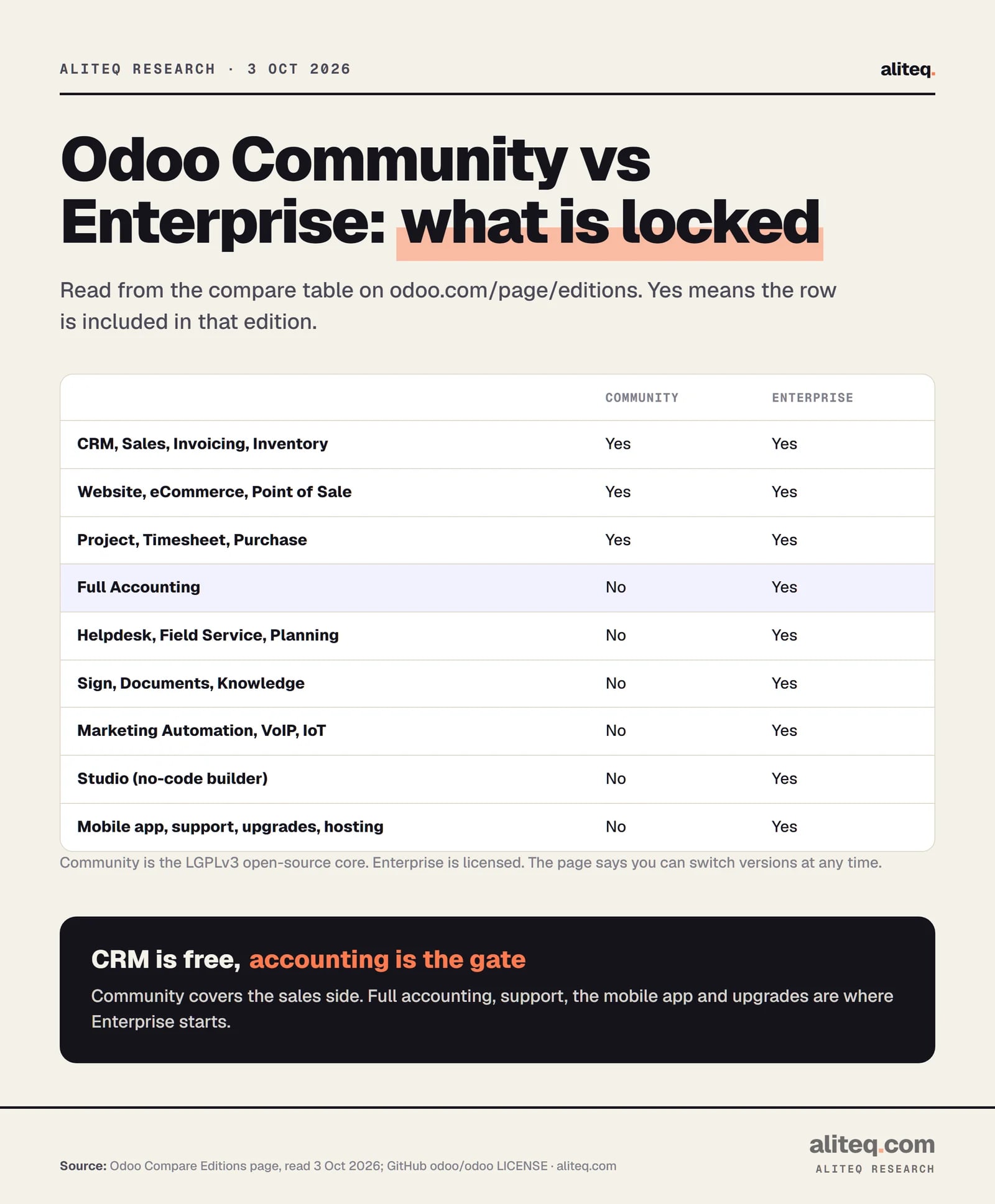
Odoo Community is the free open-source core. Odoo Enterprise is the licensed edition built on top of it. Odoo's editions page says Community "is the core upon which Odoo Enterprise is built" and that you can switch versions at any time.
Community vs Enterprise rows from odoo.com/page/editions, read 3 Oct 2026. · aliteq research
Both editions include CRM, Sales, Invoicing, Point of Sale, Website and eCommerce, Inventory, Manufacturing, Purchase, Project, Timesheet, Employees, Recruitment and Email Marketing. That means a small team can run a CRM and quoting on Community.
The compare table shows these as Enterprise only:
Finance and documents: comprehensive Accounting, Documents, Spreadsheet, Sign and ESG
Sales extras: Subscriptions, Rental and the Amazon Connector
Operations: Barcode, Shopfloor and scheduling, PLM and Quality
Services and support desks: Helpdesk, Field Service, Planning and Appointments
Marketing: Marketing Automation and Social Marketing
Productivity and building: Approvals, VoIP, IoT, Knowledge and Studio
Service layer: unlimited functional support, version upgrades, hosting and the Android and iOS app
We left out two rows (Payroll and Appraisals) because the table did not show them clearly for each edition. If either matters to you, check the page.
The practical point is accounting. Community has Invoicing, but the compare table marks comprehensive Accounting (bank reconciliation, budgets, consolidation and localizations) as Enterprise. Many buyers find that out late.
Odoo's download page lists both Community and Enterprise builds for Odoo 20, 19 and 18. Enterprise downloads need a subscription code.
The Community licence, quoted
Community's source licence is the GNU Lesser General Public License version 3. The repository's LICENSE file says: "Odoo is published under the GNU LESSER GENERAL PUBLIC LICENSE, Version 3 (LGPLv3), as included below." It adds: "Some external libraries and contributions bundled with Odoo may be published under other GPL-compatible licenses."
Read the LICENSE file and any module's own licence before you build a product on it. This is not legal advice. We did not read the Enterprise licence text, so we describe Enterprise only as Odoo does: licensed.
Where you can host it, and what each option costs
You have three hosting choices: Odoo Online, Odoo.sh, or your own server. Online is included in the per-user price. Odoo.sh and your own server are extra.
Odoo Online is the managed default. Hosting, backups and upgrades are in the plan.
Odoo.sh is Odoo's own cloud platform for custom development, with staging servers, GitHub deploys and daily backups kept up to three months. It is priced by usage, in dollars:
Odoo.sh pricing (odoo.sh/pricing, read 3 October 2026)
Worker (a month)
Annual billing
$57.60
Monthly billing
$72.00
Storage (per GB a month)
Annual billing
$0.20
Monthly billing
$0.25
Staging environment (a month)
Annual billing
$14.40
Monthly billing
$18.00
Dedicated hosting (a month)
Annual billing
$480.00
Monthly billing
$600.00
Annual billing
Monthly billing
Worker (a month)
$57.60
$72.00
Storage (per GB a month)
$0.20
$0.25
Staging environment (a month)
$14.40
$18.00
Dedicated hosting (a month)
$480.00
$600.00
The page says "The hosting price does not include the enterprise licence." So Odoo.sh is the Custom plan plus this bill. Odoo's tooltips recommend "1 additional worker per 25 back-end users" and "1 GB per user to start with". On those rules, 5 users need roughly $58.60 a month on annual billing, 20 users $61.60 and 50 users $125.20 (our reading: 1, 1 and 2 workers). That is small next to the licence.
Self-hosting means you download Odoo and run it on a server you rent. Community is free to download. Enterprise needs a subscription, and under the published plans that means the Custom plan.
What self-hosting really costs
Self-hosted Community costs very little in cash and a lot in time. On our assumptions it totals $4,562 for 5 users over three years, and only $561.60 of that is cash.
Server: a DigitalOcean Basic Droplet in the US: $12 a month (2 GB) at 5 users, $24 (4 GB) at 20 users, and $48 (8 GB) at 50 users, each plus 30 percent for daily backups. DigitalOcean's prices were read on 2 October 2026.
Sizing: Odoo's docs say about 6 concurrent users per worker, with heavy workers using around 1 GB of RAM and light ones around 150 MB. That works out to roughly 325 MB per worker on Odoo's own 80/20 mix. Four workers need about 1.3 GB before the database and operating system. Our 50-user box is headroom, not a published requirement.
Admin time: 8 hours of setup plus 2 hours a month for updates, backup checks and restore tests, at $50 an hour. The $50 rounds up the U.S. Bureau of Labor Statistics median of $47.66 an hour for network and computer systems administrators. This is wage only. A real consultant charges more.
Setup plus upkeep is $4,000 over 36 months, regardless of size. That is why the self-hosted total barely moves with headcount.
Implementation: what Odoo publishes and what it does not
Odoo publishes its own Success Pack prices, and does not publish partner rates. If a partner implements Odoo for you, we found no price list. Treat any partner number as "not published" until you have a quote.
Success Packs are blocks of hours with a dedicated consultant. Odoo says the hours expire after one year. Prices on the packs page, in euros:
Odoo Success Packs (odoo.com/pricing-packs, read 3 October 2026)
Starter
Hours
4
New customer (15% off)
€499 ($569)
Returning customer
€587.06 ($669)
Basic
Hours
25
New customer (15% off)
€2,635 ($3,005)
Returning customer
€3,100 ($3,535)
Standard
Hours
50
New customer (15% off)
€4,675 ($5,331)
Returning customer
€5,500 ($6,272)
Custom
Hours
100
New customer (15% off)
€8,415 ($9,595)
Returning customer
€9,900 ($11,289)
Pro
Hours
200
New customer (15% off)
€16,830 ($19,191)
Returning customer
€19,800 ($22,578)
Hours
New customer (15% off)
Returning customer
Starter
4
€499 ($569)
€587.06 ($669)
Basic
25
€2,635 ($3,005)
€3,100 ($3,535)
Standard
50
€4,675 ($5,331)
€5,500 ($6,272)
Custom
100
€8,415 ($9,595)
€9,900 ($11,289)
Pro
200
€16,830 ($19,191)
€19,800 ($22,578)
The 15 percent discount applies to a new customer's first pack only. Odoo notes that extra monthly charges apply for maintaining extra modules or lines of code, and that above 50 users you should contact Odoo. None of these packs are in our three-year totals.
The three-year cost at 5, 20 and 50 users
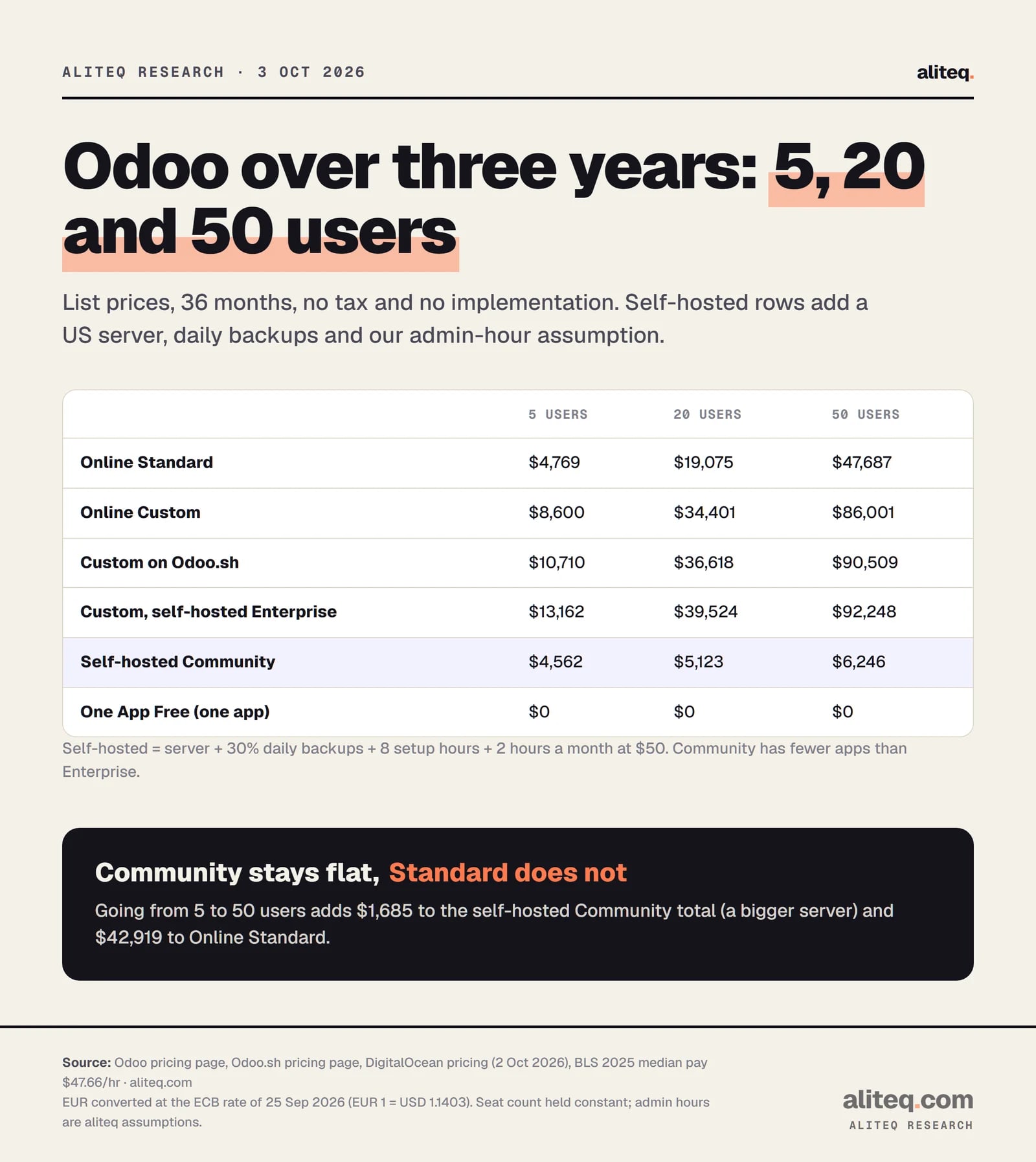
Self-hosted Community is the cheapest paid-for route at every size, but it does not include the same apps. At 5 users the gap is small: $4,562 against $4,769 for Online Standard.
Three-year list-price totals, 36 months, no tax, no implementation. Euros converted at the ECB rate of 25 Sep 2026. · aliteq research
Odoo over three years (our model, list prices)
One App Free (one app)
5 users
$0
20 users
$0
50 users
$0
Online Standard
5 users
$4,769
20 users
$19,075
50 users
$47,687
Online Custom
5 users
$8,600
20 users
$34,401
50 users
$86,001
Custom on Odoo.sh
5 users
$10,710
20 users
$36,618
50 users
$90,509
Custom, self-hosted Enterprise
5 users
$13,162
20 users
$39,524
50 users
$92,248
Self-hosted Community
5 users
$4,562
20 users
$5,123
50 users
$6,246
5 users
20 users
50 users
One App Free (one app)
$0
$0
$0
Online Standard
$4,769
$19,075
$47,687
Online Custom
$8,600
$34,401
$86,001
Custom on Odoo.sh
$10,710
$36,618
$90,509
Custom, self-hosted Enterprise
$13,162
$39,524
$92,248
Self-hosted Community
$4,562
$5,123
$6,246
How the numbers are built.
Standard: 12 months at €19.90 plus 24 months at €24.90 is €836.40 a user, or $953.75 at the ECB rate of 25 September 2026. Multiply by headcount.
Custom: 12 months at €35.90 plus 24 months at €44.90 is €1,508.40 a user, or $1,720.03.
Odoo.sh row: Custom licence plus Odoo.sh at annual billing for 36 months (our worker and storage reading above), with no staging environment. A staging environment adds $14.40 a month.
Self-hosted Enterprise row: Custom licence plus the self-hosted server, backups and admin time.
Self-hosted Community: server and backups ($561.60, $1,123.20 or $2,246.40) plus $4,000 of setup and upkeep.
What the table shows. From 5 to 50 users, Community self-hosted rises by $1,685, a bigger server. Online Standard rises by $42,919. Admin time is 88 percent of the Community total at 5 users and 64 percent at 50. If you value your own time at zero, Community's cash cost is $561.60 to $2,246.40 over three years.
What the table hides. Community and Standard are not the same product. Standard has every app; Community lacks full Accounting, Helpdesk, Studio and the rest listed above. You also own security patches, backups and every major upgrade. A Standard plan includes those. And if you add Odoo Enterprise on your own server, the licence dominates: self-hosting Custom costs more than Online Custom by the server and admin bill.
Which route fits which team
Pick by the gate you hit first, then confirm it on Odoo's pages.
You only need a CRM or one other app: start on One App Free. It is $0 for unlimited users, until you install an unrelated second app.
You want all apps and Odoo to run it: Standard. Budget $953.75 a user over three years, and more for users added after year one.
You need custom modules, Studio, multi-company or the external API: Custom, with Odoo Online, Odoo.sh or your own server.
You have someone who can run a Linux server: Community self-hosted is the lowest cash cost, with fewer apps and no included support.
You need local implementation help above 50 users: Odoo points mid-size companies to partners, and partner rates are not published. Get quotes first.
On odoo.com on 3 October 2026, Standard was €19.90 a user a month on yearly billing for the first year, then €24.90, and Custom was €35.90, then €44.90. Monthly billing was €24.90 then €31.10 for Standard and €44.90 then €56.90 for Custom. At the ECB rate of 25 September 2026 that is $22.69, $28.39, $40.94 and $51.20 on yearly billing.
Is Odoo really free?
Two parts are. The One App Free plan is €0 for one app (plus the apps it depends on) and unlimited users, and Odoo Community is open-source software you can download and run yourself. Using all apps on Odoo Online costs money, and so does Enterprise.
What is the difference between Odoo Community and Enterprise?
Community is the open-source core under LGPLv3. Enterprise is the licensed edition built on it. Both include CRM, Sales, Invoicing, Point of Sale, Inventory and Website. Per Odoo's compare table, only Enterprise has full Accounting, Helpdesk, Studio, Sign, Documents, Marketing Automation, the mobile app, support and upgrades.
What is the difference between Odoo Standard and Custom?
Standard is all apps on Odoo Online with no custom modules. Custom adds Odoo Studio, multi-company, the external API and custom development, and lets you host on Odoo.sh or your own server. Custom costs about 80 percent more in the first year.
How much does it cost to self-host Odoo?
On our assumptions, Community self-hosted costs $4,562 over three years at 5 users, $5,123 at 20 and $6,246 at 50. Only $561.60 to $2,246.40 of that is cash for the server and backups. The rest is 8 setup hours plus 2 hours a month at $50. Those hours are our estimate, not an Odoo figure.
Does Odoo publish what an implementation partner costs?
No partner prices are published on odoo.com. Odoo does publish its own Success Packs, from €499 for 4 hours to €16,830 for 200 hours for a new customer, and says mid-size companies usually work with a partner.