Google Cloud's new spec for agent knowledge is a folder of markdown files with a few lines of YAML on top. Here is what is in the file, what v0.2 added, and where it differs from a vector index.
I read launch threads for a living, so I'll say it straight: most "new standard" announcements are a logo and a promise. OKF is different in one way. You can read the whole spec in one sitting, and it asks for almost nothing.
Here is what Google actually published, what changed in v0.2, and the one comparison people keep getting wrong.
What is the Open Knowledge Format?
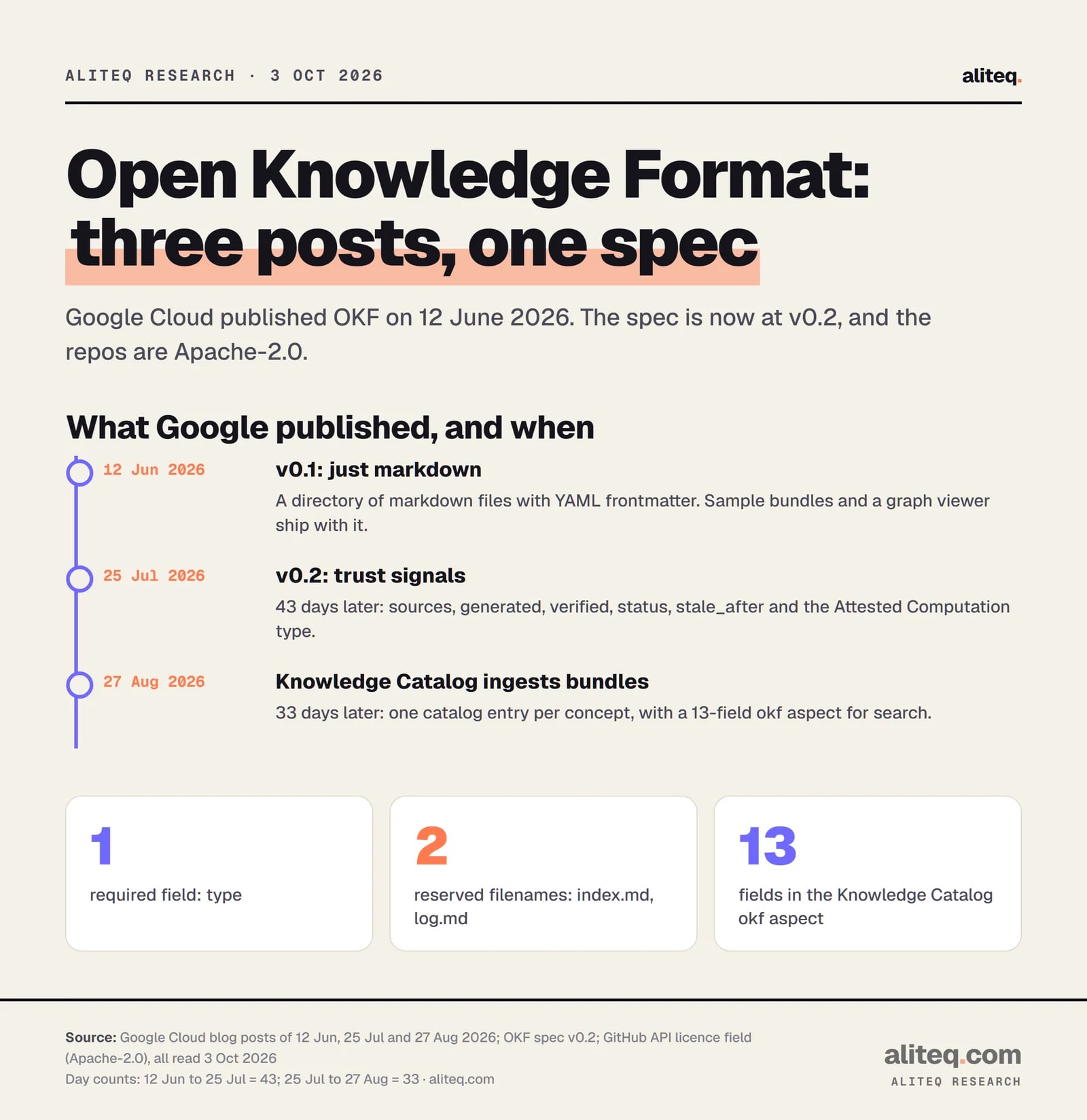
OKF is Google Cloud's open specification for packaging knowledge for AI agents as markdown files with YAML frontmatter. Google's launch post calls it a way to formalize the "LLM-wiki pattern" into a portable format. It is vendor-neutral, and the spec and repos are Apache-2.0 licensed on GitHub.
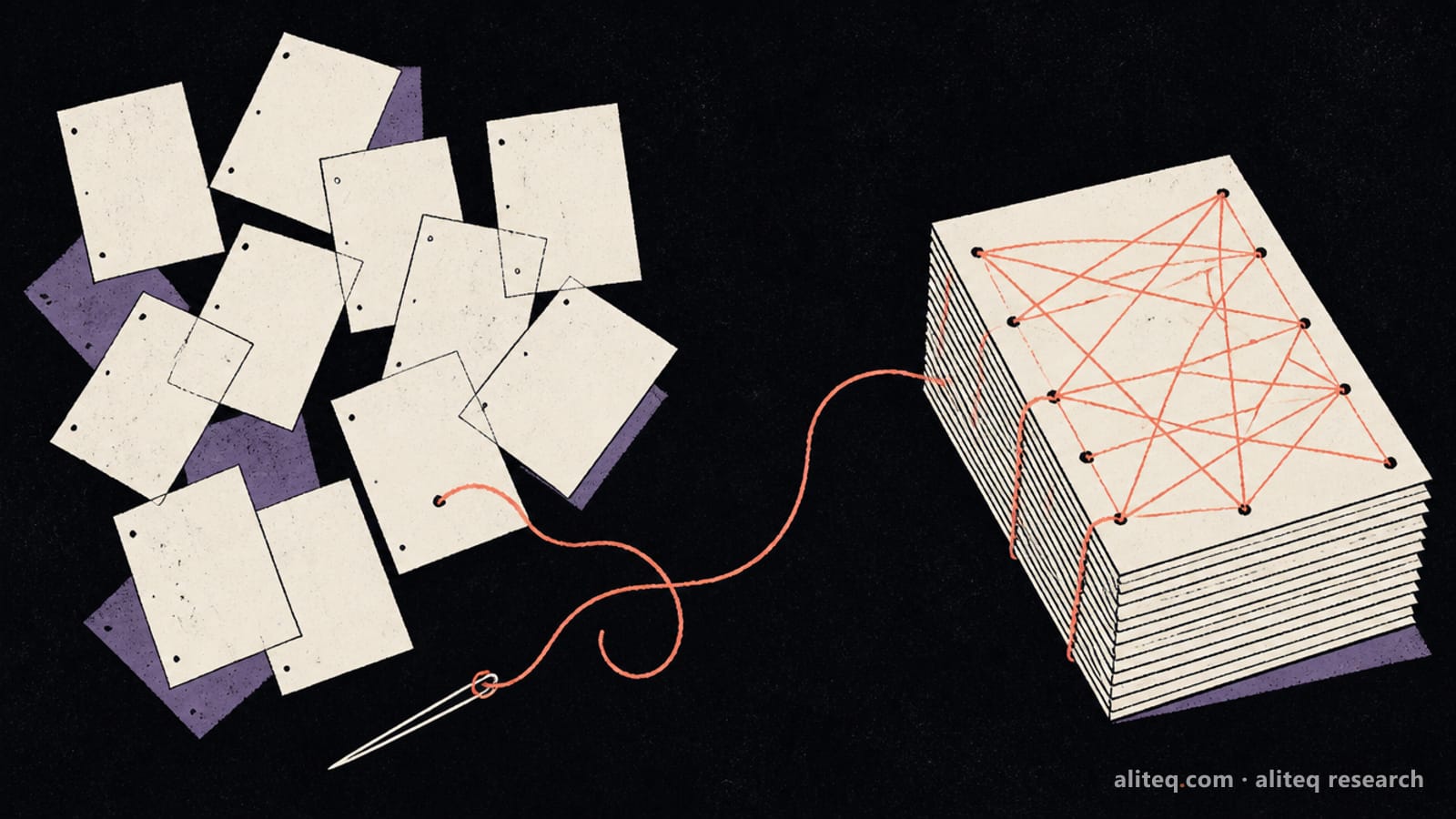
The problem Google names is scattered context. A table's schema, the meaning of a metric, an incident runbook: these live in catalogs, wikis, code comments and, in Google's words, "the heads of a few senior engineers." An agent has to stitch an answer together from all of it.
Google's pitch is that you need a format, not another service. The launch post says OKF has "no new runtime, no required SDK." If you can read a text file, you can read OKF.
The "LLM wiki" idea is not Google's. The launch post credits Andrej Karpathy's LLM Wiki gist and points to Obsidian vaults, AGENTS.md and CLAUDE.md files, and repos full of index.md files as the same pattern. OKF is the attempt to make those cooperate.
What does an OKF bundle look like?
A bundle is a directory of markdown files. Each file is one concept: a table, a metric, a runbook, an API. The file's path is its identity. Each file opens with a YAML block, then free-form markdown. Reserved names are index.md for a directory listing and log.md for update history.
Only type is required. The spec's recommended extras are title, description, resource (a link to the real asset) and tags. Here is a trimmed example in the spec's own style:
---
type: Metric
title: Weekly active users
description: Distinct users with one or more events in a 7-day window.
tags: [product, engagement]
---

# Definition

Counted from the events table, which this file links to by its bundle path.
In a real file that reference is a normal markdown link to the other concept's path, and it matters. Concepts point at each other with ordinary markdown links, so the folder becomes a graph. The spec says the kind of relationship lives in the surrounding sentence, not in the link. If you were hoping for a typed knowledge graph, that is not in v0.2. Google's July post says contributors proposed typed edges as an extension, but they are proposals.
Dates from Google Cloud's three OKF posts, read 3 October 2026. · aliteq research
What did OKF v0.2 add?
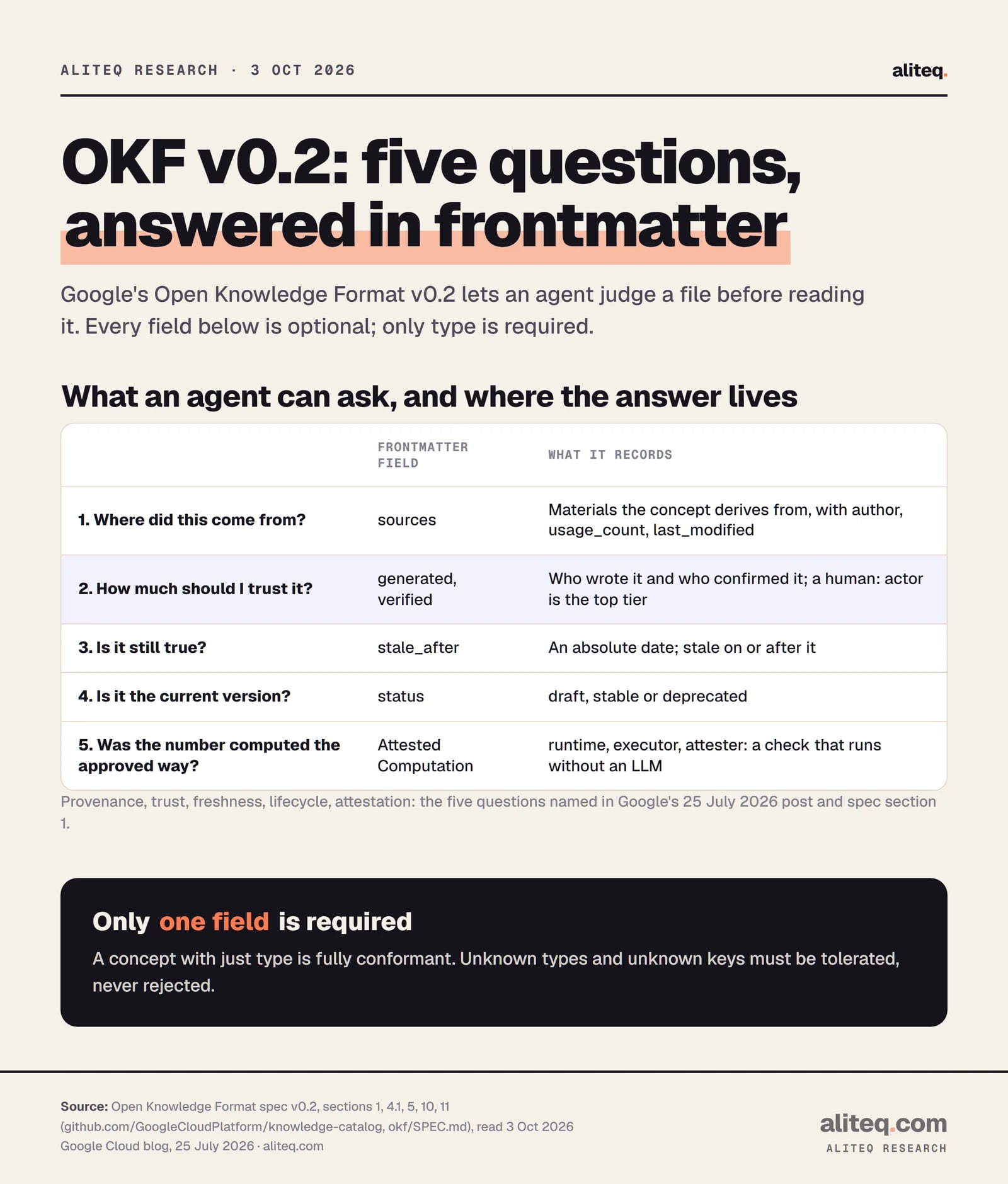
v0.2 added a set of optional frontmatter fields so an agent can judge a file before reading it. They answer five questions: where did this come from, how far to trust it, is it still true, is it the current version, and was a number computed the approved way. Every new field is opt-in.
Google's reason is that agents now write knowledge too. A person who writes a wiki page can be held to it. When an agent generates ten thousand concepts overnight, you need explicit signals instead.
Here is how the fields map to the questions.
OKF v0.2: question to field
Where did this come from?
Field
sources
What it records
Materials it derives from, with optional author, usage_count and last_modified
How much should I trust it?
Field
generated, verified
What it records
Who or what wrote it, and who confirmed it
Is it still true?
Field
stale_after
What it records
An absolute date; the file is stale on or after it
Is it the current version?
Field
status
What it records
draft, stable or deprecated (no value means stable)
Was the number computed the approved way?
Field
Attested Computation type
What it records
A runtime, an executor and a no-LLM attester that checks the receipt
Field
What it records
Where did this come from?
sources
Materials it derives from, with optional author, usage_count and last_modified
How much should I trust it?
generated, verified
Who or what wrote it, and who confirmed it
Is it still true?
stale_after
An absolute date; the file is stale on or after it
Is it the current version?
status
draft, stable or deprecated (no value means stable)
Was the number computed the approved way?
Attested Computation type
A runtime, an executor and a no-LLM attester that checks the receipt
The trust tiers are simple. No verified field means unverified. Verified only by machines or processes means machine-confirmed. Any verifier written as human:<id> makes it human-reviewed. The spec calls these "advisory signals, not access control," so OKF does not lock anything.
Two fields from v0.1 were retired. timestamp became generated.at, and the body # Citations list became sources. Both have fallbacks, so old bundles still load.
OKF specification v0.2, sections 1, 5 and 10, read 3 October 2026. · aliteq research
Is OKF a replacement for RAG?
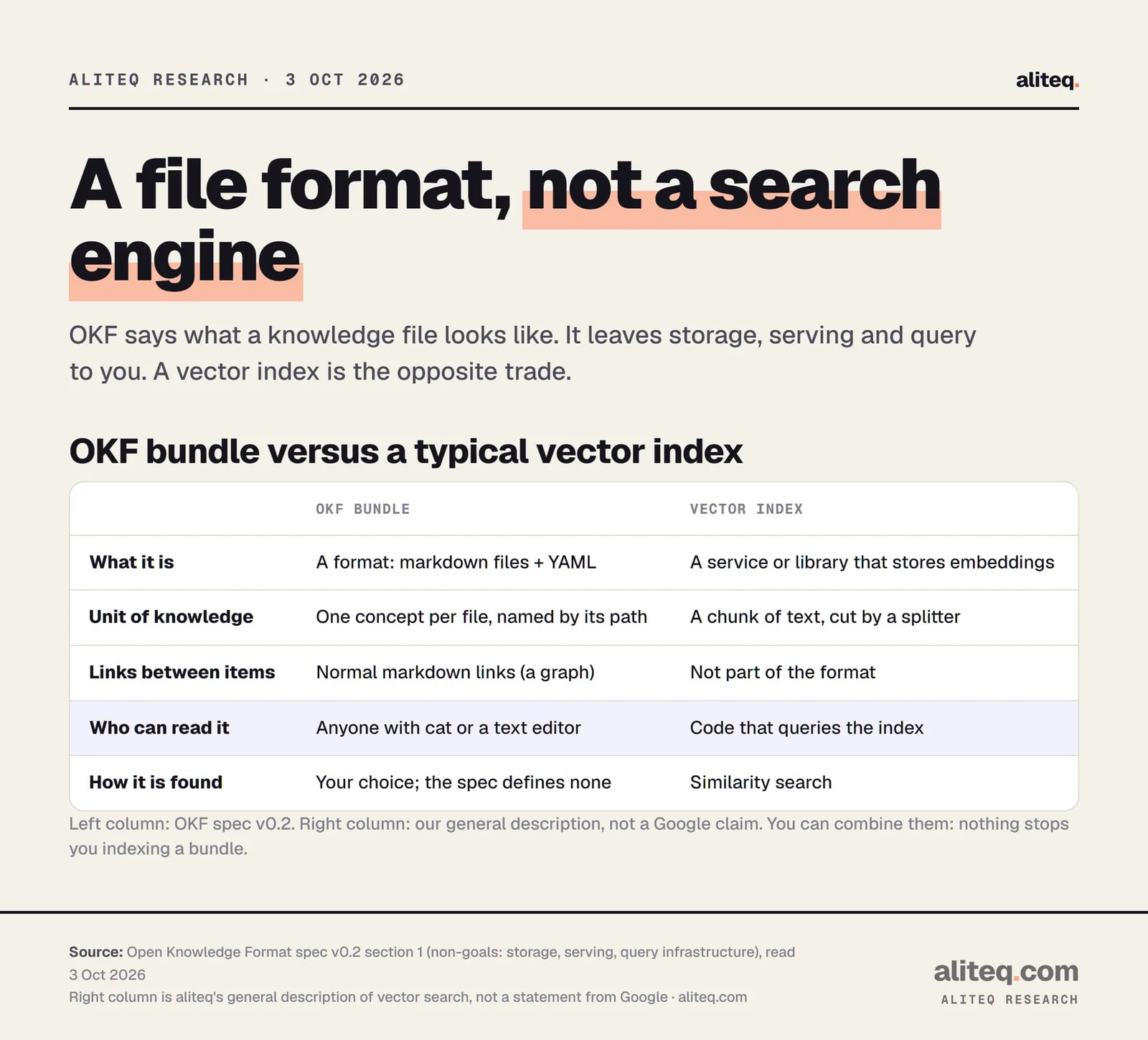
No. OKF is a file format and RAG is a retrieval technique, so they are not the same kind of thing. The spec lists "prescribing storage, serving, or query infrastructure" as a non-goal. You could chunk and embed an OKF bundle for vector search, or just let an agent read files.
This is our reading, not Google's. Google's posts compare OKF to the LLM-wiki pattern, and none of the three posts we read frames it as a RAG alternative. The seed idea that OKF "beats RAG" has no source behind it.
Still, the design makes a real difference to how you would retrieve. In a typical retrieval-augmented setup, the unit is a text chunk cut by a splitter. In OKF the unit is a whole concept with a name, a path and links.
The spec also leans on progressive disclosure. An index.md lets an agent see what is in a folder before opening anything. Google's July post says most interactions with a concept never reach the body, because the agent first decides whether it is relevant. That is why trust lives in frontmatter, where it costs few tokens to check.
Left column from the OKF spec v0.2. Right column is our general description, not a Google claim. · aliteq research
With v0.1, Google shipped a reference agent that drafts concept files from a BigQuery dataset, a one-file HTML graph viewer, and three sample bundles (GA4 e-commerce, Stack Overflow and Bitcoin). Google calls these "proofs of concept, deliberately." On 27 August it added Knowledge Catalog ingestion.
Knowledge Catalog is Google Cloud's "context engine for agents." Per the 27 August post, pushing a bundle creates one catalog entry per concept, with an okf aspect that carries the OKF signal fields. Google says the search, access controls and lineage the catalog already has then apply to bundles.
That last part is Google's product, so treat it as one way to use OKF, not the point of it. The spec itself says you can ship a bundle as a git repo, a tarball or a subfolder.
Here is what we could not verify. We found no Google statement that Gemini or any other Google product reads OKF outside Knowledge Catalog. We found no accuracy or cost numbers. And we did not check whether Anthropic, OpenAI or other vendors support it. If a post tells you otherwise, ask for the source.
Should you care yet?
Care if you already keep agent context in markdown. If you maintain CLAUDE.md-style files, an index.md of notes or an Obsidian vault for an agent, OKF is a free naming convention for what you already do. If you do not, it solves nothing today.
The cost of trying is low because the format is one required field. That is also the risk. The spec is at v0.2, it had two breaking renames in its first minor bump, and its own "considered and deferred" list includes the runtime protocol for attestation. Treat it as promising and early.
Pick one set of notes an agent already reads, such as a runbook or a metrics glossary, and split it into one concept per file.
Add a `type` line to each file. Add `title`, `description` and `tags` if you like. That is a valid bundle.
Link related files with normal markdown links, and add an `index.md` per folder so an agent can scan before it opens.
Only then add trust fields: `verified` by a named human, and a `stale_after` date for anything that goes out of date.
Keep it in git. The spec recommends a git repo because it gives you history, attribution and diffs.
For more on agents and the tools around them, browse our AI coverage. We earn nothing from Google or from any OKF project, and every claim here was read from Google's own posts or the spec on 3 October 2026.
Quick answers
What does OKF stand for?
Open Knowledge Format. It is a specification from Google Cloud for representing knowledge as markdown files with YAML frontmatter, published on 12 June 2026. The current spec version is 0.2.
Is the Open Knowledge Format open source?
Yes. The GitHub repos for the spec and the reference tooling carry the Apache-2.0 license, according to GitHub's license field on 3 October 2026. Google describes it as vendor-neutral and says it does not need an account or an SDK.
What is required in an OKF file?
One field, type, a short string such as Metric, Playbook or BigQuery Table. A file with only a type is conformant. Title, description, resource and tags are recommended, and unknown fields must not cause a rejection.
How is OKF different from RAG?
OKF is a file format; RAG is a retrieval method. OKF defines what a knowledge file contains and says nothing about storage or search. You can run RAG over an OKF bundle. Google does not present OKF as a RAG replacement.
What changed in OKF v0.2?
Optional trust and lifecycle fields: sources, generated, verified, status and stale_after, plus an Attested Computation type. It also replaced timestamp with generated.at and the body citations list with sources. Google announced it on 25 July 2026.
Does OKF only work with Google Cloud?
No. The spec is not tied to any cloud, model or agent framework. Google's Knowledge Catalog can ingest bundles, but a bundle can be a git repo or a zip file read by anything that reads markdown.