The 5080 is the newer card and holds its own on speed, but its 16GB stops 27–32B models at good quality. The 4090's 24GB runs them. Specs from NVIDIA, measured llama.cpp speeds, our VRAM math, street and rental prices, all read Nov 6, 2026.
Some links on this page are referral links: we may earn a commission, at no cost to you.
Share
RTX 5080 or RTX 4090 for local AI? For running language models, the RTX 4090. NVIDIA lists the 5080 with 16 GB of GDDR7 and the 4090 with 24 GB of GDDR6X, and that 8GB is the whole decision: the 27–32B models that are the sweet spot for local AI fit 24GB at Q4_K_M and don't fit 16GB at that quality. On the models both cards hold, they're close in speed. The 5080 is the right buy only if your models stay at 14B or below, or you want a cheaper, cooler, current card. Specs, speeds and prices below were read on November 6, 2026.
Does Qwen3-32B fit? VRAM at a glance
Qwen3-32B (Q4_K_M, 8K context) needs ≈21.3 GB
RTX 508016 GBover 5.300000000000001 GB
RTX 409024 GBfits
RTX 509032 GBfits
Our VRAM engine's estimate for Qwen3-32B at Q4_K_M with 8K context. The 5080's 16GB falls short; the 4090's 24GB clears it.
Which models fit on an RTX 5080 vs an RTX 4090?
Anything up to the 14B class fits both. From about 27B up, only the 4090 keeps Q4_K_M, the quantization level most people treat as the quality floor. We ran each model's published config through the same VRAM engine that powers our VRAM calculator on November 6, 2026. "Tight" means the model uses more than 90% of the card: it loads, but a browser or desktop on the same GPU can push it over.
Best quant that fits at 8K context (our VRAM engine, Nov 6, 2026)
Longer context widens the gap. At 32K context, Qwen3.8 27B drops to Q3_K_M on 16GB (about 15.4GiB) but keeps Q4_K_M on 24GB (about 18.5GiB). Qwen3-32B at 32K needs about 27.3GiB at Q4_K_M, which is too much for either card; the 4090 has to drop to Q3_K_M and the 5080 can't hold it at all. Gemma 4 and Qwen3.8 use hybrid attention, so add a few hundred MB for their fixed per-layer state. These are estimates from each model's config, not measurements. Per-model detail: best GPU for Qwen3.8 27B, Gemma 4 26B-A4B and Qwen3-32B.
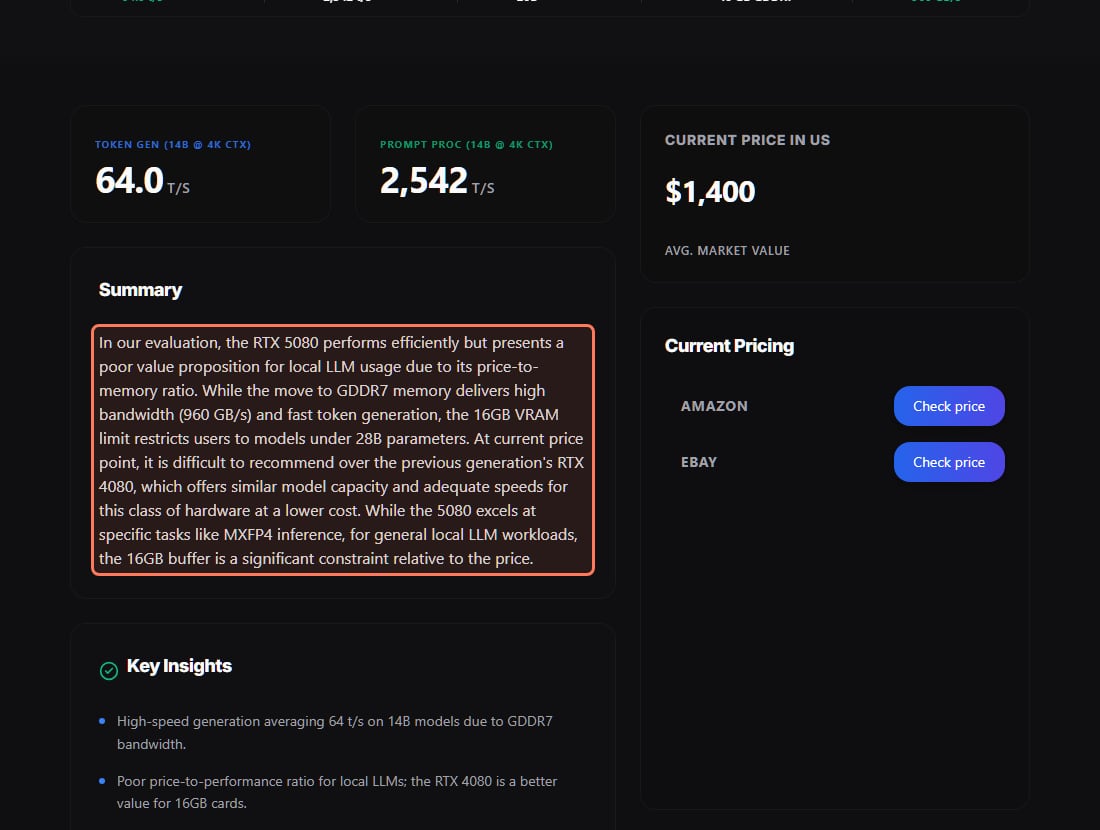
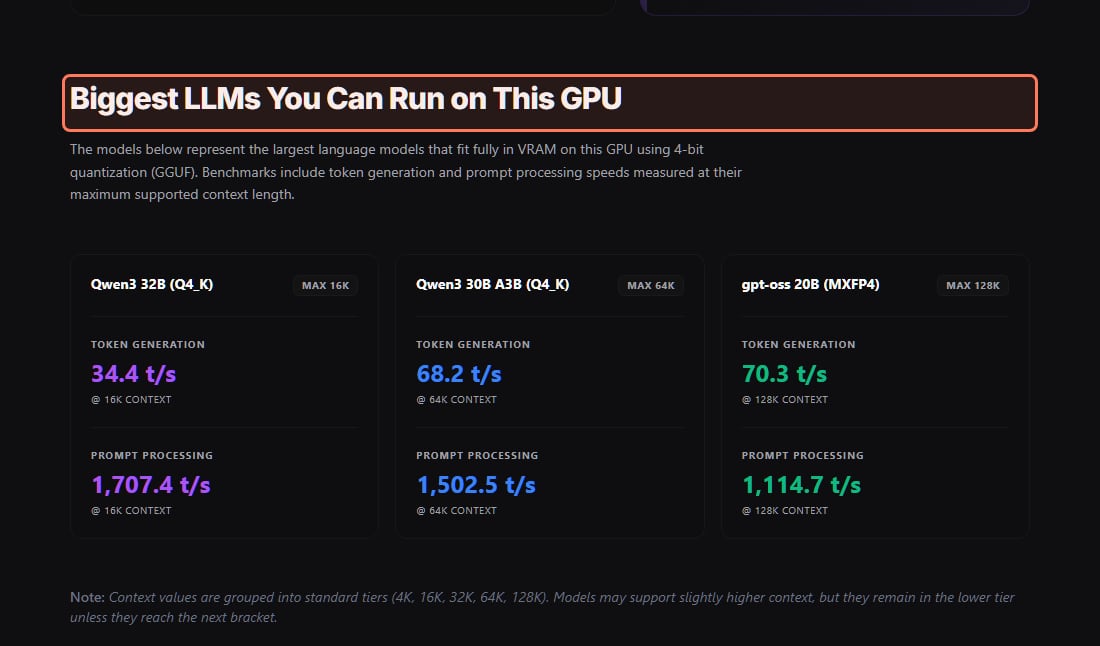
hardware-corner reaches the same line from the other side. Its RTX 5080 summary says "the 16GB VRAM limit restricts users to models under 28B parameters", while its RTX 4090 page lists Qwen3 32B (Q4_K) as the biggest model that fits, at 34.4 tokens/sec with 16K context.
hardware-corner.net's RTX 5080 benchmark page, read November 6, 2026. The outline is ours. · Screenshot of hardware-corner.net by aliteq
This is the same trap as the RTX 5060 Ti vs used RTX 3090 decision, one tier up. A newer 16GB card is still a 16GB card: the model file either fits in VRAM or it doesn't, and speed only matters between cards that can both load it.
Is the RTX 5080 faster than the RTX 4090 for LLMs?
Not by much either way. On models both cards hold, hardware-corner's llama.cpp tables (read November 6, 2026) put the 4090 slightly ahead at short and medium context, and the 5080 ahead on gpt-oss-20b in its native MXFP4 format at very long context. Token generation is bound by memory bandwidth, and NVIDIA lists 960 GB/sec for the 5080; hardware-corner lists 1,008 GB/s for the 4090.
Measured llama.cpp speeds, tokens/sec (hardware-corner.net, read Nov 6, 2026)
Qwen3-8B Q4_K, generation @16K
Test
94.1
RTX 5080
108.0
Qwen3-14B Q4_K, generation @4K
Test
80.6
RTX 5080
84.4
Qwen3-14B Q4_K, generation @16K
Test
64.0
RTX 5080
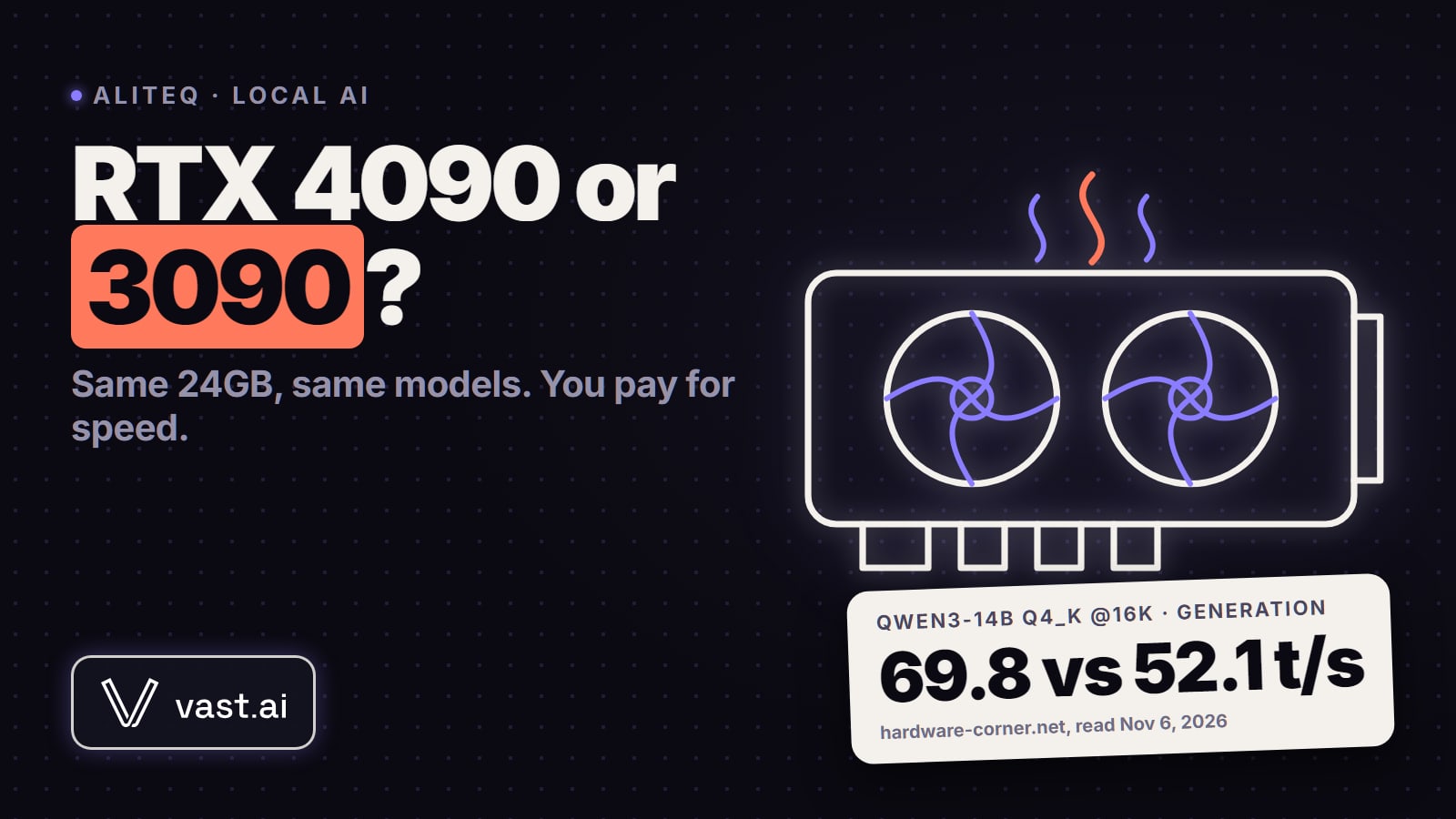
69.8
Qwen3-14B Q4_K, prompt processing @16K
Test
2,542
RTX 5080
3,452
gpt-oss-20b MXFP4, generation @16K
Test
161.3
RTX 5080
163.3
gpt-oss-20b MXFP4, generation @128K
Test
105.6
RTX 5080
70.3
Qwen3-30B-A3B Q4_K, generation @16K
Test
Doesn't fit
RTX 5080
139.2
Qwen3-32B Q4_K, generation @16K
Test
Doesn't fit
RTX 5080
34.4
Test
RTX 5080
RTX 4090
Qwen3-8B Q4_K, generation @16K
94.1
108.0
Qwen3-14B Q4_K, generation @4K
80.6
84.4
Qwen3-14B Q4_K, generation @16K
64.0
69.8
Qwen3-14B Q4_K, prompt processing @16K
2,542
3,452
gpt-oss-20b MXFP4, generation @16K
161.3
163.3
gpt-oss-20b MXFP4, generation @128K
105.6
70.3
Qwen3-30B-A3B Q4_K, generation @16K
Doesn't fit
139.2
Qwen3-32B Q4_K, generation @16K
Doesn't fit
34.4
These are hardware-corner's measurements, not benchmarks we ran. Its 4090 page says "Updated Benchmarks: March 2026"; its 5080 table names llama.cpp build 8233. One oddity worth knowing: both pages' headline cards disagree with their own tables (the 4090 card shows 78.7 t/s for 14B, its table 69.8 at 16K; the 5080 card labels 64.0 as 4K context, its table puts 64.0 at 16K and 80.6 at 4K), so we quote the tables.
hardware-corner.net's RTX 4090 page, read November 6, 2026. Its RTX 5080 list of biggest models stops at gpt-oss 20B, Qwen3 14B and Qwen3 8B. · Screenshot of hardware-corner.net by aliteq
RTX 5080 vs RTX 4090: the specs that matter for AI
From NVIDIA's own pages, plus hardware-corner prices (read Nov 6, 2026)
VRAM
Spec
16 GB GDDR7
RTX 5080
24 GB GDDR6X
Memory bus
Spec
256-bit
RTX 5080
384-bit
Memory bandwidth
Spec
960 GB/sec (NVIDIA)
RTX 5080
1,008 GB/s (hardware-corner)
Architecture
Spec
Blackwell, 5th-gen Tensor Cores
RTX 5080
Ada Lovelace, 4th-gen Tensor Cores
Native FP4
Spec
Yes
RTX 5080
No
Total graphics power
Spec
360W
RTX 5080
450W
Required system power
Spec
850W
RTX 5080
850W
US average market value
Spec
$1,400
RTX 5080
$2,200
Spec
RTX 5080
RTX 4090
VRAM
16 GB GDDR7
24 GB GDDR6X
Memory bus
256-bit
384-bit
Memory bandwidth
960 GB/sec (NVIDIA)
1,008 GB/s (hardware-corner)
Architecture
Blackwell, 5th-gen Tensor Cores
Ada Lovelace, 4th-gen Tensor Cores
Native FP4
Yes
No
Total graphics power
360W
450W
Required system power
850W
850W
US average market value
$1,400
$2,200
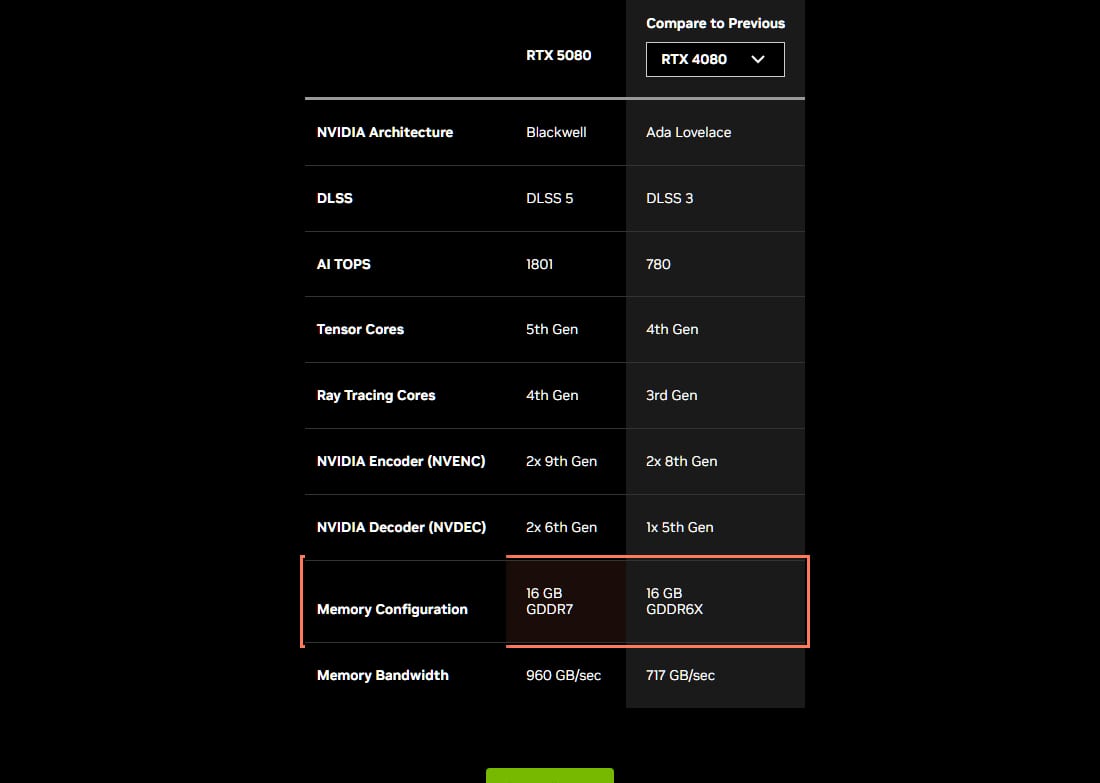
NVIDIA's own RTX 5080 spec table, read November 6, 2026. The page compares it with the RTX 4080 by default; both are 16GB cards. The outline is ours. · Screenshot of nvidia.com by aliteq
NVIDIA lists 1,801 AI TOPS for the 5080 and 1,321 for the 4090. Don't read that as a speed ratio for local LLMs: generation speed tracks memory bandwidth, which is about equal here, and the table above shows it.
Head to head for local AI
RTX 5080
16GB · Blackwell
vs
RTX 4090
24GB · Ada
16 GB
VRAM
24 GB
~14B
Biggest dense model, Q4_K_M
~32B
64.0 t/s
14B gen @16K
69.8 t/s
105.6 t/s
gpt-oss-20b @128K
70.3 t/s
360W
Power
450W
~$1,400
US average price
~$2,200
5080 wins 3wins 3 4090
When is the RTX 5080 the better buy?
When your models stay at 14B or below, or the card also has to game. Then the 5080 does the job for about $800 less on hardware-corner's US averages, on 90W less power per NVIDIA, as a current-generation card. Specifically:
Your models are 14B or smaller, or gpt-oss-20b. Both fit 16GB, and hardware-corner measured the 5080 within about 15% of the 4090 on them (64.0 vs 69.8 t/s on Qwen3-14B at 16K), ahead at 128K context on gpt-oss-20b.
Price. About $1,400 vs $2,200 is a real gap. If the extra $800 doesn't buy you a model you'll actually run, it's wasted.
Power and heat. 360W vs 450W total graphics power, per NVIDIA. Both list an 850W power supply.
New vs used. The 4090 is a 2022 card and the 5090 has replaced it at the top of NVIDIA's range, so in late 2026 buying one often means the used market, without the warranty a new 5080 carries.
FP4. NVIDIA's 5080 page pitches "Max AI performance with FP4". MXFP4 models like gpt-oss run natively on Blackwell; Ada has no FP4 support.
We haven't found a like-for-like image-generation benchmark of these two cards that we can source, so we don't call a winner for Stable Diffusion or Flux here. For image work, 16GB covers most common workflows; the VRAM argument above is an LLM argument first.
Can I try a 24GB card before I buy?
Yes, by the hour. Rent an RTX 4090, load the exact 27–32B model you want, and see whether you'd use it daily. In our price feed at 21:20 UTC on November 6, 2026, Vast.ai listed an RTX 4090 from $0.27 an hour on-demand (38 offers; $0.20 spot, which can be interrupted) and an RTX 5080 from $0.20 on-demand. Runpod listed its RTX 4090 at $0.89 and RTX 5080 at $0.59 on-demand. Prices move hourly; today's are on our cloud GPU price page. If you never reach past 14B, buy the 5080 with confidence. If you do, you've just shown yourself you need the 24GB.
Our call
Verdict
RTX 4090 for local LLMs; RTX 5080 for 14B-and-under
If local LLMs are the reason you're buying, get the RTX 4090. Its 24GB runs the 27–32B models at Q4_K_M; the RTX 5080's 16GB only loads them at lower-quality quants, and speed between the two is close. Buy the 5080 if your models stay at 14B and under or gpt-oss-20b, if the extra $800 doesn't buy you a model you'll use, or if you want a current card that draws 90W less. Buying a 5080 and then wanting a 32B model is the one regret to avoid.
Best for: RTX 4090: 27–32B local models, longer context, max capability. RTX 5080: 14B-class models and gpt-oss-20b, gaming, lower price and power, new with warranty.
RTX 5080 vs 4090: the questions buyers ask
Is the RTX 5080 better than the RTX 4090 for AI?
For local LLMs, no. The 4090's 24GB runs 27–32B models at Q4_K_M that the 5080's 16GB can't, and hardware-corner measured the two close in speed on models both can load. The 5080 is cheaper and draws less power, so it's the better buy only if your models stay at 14B or below.
Can the RTX 5080 run a 32B model?
Only at Q2_K with 8K context on our VRAM engine (about 15.6GiB, tight), which costs a lot of quality. You can offload part of a larger quant to system RAM, but generation then slows sharply because every token waits on the slower memory. If 32B is the target, get a 24GB card.
Can the RTX 5080 run gpt-oss-20b?
Yes. hardware-corner measured it at 161.3 tokens/sec at 16K context and 105.6 at 128K in MXFP4, faster than its 4090 figure at 128K (70.3).
Is there a 24GB RTX 50-series card?
Not on NVIDIA's comparison page as of November 6, 2026. It lists 50 Series memory configs of 32GB (the RTX 5090), 16GB, 12GB, 16/8GB and 8GB. For 24GB today your options are the RTX 4090 or a used RTX 3090; for more, the 32GB RTX 5090.
How much do the RTX 5080 and RTX 4090 cost?
hardware-corner lists a US average market value of $1,400 for the RTX 5080 and $2,200 for the RTX 4090, read November 6, 2026. NVIDIA's own pages didn't show a live price when we checked. To rent instead, see today's hourly prices on our cloud GPU page.
Is the 5080 faster than the 4090 at all?
On hardware-corner's tables, at long context on gpt-oss-20b (105.6 vs 70.3 tokens/sec at 128K). At short context and on Qwen3 models, the 4090 is slightly faster, and its prompt processing is quicker (3,452 vs 2,542 tokens/sec on Qwen3-14B at 16K).