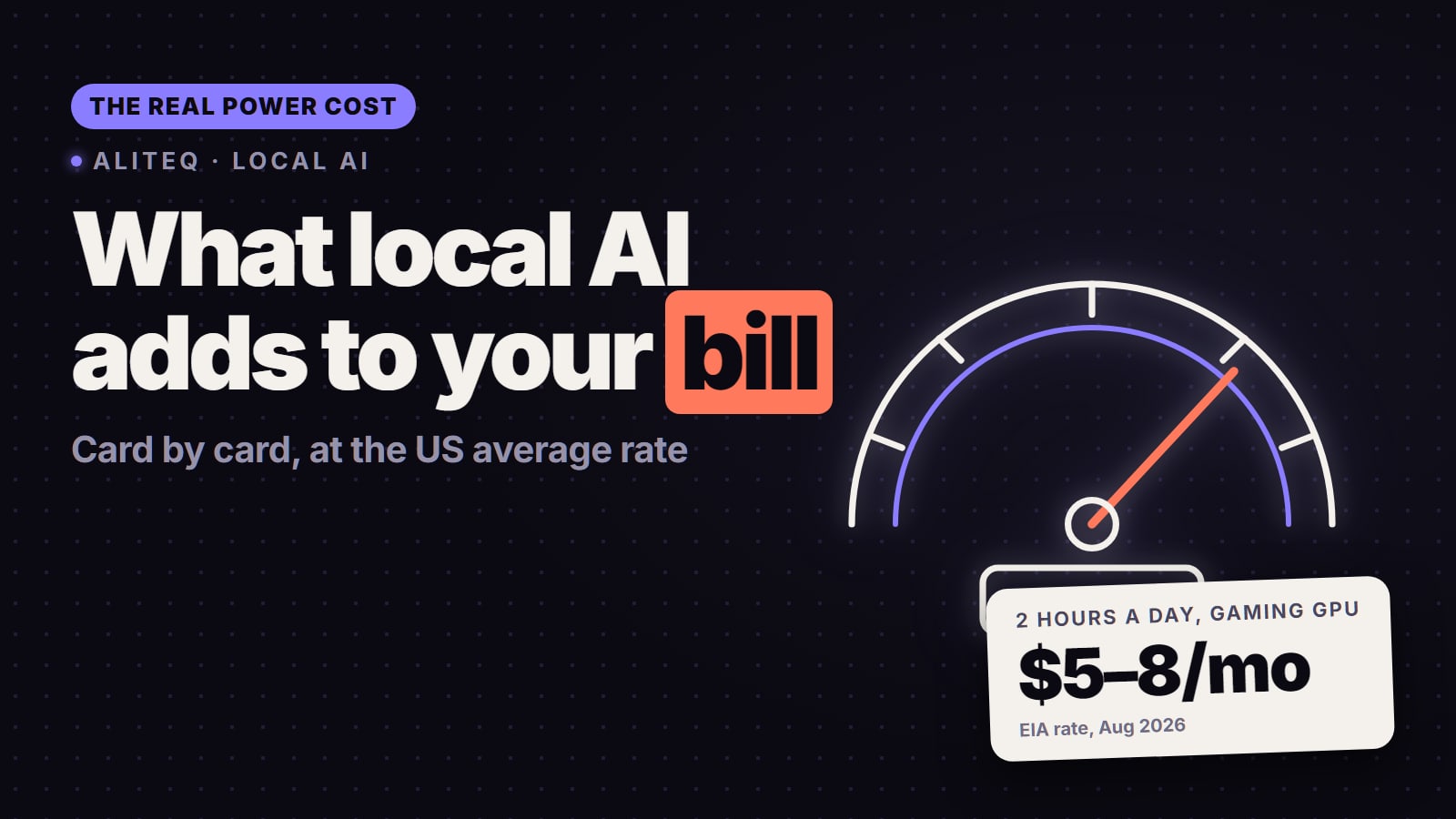
A gaming GPU running AI two hours a day adds about $5 to $8 a month at the US average rate. Running it flat out 24/7 is $65 to $95. The maths, card by card.
Before buying a GPU for local AI, the fair question is what it does to the power bill. We worked it out from the manufacturers' own power ratings and the US government's average electricity price, then checked it against one user's measured month. Short version: for how most people use a local model, electricity is a small line item. The hardware is the big one.
How much power does a GPU draw running a local LLM?
At most, its rated board power plus the rest of the PC. NVIDIA rates the RTX 3090 at 350 W, the RTX 4090 at 450 W and the RTX 5090 at 575 W; AMD rates the RX 7900 XTX at 355 W typical board power. Apple lists a Mac mini M4 at 4 W idle and 65 W max, and an M4 Pro at 5 W idle and 140 W max.
Two things pull real use below those figures. First, a GPU only draws heavily while it is generating; between prompts it drops to idle. Second, generating text one token at a time is usually limited by memory speed, not raw compute, so a card often runs below its rating. The rated figure is a ceiling, which makes the sums below a cautious estimate.
For a whole PC we add 150 W for the CPU, board, drives and fans. That's our assumption, not a measurement; your system may be lower or higher.
What it costs per month, card by card
All figures at 18.16 cents/kWh, the US average residential price for August 2026 in the EIA's Electric Power Monthly (preliminary, released October 23, 2026). Hours are hours of full-load generation, not hours the PC is switched on.
Mac mini M4 (65 W max)
Per hour
1.2 cents
2 h a day
$0.71
8 h a day
$2.83
24/7
$8.50
Mac mini M4 Pro (140 W max)
Per hour
2.5 cents
2 h a day
$1.53
8 h a day
$6.10
24/7
$18.31
RTX 3090 PC (350 + 150 W)
Per hour
9.1 cents
2 h a day
$5.45
8 h a day
$21.79
24/7
$65.38
RX 7900 XTX PC (355 + 150 W)
Per hour
9.2 cents
2 h a day
$5.50
8 h a day
$22.01
24/7
$66.03
RTX 4090 PC (450 + 150 W)
Per hour
10.9 cents
2 h a day
$6.54
8 h a day
$26.15
24/7
$78.45
RTX 5090 PC (575 + 150 W)
Per hour
13.2 cents
2 h a day
$7.90
8 h a day
$31.60
24/7
$94.80
Per hour
2 h a day
8 h a day
24/7
Mac mini M4 (65 W max)
1.2 cents
$0.71
$2.83
$8.50
Mac mini M4 Pro (140 W max)
2.5 cents
$1.53
$6.10
$18.31
RTX 3090 PC (350 + 150 W)
9.1 cents
$5.45
$21.79
$65.38
RX 7900 XTX PC (355 + 150 W)
9.2 cents
$5.50
$22.01
$66.03
RTX 4090 PC (450 + 150 W)
10.9 cents
$6.54
$26.15
$78.45
RTX 5090 PC (575 + 150 W)
13.2 cents
$7.90
$31.60
$94.80
The sum is simple enough to redo with your own numbers: watts ÷ 1,000 × hours × your price per kWh. Your bill shows your rate; it can be well above or below the national average. If yours is double, double the table.
Monthly electricity at 2 hours of full-load generation a day (18.16 cents/kWh)
Mac mini M4$0.71
Mac mini M4 Pro$1.53
RTX 3090 PC$5.45
RTX 4090 PC$6.54
RTX 5090 PC$7.90
What one user measured over 30 days
The best real-world check this month came from r/LocalLLM. A user measured 30 days of local inference on an RX 7900 XTX at the wall: 30.20 kWh, which cost them 12.38 CHF (about $14.05) at Swiss rates, for 964 million input and 13 million output tokens. They priced the same token counts on an equivalent API, qwen3.8-flash at $0.15 per million input and $0.47 per million output tokens, at $150.71.
Two things stand out. 30.20 kWh over 30 days is an average of about 42 W, far below the card's 355 W rating, because most of the month was idle time and prompt reading, not flat-out generation. And at the US average rate the same 30.20 kWh would cost about $5.48.
The replies raised the right objections. The comparison leaves out the price of the card (and whether it loses or gains value), and the time spent setting it up. Several pointed out that a fair test needs the same quantization the API provider runs, since a smaller local quant is cheaper to run but not the same model. Treat it as one person's month, not a benchmark, but it matches what the ratings predict.
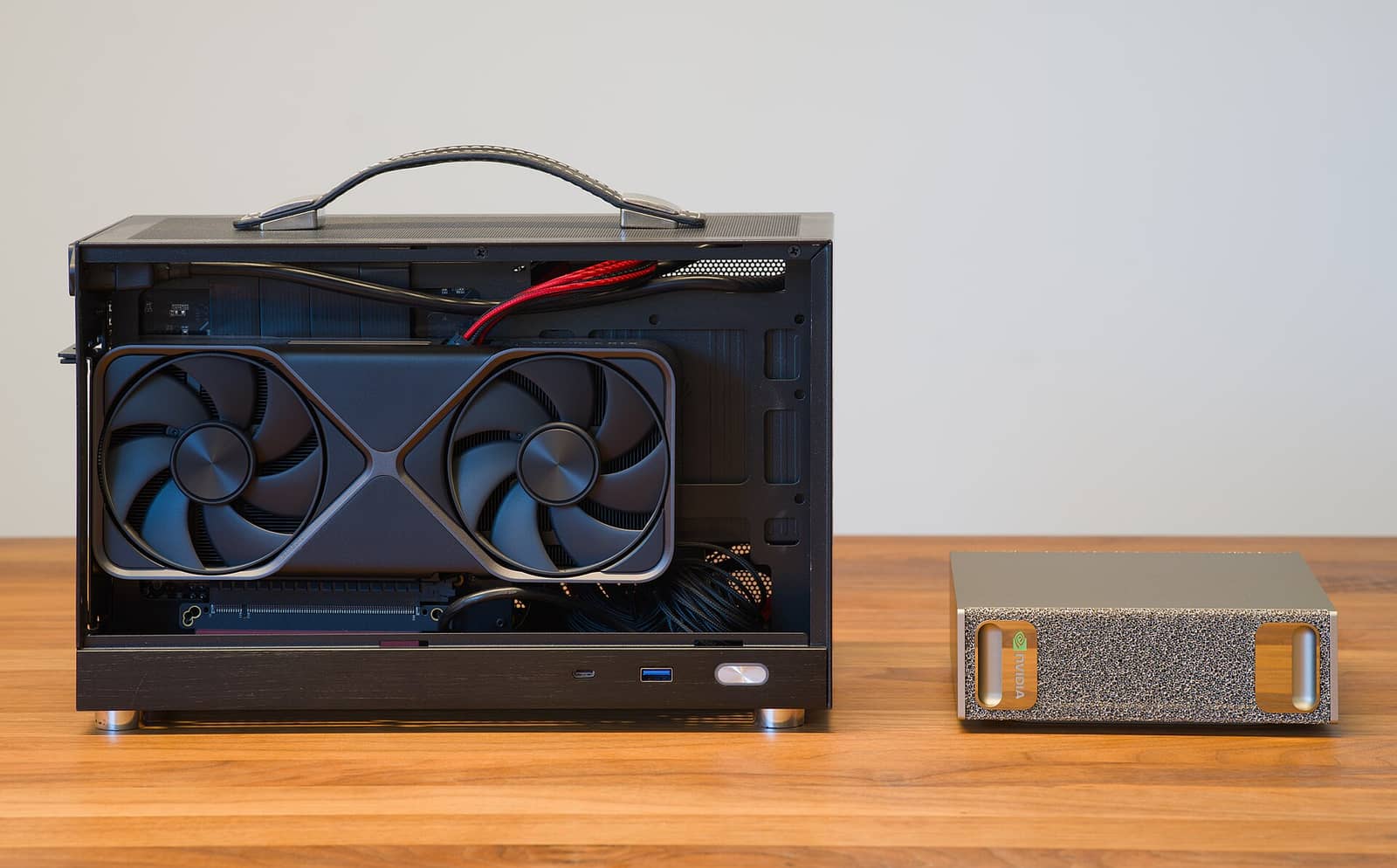
For on-demand use, electricity is a small line item. The card is the big one. · Unsplash
When does electricity matter?
Mostly in three cases:
You run it around the clock. A batch job or an always-busy API server at full load is the $65 to $95 a month row, more than many cloud subscriptions.
Your rate is high. At 40 or 50 cents per kWh, every figure in the table more than doubles.
You're choosing between hardware. Over three years of daily use, an RTX 5090 PC and a Mac mini M4 Pro differ by about $230 in electricity at two hours a day, and about $920 at eight hours; that can narrow the price gap between them.
For on-demand use (ask, read, ask again), the GPU sits idle most of the time and the monthly cost is a few dollars. Capping the card's power limit lowers the full-load figure further; see how to power-limit your GPU for local AI.
Is electricity the cost that decides it?
Rarely. The card, and the RAM to go with it, cost far more than a year of power for most people. Whether local AI pays off depends on how much you use it and how much privacy matters to you, which we cover in is running local AI worth it?. If you only need a big GPU now and then, compare renting against buying, and use cost to run to see what a specific model needs.
The image that ran with an earlier version of this guide.
Quick answers
How much electricity does running a local LLM use?
While it generates, a GPU PC draws up to its card's rating plus the rest of the system: roughly 500 W for an RTX 3090 PC, 600 W for an RTX 4090 PC and 725 W for an RTX 5090 PC. Between prompts it drops to idle. A Mac mini M4 tops out at 65 W per Apple.
How much does it add to a monthly bill?
At the US average of 18.16 cents per kWh, two hours of full-load generation a day costs about $5.45 a month on an RTX 3090 PC and $7.90 on an RTX 5090 PC. Running flat out 24/7 is $65 to $95 a month.
Is local AI cheaper than an API on electricity alone?
Often, if you use it a lot. One Reddit user measured 30.20 kWh over 30 days on an RX 7900 XTX for about $14 at Swiss rates, against $150.71 for the same tokens on an API. That leaves out the hardware, your time, and differences in model quantization.
Does a GPU use full power the whole time?
No. It draws heavily only while generating, and text generation is usually limited by memory speed, so the card often runs below its rating. The user above averaged about 42 W over a month on a 355 W card.
How do I work out my own cost?
Multiply watts by hours, divide by 1,000 to get kWh, then multiply by the price per kWh on your bill. A 600 W PC generating for 2 hours a day uses 36 kWh a month.
Verdict
Is electricity a reason not to run AI at home?
For on-demand use, a local LLM adds a few dollars a month to a US power bill. Only round-the-clock full-load use costs real money, $65 to $95 a month on a gaming-GPU PC. The decision is about the hardware and how often you'll use it, not the electricity.
Best for: anyone pricing a local AI setup in the US