The MI50 still gives you 32GB of 1 TB/s HBM2 for about a third of a used RTX 3090, but it's no longer the $150 bargain old guides promise, and AMD's current ROCm doesn't support it. Who should buy one, what to pay, and what breaks.
Some links on this page are referral links: we may earn a commission, at no cost to you.
Share
Is a used MI50 32GB worth it? Only if you run Linux, only for llama.cpp-style inference, and only at the right price. It's still the cheapest fast 32GB card you can own: American Compute puts used 32GB units at about $500–540 (12 months of sales, data through August 2026), roughly $16 per GB of VRAM, against about $66 per GB for a used RTX 3090 on Nov 3, 2026. But it's no longer the "$150 card" older guides describe, and AMD's current ROCm release lists it as unsupported. If you want Windows, vLLM or anything that just works, buy or rent an Nvidia card instead.
The MI50 32GB in four numbers (Nov 3, 2026)
$500
Used value, low end
American Compute, 12 months to Aug 2026
32GB
VRAM
HBM2, AMD spec page
1 TB/s
Bandwidth
Peak memory bandwidth, AMD spec page
300W
Power per card
Thermal design power, AMD spec page
What should you pay for a used MI50 32GB?
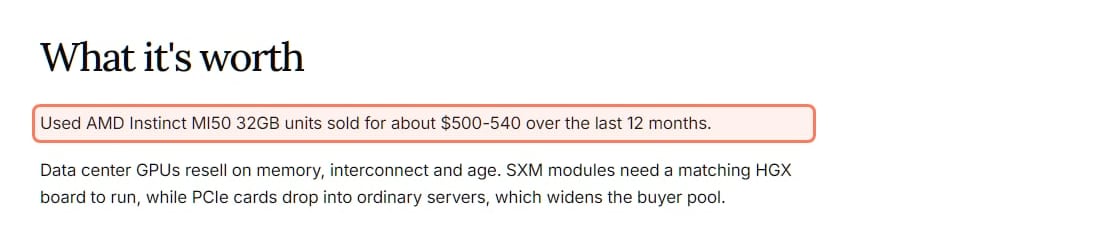
Around $500–540 in the US, and be suspicious of anything far below that. American Compute, a GPU-finance firm that appraises used data-center cards, says "Used AMD Instinct MI50 32GB units sold for about $500-540 over the last 12 months", with data through August 2026.
American Compute's MI50 32GB appraisal (data through August 2026), read Nov 3, 2026. The value line is outlined. · Screenshot of amcompute.com by aliteq
That is far above the "$120–250" you'll still see in older write-ups, and the people who made this card popular say the same thing happened to them:
December 2025: Willy Tarreau, who documented his MI50 build in detail, first found cards "around $250 used". When he went back for a second one, "prices went crazy, with most being between 380 and 450 EUR, and some even at 1700."
August 2026, a European roundup: Pasquale Pillitteri's price table, built from used listings on eBay US and eBay UK, put MI50 32GB cards at 200–260 euros (about €220 typical, shipping included). That's well under American Compute's sold range, so treat listing prices with care. Prices in Europe and from export sellers can still be lower than US resale, so check where the card ships from and what import fees add.
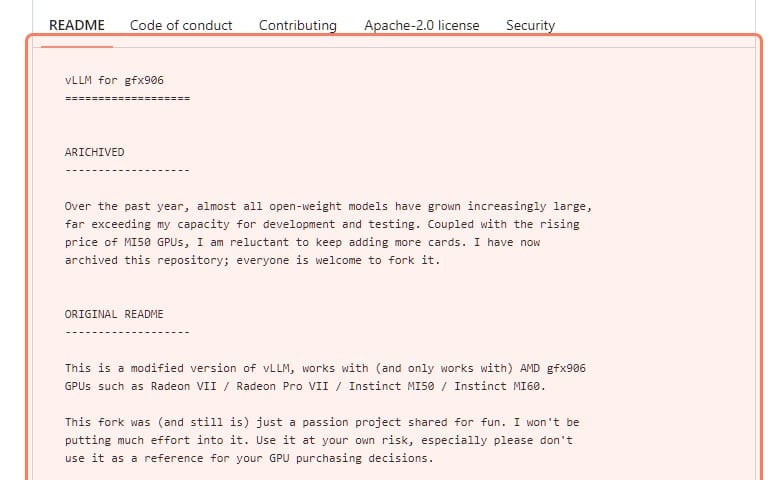
2026: the developer of the main vLLM port for the card archived it, writing that "Coupled with the rising price of MI50 GPUs, I am reluctant to keep adding more cards."
How to use that:
Inside $500–540: a fair US price for a 32GB card that's sold as tested, with a photo of it running (for example rocm-smi output showing 32GB).
Far below: possible from export sellers, but insist on buyer protection, and check it's really the 32GB card (the 16GB MI50 looks the same).
Above: compare with a used RTX 3090 first. At that point you're paying close to a fully supported card's price for an unsupported one.
These are reported sales and listing ranges, not a live feed. Check eBay's sold filter on the day you buy.
Is it still cheaper than a used RTX 3090?
Yes, by a wide margin, per gigabyte of VRAM. A used RTX 3090 averaged $1,573 on eBay US on Nov 3, 2026 (ResalePrices, 328 listings), about $66 per GB for 24GB. At $500–540 the MI50 is about $16 per GB for 32GB. Other old server cards sit on either side:
Used price per GB of VRAM (midpoint of each range, read Nov 3, 2026)
Tesla P40~$10/GB
24GB, American Compute $210-250
Instinct MI50 32GB~$16/GB
32GB, American Compute $500-540
Tesla V100 PCIe 32GB~$25/GB
32GB, American Compute $760-830
RTX 3090~$66/GB
24GB, ResalePrices eBay US average $1,573
The sources differ (American Compute reports 12 months of sales through August 2026; ResalePrices reports current eBay US asking prices), so treat the bars as orders of magnitude, not exact prices. The Tesla P40 is cheaper per GB but much slower and older. The used RTX 3090 costs about four times as much per GB, but it runs CUDA on Windows or Linux with full driver support.
How fast is the MI50 for local LLMs?
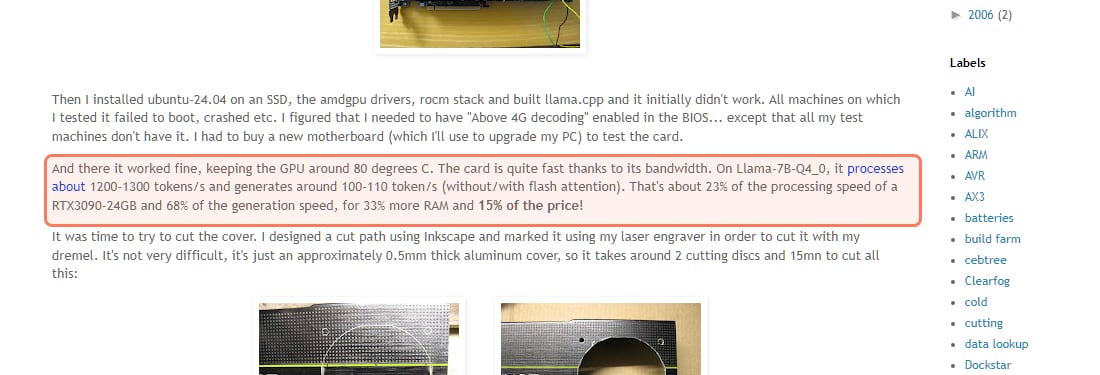
Fast at generating text, because 1 TB/s of memory bandwidth is what token generation mostly depends on, and slow at reading long prompts. These are one owner's llama.cpp measurements (Willy Tarreau, December 2025), not our tests:
Llama 7B, Q4_0
Reading the prompt
about 1,200–1,300 tokens/s
Generating
about 100–110 tokens/s
Qwen3-30B-A3B (MoE), Q5_K_M
Reading the prompt
588 tokens/s
Generating
75.7 tokens/s
Qwen3-VL-32B, Q4_K_M
Reading the prompt
216 tokens/s
Generating
19.8 tokens/s
Qwen3-VL-32B, Q4_0
Reading the prompt
278 tokens/s
Generating
24.5 tokens/s
Reading the prompt
Generating
Llama 7B, Q4_0
about 1,200–1,300 tokens/s
about 100–110 tokens/s
Qwen3-30B-A3B (MoE), Q5_K_M
588 tokens/s
75.7 tokens/s
Qwen3-VL-32B, Q4_K_M
216 tokens/s
19.8 tokens/s
Qwen3-VL-32B, Q4_0
278 tokens/s
24.5 tokens/s
One owner's MI50 benchmark against an RTX 3090, from Willy Tarreau's blog (Dec 7, 2025), read Nov 3, 2026. Note the "15% of the price" was at December 2025 prices. · Screenshot of wtarreau.blogspot.com by aliteq
His own comparison: "about 23% of the processing speed of a RTX3090-24GB and 68% of the generation speed". So the MI50 feels fine in a chat, where you mostly wait for generated text, and slow when you paste in a long document or a big codebase, where prompt processing dominates.
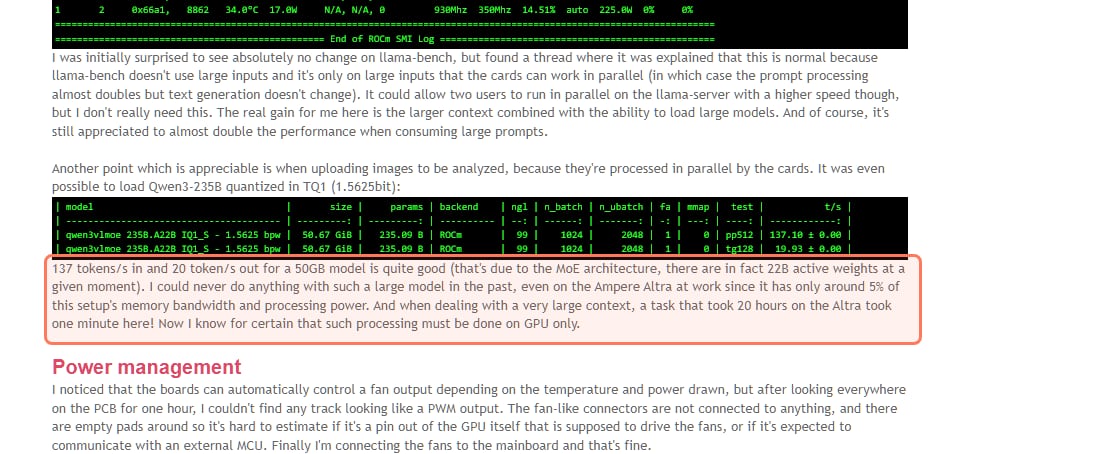
With two cards (64GB), he loaded Qwen3-VL-235B-A22B at a very aggressive 1.56-bit quant (IQ1_S, 50.67 GiB) and measured 137 tokens/s reading and 19.93 tokens/s generating. That's a mixture-of-experts model with 22B active weights, which is why it runs at all. A 1.56-bit quant loses real quality, so treat this as "it loads and runs", not "a 235B model at full quality". (Older versions of this page said four cards; Tarreau's post shows two.)
Qwen3-235B at 1.56-bit on two MI50 32GB cards, Willy Tarreau's blog (Dec 7, 2025), read Nov 3, 2026. · Screenshot of wtarreau.blogspot.com by aliteq
Which models fit in 32GB at which quantization is a VRAM question, not an AMD one. Check yours in the VRAM calculator before you buy.
What are the MI50's specs, per AMD?
AMD's own page for the Instinct MI50 (32GB), read Nov 3, 2026:
Launch date
Instinct MI50 (32GB)
Nov 18, 2018
GPU
Instinct MI50 (32GB)
Vega20, TSMC 7nm FinFET (gfx906 in ROCm)
Stream processors / compute units
Instinct MI50 (32GB)
3,840 / 60
Memory
Instinct MI50 (32GB)
32GB HBM2, 4096-bit
Peak memory bandwidth
Instinct MI50 (32GB)
1 TB/s
Peak FP16 / FP32
Instinct MI50 (32GB)
26.5 / 13.3 TFLOPs
Thermal design power
Instinct MI50 (32GB)
300W, 2x 8-pin power
Cooling
Instinct MI50 (32GB)
Passive
Bus
Instinct MI50 (32GB)
PCIe 4.0 x16
OS support
Instinct MI50 (32GB)
Linux x86 64-bit
Form factor
Instinct MI50 (32GB)
Servers, full height, double slot, 10.5 in (267 mm)
Instinct MI50 (32GB)
Launch date
Nov 18, 2018
GPU
Vega20, TSMC 7nm FinFET (gfx906 in ROCm)
Stream processors / compute units
3,840 / 60
Memory
32GB HBM2, 4096-bit
Peak memory bandwidth
1 TB/s
Peak FP16 / FP32
26.5 / 13.3 TFLOPs
Thermal design power
300W, 2x 8-pin power
Cooling
Passive
Bus
PCIe 4.0 x16
OS support
Linux x86 64-bit
Form factor
Servers, full height, double slot, 10.5 in (267 mm)
For scale, NVIDIA's comparison page lists 448 GB/s for the RTX 5060 Ti and 1,792 GB/s for the RTX 5090. So the MI50 has more than twice the bandwidth of a 16GB mid-range card, but well under the 5090 (older versions of this page said otherwise).
Will the MI50 keep working with ROCm?
Today, yes, through community builds. Officially, AMD has moved on, and that's the real risk in this purchase.
AMD's timeline. AMD's ROCm 6.0 release notes say the MI50, Radeon Pro VII and Radeon VII "(collectively gfx906 GPUs) enters maintenance mode in ROCm 6.0", that "ROCm 5.7 was the final release for gfx906 GPUs in a fully supported state", and that bug fixes and critical security patches would continue "until Q2 2024".
Today. AMD's Linux system requirements for ROCm 7.14.0, read Nov 3, 2026, list "AMD Instinct MI50" with LLVM target gfx906 and a ❌, which the page defines as "The current ROCm release does not support this hardware."
The workaround owners use. Tarreau wrote that it "still works to install ROCm 7 and copy all the tensile files having "gfx906" in their names from ROCm-6.4.4 into /opt/rocm/ but it might trigger bugs", and warned that "in the near future, this board it just going to become e-waste".
The community layer. The mixa3607/ML-gfx906 project ("ML software for deprecated GFX906 arch") publishes ROCm packages and images for llama.cpp, ComfyUI and PyTorch for these cards, and was last updated Oct 31, 2026. Its own table lists its vLLM build as "Paused". There's also a gfx906-tuned llama.cpp fork (iacopPBK/llama.cpp-gfx906), last updated Aug 23, 2026.
vLLM. The best-known vLLM port, nlzy/vllm-gfx906, is archived. Its README always warned: "please don't use it as a reference for your GPU purchasing decisions."
The archived vLLM port for gfx906 cards (MI50, MI60, Radeon VII), github.com/nlzy/vllm-gfx906, read Nov 3, 2026. · Screenshot of github.com by aliteq
What this means for you: llama.cpp (and tools built on it) is the safe path. vLLM, newer PyTorch features and anything that needs current ROCm are not. Budget for the day a kernel or distro update breaks your setup, and keep a known-good install image.
What do you need besides the card?
A board with Above 4G Decoding enabled in the BIOS. Without it, Tarreau's machines wouldn't boot with the card.
A fan or shroud. Tarreau fitted a 75mm fan inside the card's cover and found a low-power (0.45A) fan enough; capping each card at 180W cost him "around 10% processing capacity, almost no generation capacity".
Power. AMD lists a 300W TDP and 2x 8-pin connectors per card. With two cards, Tarreau never saw more than 500W on his wall meter; the usual draw was 270–330W.
A separate display output. It's a server compute card; plan on your CPU's graphics or another GPU for the monitor.
Linux. AMD's spec page lists Linux x86 64-bit as the supported OS.
If you're not sure 32GB is what you need, yes. Nobody rents out MI50s on the providers we track, but you can test whether your model and context fit in 32GB for very little. On Nov 3, 2026 at 16:00 UTC our tracker showed 32GB Tesla V100s (SXM2) on Vast from $0.05 an hour (median $0.07), and RTX 5090s (also 32GB) on Vast from $0.27 an hour (median $0.56). Speeds won't match an MI50, but the fit will. Today's prices are on /cloud-gpu.
6/ 10
Verdict
Is a used MI50 32GB worth it for local AI in 2026?
Worth it for a Linux user who wants the cheapest fast 32GB of VRAM, runs llama.cpp, and can pay around $500-540. Not worth it if you need Windows, vLLM, fine-tuning or a card that keeps getting official driver updates; at today's prices, a used RTX 3090 costs about three times as much but is fully supported. Either way, the "$150 MI50" is gone.
Best for: Linux tinkerers who want maximum VRAM per dollar for llama.cpp inference and accept community-maintained drivers.
How much is a used AMD Instinct MI50 32GB worth in 2026?
About $500-540 in the US, per American Compute's appraisal (12 months of sales, data through August 2026). Listings have been lower: a European price roundup of eBay US and UK listings put them at around 200-260 euros in August 2026. Check eBay's sold listings on the day you buy.
Does the MI50 still work with ROCm?
Not officially. AMD's ROCm 7.14 system requirements mark the MI50 (gfx906) as unsupported; full support ended with ROCm 5.7. Owners run it with older ROCm files or community builds such as mixa3607/ML-gfx906.
Does the MI50 work on Windows?
AMD's spec page lists Linux x86 64-bit as the supported OS. Plan on Linux for local AI with this card.
Can it run Ollama or llama.cpp?
llama.cpp runs on it with ROCm, and there are gfx906-tuned builds. Tools built on llama.cpp can work, but they depend on how they bundle ROCm, so expect some setup.
MI50 or used Tesla P40?
The P40 is cheaper per GB (about $210-250 for 24GB, per American Compute) and runs CUDA, but it's much slower. The MI50 has 32GB and 1 TB/s bandwidth for faster generation. See our P40 guide.
Can I pool an MI50 with an Nvidia card for one model?
Not with a plain ROCm or CUDA build, which each see only their own vendor's cards. It takes a mixed setup: the mixa3607/ML-gfx906 project, for example, publishes a llama.cpp "multiruntime" image with CPU, RPC, ROCm and CUDA backends. Expect extra setup and some speed loss. See do you need two GPUs for local AI.
If you want plug-and-play, read our AMD vs Nvidia for local AI guide first. If you like tinkering and the price is right, the MI50 is still the cheapest fast 32GB you can own. Just go in knowing AMD isn't supporting it anymore.