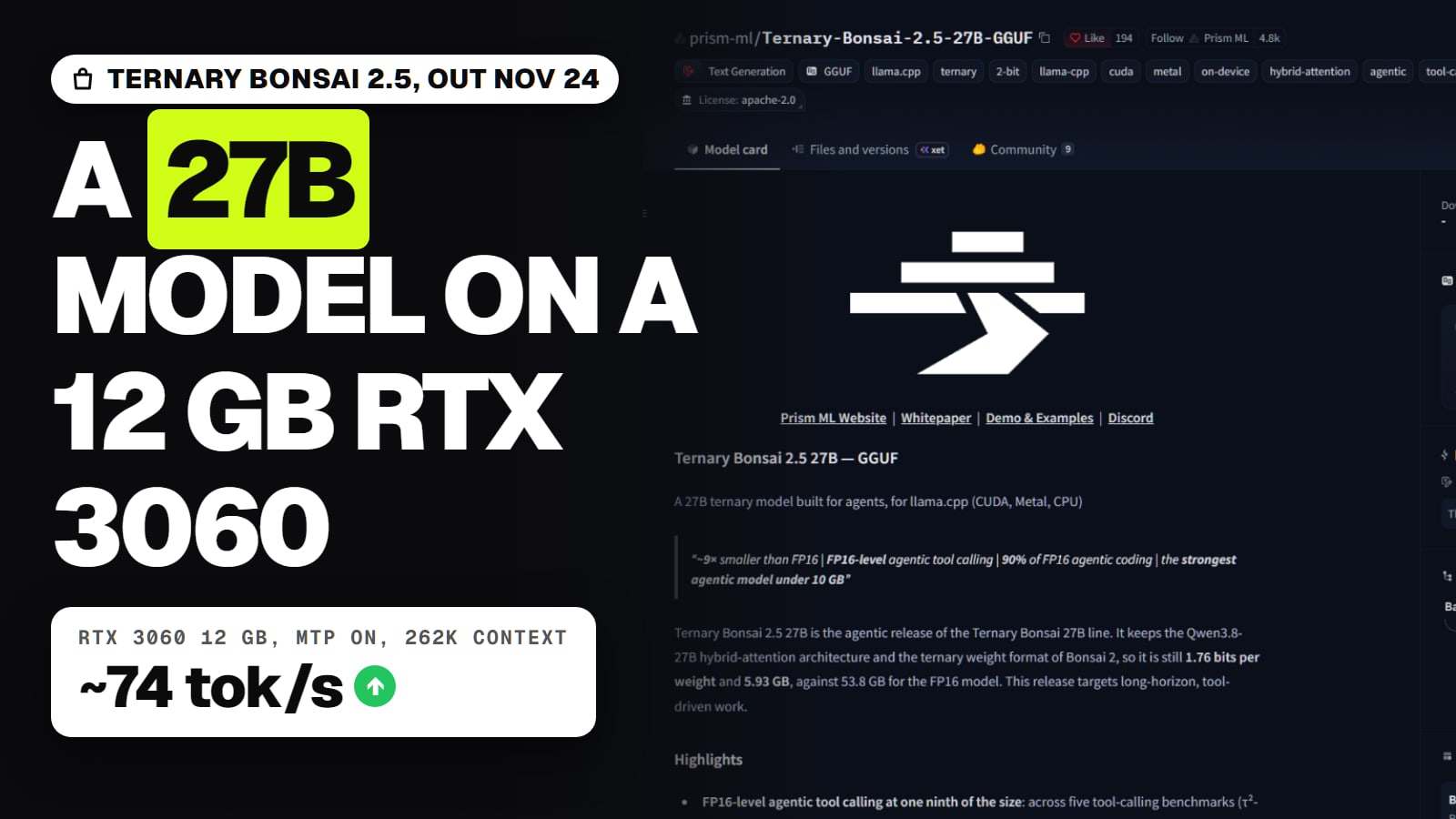
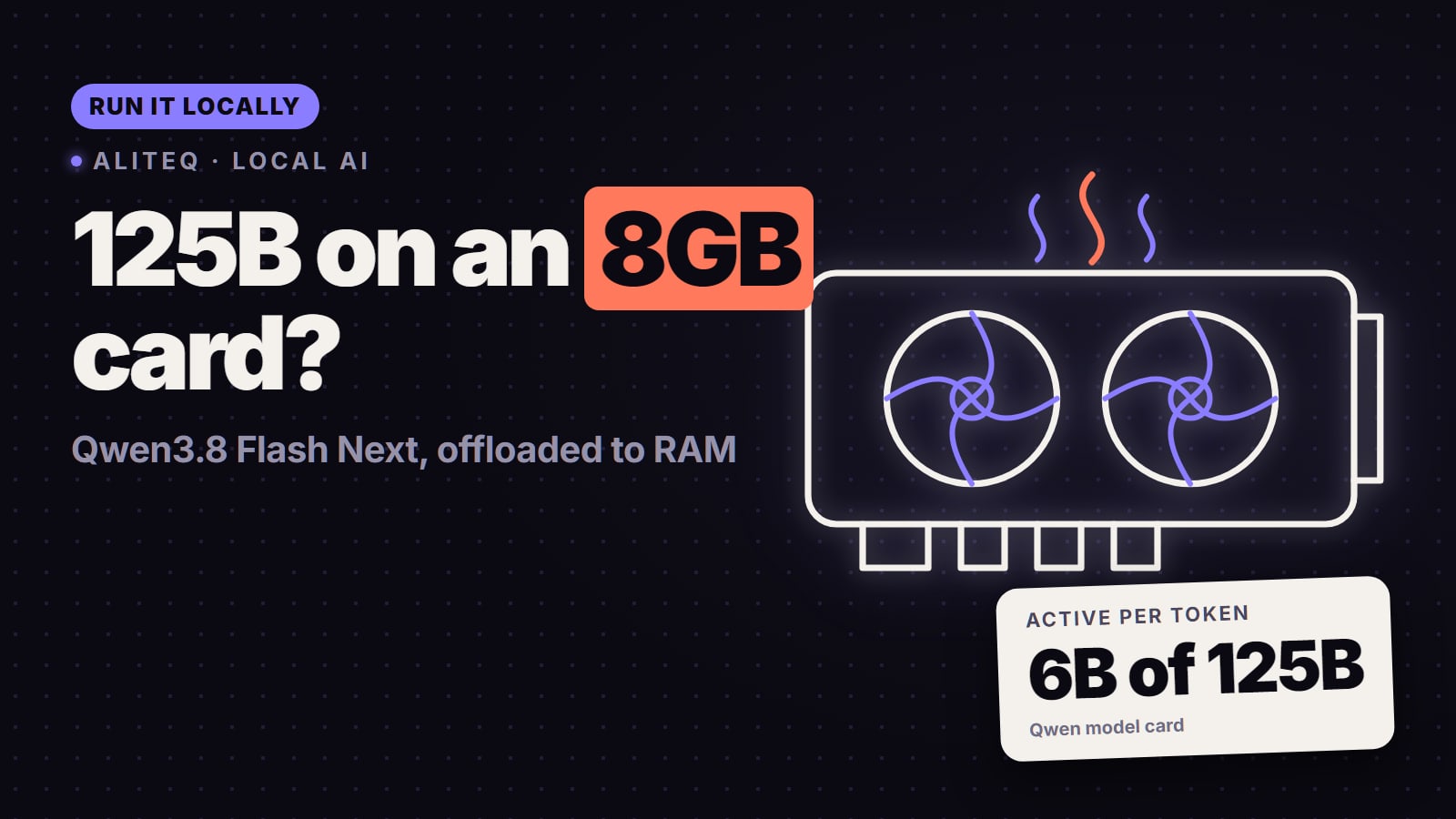
PrismML's Ternary Bonsai 2.5, released Nov 24, 2026, squeezes Qwen3.8-27B into a 6 GB file with every weight set to -1, 0 or +1. People ran it on day one on an RTX 3060, a 10 GB RTX 3080, a gaming laptop and an 8 GB AMD card from 2019. Speeds by setup, which file your app can load, and the one flag that fixes "it won't start".
Yes, on almost any GPU from the last six years. Ternary Bonsai 2.5 27B, which PrismML released on November 24, 2026, is Qwen3.8-27B stored with every weight set to -1, 0 or +1. The whole 27B model is a 5.99 GB file (6.23 GB with the new speed-up head), against 53.8 GB at full precision. On day one people ran it fully on a 12 GB RTX 3060 at about 74 tokens a second, on a 10 GB RTX 3080 at 79, and on an 8 GB AMD card from 2019. The catch is software: the smallest file needs PrismML's own build of llama.cpp. Checked November 25, 2026.
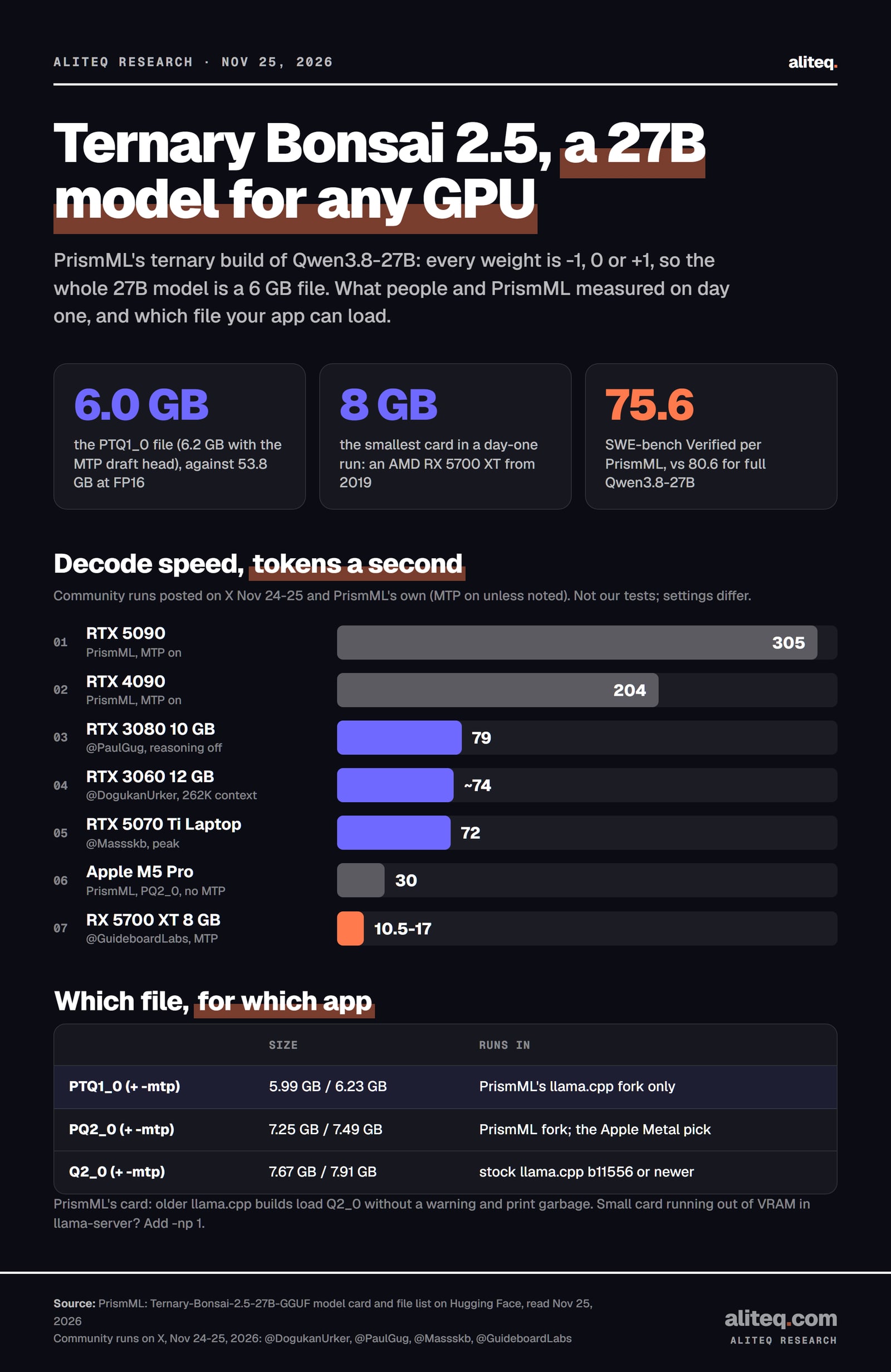
The whole answer on one image, free to share with a link back. Speeds are the posters' and PrismML's, not ours; file sizes from the Hugging Face repo, Nov 25, 2026. · aliteq research
Will it run on my GPU?
Your setup and Ternary Bonsai 2.5 27B (day-one reports, Nov 24-25, 2026)
8 GB card (RX 5700 XT, RTX 3070, 4060)
What people measured
Runs. @GuideboardLabs: 17 tok/s at the start of a task with MTP and a q8_0 KV cache, 10.5 sustained in long agent runs
File and settings
PTQ1_0-mtp with a q8_0 or q4_0 cache, short context, -np 1
Fully on the GPU. @PaulGug 79 tok/s on a 3080 10 GB; @DogukanUrker ~74 on a 3060 at 262K context; @Massskb 72 peak on an RTX 5070 Ti laptop
PTQ1_0-mtp; a q4_0 cache for the full 262K
16 GB card (RTX 5060 Ti, 4060 Ti 16GB, 5080)
Fits with plenty of room for long context at a q8_0 cache
PTQ1_0-mtp
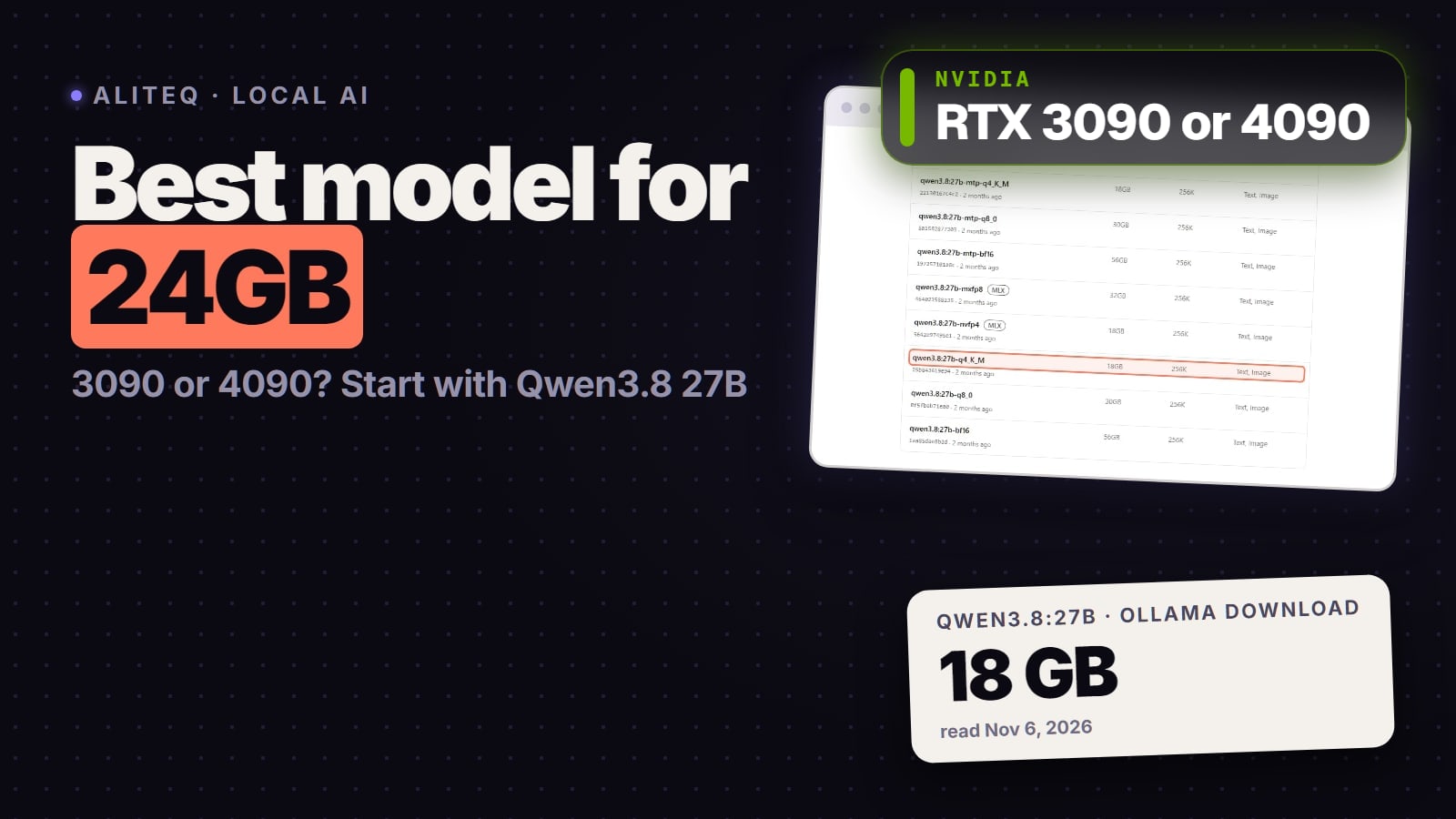
24 to 32 GB card (RTX 3090, 4090, 5090)
PrismML: RTX 4090 112 tok/s plain, 204 with MTP; RTX 5090 163 plain, 305 with MTP
PTQ1_0-mtp, full context at fp16 cache
Mac (16 GB and up)
PrismML: M5 Pro 30.2 tok/s plain (PQ2_0, Metal); M4 Pro 25 to 29 with MTP
PQ2_0, or PrismML's MLX build
Laptop without a gaming GPU
PrismML: a Core Ultra laptop's integrated GPU did 11 tok/s plain and 23 with MTP (SYCL)
PTQ1_0-mtp with PrismML's SYCL preset
These are other people's runs and PrismML's own, not ours. Settings differ (context, cache type, reasoning on or off), so treat them as a range, not a promise.
How much VRAM does Ternary Bonsai 2.5 need?
About 6 GB for the weights plus the KV cache, which grows with context. Bonsai 2.5 keeps Qwen3.8-27B's hybrid attention: only 16 of its 64 layers hold a full-context cache, so long context is cheaper than on most 27B models. Our VRAM engine puts the cache at:
Ternary Bonsai 2.5 27B KV cache by context (our VRAM engine, Nov 25, 2026)
32K tokens
fp16 cache
2.1 GB
q8_0 cache
1.1 GB
q4_0 cache
0.6 GB
128K tokens
fp16 cache
8.6 GB
q8_0 cache
4.6 GB
q4_0 cache
2.4 GB
262K tokens (the maximum)
fp16 cache
17.2 GB
q8_0 cache
9.1 GB
q4_0 cache
4.8 GB
fp16 cache
q8_0 cache
q4_0 cache
32K tokens
2.1 GB
1.1 GB
0.6 GB
128K tokens
8.6 GB
4.6 GB
2.4 GB
262K tokens (the maximum)
17.2 GB
9.1 GB
4.8 GB
Add the 6.23 GB MTP file, about 0.3 to 0.5 GB of linear-attention state and the runtime. That's why a 12 GB RTX 3060 holds the full 262K context only with a q4_0 cache, as in @DogukanUrker's config.
Does Ternary Bonsai 2.5 fit your card at 32K context?
Ternary Bonsai 2.5 PTQ1_0-mtp at 32K context needs ≈9 GB
RTX 3070 / 4060 8GB8 GBover 1 GB
RTX 3080 10GB10 GBfits
RTX 3060 12GB12 GBfits
RTX 5060 Ti 16GB16 GBfits
6.23 GB PTQ1_0-mtp file + 2.1 GB of fp16 KV cache at 32K (our engine) + runtime overhead. An 8 GB card fits with a q8_0 or q4_0 cache. Run llama-server with -np 1 so it keeps one cache, not four.
"It won't start" or "it's so slow": the -np 1 fix
PrismML's card lists one known issue. In automatic mode, llama-server can open four request slots that share one KV cache, which eats VRAM a small card doesn't have. A report on the model's Hugging Face page measured about 9.5 GB on an RTX 3080 10 GB, falling to about 7.8 GB after adding -np 1. If you chat with it alone, add -np 1.
If it runs but at a crawl in LM Studio or Ollama, the app probably fell back to the CPU or can't use the file. LM Studio and Ollama build on stock llama.cpp code, which rejects PTQ1_0 and PQ2_0 as unknown types. Only Q2_0 works there, and only if the app's engine is built from llama.cpp b11556 or newer.
Email list
Next model drops, can your GPU run it?
When a big open model launches, one email: does it run on your GPU or Mac, which file to get, and what renting costs if it doesn't. Only for launches that matter.
Written and sent by hand. One-click unsubscribe in every email. Emails may contain referral links.
Which file should I download?
All three files are the same ternary model, packed differently:
PTQ1_0 (5.99 GB, 6.23 GB with MTP): the pick on NVIDIA. Smallest and fastest decode on every NVIDIA GPU PrismML measured. Needs PrismML's llama.cpp fork.
PQ2_0 (7.25 GB, 7.49 GB with MTP): the format PrismML benchmarked on Apple Metal. Also needs the fork. On a Mac, PrismML's MLX build is the other route.
Q2_0 (7.67 GB, 7.91 GB with MTP): llama.cpp's standard 2-bit type, for stock llama.cpp from release b11556 onward. PrismML warns that older stock builds "load Q2_0 without any warning and produce garbage". Check with llama-cli --version.
Is it in mainline llama.cpp? Only Q2_0. PTQ1_0 is under upstream review, per PrismML's card, so for now the fork is the only way to run the smallest file.
The "-mtp" files carry a draft head that guesses a few tokens ahead, and the full model checks the guesses. PrismML measured 1.5 to 1.8 times faster decode on NVIDIA GPUs, with output that matches decoding without drafting. It costs about 0.24 GB and slows prompt reading by 9 to 23% on NVIDIA. One owner found the KV cache type matters: on the RX 5700 XT, MTP doubled decode with a q8_0 cache but made it slower than no drafting with an f16 cache.
How do I run it?
PrismML points to its Bonsai-demo repo as "the source of truth" for every backend. The short version on an NVIDIA card:
Download Ternary-Bonsai-2.5-27B-PTQ1_0-mtp.gguf from the Hugging Face repo.
Run llama-server with -ngl 99 -fa on -np 1, a context that fits your card (-c 32768 to start), and PrismML's MTP preset for CUDA from the repo's presets folder.
Use PrismML's sampling: temperature 1.0, top-p 0.95, top-k 20, and --min-p 0, since llama.cpp defaults to 0.05.
It's a reasoning model that thinks at "xhigh" effort by default. Leave room for the thinking (PrismML's example allows 16,384 output tokens), or switch to "medium" for shorter answers.
What does "based on Qwen3.8 27B" mean?
PrismML didn't train a new model from scratch. It took Alibaba's open Qwen3.8-27B, kept its architecture, and converted every weight to -1, 0 or +1 with one shared scale per 128 weights. Then it trained that ternary model further for agent work. The result behaves like Qwen3.8-27B in the same chat template, at a ninth of the size.
How much it gives up, by PrismML's own benchmarks: tool calling averages 77.2 against 77.7 for full precision. Agentic coding keeps 90% of the full model's score, with SWE-bench Verified at 75.6 against 80.6. The general average is 82.1 against 84.3. Bonsai 2 from September scored 60.8 on SWE-bench Verified. These are PrismML's numbers; we haven't tested the model. @GuideboardLabs scored it 57.33 of 66 on their own Agon agent test, 12th of 40 models they've run.
If you have a 24 GB card and want the full-quality model, the NVFP4 build of Qwen3.8-27B is the next step up.
Ternary Bonsai 2.5 27B questions
Can I run Ternary Bonsai 2.5 27B on a 12 GB GPU?
Yes. On day one, an RTX 3060 12 GB ran it at about 74 tok/s at 262K context with the MTP file and a q4_0 KV cache, and an RTX 5070 Ti laptop with 12 GB peaked at 72 tok/s at 64K (posts on X, Nov 24-25, 2026).
How big is Ternary Bonsai 2.5 27B?
The PTQ1_0 file is 5.99 GB, or 6.23 GB with the MTP draft head. PQ2_0 is 7.25 GB and Q2_0 7.67 GB. The full-precision model is 53.8 GB.
Can I run it on an M5 Pro with 24 GB?
Yes. The 7.25 GB PQ2_0 file fits with room for context, and PrismML measured 30.2 tok/s on an M5 Pro without the draft head.
Does it work in mainline llama.cpp?
Only the Q2_0 file, on llama.cpp b11556 or newer. PTQ1_0 and PQ2_0 need PrismML's fork; stock llama.cpp rejects them. Older stock builds load Q2_0 but print garbage.
Does Ternary Bonsai 2.5 work in Ollama or LM Studio?
Not officially as of Nov 25, 2026. Both use stock llama.cpp, so only the Q2_0 file can work, and only with an engine built from b11556 or newer.
Why is it slow or won't start on my card?
Add -np 1 to llama-server. Without it the server can open four slots that share one KV cache; one report on a 10 GB RTX 3080 fell from about 9.5 GB to 7.8 GB of VRAM.
What is the MTP file?
The same model plus a draft head that guesses a few tokens ahead. PrismML measured 1.5 to 1.8 times faster decode on NVIDIA GPUs, for about 0.24 GB more.
When a big open model launches, one email: does it run on your GPU or Mac, which file to get, and what renting costs if it doesn't. Only for launches that matter.
Written and sent by hand. One-click unsubscribe in every email. Emails may contain referral links.