CoreWeave, Nebius, Lambda and Crusoe rent you the same Nvidia silicon at very different prices — and the marketplace tier undercuts all of them. This is our cloud-GPU pricing pillar; the full market, dated.
This post contains affiliate links. If you buy through them, Aliteq may earn a commission — at no extra cost to you. Prices verified at publish time.
Share
I put five GPU cloud providers' actual published prices next to each other, and the spread is bigger than the marketing lets on. Rent an H100 from CoreWeave and you pay $6.16 an hour. Rent the same chip from Nebius and it's $3.85. That's not a rounding difference — it's CoreWeave charging 60% more for identical Nvidia silicon, and it holds up across almost every GPU tier these providers sell. This is our cloud-GPU pricing pillar — I track the full market here, from these enterprise neoclouds down to the marketplace clouds where an H100 rents for a fraction of the price. If you're renting for a personal or small-team AI project, start with the live compare page and the spoke guides linked at the end.
CoreWeave is the only provider in this comparison rated Platinum by SemiAnalysis's ClusterMAX 2.0 methodology, and the company backs that up with real numbers: its own Q2 2026 investor release shows $2.575 billion in quarterly revenue, up 112% year over year, and a revenue backlog of roughly $104 billion — not counting more than $25 billion in fresh commitments added in early Q3. That scale is what the premium buys: guaranteed multi-year capacity and enterprise SLAs, not a faster H100. If you're a startup that needs a guaranteed cluster reservation two years out, that's worth paying for. If you're one engineer running weekend fine-tuning jobs, it's dead weight.
We've already run the math on renting versus buying a single RTX 5090 for local AI work, and the conclusion holds up here too: for one person's personal or small-team workload, the cheapest reliable on-demand rate — right now that's Nebius or Crusoe for H100/H200, Lambda for B200 if you can live without spot — beats anything CoreWeave-tier. CoreWeave's pricing only starts making sense once you need contracted capacity at a scale where a canceled reservation would actually hurt.
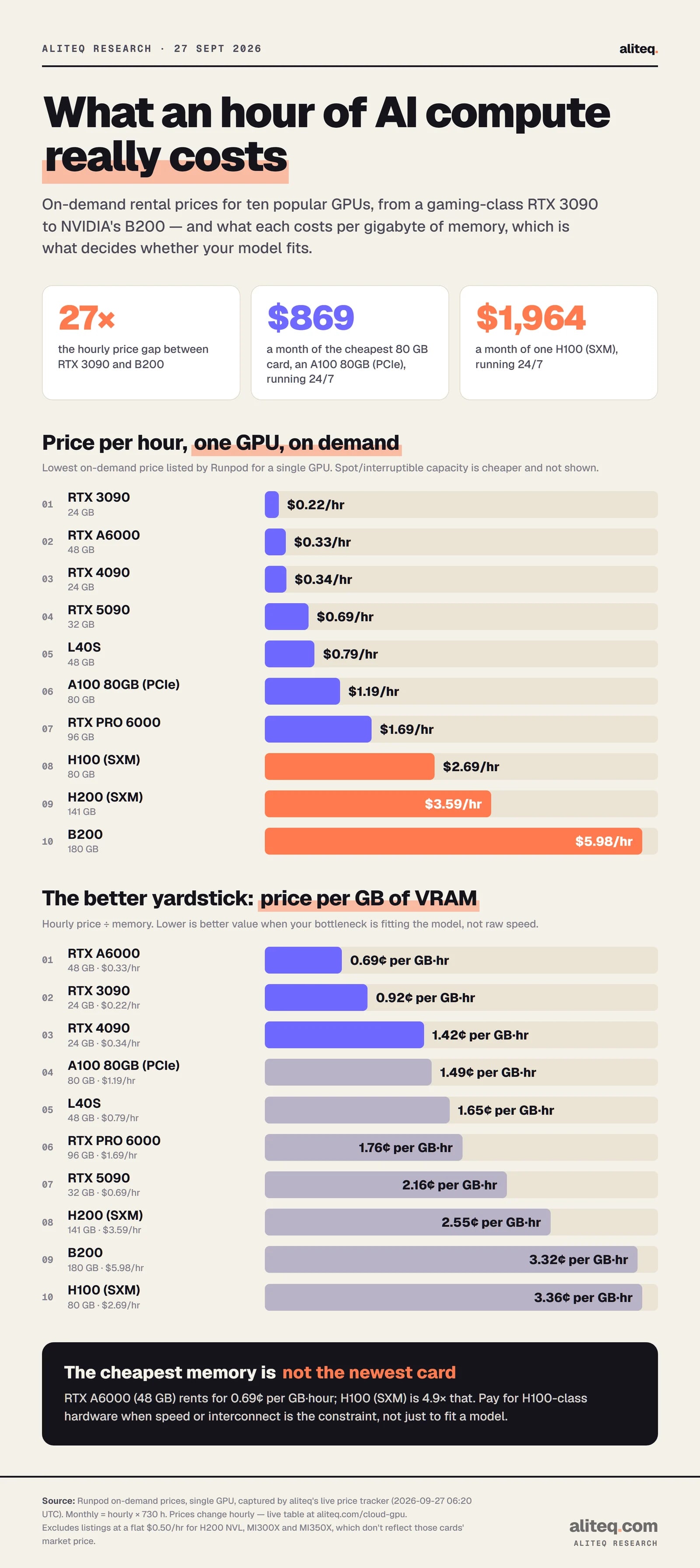
What an hour of AI compute costs: Runpod on-demand prices for ten GPUs, captured by the aliteq price tracker on 27 Sep 2026. Prices move hourly; the live table is at aliteq.com/cloud-gpu. · aliteq research
Groq's pivot, and the AMD wildcard
Groq quietly stopped being a chip company this year. After licensing its LPU architecture to Nvidia in December 2025, the independent Groq business refocused entirely on running GroqCloud as inference-cloud infrastructure rather than selling its own hardware — worth knowing if you'd been tracking Groq as a Nvidia alternative. Crusoe is the outlier in the other direction: it's the only provider of the five with AMD's MI300X and MI355X on its rate card, which matters if your stack is ROCm-based rather than CUDA-locked.
Verdict
Who should rent from whom
Personal projects and small fine-tuning runs: Nebius or Crusoe on-demand, or Lambda if you specifically need B200 and can pay the on-demand rate. Anything requiring guaranteed multi-month capacity at real scale: CoreWeave, and budget for the premium going in rather than being surprised by it.
Best for: Anyone comparing cloud GPU rental against buying their own card
Referral link
Skip the enterprise premium — rent on the marketplace
For a single-person workload the marketplace tier wins: an H100 from about $1.73/hr on Vast.ai spot (22 Sep 2026), versus $3.85–$6.16 on the neoclouds above.
Referral link — we may earn a commission at no cost to you. Prices on our compare page are the provider's live figures, cheapest first; this never changes the ranking.
Common questions
What is a GPU neocloud?
A cloud provider built specifically around renting Nvidia/AMD GPU capacity for AI workloads, rather than a general-purpose cloud like AWS or Azure that happens to also offer GPUs.
Is CoreWeave worth the premium over Lambda or Nebius?
Only if you need contracted, guaranteed capacity at scale with enterprise SLAs. For smaller or interruptible workloads, its on-demand pricing is 50–80% more than competitors for the same chip.
Can I rent a single GPU instead of a full cluster?
Yes — Lambda, for example, prices down to a 1x GPU instance on both H100 and B200 tiers, though the per-GPU rate rises slightly compared to 8x reservations.
Is renting cheaper than buying an RTX 5090 for local AI?
None of these five providers are lying about their pricing — it's all published, and it's all real. The gap just doesn't get talked about enough, because most coverage treats "cloud GPU" as one commodity market instead of five providers selling genuinely different products at the same chip. If you're about to rent compute for a local-AI project, compare the actual per-hour number against what a card in your own case would cost before you commit — the crossover point moves every few months right now.