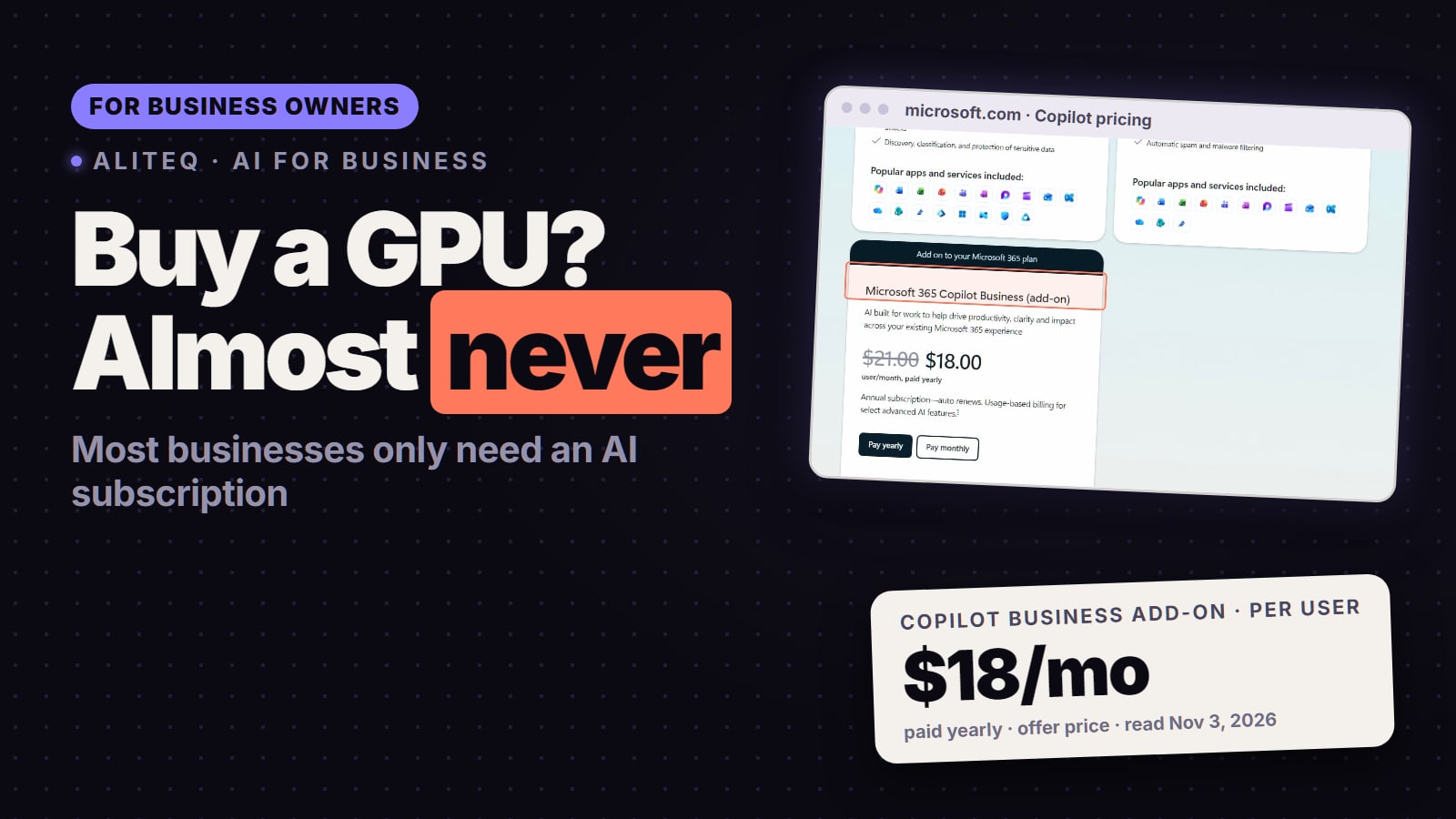
ChatGPT, Claude, Copilot and Gemini all run on the vendor's servers, so a business pays per seat or per use, not for hardware. What each option cost on Nov 3, 2026, what the business plans say about your data, and the few cases where a GPU really comes in.
Some links on this page are referral links: we may earn a commission, at no cost to you.
Share
Does your business need to buy a GPU to use AI? Almost never. The AI tools a business actually uses (ChatGPT, Claude, Microsoft Copilot, Google's Gemini) run on the vendor's servers. You open them in a browser or an app on the computers you already have and pay per person per month. On November 3, 2026 a standard business seat cost $20 to $25 a month on ChatGPT Business and Claude Team. If you're building AI into your own website or tools, you pay per use through an API instead, still with no hardware. A GPU only makes sense in a few specific cases, covered below, and even then you'd normally rent one by the hour before you buy anything.
Do I need a GPU to use ChatGPT, Copilot or Gemini at work?
No. When someone on your team asks ChatGPT to draft an email or Copilot to summarize a meeting, the work happens on OpenAI's or Microsoft's servers. Your computer only shows the result. That's why none of the business plans below lists any hardware requirement beyond the apps they run in: you pay for seats, the same way you pay for email or accounting software.
So the real question for a business owner isn't "which GPU?" but "which plan, for how many people?", and for some businesses, "subscription or API?".
What does AI cost a business per person?
Here's what each vendor's own pricing page listed on November 3, 2026, in US dollars, per user per month.
ChatGPT Business, standard seat
Price per user a month
$20 billed annually, $25 billed monthly
Billing
For teams of 2 to 200 employees
What the page says about your data
"No training on your business data by default"
Claude Team, standard seat
Price per user a month
$20 billed annually, $25 billed monthly
Billing
Per seat
What the page says about your data
"No model training on your content by default"
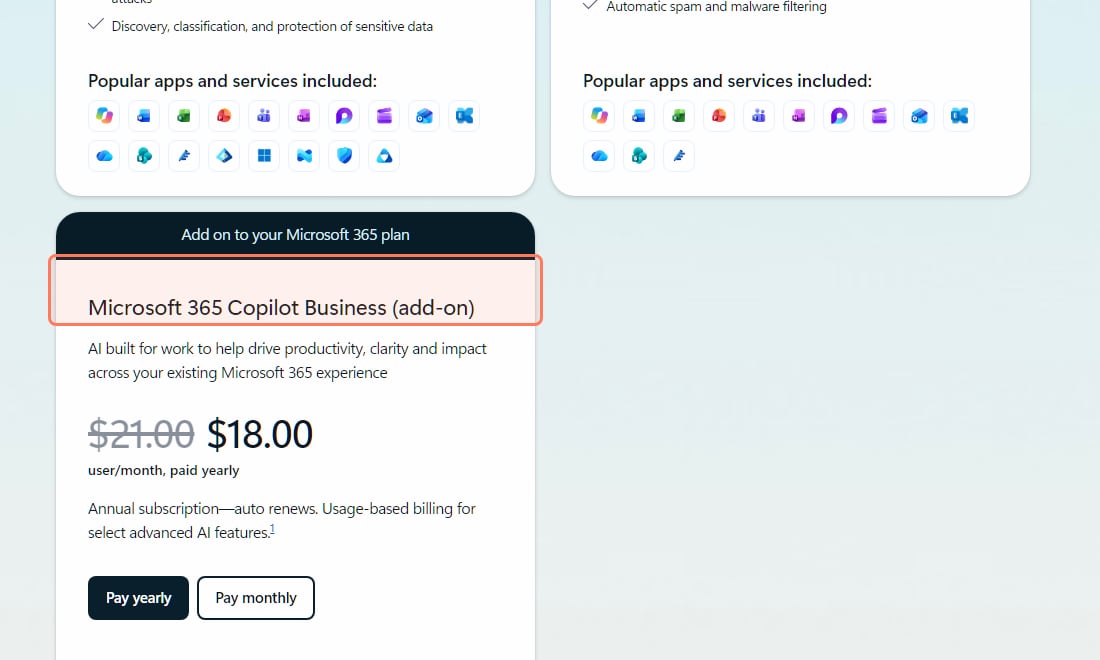
Microsoft 365 Copilot Business (add-on)
Price per user a month
$18 (offer price, normally $21)
Billing
Paid yearly; needs an eligible Microsoft 365 business plan
What the page says about your data
Lists "Enterprise Data Protection (EDP)"
Microsoft 365 Business Standard with Copilot
Price per user a month
$23.50
Billing
Paid yearly
What the page says about your data
Includes Word, Excel, Outlook and Teams
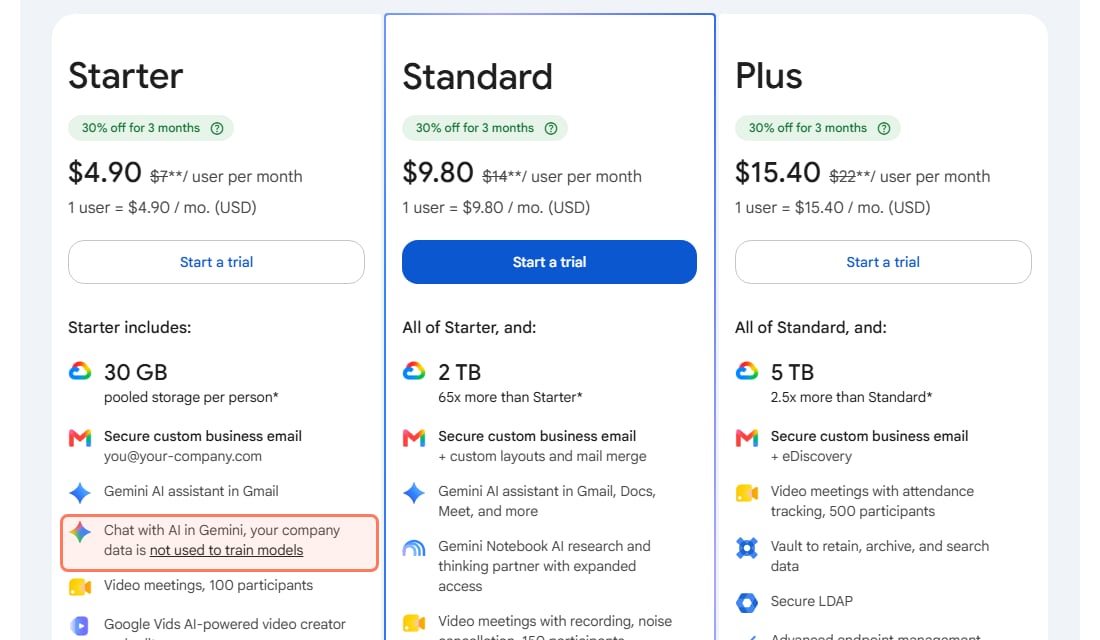
Google Workspace Business Standard
Price per user a month
$14 list (new-customer discounts shown)
Billing
Per user
What the page says about your data
"your company data is not used to train models" (Gemini chat)
Price per user a month
Billing
What the page says about your data
ChatGPT Business, standard seat
$20 billed annually, $25 billed monthly
For teams of 2 to 200 employees
"No training on your business data by default"
Claude Team, standard seat
$20 billed annually, $25 billed monthly
Per seat
"No model training on your content by default"
Microsoft 365 Copilot Business (add-on)
$18 (offer price, normally $21)
Paid yearly; needs an eligible Microsoft 365 business plan
Lists "Enterprise Data Protection (EDP)"
Microsoft 365 Business Standard with Copilot
$23.50
Paid yearly
Includes Word, Excel, Outlook and Teams
Google Workspace Business Standard
$14 list (new-customer discounts shown)
Per user
"your company data is not used to train models" (Gemini chat)
A few things the table hides, all from the same pages:
ChatGPT Business also has a premium seat at "$100/month if billed annually. $125/month if billed monthly", described as "More usage than standard". Most staff only need the standard seat. Bigger companies go to ChatGPT Enterprise, which is "Custom pricing".
Claude Team likewise has a premium seat; the standard seat is "$20 Per seat / month if billed annually. $25 if billed monthly."
Microsoft's $18 add-on price is a promotion. Microsoft's terms say the discount "is available between July 1, 2026, and December 31, 2026", that "An annual commitment is required, and promotional pricing applies to the first year only", and that the add-on "is available only to existing Microsoft 365 customers with an eligible Business plan."
Google Workspace was showing introductory discounts to new customers, and the offer changed between visits on November 3, 2026: one load showed 30% off for 3 months ($9.80 for Standard), a later one 50% off for 3 months ($7). Either way, the list price is $14. Google's footnote says the introductory price "is only available for the first 20 users added, for 12 months". Business Starter ($7 list) only has Gemini in Gmail plus the Gemini chat app; Standard adds "Gemini AI assistant in Gmail, Docs, Meet, and more".
Microsoft's own pricing page, read November 3, 2026. The $18.00 is an offer price for the first year; the outline is ours. · Screenshot of microsoft.com by aliteq
Google Workspace pricing, read November 3, 2026. The lower prices are a new-customer offer that changed between visits that day; the crossed-out numbers are the list prices. · Screenshot of workspace.google.com by aliteq
What that means in practice: a 10-person team on ChatGPT Business standard seats, billed monthly, comes to $250 a month by OpenAI's listed price. That's the whole bill. No server, no graphics card, no IT setup beyond inviting people.
Should my business use a subscription or an API?
It depends on who is using the AI:
People typing into a chat window (writing, research, summaries, spreadsheets) → a subscription. A flat monthly price per person is easier to budget, and the business plans add admin controls. ChatGPT Business, for example, lists "Centralized billing and administration" and "Usage analytics and spend controls".
Your website, app or automation calling AI on its own (a support bot, tagging incoming orders, writing product descriptions in bulk) → an API. You pay per use, measured in tokens (small chunks of text sent in and returned). There's still no GPU: the API runs on the vendor's servers, just like the chat app.
API prices vary a lot by model. On OpenAI's API pricing page on November 3, 2026, its most efficient model, GPT-6 Luna, was listed at $0.10 per million input tokens and $0.50 per million output tokens, while its most capable model, GPT-6 Astra, was $10.00 in and $50.00 out. OpenAI also lists a "Batch -50%" mode for work that doesn't need an instant answer. Start with the cheapest model that does the job well, and only move up if it doesn't.
Is my business data safe if I don't run AI on my own GPU?
For most businesses, the business plans are the safer bet than the free consumer apps, because of what the vendors commit to on their own pages:
OpenAI's ChatGPT Business: "No training on your business data by default". Enterprise adds "custom data retention policies" and "Support for data residency in ten regions".
Anthropic's Claude Team: "No model training on your content by default".
Google Workspace: "Chat with AI in Gemini, your company data is not used to train models".
Microsoft's Copilot Business add-on lists "Enterprise Data Protection (EDP), management, compliance, and controls".
The honest limit: "not used for training" isn't the same as "never leaves your building". Your prompts and files are still processed on the vendor's servers. If a law, a contract or a client agreement says certain data must not go to an outside provider, a subscription may not be allowed for that data, and that's the case where running a model on a GPU you control comes in. Check with whoever handles your compliance; we can't tell you what your contracts allow.
If your company is in the EU and wants prompts kept inside the EU, every EU-resident route is priced in private LLM cost for EU companies.
When does a business actually need a GPU?
Only in a handful of cases:
Data that must stay on systems you control. Legal, medical or confidential client records that an outside AI provider isn't allowed to see. Then you'd run an open-weight model yourself, and that model needs a GPU with enough memory to hold it. Our VRAM calculator tells you how much memory a given model needs.
Heavy, steady self-hosted use. If your product sends AI requests around the clock, a GPU you rent or own can end up cheaper than per-token API fees. Usually that only happens at real scale.
Fine-tuning an open model on your own data.
Self-hosted image or video models, for example running image generation for a product catalogue on your own setup.
Even in these cases, rent before you buy. A rented cloud GPU is billed by the hour, you turn it off when you're done, and there's nothing to maintain. On November 3, 2026 (20:20 UTC), our live cloud GPU table showed an NVIDIA RTX A6000 (48 GB) from $0.30 an hour on Vast.ai spot and $0.59 on Runpod on-demand, and an NVIDIA H100 PCIe (80 GB) from $0.77 an hour on Vast.ai spot and $2.89 on Runpod on-demand. Spot machines can be interrupted; on-demand ones are yours while they run. Prices change every hour, so check the cloud GPU page for today's numbers, or see what any model costs to run both ways.
Should my business buy a GPU or rent one?
Buy only when you know you'll use the card heavily, every day, for years, and you have someone to run it. A machine you own also needs power, cooling, updates, backups and a plan for when it breaks. For most businesses the honest order is: subscription first, API if you build something, rented GPU if your data rules demand it, and owned hardware last.
Almost never. ChatGPT, Claude, Microsoft Copilot and Google's Gemini run on the vendor's servers, so you use them in a browser or app on ordinary computers and pay per user. On Nov 3, 2026 a standard business seat on ChatGPT Business or Claude Team was $20 a month billed annually or $25 billed monthly.
Is a subscription or an API better for a small business?
A subscription if your staff are the ones using AI, because the price per person is fixed and the business plans add admin controls. An API if your own website, app or automation calls AI on its own, because you pay only for what it uses. Neither needs a GPU.
How much does AI cost a small business per month?
By the vendors' listed prices on Nov 3, 2026, roughly $20 to $25 a person a month for ChatGPT Business or Claude Team standard seats, $18 a user a month paid yearly for Microsoft's Copilot Business add-on on its current offer (normally $21), or $14 a user a month list for Google Workspace Business Standard with Gemini. API use is billed per token and depends on the model and volume.
Do ChatGPT Business and Claude Team train on my company's data?
Not by default, according to their own pricing pages. OpenAI lists "No training on your business data by default" for ChatGPT Business, and Anthropic lists "No model training on your content by default" for Claude Team. Your data is still processed on their servers, so check your own contracts for data that must not leave your systems.
When would a business actually need its own GPU?
When data must stay on systems you control, when you run open models yourself at high, steady volume, when you fine-tune a model, or when you self-host image or video models. Even then, renting a cloud GPU by the hour is usually the first step; buying only pays off with heavy daily use.
Can I try self-hosting without buying hardware?
Yes. Cloud providers rent GPUs by the hour. On Nov 3, 2026 our live table showed a 48 GB RTX A6000 from $0.30 an hour on Vast.ai spot. Prices change hourly; see our cloud GPU page for today's.
Bottom line: for nearly every business, using AI means choosing a plan, not buying hardware. Your next step: pick one clear job (emails, product descriptions, customer replies), try it on a business plan for a month, and only look at GPUs if your data rules leave you no other way. For hands-off multi-step work, see what AI agents can and can't do.