Owning the cartridge doesn't make a downloaded copy legal. Making your own copy is a gray area, and the emulator itself is fine. Here's what the statute, the Copyright Office and the courts say, quoted, with sources.
Is it legal to download ROMs of games you own? Under US copyright law as it is generally read, no. Owning a cartridge or disc does not make a copy you download from the internet legal. The law's backup rule covers a copy you make yourself from your own copy, not one someone else uploaded. Dumping your own cartridge is a gray area that no court has squarely settled for games. The emulator itself is legal. This page is general information about US law, not legal advice for your situation.
Updated Nov 15, 2026: every statute, the Copyright Office guidance, Nintendo's FAQ and Dolphin's FAQ were read on their own pages today. This page is the narrow question: ROMs of games you already own. For the wider question of whether emulation is legal, with the full case history, see our hub on is emulation legal in the US.
What US copyright law says about copying a game
A game is a copyrighted work, and its code is a computer program. Section 106 of the Copyright Act gives the copyright owner the exclusive right "to reproduce the copyrighted work in copies" and "to distribute copies" of it to the public. Downloading a ROM makes a new copy. Uploading one distributes it. Both are the owner's rights unless an exception applies.
People who own the game usually point to one of two exceptions: the computer-program backup rule in Section 117, or fair use in Section 107. Neither works the way the common belief says.
Does Section 117 let you download a backup of a game you own?
No. Section 117(a) says it is not an infringement "for the owner of a copy of a computer program to make or authorize the making of another copy" if the new copy "is for archival purposes only." It adds that all archival copies must be "destroyed in the event that continued possession of the computer program should cease to be rightful."
Read that closely. The rule is about the owner making another copy of their copy. The US Copyright Office's own FAQ puts it in plain words: "you or someone you authorize may make a copy of an original computer program" for archival purposes, as long as you are the legal owner of the copy. A ROM on a download site was made from someone else's cartridge and distributed by someone else. Your cartridge sitting on a shelf doesn't change where that file came from.
The same Copyright Office page goes further. It says "Section 117 does NOT permit the sale of backup copies" and doesn't allow anyone to distribute "backup" copies to the public. It ends with a line that answers this whole question: "Lesson: if you want a backup copy of a lawfully owned computer program, back it up yourself."
Is downloading a ROM of a game you own fair use?
Fair use (Section 107) is decided case by case on four factors: the purpose and character of the use, the nature of the work, how much is copied, and "the effect of the use upon the potential market for or value of the copyrighted work." A ROM is a complete copy of a creative work, which weighs against fair use on the third factor.
We found no US court ruling holding that downloading a ROM of a game you own is fair use. The emulator cases that did find fair use, below, were about reverse engineering and advertising, not about players downloading games. So "fair use" is an argument someone could make, not a rule you can rely on.
Is it legal to dump your own cartridges?
This is the real gray area. It splits by how old the hardware is.
Older cartridges and discs with no encryption (NES, SNES, Game Boy, N64, Genesis, PS1 and similar). Section 117 allows the owner of a copy of a program to make an archival copy. Whether a court would apply that to a game cartridge, which also holds art, music and other non-code material, has not been squarely tested for video games, as far as we found. Your own dump of your own cartridge is the strongest version of the "I own it" position. It is still not a guarantee.
Encrypted media (Wii U, 3DS, Switch, PS3 and later, depending on the method). Section 1201(a)(1)(A) says "No person shall circumvent a technological measure that effectively controls access to a work protected under this title." Section 117 doesn't override that. Section 1201 has a reverse engineering exception in 1201(f) for interoperability, but no general exception for making a personal backup.
Every three years the Librarian of Congress, on the Copyright Office's recommendation, adds temporary exemptions to Section 1201. The latest final rule was published October 28, 2024. The current video game exemption, 37 C.F.R. § 201.40(b)(19), is narrow:
For players: you may circumvent on a lawfully acquired complete game only when the copyright owner has "ceased to provide access to an external computer server necessary to facilitate an authentication process," and only for "personal, local gameplay on a personal computer or video game console." "Ceased" means the owner announced the server shutdown, or the server has been gone for at least six months.
For libraries, archives and museums: separate preservation exemptions, limited to eligible institutions, with no commercial advantage and no distribution outside their premises.
There is no exemption for an individual to dump an encrypted game they own just to keep a backup or play it on an emulator.
Are emulators legal?
Yes, in the US. In Sony Computer Entertainment v. Connectix (9th Cir., filed February 10, 2000), the court held that Connectix's "intermediate copying and use of Sony's copyrighted BIOS was a fair use for the purpose of gaining access to the unprotected elements of Sony's software." It called the emulator "a legitimate competitor in the market for platforms on which Sony and Sony-licensed games can be played."
Sony v. Bleem (9th Cir., filed May 4, 2000) is the other case people cite. It decided a narrower point: that a PlayStation game "screen shot" used in an emulator's comparative advertising was fair use. It helps emulator makers, but it is about ads.
That's why the software side is safe and the files are not. Most emulators ship without console BIOS or keys and ask you to supply your own. For which emulator to use on each system, see the best emulator for every console.
Is the Dolphin emulator legal?
Yes. Dolphin is independently written, open-source GameCube and Wii software, the kind of emulator Connectix protects, and its FAQ says "Dolphin is not affiliated with Nintendo in any way." The project is blunt about ROMs. Its FAQ answers "Where can I download game ISOs/ROMs?" with "Short answer: You don't. Buy games and dump them with a Wii."
Its long answer says downloading commercial games is illegal, and "this includes gray areas like downloading games which you purchased earlier." It adds that you can dump a disc you bought on a friend's console, but copying a friend's dump "is considered illegal again." Our Dolphin setup guide for Wii and GameCube covers the dumping route.
What Nintendo says (its position, not the law)
Nintendo of America's Intellectual Property & Piracy FAQ states its position directly. It calls game files offered through peer-to-peer networks or third-party file hosts "an unauthorized copy (i.e. a pirate copy)" and says "Pirate copies of game files are often referred to as “ROMs”." It then says "The uploading and downloading of pirate copies of Nintendo games is illegal."
On emulators, Nintendo writes that "some unauthorized emulators also circumvent the security measures in the games and are therefore unlawful pieces of software." Note the word "some." Nintendo is a party with an interest here, so treat this as the company's view of the law, not the law itself. It does line up with the cases it has won.
Can you get in trouble for downloading ROMs?
The public US cases we found target the people who distribute ROMs or build circumvention tools, not individual players.
RomUniverse (2021). In Nintendo of America v. Storman, a federal court in Los Angeles awarded Nintendo $2,115,000 against the site's operator: $35,000 in statutory damages for each of 49 works, plus $400,000 in trademark damages, according to Video Games Chronicle's report of the ruling.
Yuzu (2024). Nintendo sued Tropic Haze, Yuzu's developer, in February 2024. Less than a week later the two sides filed an agreed final judgment: $2.4 million and a permanent injunction that, per Engadget, required deleting the Nintendo cryptographic keys and handing over the emulator's domain. The claims were under Section 1201, about decryption, not emulation as such. On the 3DS side, the Azahar project says it "continues the legacy of Citra" (how to set up the Azahar 3DS emulator).
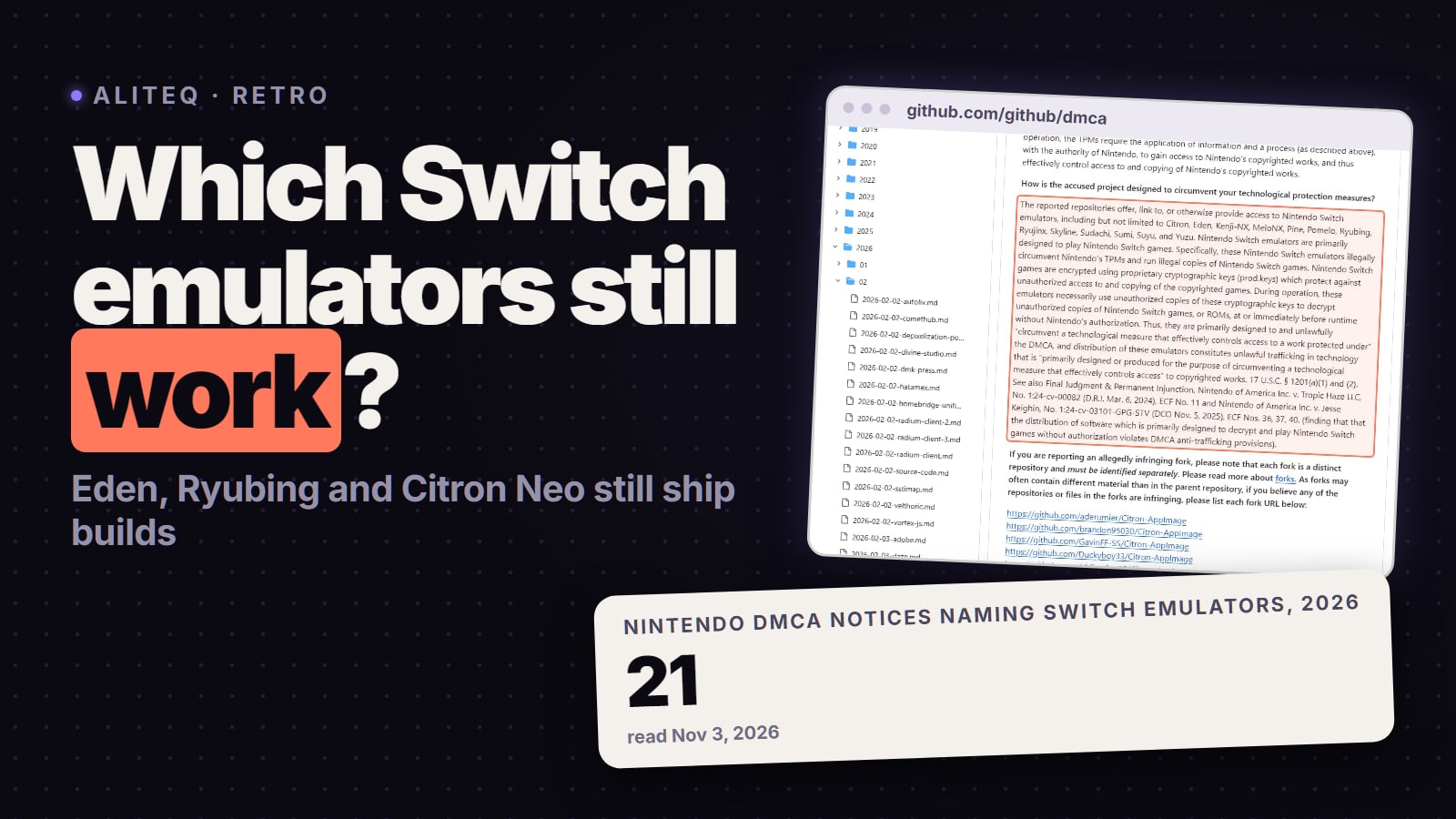
Since then Nintendo has kept filing DMCA notices against Switch emulator repositories on GitHub; we track which projects survived in which Switch emulators still work.
None of this means downloading is allowed for individuals. Section 504 sets statutory damages of "not less than $750 or more than $30,000" per work, and up to $150,000 for willful infringement, for any infringer. The cases mean the enforcement we can see has aimed at sites and developers.
Are abandonware ROMs legal?
No, not as a category. "Abandonware" is not a term in US copyright law. A game doesn't enter the public domain because it's out of print, its publisher closed, or nobody sells it. Copyright lasts the author's life plus 70 years, and for works made for hire, which most commercial games are, 95 years from first publication or 120 years from creation, whichever ends first (Section 302). No commercial game from the 1980s or 1990s has run out its term.
The narrow exceptions are the ones the rights holder grants: a game officially released for free, or a publisher that puts it out under an open license. If the rights holder hasn't done that, an old ROM has the same status as a new one.
Download a ROM of a game you don't own
US status (general information)
Copyright infringement (Section 106)
Download a ROM of a game you do own
US status (general information)
Not covered by Section 117; the copy wasn't made from yours
Dump your own unencrypted cartridge for your own use
US status (general information)
Gray area under Section 117, untested for games
Dump or decrypt your own encrypted game
US status (general information)
Runs into Section 1201; no general backup exemption
Play a game whose authentication server shut down
US status (general information)
Allowed under the 1201 exemption for personal, local play, if you acquired it lawfully
Download an "abandonware" ROM
US status (general information)
Same as any ROM; old age doesn't end copyright
Download or use an emulator from its official site
US status (general information)
Legal (Sony v. Connectix)
Download console BIOS files or Switch keys
US status (general information)
Copyrighted code or circumvention material; keys were central to the Yuzu judgment
US status (general information)
Download a ROM of a game you don't own
Copyright infringement (Section 106)
Download a ROM of a game you do own
Not covered by Section 117; the copy wasn't made from yours
Dump your own unencrypted cartridge for your own use
Gray area under Section 117, untested for games
Dump or decrypt your own encrypted game
Runs into Section 1201; no general backup exemption
Play a game whose authentication server shut down
Allowed under the 1201 exemption for personal, local play, if you acquired it lawfully
Download an "abandonware" ROM
Same as any ROM; old age doesn't end copyright
Download or use an emulator from its official site
Legal (Sony v. Connectix)
Download console BIOS files or Switch keys
Copyrighted code or circumvention material; keys were central to the Yuzu judgment
What about the UK and other countries?
The cases above are US law. Other countries have their own rules. In the UK, section 50A of the Copyright, Designs and Patents Act 1988 says a "lawful user of a copy of a computer program" may make a backup copy "which it is necessary for him to have for the purposes of his lawful use." Like the US rule, it is about a copy you make from your own copy. If you live outside the US, check your own country's law instead of relying on US cases.
Quick answers
Is it legal to download ROMs of games you own?
Not under US law as it is generally read. Section 117 lets the owner of a computer program make an archival copy of their own copy, and the US Copyright Office's advice is "back it up yourself." A downloaded ROM was made from someone else's copy, so owning the cartridge doesn't cover it.
Is it legal to dump my own cartridges?
It's a gray area. For unencrypted older cartridges, Section 117 allows archival copies of programs you own, but no court has clearly applied it to game cartridges, as far as we found. For encrypted media like Switch cards, DMCA Section 1201 bans circumvention and has no general backup exemption. This is general information, not legal advice.
Are emulators legal?
Yes, in the US. In Sony v. Connectix (9th Cir. 2000) the court held that copying the PlayStation BIOS during reverse engineering to build an emulator was fair use. An emulator becomes a legal problem when it ships copyrighted firmware or keys or is built mainly to break encryption.
Is Dolphin emulator legal?
Yes. Dolphin is independently written open-source software with no Nintendo code, and it says it is not affiliated with Nintendo. Its FAQ tells users to buy games and dump them with a Wii, and says downloading games you purchased earlier is a gray area it treats as off-limits.
Can I get in trouble for downloading ROMs?
Downloading a ROM is copying a copyrighted work, and US statutory damages run from $750 to $30,000 per work (Section 504). In practice, every public US case we found targeted distributors and developers, such as the $2,115,000 RomUniverse judgment in 2021 and the $2.4 million Yuzu judgment in 2024, not individual players. That is an enforcement pattern, not permission.
Are abandonware ROMs legal?
No. US law has no abandonware exception. A game stays under copyright even when it's out of print, and for most commercial games the term is 95 years from publication (Section 302). Only an official free or open release by the rights holder changes that.
Does the law differ outside the US?
Yes. The UK, for example, allows a lawful user of a computer program to make a necessary backup copy (CDPA section 50A), which is again a copy you make yourself. Check your own country's law.