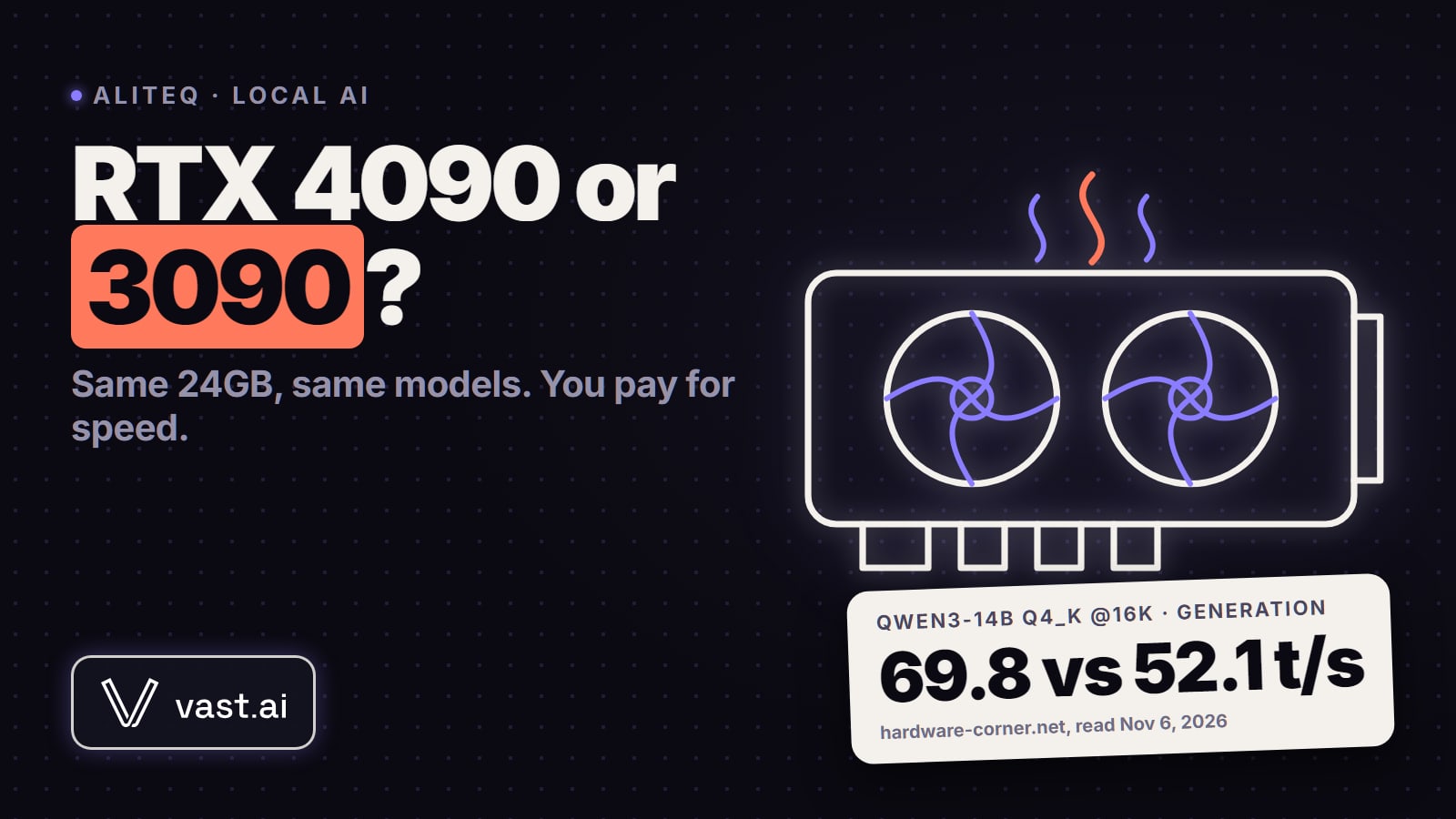
Both cards run exactly the same models. The 4090 generates 14–34% faster and reads long prompts about twice as fast, but used 4090 listings ran about 2.2 times the price of a used 3090 on Nov 6, 2026. Here's who should pay for the speed, with sourced numbers and a way to test both by the hour.
Some links on this page are referral links: we may earn a commission, at no cost to you.
Share
RTX 4090 or RTX 3090 for local AI? For most people, the used RTX 3090. Both cards have 24GB of VRAM, so they run exactly the same models. The 4090 is faster (34% at generating text with Qwen3-14B, 14% with Qwen3-32B, and about twice as fast at reading long prompts, in hardware-corner.net's llama.cpp tests), but on Nov 6, 2026 used 4090 listings averaged about 2.2 times the price of a used 3090. Pay for the 4090 only if you paste long documents or code all day, serve models in FP8, or also generate images.
Can the RTX 4090 run bigger models than the RTX 3090?
No. Both are 24GB GDDR6X cards on a 384-bit bus, per NVIDIA's RTX 4090 and RTX 3090 spec pages (read Nov 6, 2026). Every model that fits one fits the other, at the same quant and the same context. A dense 70B at Q4 fits neither: our VRAM calculator puts the DeepSeek R1 70B distill at about 43GiB with 8K context, so on either card you're into offload tricks or two cards.
Here's what our VRAM engine says fits a 24GB card (estimates from each model's published config, run Oct 28, 2026):
What fits a 24GB card, 3090 or 4090 (our VRAM engine, Oct 28, 2026)
Qwen3.8 27B
Model
Q4_K_M, ~17.0GiB (comfortable)
At 8K context
Q4_K_M, ~18.5GiB (comfortable)
Qwen3.6 35B-A3B
Model
Q4_K_M, ~21.2GiB (comfortable)
At 8K context
Q4_K_M, ~21.7GiB (tight)
Gemma 4 31B
Model
Q4_K_M, ~19.9GiB (comfortable)
At 8K context
Q4_K_M, ~21.7GiB (tight)
Qwen3-32B
Model
Q4_K_M, ~21.3GiB (comfortable)
At 8K context
Q3_K_M, ~23.7GiB (tight)
gpt-oss-20b
Model
Q8_0, ~21.9GiB (tight)
At 8K context
Not estimated
Model
At 8K context
At 32K context
Qwen3.8 27B
Q4_K_M, ~17.0GiB (comfortable)
Q4_K_M, ~18.5GiB (comfortable)
Qwen3.6 35B-A3B
Q4_K_M, ~21.2GiB (comfortable)
Q4_K_M, ~21.7GiB (tight)
Gemma 4 31B
Q4_K_M, ~19.9GiB (comfortable)
Q4_K_M, ~21.7GiB (tight)
Qwen3-32B
Q4_K_M, ~21.3GiB (comfortable)
Q3_K_M, ~23.7GiB (tight)
gpt-oss-20b
Q8_0, ~21.9GiB (tight)
Not estimated
"Tight" means the model uses more than 90% of the card; "comfortable" leaves at least 10% free. The newer hybrid models stretch 24GB further: Qwen3.8 27B keeps a KV cache in only 16 of its 64 layers, so 32K tokens of context costs it about 2GiB, where Qwen3-32B pays about 8GiB. Per-model detail: best GPU for Qwen3.8 27B, Qwen3.6 35B-A3B and gpt-oss-20b. We leave gpt-oss-20b out at 32K because our engine treats all its layers as full attention, which overstates its long-context cost.
How much faster is the RTX 4090 for local LLMs?
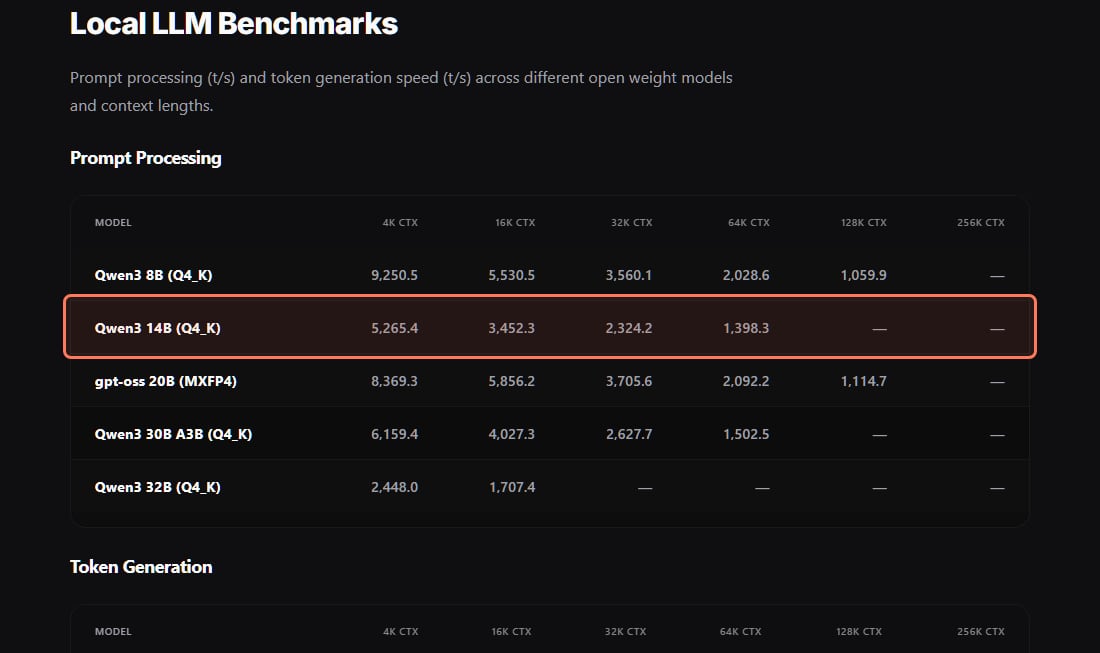
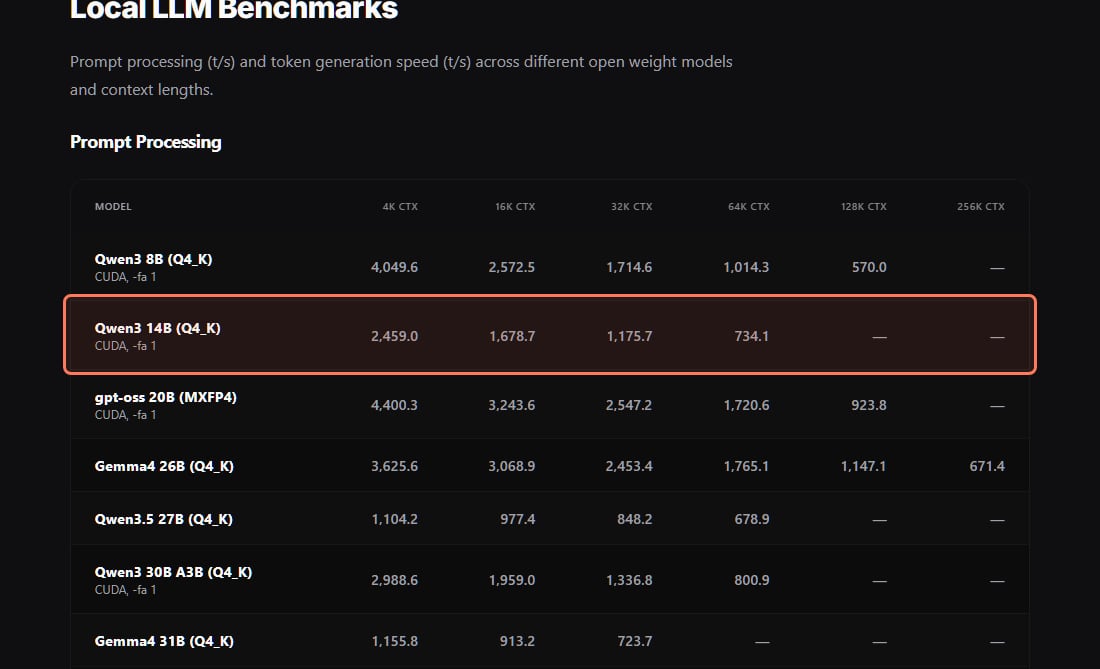
Between 14% and 34% at generating text, and about twice as fast at reading your prompt. These are hardware-corner.net's llama.cpp measurements, the same model and quant on both cards (their pages say "Updated Benchmarks: March 2026"; we read them on Nov 6, 2026):
Measured llama.cpp speed at 16k context, Q4_K (hardware-corner.net, read Nov 6, 2026)
Qwen3-14B, generation
Test
52.1 t/s
RTX 3090
69.8 t/s
RTX 4090
+34%
Qwen3-14B, prompt processing
Test
1,678.7 t/s
RTX 3090
3,452.3 t/s
RTX 4090
2.1x
Qwen3-32B, generation
Test
30.3 t/s
RTX 3090
34.4 t/s
RTX 4090
+14%
Qwen3-32B, prompt processing
Test
767.8 t/s
RTX 3090
1,707.4 t/s
RTX 4090
2.2x
Test
RTX 3090
RTX 4090
4090 lead
Qwen3-14B, generation
52.1 t/s
69.8 t/s
+34%
Qwen3-14B, prompt processing
1,678.7 t/s
3,452.3 t/s
2.1x
Qwen3-32B, generation
30.3 t/s
34.4 t/s
+14%
Qwen3-32B, prompt processing
767.8 t/s
1,707.4 t/s
2.2x
hardware-corner.net's RTX 4090 prompt-processing table, read November 6, 2026. The Qwen3 14B row is outlined. · Screenshot of hardware-corner.net by aliteq
The same table for the RTX 3090, read November 6, 2026. Same model, same quant, about half the prompt speed. · Screenshot of hardware-corner.net by aliteq
Notice the generation gap shrinks on the bigger model. On Qwen3-14B the 4090 is 34% ahead; on Qwen3-32B, the size most people buy a 24GB card for, it's 14%. Generation is mostly limited by memory bandwidth, and the two cards are close there: NVIDIA's Ampere whitepaper gives the 3090 "936 GB/sec", and its Ada whitepaper gives the 4090 1008 GB/sec, an 8% difference. The 4090's 72MB L2 cache (73,728 KB, against 6,144 KB on the 3090) helps most when a model is small enough for a useful share of it to stay on-chip, which is why the gap is wider at 14B than at 32B.
Qwen3-32B Q4_K at 16k context, llama.cpp (hardware-corner.net, read Nov 6, 2026)
RTX 3090, generation30.3 t/s
RTX 4090, generation34.4 t/s
RTX 3090, prompt processing767.8 t/s
RTX 4090, prompt processing1,707.4 t/s
When does the 4090's speed actually matter?
When you feed the model long prompts. Generation speed is the number you watch while the model types, but if your day is "paste a long document or a chunk of code, then ask about it" (coding assistants, document Q&A, RAG), the wait before the first word is set by prompt processing. On the figures above, a 16,000-token prompt into Qwen3-32B takes the 3090 about 21 seconds before it starts answering, and the 4090 about 9. With Qwen3-14B it's about 10 seconds against 5. Do that forty times a day and the 4090 earns its keep.
The other cases where the 4090 is worth more:
You want FP8. NVIDIA's Ada whitepaper says the 4090's fourth-generation Tensor Cores add "support for a new FP8 tensor format"; it lists FP8 as N/A for the Ampere cards. For llama.cpp chat with GGUF files this barely matters, but for serving models with vLLM in FP8 it's a real fork in the road.
You also generate images or video. Diffusion is limited by compute more than bandwidth, so the 4090's lead there is much larger than its lead at generating text. We haven't measured it ourselves, so we don't put a number on it.
You want a younger card. The 3090 launched in 2020 and many used ones mined for a living; the 4090 launched in 2022.
If you mostly chat, run agents, or ask short questions, the 14% you'd gain on a 32B model is hard to notice, and the 3090 is the better buy.
Does the RTX 4090 use more electricity?
Per token, barely. NVIDIA rates the 4090 at 450W and the 3090 at 350W. Divide rated power by measured speed and you get about 6.4 joules per generated token on the 4090 against 6.7 on the 3090 with Qwen3-14B, and about 13.1 against 11.6 with Qwen3-32B, where the 3090 comes out ahead. Rated power isn't measured draw (cards rarely sit at their limit during inference), so treat these as rough, but they're enough to say electricity shouldn't decide this. The 4090 finishes sooner; your meter barely notices.
How much do a used RTX 3090 and a used RTX 4090 cost in November 2026?
A lot more than buying guides from earlier this year say. GPUPoet, which tracks eBay listings, put the RTX 3090's lowest average at $1,565 and the RTX 4090's at $3,454 when we read them on Nov 6, 2026. Those are listing prices, not sold prices, so check recently sold listings on the day you buy. On those numbers a used 4090 costs about 2.2 times a used 3090, and two used 3090s ($3,130) cost less than one 4090. The memory shortage is the usual explanation for why used 24GB cards went up with new ones.
A simple rule: if the 3090 costs well under two-thirds of the 4090 you're looking at, the 3090 is the value buy, and on Nov 6 it was under half. If you find a 4090 close to 3090 money, its prompt speed, FP8 support and younger age are worth paying for. If you'd only use either card a few hours a week, renting beats both; see our rent vs buy math.
Can I try both before I buy?
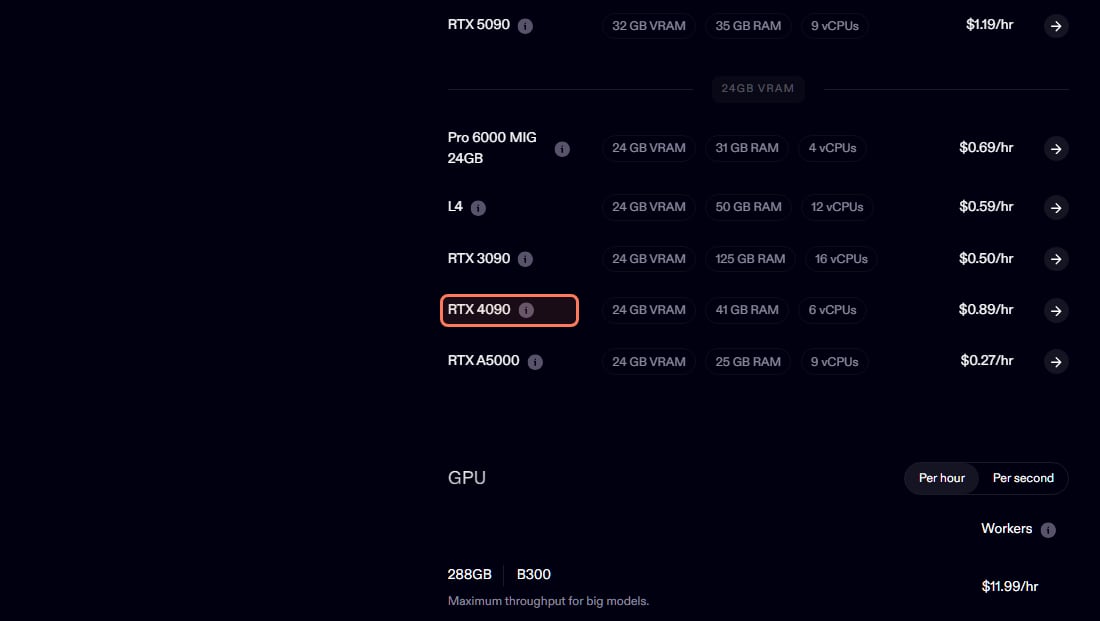
Yes, and it's the cheapest test there is. At 21:20 UTC on Nov 6, 2026, our tracker read a single RTX 3090 on Vast.ai from $0.10 an hour on-demand (median $0.20 across 32 offers) and an RTX 4090 from $0.27 an hour (median $0.44 across 38 offers). Runpod's own pricing page listed them at $0.50 and $0.89 an hour on Secure Cloud, and $0.22 and $0.34 on Community Cloud. Run your real prompts on both: if the 3090's wait before the first word doesn't bother you, you've found your card. For scale, $3,454 would rent a median-priced 4090 on Vast for roughly 7,800 hours.
Runpod's pricing page, 24GB section, read November 6, 2026 (these are the Secure Cloud rates). Live prices for both providers are on our cloud GPU page. · Screenshot of runpod.io by aliteq
Is a used RTX 3090 risky?
Manageable, not trivial. The 3090's GDDR6X memory runs hot, and on many cards aged thermal pads are the most common real problem. Ask the seller for HWiNFO screenshots under load; memory-junction temperatures sustained above about 100°C mean the pads are overdue. Budget an hour and a set of pads for a repad on any card without service history. Our used RTX 3090 buying guide has the full checklist.
The RTX 3090 Founders Edition, launched in 2020 and still the cheapest 24GB GeForce card on the used market. · NVIDIA
RTX 4090 vs RTX 3090 for local AI, head to head
RTX 4090
24GB · Ada
vs
RTX 3090
24GB · Ampere
24 GB
VRAM
24 GB
34.4 t/s
32B gen @16k
30.3 t/s
1,707 t/s
32B prompt @16k
768 t/s
Yes
Native FP8
No
~$3,454
Used (Nov 6)
~$1,565
~13.1 J
Energy/token, 32B
~11.6 J
4090 wins 3wins 2 3090
Our call
Both cards run the same models, so you're paying for speed, and in November 2026 the 4090 asks about 2.2 times as much for a 14% generation lead on a 32B model and a 2x lead on long prompts. For a first serious local-AI box that mostly chats or runs agents, buy the used 3090 and put the difference toward more system RAM or a second card. Buy the 4090 if long prompts are your whole day, if you need FP8, or if you also make images. Check what actually fits in 24GB first; the ceiling is the same on both.
Verdict
Buy the 3090 for value. Buy the 4090 for long prompts.
Same 24GB, same models. The 4090 is 14–34% faster at generating and about 2x faster at prompt processing in hardware-corner.net's llama.cpp tests, and on Nov 6, 2026 used 4090 listings averaged about 2.2 times a used 3090. Energy per token is close. Take the 3090 for value; take the 4090 for long prompts, FP8 or image work. Rent an hour on each first.
Best for: 3090: first local-AI build, chat and agent workloads, value hunters. 4090: long-context daily drivers, vLLM/FP8 servers, anyone also doing image generation.
The questions people actually ask
Is the RTX 4090 or RTX 3090 better for local AI?
For most people buying used in November 2026, the RTX 3090. Both have 24GB and run the same models. The 4090 is 14–34% faster at generating text and about 2x faster at prompt processing in hardware-corner.net's llama.cpp tests, but on Nov 6, 2026 used 4090 listings averaged about $3,454 against $1,565 for a 3090. The 4090 is worth it for long prompts, FP8 serving or image generation.
Can the RTX 4090 run bigger models than the 3090?
No. Both are 24GB cards and the ceiling is identical: Qwen3.8 27B, Gemma 4 31B, Qwen3.6 35B-A3B or Qwen3-32B at Q4_K_M is the practical top on either. The 4090 runs the same models faster; it doesn't run larger ones. For bigger models you need two cards, an offload strategy, or a rented GPU.
How much faster is the 4090 than the 3090 for Qwen3-32B?
In hardware-corner.net's llama.cpp measurements at 16k context, Q4_K, the 4090 generates 34.4 tokens/sec against 30.3 on the 3090, about 14% faster, and processes prompts at 1,707.4 against 767.8 tokens/sec, about 2.2x.
How much does it cost to rent each card?
At 21:20 UTC on Nov 6, 2026, Vast.ai listed a single RTX 3090 from $0.10 an hour and an RTX 4090 from $0.27 an hour, both on-demand; Runpod's pricing page listed them at $0.50 and $0.89 on Secure Cloud, or $0.22 and $0.34 on Community Cloud. Prices change hourly; our cloud GPU page shows the live list.
Is the RTX 5090 a better buy than either?
Only if you need more than 24GB on one card. NVIDIA's RTX 5090 page lists 32GB of GDDR7, which fits models neither the 3090 nor the 4090 can hold at the same quant. Our RTX 5090 page covers price and availability.
Does the gpu-unlock patch close the gap?
Partly, for some work. The community gpu-unlock project's README says it is Linux only, stable on RTX 30 cards and experimental on RTX 40, and lists +25–55% for FP16/BF16 prompt processing in vLLM or PyTorch, "No change" for token generation, and 0–15% for llama.cpp or Ollama with GGUF, mostly at long context. It's unofficial and we haven't tested it, so don't price it into either card.
What about an RTX 3090 Ti?
Worth a look when it's priced near the 3090. It's the same 24GB but with 1008 GB/sec of bandwidth, the same figure NVIDIA gives the 4090, and a 450W rating. It still lacks FP8 and the 4090's 72MB L2 cache, so don't pay 4090 money for one.
If you're still deciding what you'd run on 24GB, our VRAM calculator does the fit math per model and quant, and the Qwen3-32B cost-to-run page keeps live rent-vs-buy numbers. Know your workload first, then buy the card it needs.