Both cards have 16GB, so the same models fit. In llama.cpp's public benchmark tables the RTX 5070 Ti generates text about 30% faster, and it costs about 44% more at US retail. How the speed, the price, Windows support and rental compare, with every number dated and sourced.
Some links on this page are referral links: we may earn a commission, at no cost to you.
Share
RX 9070 XT or RTX 5070 Ti for local AI? Buy the RTX 5070 Ti if you want the fastest 16GB card and the easiest setup, especially on Windows. Buy the RX 9070 XT if you're on Linux, happy to use llama.cpp's Vulkan backend, and would rather keep about $380. Both cards have 16GB of VRAM, so the same models fit on either. The 5070 Ti is faster because its memory is faster: NVIDIA lists 896 GB/s against AMD's "up to 640 GB/s". In llama.cpp's public benchmark tables it generates text about 30% faster. In the US it also cost about 44% more in October 2026. Specs and benchmark tables read on November 3, 2026.
RX 9070 XT vs RTX 5070 Ti in four numbers (read Nov 3, 2026)
177
5070 Ti tokens/sec, llama.cpp CUDA
9070 XT: 136.56 on Vulkan
896
5070 Ti memory bandwidth, GB/s (NVIDIA)
9070 XT: up to 640 GB/s (AMD)
$870
9070 XT US street price
5070 Ti: $1,250 (TechSpot, Oct 2026)
16
GB of VRAM on each card
Same models fit on both
Which is faster for local AI, the RX 9070 XT or the RTX 5070 Ti?
The RTX 5070 Ti, by about 30% at generating text. The cleanest comparison we could find is llama.cpp's own public scoreboards. Every entry runs the same test: Llama 2 7B at Q4_0, with llama-bench reporting prompt processing (pp512) and text generation (tg128) in tokens per second. There is one scoreboard per backend: CUDA for NVIDIA, ROCm for AMD, and Vulkan for both. These are community submissions from different PCs and llama.cpp builds, not our own tests.
Text generation, Llama 2 7B Q4_0, tokens/sec (llama.cpp scoreboards, no flash attention, read Nov 3, 2026)
RTX 5070 Ti on CUDA177
CUDA scoreboard
RX 9070 XT on Vulkan137
Vulkan scoreboard
RTX 5070 Ti on Vulkan136
Vulkan scoreboard
RX 9070 XT on ROCm101
ROCm scoreboard, older build
Three things stand out:
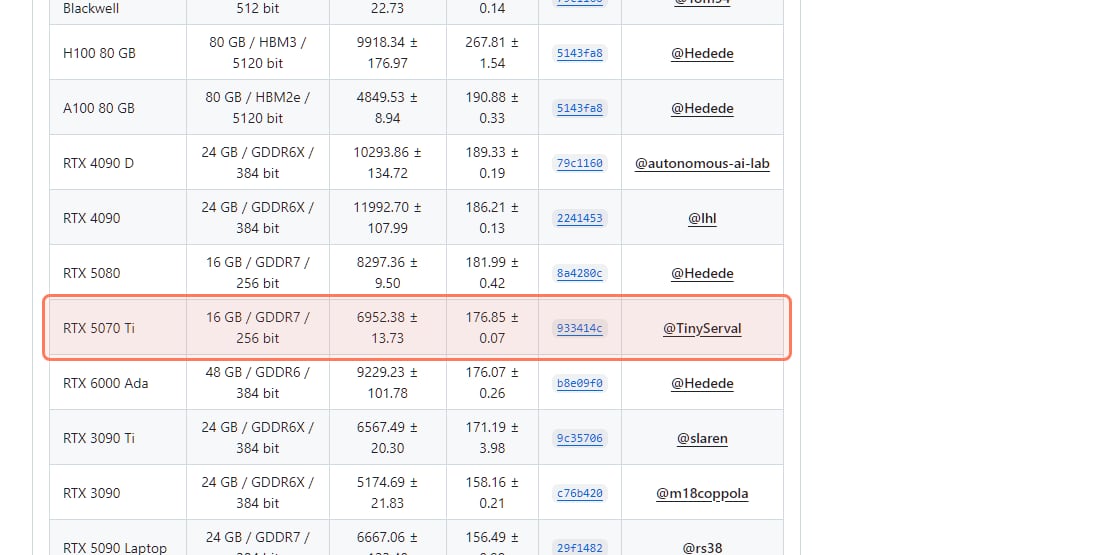
On its best backend, the 5070 Ti wins by about 30%. 176.85 tokens per second on CUDA against 136.56 for the 9070 XT on Vulkan. Prompt processing, which decides how fast a long prompt or document is read in, shows a similar gap: 6,952 against 5,202 tokens per second.
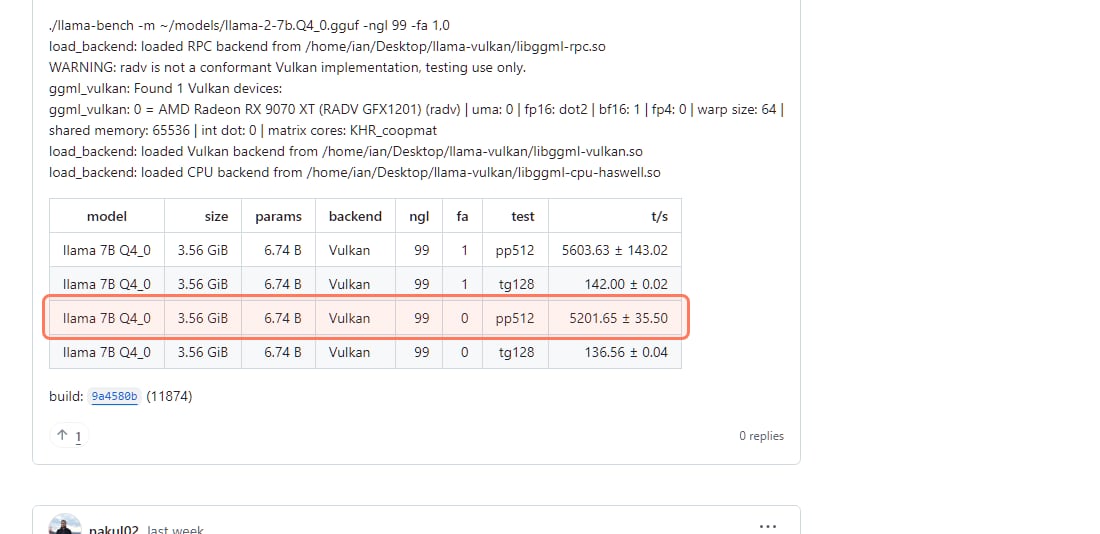
On Vulkan the result depends on settings. With flash attention off, the 5070 Ti's Vulkan entry is 135.63, almost exactly the 9070 XT's 136.56. With flash attention on, the same Vulkan scoreboard has the 5070 Ti at 176.18 against 142.00 for the 9070 XT, about 24% faster. The entries come from different llama.cpp builds, so read the no-flash-attention tie with care. On an NVIDIA card, Ollama, LM Studio and most tools use CUDA anyway.
On the 9070 XT, Vulkan beats ROCm. The ROCm scoreboard entry is 101.27, from an older build. A tester who ran both backends on the same 9070 XT on July 15, 2026 reported: "Vulkan is consistently ~23% faster than ROCm/HIP (220 vs 179 t/s)" for text generation with a smaller 3B model, while ROCm was steadier at prompt processing. The same tester measured 122 tokens per second on ROCm with a newer build, so ROCm results move with each release.
The RTX 5070 Ti row on llama.cpp's CUDA scoreboard (Discussion #15013, read Nov 3, 2026): 6,952 tokens/sec reading the prompt, 176.85 generating. · Screenshot of github.com/ggml-org/llama.cpp by aliteq
The RX 9070 XT run behind its Vulkan scoreboard entry (Discussion #10879, read Nov 3, 2026): 136.56 tokens/sec generating, 142.00 with flash attention on. · Screenshot of github.com/ggml-org/llama.cpp by aliteq
What 30% means in practice: on a 7B or 8B model both cards are far faster than you can read. The gap matters more on bigger models that fill the 16GB, where every token is slower, and for agents or batch jobs that generate a lot of text.
Why is the RTX 5070 Ti faster if both have 16GB?
Because its memory is faster. Generating text is limited mostly by how fast the card can read the model's weights from VRAM, and the 5070 Ti's GDDR7 moves about 40% more data per second than the 9070 XT's GDDR6.
RX 9070 XT vs RTX 5070 Ti, from AMD's and NVIDIA's own pages (read Nov 3, 2026)
VRAM
Spec
16 GB GDDR6
RX 9070 XT
16 GB GDDR7
Memory bus
Spec
256-bit
RX 9070 XT
256-bit
Memory bandwidth
Spec
Up to 640 GB/s
RX 9070 XT
896 GB/s
Board power
Spec
304W (typical board power)
RX 9070 XT
300W (total graphics power)
Launch price
Spec
$599 (AMD SEP, Feb 28, 2025)
RX 9070 XT
$749 (NVIDIA, Jan 6, 2025)
US street price, Oct 2026 (TechSpot)
Spec
About $870
RX 9070 XT
About $1,250
Main AI software
Spec
ROCm or Vulkan
RX 9070 XT
CUDA (Vulkan also works)
Spec
RX 9070 XT
RTX 5070 Ti
VRAM
16 GB GDDR6
16 GB GDDR7
Memory bus
256-bit
256-bit
Memory bandwidth
Up to 640 GB/s
896 GB/s
Board power
304W (typical board power)
300W (total graphics power)
Launch price
$599 (AMD SEP, Feb 28, 2025)
$749 (NVIDIA, Jan 6, 2025)
US street price, Oct 2026 (TechSpot)
About $870
About $1,250
Main AI software
ROCm or Vulkan
CUDA (Vulkan also works)
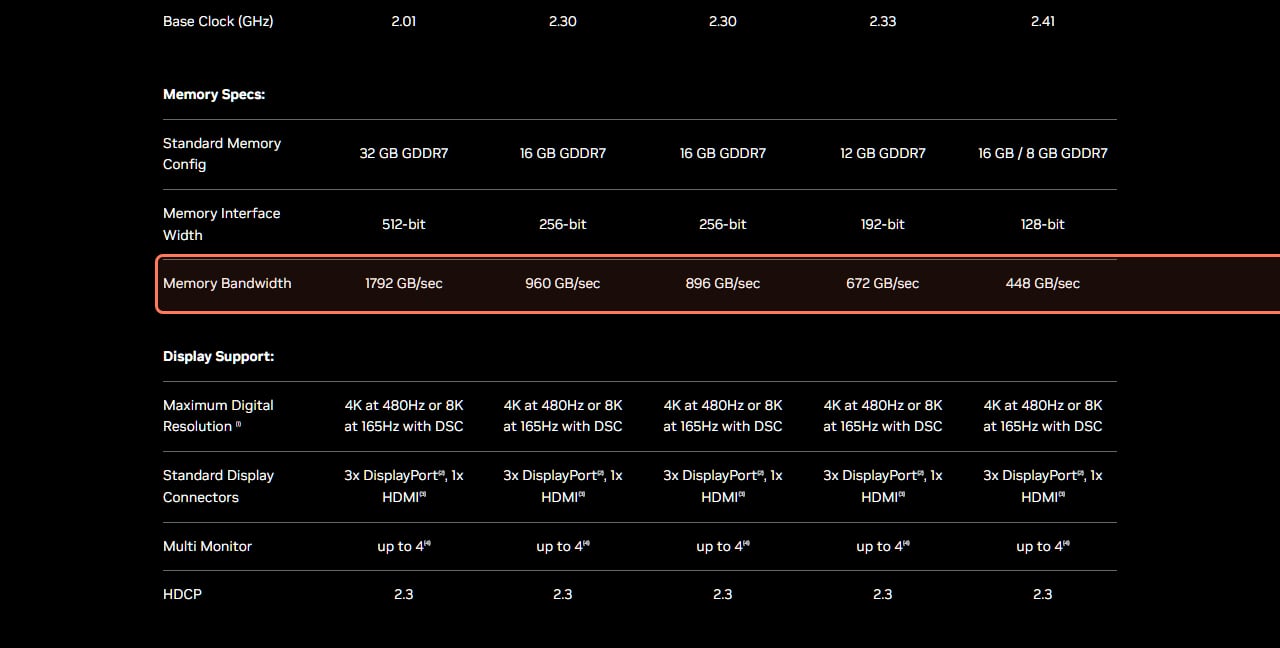
NVIDIA's 50 Series comparison table (nvidia.com, read Nov 3, 2026). The columns run RTX 5090, 5080, 5070 Ti, 5070, 5060 Ti; the third, 16 GB GDDR7 on 256-bit, is the 5070 Ti at 896 GB/sec. · Screenshot of nvidia.com by aliteq
The bandwidth ratio (896 ÷ 640 = 1.4) is larger than the 30% speed gap in the benchmark tables, because no card reaches its full bandwidth in practice. It still explains which card wins and why the gap won't close with a driver update. For how memory speed and model size interact, see what quantization does.
How much more does the RTX 5070 Ti cost right now?
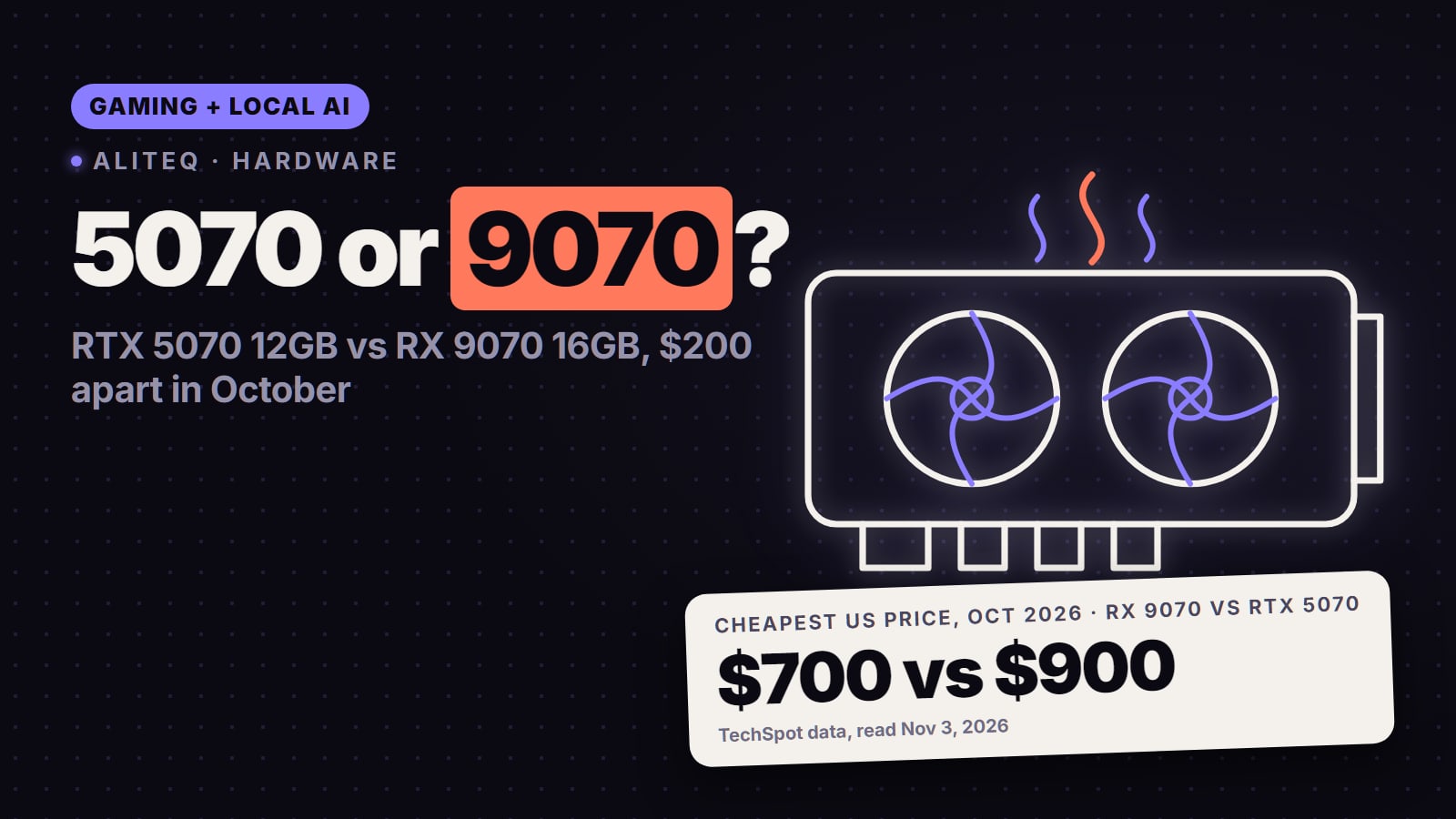
About $380 more in the US, roughly 44%. TechSpot's Q4 2026 price update, published November 2, 2026, tracked these US prices:
US street prices (TechSpot, Q4 2026 update, published Nov 2, 2026)
RTX 5070 Ti, October 2026$1,250
Launched at $749
RTX 5070 Ti, February 2026$1,000
RX 9070 XT, October 2026$870
Launched at $599
RX 9070 XT, February 2026$700
TechSpot says "The gap between the RTX 5070 Ti and RX 9070 XT continues to be huge as well. The GeForce costs ~47% more right now". On the US prices alone the gap is about 44%. It puts the 5070 Ti at 67% above its launch price in the US and the 9070 XT at 45% above. Both rose between September and October, the 9070 XT by $80 and the 5070 Ti by $130, so check today's price before you buy: these numbers change every month.
Price per unit of speed, by our arithmetic from the two tables above: $1,250 ÷ 177 tokens per second is about $7.07 per token/sec for the 5070 Ti, and $870 ÷ 137 is about $6.37 for the 9070 XT. So the 9070 XT is about 10% cheaper for the speed you get, if you run it on Vulkan. If you're stuck on ROCm's older 101 tokens per second, it's about $8.59 and the value edge is gone.
Does the RX 9070 XT work with ROCm and Ollama?
Yes on Linux, and on Windows mostly through Vulkan. Two older claims about this card are out of date, including one this page used to make:
ROCm has supported it since May 2025, not March 2026. AMD's ROCm 6.4.1 release notes (May 7, 2025) say the release "introduces support for the RDNA4 architecture-based ... Radeon RX 9070 XT ... for compute workloads", on Ubuntu and RHEL. AMD's current release, ROCm Core SDK 10.1.0 (October 5, 2026), applies to Linux and Windows and lists the RX 9070 XT among supported Radeon cards, with PyTorch 2.14 on both systems.
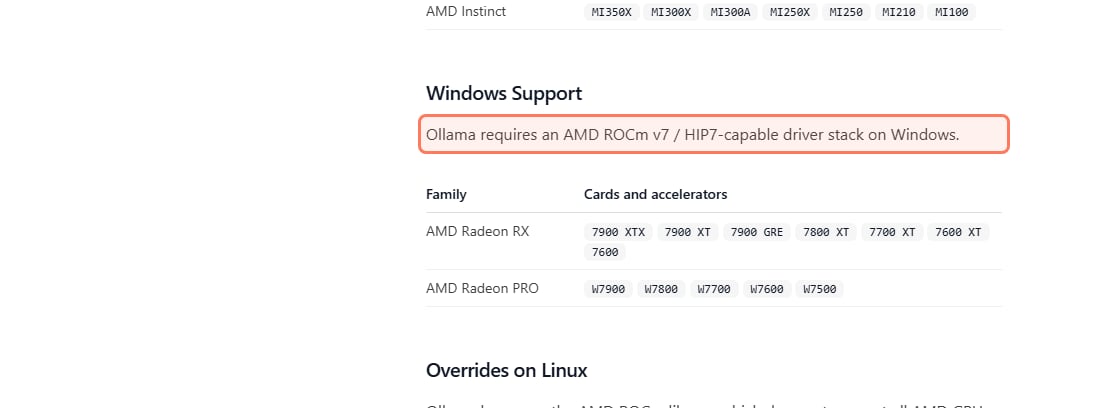
Ollama's ROCm list for Windows doesn't include it. Ollama's hardware page (read November 3, 2026) lists the RX 9070 XT under Linux ROCm support, which "requires the AMD ROCm v7 driver". Its Windows ROCm list stops at the RX 7000 series. On Windows, Ollama reaches other AMD cards through Vulkan: "Additional GPU support on Windows and Linux is provided via Vulkan." Since Vulkan is the 9070 XT's faster backend in llama.cpp's tables anyway, that costs you little for chat models.
Ollama's Windows ROCm list (docs.ollama.com/gpu, read Nov 3, 2026) has no RX 9000 card. The RX 9070 XT appears in the Linux list; on Windows it runs through Ollama's Vulkan support. · Screenshot of docs.ollama.com by aliteq
The RTX 5070 Ti has none of this to check. Ollama lists it under NVIDIA compute capability 12.0 and needs "driver version 550 and newer". Most local-AI tools, image generators and training scripts are written for CUDA first. If you want ComfyUI, fine-tuning or a tool whose install guide only says "NVIDIA GPU", that is worth more than the benchmark gap. Our AMD vs Nvidia for local AI guide covers the wider ecosystem, and Ollama vs LM Studio covers the two apps most people start with.
What can you run on 16GB with either card?
The same models on both: VRAM decides what fits, and they have the same amount. A 16GB card comfortably runs 7B to 14B models at 4-bit, and OpenAI's model card says gpt-oss-20b runs "within 16GB of memory". Models around 27B to 32B need a tighter quantization, a shorter context or spilling into system RAM, which slows both cards down.
Check your exact model and context length in our VRAM calculator, and see live cloud costs for gpt-oss 20B and Qwen3 14B. If you already know you need 32B models with long context, neither card is the right buy; our best GPU for local AI guide covers the 24GB and 32GB options, and RTX 5070 Ti vs RTX 5080 covers the step up on NVIDIA's side.
Should you rent an RTX 5070 Ti before you buy?
If you're unsure the speed is worth $380, yes: an hour costs well under a dollar. At 20:20 UTC on November 3, 2026, our price tracker's cheapest on-demand RTX 5070 Ti on Vast.ai was $0.161 an hour, out of 14 offers. At that rate the 5070 Ti's $1,250 street price buys about 7,800 hours of rental. Neither Vast.ai nor Runpod listed an RX 9070 XT in our data that day, so you can only test the NVIDIA card this way. See today's cloud GPU prices for the live numbers.
Which should you buy?
Buy the RTX 5070 Ti if:
You're on Windows and want Ollama, LM Studio and everything else to use the GPU with no extra steps.
You want image or video generation, fine-tuning, or any tool written for CUDA first.
Speed matters: agents, coding assistants or batch jobs that generate a lot of text.
Buy the RX 9070 XT if:
You run Linux, or you're fine running llama.cpp-based tools on Vulkan.
You mostly chat with models up to 14B to 20B, where 137 tokens per second is already far faster than reading speed.
The $380 is better spent on more system RAM, a bigger SSD, or saved toward a second card.
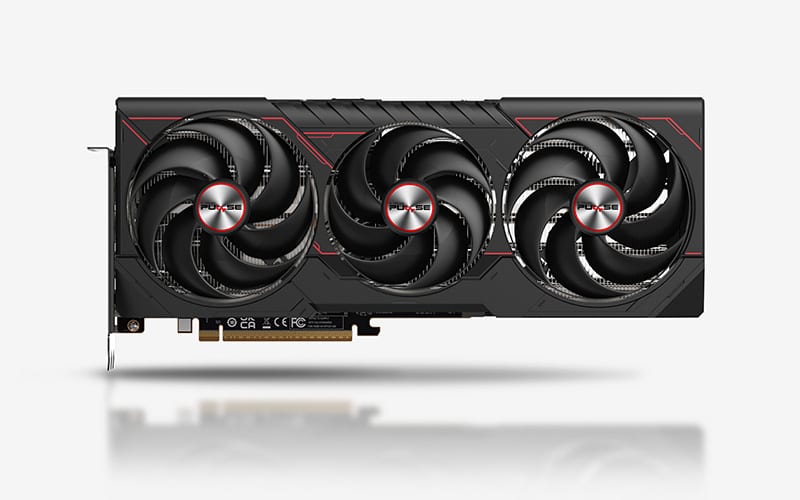
Sapphire Pulse Radeon RX 9070 XT 16GB
An RX 9070 XT with 16GB of GDDR6, the card this page recommends for Linux and Vulkan users who want the lower price.
The Amazon button above is a referral link: we may earn a commission if you buy, at no extra cost to you.
7/ 10
Verdict
RTX 5070 Ti for ease and speed, RX 9070 XT for value
Same 16GB, so the same models fit. The RTX 5070 Ti is about 30% faster at generating text and needs no setup thought on any system, which makes it the safe pick for most buyers. The RX 9070 XT costs about $380 less in the US and is about 10% better value per token per second on Vulkan, which makes it the smart pick on Linux. Check the price on the day: both rose by $80 to $130 in one month.
Best for: Anyone choosing a 16GB GPU for running AI models at home
RX 9070 XT vs RTX 5070 Ti: quick answers
Is the RX 9070 XT or RTX 5070 Ti better for local AI?
The RTX 5070 Ti is faster and easier; the RX 9070 XT is cheaper. In llama.cpp's community benchmark tables (read Nov 3, 2026) the 5070 Ti generated about 177 tokens per second on CUDA against about 137 for the 9070 XT on Vulkan. In the US the 5070 Ti cost about $1,250 and the 9070 XT about $870 in October 2026, per TechSpot.
How much faster is the RTX 5070 Ti than the RX 9070 XT for LLMs?
About 30% at generating text and about 34% at reading the prompt, on each card's best backend in llama.cpp's Llama 2 7B Q4_0 scoreboards. On Vulkan the two cards tied with flash attention off, but with it on the 5070 Ti was about 24% faster there too, in line with its faster memory: 896 GB/s against 640 GB/s.
Does ROCm support the RX 9070 XT?
Yes. AMD added it in ROCm 6.4.1 on May 7, 2025, for Linux, and the current ROCm Core SDK 10.1.0 (Oct 5, 2026) lists it for Linux and Windows. In llama.cpp, though, testers found the Vulkan backend faster than ROCm at generating text on this card.
Does Ollama work with the RX 9070 XT on Windows?
Yes, through Vulkan. Ollama's hardware page (read Nov 3, 2026) lists the RX 9070 XT for ROCm on Linux only; its Windows ROCm list covers the RX 7000 series. On Windows, Ollama supports other AMD cards through its Vulkan backend.
Is 16GB of VRAM enough for local AI?
For 7B to 14B models at 4-bit, yes, with room for context. OpenAI says gpt-oss-20b runs within 16GB. Models of 27B to 32B need tighter quantization or spill into system RAM. Use our VRAM calculator to check a specific model.
Is the RTX 5070 Ti worth $380 more for AI?
If you use Windows, CUDA-only tools or image generation, or you generate a lot of text, usually yes. If you're on Linux and mostly chat with models up to 20B, the RX 9070 XT gives about 10% more speed per dollar on Vulkan, by our arithmetic from TechSpot's prices and llama.cpp's tables.
Both are good 16GB cards; the choice is about your operating system, your tools and your budget, not about which models you can load. If you're still choosing the tier, our best GPU for local AI guide covers the full range, and RTX 5070 vs RX 9070 compares the cheaper cards one step down.