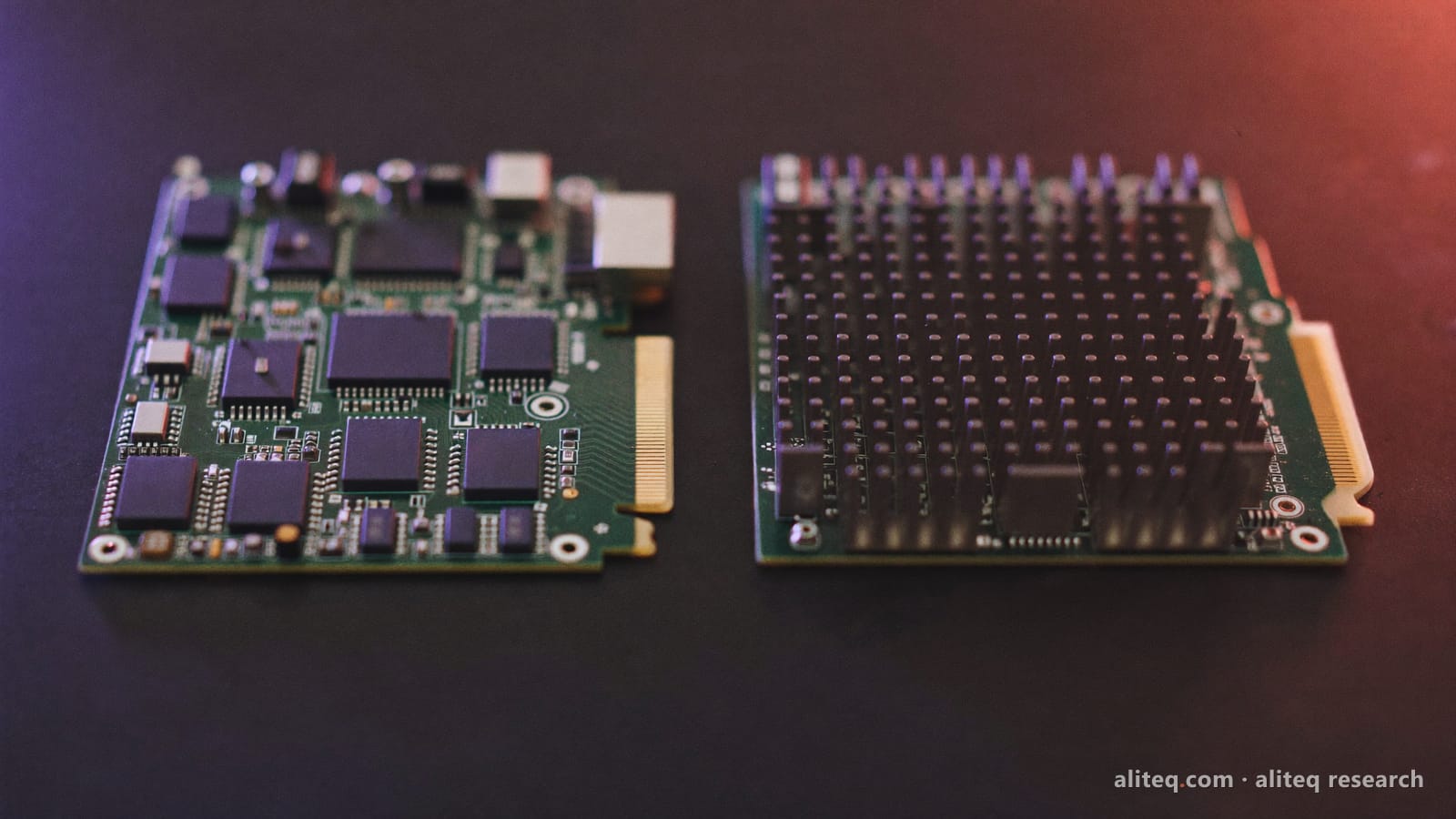
On Nov 6, 2026 the gap at Best Buy was $270 for the same chip with twice the memory. For local AI the 16GB is worth it; for 1080p gaming at medium settings it isn't. Here is the math, with every price and benchmark dated and sourced.
Some links on this page are referral links: we may earn a commission, at no cost to you.
Share
How much more does the 16GB RTX 5060 Ti cost right now?
$270 for the same model from the same brand. On Nov 6, 2026, Best Buy listed:
PNY RTX 5060 Ti Overclocked, Dual Fan
VRAM
8GB
Price
$499.99
Price per GB
$62.50
PNY RTX 5060 Ti Overclocked, Dual Fan
VRAM
16GB
Price
$769.99
Price per GB
$48.12
ASUS Dual RTX 5060 Ti OC Edition
VRAM
16GB
Price
$839.99
Price per GB
$52.50
ASUS Prime RTX 5060 Ti
VRAM
16GB
Price
$869.99
Price per GB
$54.37
PNY RTX 5060 (non-Ti) Overclocked
VRAM
8GB
Price
$449.99
Price per GB
$56.25
VRAM
Price
Price per GB
PNY RTX 5060 Ti Overclocked, Dual Fan
8GB
$499.99
$62.50
PNY RTX 5060 Ti Overclocked, Dual Fan
16GB
$769.99
$48.12
ASUS Dual RTX 5060 Ti OC Edition
16GB
$839.99
$52.50
ASUS Prime RTX 5060 Ti
16GB
$869.99
$54.37
PNY RTX 5060 (non-Ti) Overclocked
8GB
$449.99
$56.25
So the 16GB card costs 54% more and gives you 100% more memory. Per gigabyte, the 16GB card is the better deal, which wasn't true at launch.
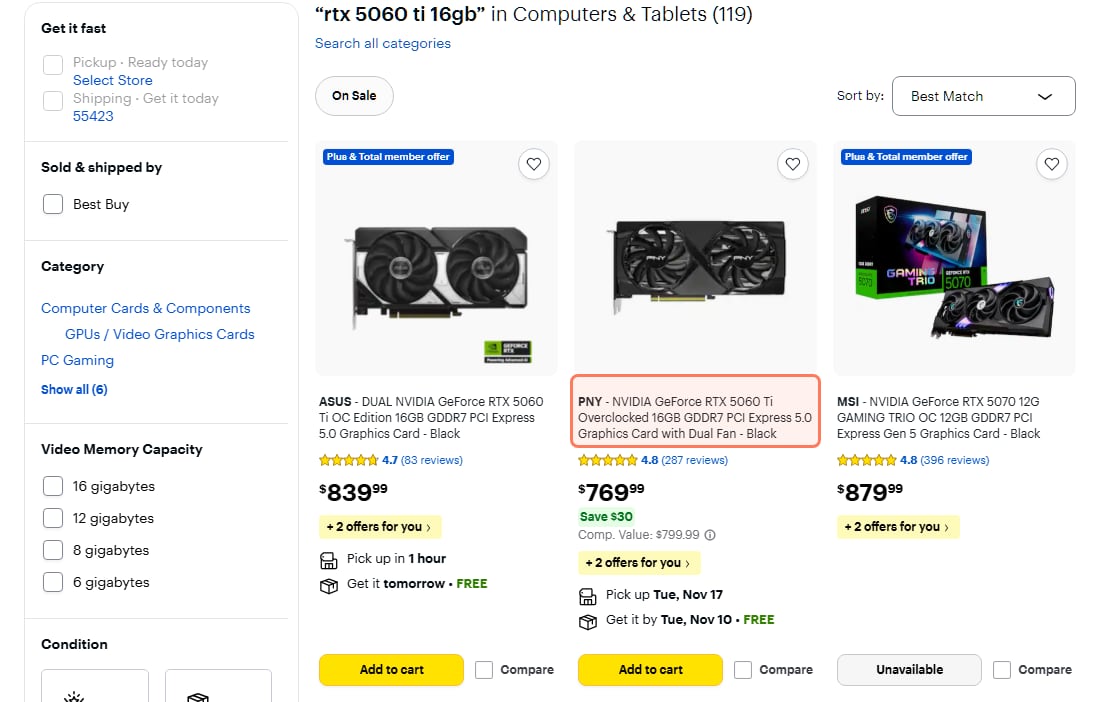
Best Buy, Nov 6, 2026: the PNY RTX 5060 Ti 16GB at $769.99 (outlined). Prices change daily. · Screenshot: bestbuy.com, Nov 6, 2026
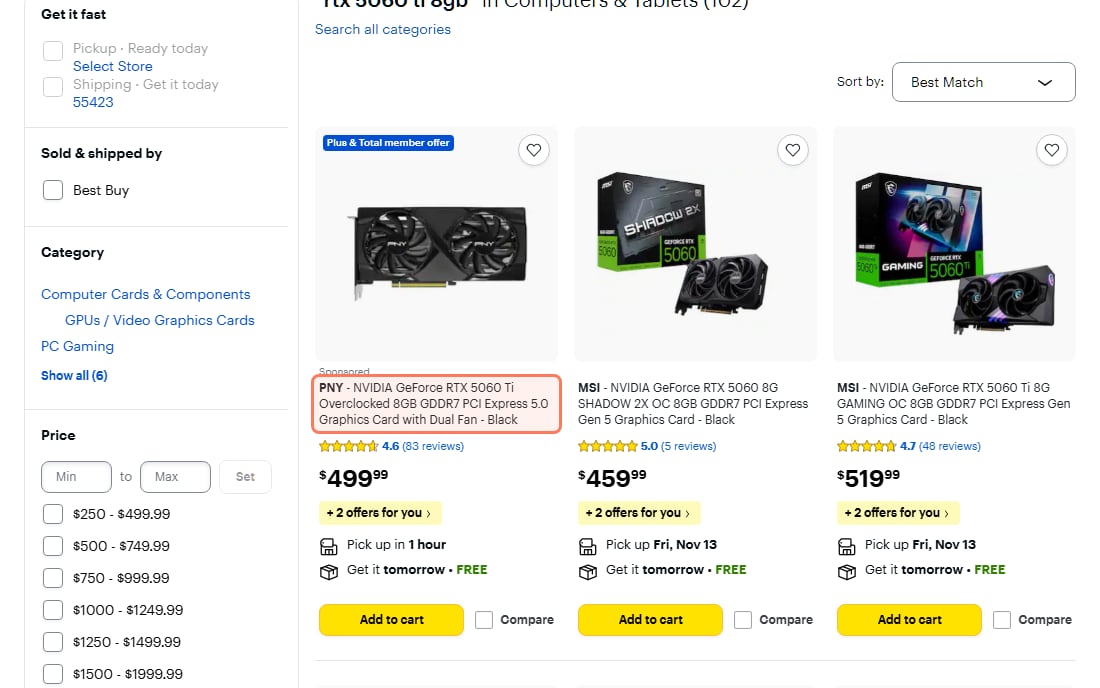
Best Buy, Nov 6, 2026: the PNY RTX 5060 Ti 8GB at $499.99 (outlined), the same card with half the memory. · Screenshot: bestbuy.com, Nov 6, 2026
Why is the gap so much bigger than at launch?
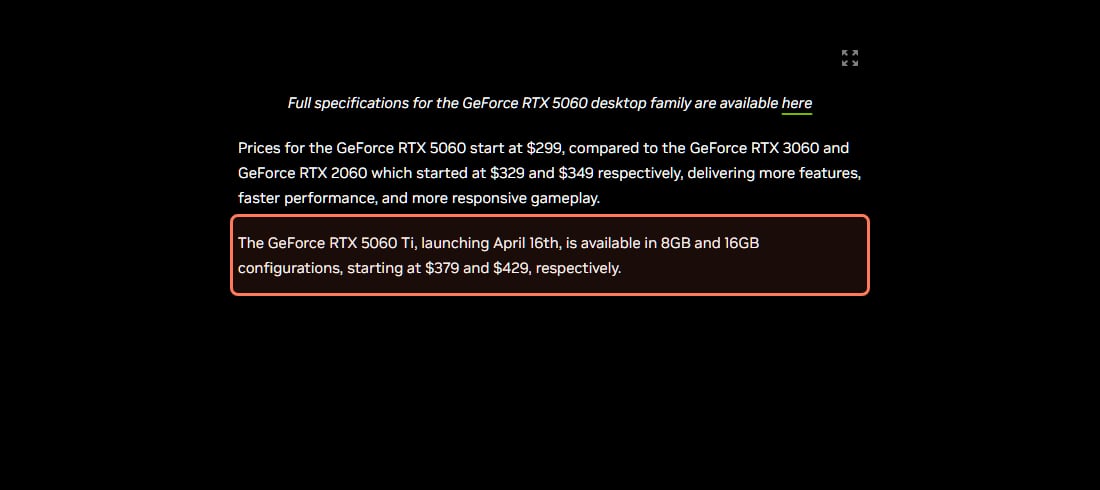
NVIDIA launched both cards on April 16, 2025 at $379 (8GB) and $429 (16GB), a $50 gap. Since then memory prices pushed the whole RTX 50 line up, and the card with twice the GDDR7 rose the most. Tom's Hardware's survey of Newegg listings on Aug 10, 2026 put the median RTX 5060 Ti 8GB at $529.99 (up from $469.99 in June 2026) and the median 16GB at $804.99 (up 39% from $569.99). The Best Buy prices above are a little below those August medians, but the gap is about the same.
NVIDIA's launch prices from April 15, 2025: $379 and $429. The gap was $50 then. · Screenshot: nvidia.com, read Nov 6, 2026
NVIDIA's own product page no longer shows a starting price for either card (it shows a placeholder and "See All Buying Options"), so store prices are the only real number.
Is 8GB enough for local AI?
Only for small models with short prompts. Running a model locally means the whole model plus its working memory (the context) has to fit in VRAM. Our VRAM calculator uses the same math for every model; here is what it gives for the two cards (Q4_K_M, the common 4-bit setting, fp16 cache):
Qwen3 8B
Context
8K
VRAM needed
6.5 GB
8GB card
Fits
16GB card
Fits (room for Q8)
Qwen3 8B
Context
32K
VRAM needed
9.9 GB
8GB card
Doesn't fit
16GB card
Fits
Qwen3.5 9B
Context
32K
VRAM needed
7.2 GB
8GB card
Tight
16GB card
Fits
Gemma 4 12B
Context
8K
VRAM needed
7.7 GB
8GB card
Tight
16GB card
Fits
Qwen3 14B
Context
8K
VRAM needed
10.4 GB
8GB card
Doesn't fit
16GB card
Fits
Qwen3 14B
Context
32K
VRAM needed
14.1 GB
8GB card
Doesn't fit
16GB card
Fits
gpt-oss-20b (MXFP4)
Context
long
VRAM needed
about 16 GB (OpenAI)
8GB card
Doesn't fit
16GB card
Fits
Qwen3 32B
Context
8K
VRAM needed
21.3 GB
8GB card
Doesn't fit
16GB card
Doesn't fit
Context
VRAM needed
8GB card
16GB card
Qwen3 8B
8K
6.5 GB
Fits
Fits (room for Q8)
Qwen3 8B
32K
9.9 GB
Doesn't fit
Fits
Qwen3.5 9B
32K
7.2 GB
Tight
Fits
Gemma 4 12B
8K
7.7 GB
Tight
Fits
Qwen3 14B
8K
10.4 GB
Doesn't fit
Fits
Qwen3 14B
32K
14.1 GB
Doesn't fit
Fits
gpt-oss-20b (MXFP4)
long
about 16 GB (OpenAI)
Doesn't fit
Fits
Qwen3 32B
8K
21.3 GB
Doesn't fit
Doesn't fit
"Tight" means it loads but uses over 90% of the card, so a browser or the desktop can push it over. The estimate counts the model weights, the context cache and about 0.8 GB of runtime overhead.
Qwen3 14B at Q4 with 8K context
Qwen3 14B (Q4_K_M) needs ≈10.4 GB
RTX 5060 Ti 8GB8 GBover 2.4000000000000004 GB
RTX 5060 Ti 16GB16 GBfits
About 10.4 GB needed (our VRAM engine, Q4_K_M, 8K context). The 8GB card can't load it; the 16GB card has room left.
The 14B class is where local models start to feel useful for writing and coding help, and gpt-oss-20b is OpenAI's smaller open-weight model. OpenAI's model card says gpt-oss-20b runs "within 16GB of memory", which is exactly the line the 8GB card sits below. For the full list of what each size runs, see our guides to the best models for an 8GB GPU and the best models for 16GB of VRAM.
How fast is the 16GB card on those models?
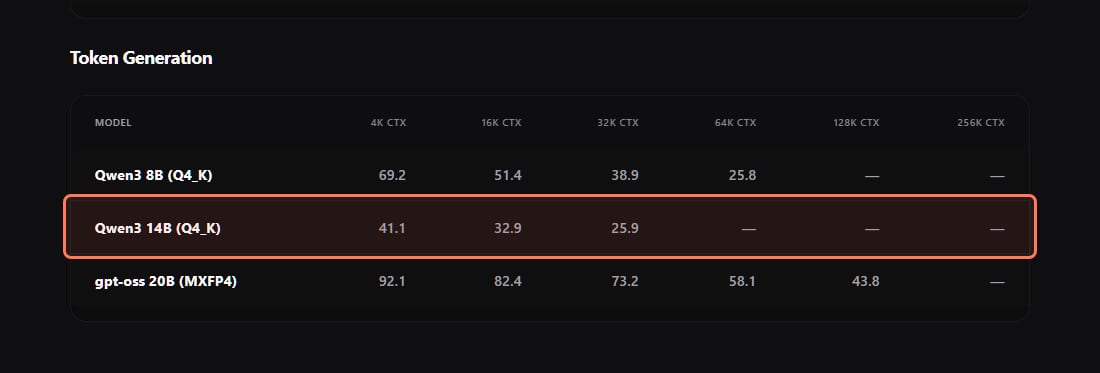
Hardware Corner measured the RTX 5060 Ti 16GB in llama.cpp (benchmarks updated March 2026). Token generation, in tokens per second:
Qwen3 8B (Q4_K)
4K context
69.2
16K
51.4
32K
38.9
Qwen3 14B (Q4_K)
4K context
41.1
16K
32.9
32K
25.9
gpt-oss 20B (MXFP4)
4K context
92.1
16K
82.4
32K
73.2
4K context
16K
32K
Qwen3 8B (Q4_K)
69.2
51.4
38.9
Qwen3 14B (Q4_K)
41.1
32.9
25.9
gpt-oss 20B (MXFP4)
92.1
82.4
73.2
They also ran gpt-oss-20b at 128K context at 43.8 tokens per second. Anything above about 20 tokens per second reads faster than most people do.
Hardware Corner's llama.cpp results for the RTX 5060 Ti 16GB (updated March 2026). The 14B row is outlined. · Screenshot: hardware-corner.net, read Nov 6, 2026
Nobody we could find publishes the same table for the 8GB card. Both cards use the same chip and the same 128-bit bus, so a model that fits in 8GB should run at about the same speed on either. The difference is which models fit, not how fast they run. We don't run our own benchmarks; this is the published data.
Is 8GB enough for gaming?
At 1080p medium, yes. Above that, you start paying for the missing memory. Tom's Hardware tested both cards across 21 games (updated Aug 16, 2025):
1080p medium
8GB card vs 16GB, all games
2.3% slower
Ray-traced games only
about the same
1080p ultra
8GB card vs 16GB, all games
11% slower
Ray-traced games only
26% slower
1440p ultra
8GB card vs 16GB, all games
18% slower
Ray-traced games only
39.6% slower
4K ultra
8GB card vs 16GB, all games
42% slower
Ray-traced games only
8GB card vs 16GB, all games
Ray-traced games only
1080p medium
2.3% slower
about the same
1080p ultra
11% slower
26% slower
1440p ultra
18% slower
39.6% slower
4K ultra
42% slower
In their words, "the 8GB model is still sufficient for delivering a good 1080p gaming experience at medium quality settings." The worst case was Indiana Jones and the Great Circle, which wouldn't run above 1080p medium on the 8GB card at all, while the 16GB card ran it up to 4K.
Is the 8GB card the better deal for anyone?
For a few buyers, yes. If one of these is you, the cheaper card is the right call:
You play esports or older games at 1080p and never run AI models. The 8GB card is enough, but at $499.99 it costs only $50 more than an RTX 5060 at $449.99 (Best Buy, Nov 6, 2026). Check whether the extra Ti performance is worth that to you.
Your budget stops at $500. The 16GB card isn't an option, and 8GB will still run 7B to 8B models with short prompts.
Your AI work happens in the cloud anyway. If you rent GPUs for bigger jobs, the card at home doesn't need the memory.
For everyone else, and for anyone who wants to try local AI, the 16GB card is the one that doesn't hit a wall. Memory can't be added later.
Should you rent before you buy?
If you aren't sure local AI will become a habit, renting answers the question for a few dollars. On Nov 6, 2026 (21:20 UTC), our price tracker showed an RTX 5060 Ti 16GB on Vast.ai from $0.11 an hour on demand, across 22 offers. At that rate the $270 gap pays for about 2,500 hours. A used RTX 3090 with 24GB rented from about $0.10 an hour on Vast at the same reading. Prices move every hour: see today's cloud GPU prices.
If you already know you want bigger models than 16GB holds, read our comparison of the RTX 5060 Ti 16GB and a used RTX 3090 before you buy either.
What this page doesn't tell you
Prices are one store on one day. We read Best Buy on Nov 6, 2026. Other stores and other days will differ, and holiday sales can move them a lot.
The gaming numbers are from 2025. Tom's Hardware ran them in August 2025; newer games usually need more memory, not less.
VRAM estimates are estimates. Our calculator is a planning tool; runtimes, drivers and settings change the real number by a few hundred megabytes.
No 8GB speed benchmarks. We found no published llama.cpp table for the 8GB card, so we don't claim a speed for it.
Quick answers
Is the RTX 5060 Ti 16GB worth it over the 8GB?
For local AI, yes: on Nov 6, 2026 it cost $270 more at Best Buy ($769.99 vs $499.99) and runs 14B models and gpt-oss-20b that 8GB can't load. For 1080p gaming at medium settings, the 8GB card performs about the same.
Are the 8GB and 16GB RTX 5060 Ti the same chip?
Yes. NVIDIA lists one RTX 5060 Ti with 4608 CUDA cores, a 128-bit memory bus and 180 W, offered with 16 GB or 8 GB of GDDR7.
What was the launch price of each?
$379 for the 8GB and $429 for the 16GB, per NVIDIA's announcement on April 15, 2025. Store prices have been well above that through 2026.
Can the 8GB RTX 5060 Ti run local AI at all?
Yes, small models. An 8B model at Q4 with about 8K of context fits in about 6.5 GB. Longer prompts or 12B to 14B models don't fit.
How much slower is the 8GB card in games?
In Tom's Hardware's 21-game test, 2.3% slower at 1080p medium, 11% at 1080p ultra, 18% at 1440p ultra and 42% at 4K ultra.
Is there a cheaper 16GB card?
Not at Best Buy on Nov 6, 2026: the in-stock Radeon RX 9060 XT 16GB listings were $794.99 and $805.99, and the $619.99 XFX model was sold out.
Verdict
16GB for local AI, 8GB only for 1080p gaming
Buy the 16GB RTX 5060 Ti if you want to run local AI at all: $270 extra (Best Buy, Nov 6, 2026) is the difference between 8B models with short prompts and 14B to 20B models with long ones, and it's cheaper per gigabyte. Buy the 8GB card only if you game at 1080p medium and never plan to run models, and compare it with the $50-cheaper RTX 5060 first.
Best for: 16GB: anyone running local models, 1440p gamers, ray tracing. 8GB: 1080p medium gamers on a hard $500 budget.