For most people in November 2026 it's an RTX 5060 Ti 16GB: it runs SDXL and FLUX.1-dev in ComfyUI for about $549. Below that a 12GB RTX 3060 still works, a used 24GB RTX 3090 holds all of Flux in memory, and the 32GB RTX 5090 is the fast, scarce top end. Prices and timings dated and sourced.
Some links on this page are referral links: we may earn a commission, at no cost to you.
Share
Buy an NVIDIA RTX 5060 Ti 16GB unless you have a reason not to. It's the cheapest new card with 16GB, it made a FLUX.1-dev image in about 37 seconds and an SDXL image in about 11 seconds in a ComfyUI test published Oct 20, 2026, and its average US market value was $549 when we read it on Nov 3, 2026. On a tighter budget, a used RTX 3060 12GB (about $230) still runs both, just slower. If you want all of Flux in memory, or you also run local LLMs, a used 24GB RTX 3090 (about $1,000) is the step up. The 32GB RTX 5090 is the fastest, but at about $3,699 on the market against its $1,999 list price, most people are better off renting one by the hour.
Which GPU should I buy for Stable Diffusion and Flux, by budget?
Prices are hardware-corner.net's average US market values, read Nov 3, 2026, next to NVIDIA's own list price where the card is current. Timings are 1024×1024, one image at a time, from Computingforgeeks' ComfyUI test (updated Oct 20, 2026): SDXL base at 30 steps, FLUX.1-dev fp8 at 20 steps. We didn't run these cards ourselves.
About $230
Card
RTX 3060 12GB (used)
VRAM
12GB
Market value (list)
$230
SDXL image
20.8 s
FLUX.1-dev image
63.9 s
Buy it if
You want to start cheap and can wait a minute per Flux image
About $550
Card
RTX 5060 Ti 16GB
VRAM
16GB
Market value (list)
$549 (from $379 for the 8GB model)
SDXL image
11.3 s
FLUX.1-dev image
37.0 s
Buy it if
Most people: SDXL, Flux, LoRAs, a new card with a warranty
About $900
Card
RTX 5070 Ti
VRAM
16GB
Market value (list)
$916 ($749)
SDXL image
about 6.1 s (third-party)
FLUX.1-dev image
not measured
Buy it if
SDXL speed matters more to you than fitting bigger models
About $1,000
Card
RTX 3090 (used)
VRAM
24GB
Market value (list)
$1,000
SDXL image
8.3 s
FLUX.1-dev image
23.2 s
Buy it if
You want all of Flux in VRAM, FLUX.2, video models or local LLMs too
About $3,700
Card
RTX 5090
VRAM
32GB
Market value (list)
$3,699 ($1,999)
SDXL image
4.8 s
FLUX.1-dev image
8.8 s
Buy it if
You generate all day and can find one near list price
Card
VRAM
Market value (list)
SDXL image
FLUX.1-dev image
Buy it if
About $230
RTX 3060 12GB (used)
12GB
$230
20.8 s
63.9 s
You want to start cheap and can wait a minute per Flux image
About $550
RTX 5060 Ti 16GB
16GB
$549 (from $379 for the 8GB model)
11.3 s
37.0 s
Most people: SDXL, Flux, LoRAs, a new card with a warranty
About $900
RTX 5070 Ti
16GB
$916 ($749)
about 6.1 s (third-party)
not measured
SDXL speed matters more to you than fitting bigger models
About $1,000
RTX 3090 (used)
24GB
$1,000
8.3 s
23.2 s
You want all of Flux in VRAM, FLUX.2, video models or local LLMs too
About $3,700
RTX 5090
32GB
$3,699 ($1,999)
4.8 s
8.8 s
You generate all day and can find one near list price
Two cards we'd skip: the RTX 5080 has the same 16GB as the 5070 Ti for about $1,400 on the market, and StorageReview measured it only 1.27x faster on SDXL (as reported by Computingforgeeks). The RTX 5070 has 12GB, less than the 5060 Ti 16GB, and its market value ($650) is higher. A used RTX 4090 (24GB, about $2,200) is fast, but it costs more than twice a 3090 for the same memory.
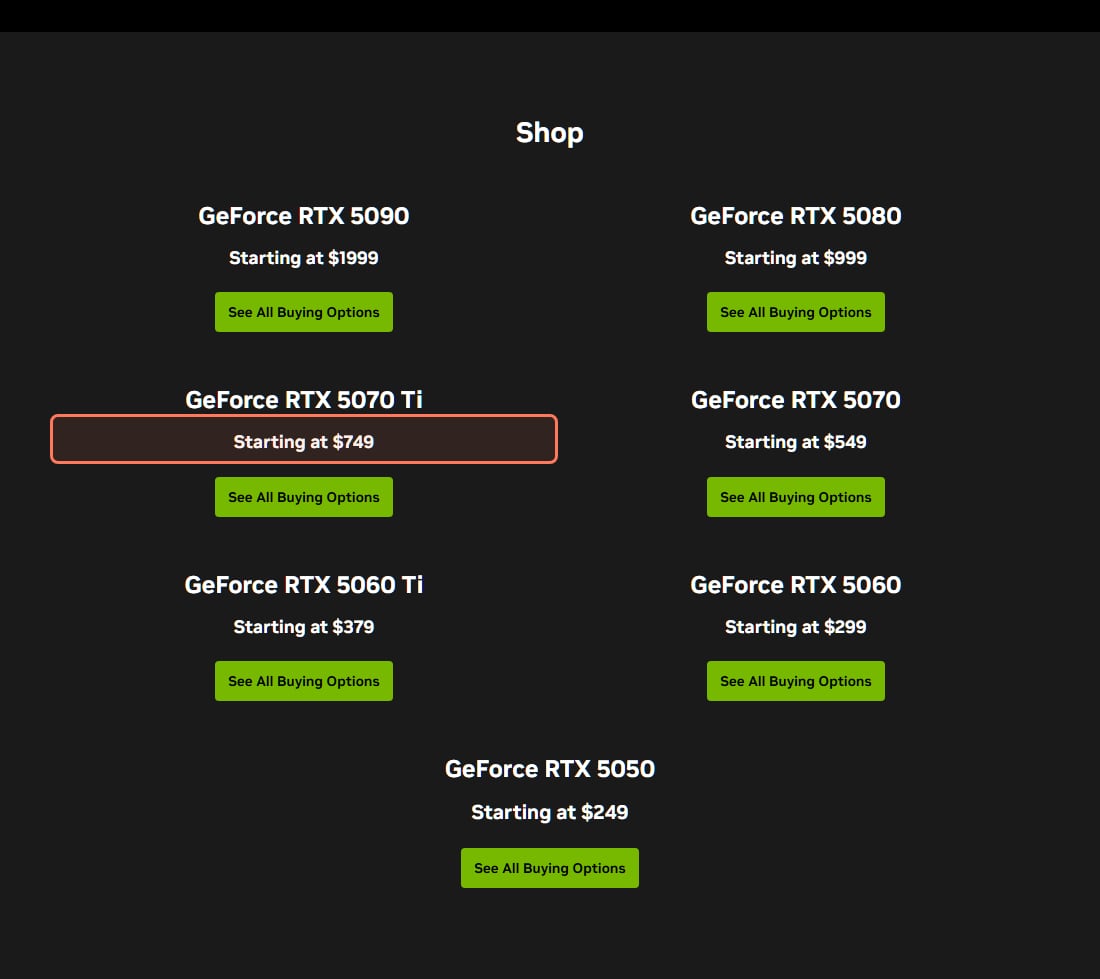
NVIDIA's own starting prices on Nov 3, 2026. The RTX 5060 Ti's $379 is the 8GB model; the 16GB version you want for image generation costs more, and store prices for most cards sit above these lists. · Screenshot: nvidia.com, GeForce RTX 50 Series page, read Nov 3, 2026
How much VRAM do Stable Diffusion and Flux need?
VRAM decides which models you can run comfortably and how big you can go; speed decides how long you wait. The model files show why the newer models need more:
SDXL base is a 6.94 GB file (Stability AI's model card). It runs well on 12GB.
FLUX.1-dev is a 12 billion parameter model and its full file is 23.8 GB (Black Forest Labs' model card). ComfyUI's fp8 version is, in ComfyUI's own words, "suitable for devices with limited VRAM", with slightly lower quality than the full model.
FLUX.2 [dev] is a 32 billion parameter model. Black Forest Labs suggests "a consumer type graphics card, like an RTX 4090 or an RTX 5090" for local use, with a 4-bit quantized model.
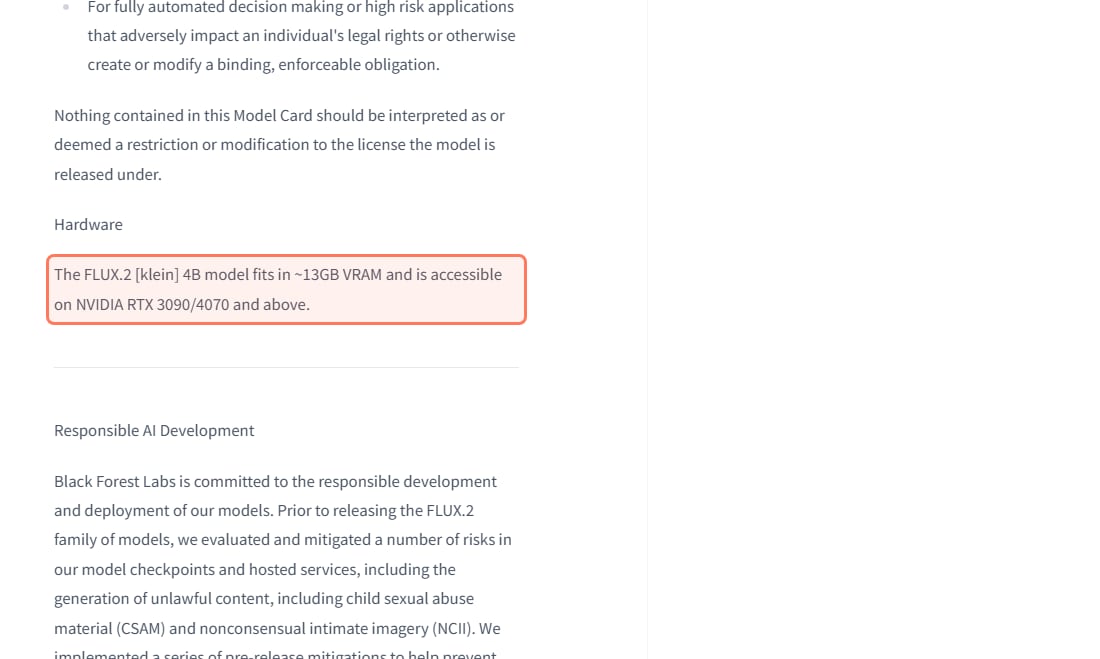
FLUX.2 [klein] 4B, the small FLUX.2, "fits in ~13GB VRAM" per its model card, and it's Apache 2.0, so the weights are open for commercial use.
A 12GB card no longer stops you from running Flux. In the Computingforgeeks test, FLUX.1-dev fp8 finished on both the 12GB and the 16GB card, because current ComfyUI streams the weights that don't fit into VRAM by itself; it peaked at 11,857 MiB on the 3060 and 15,749 MiB on the 5060 Ti. The 24GB and 32GB cards held the whole model. So less VRAM mostly costs you time, plus headroom for LoRAs, ControlNets, upscaling and video models. To check a specific model against a card, use our VRAM calculator, and our image-generation VRAM guide goes through it model by model.
The smallest FLUX.2 model needs about 13GB, per Black Forest Labs. That's one reason a 16GB card is the safer buy than 12GB in late 2026. · Screenshot: huggingface.co/black-forest-labs/FLUX.2-klein-4B, read Nov 3, 2026
Is the RTX 5060 Ti 16GB the best value for image generation?
For most buyers, yes. It's the cheapest current card with 16GB: NVIDIA lists the RTX 5060 Ti from $379 (that's the 8GB model), and the 16GB averaged $549 on the US market on Nov 3, 2026. In the Oct 20, 2026 test it made about 97 Flux images an hour, against about 56 on the RTX 3060 12GB.
Check that the box says 16GB: NVIDIA sells the 5060 Ti in both 16 GB and 8 GB versions, and we'd avoid the 8GB one for image generation. Our 8GB vs 16GB 5060 Ti page covers the price gap. Store prices also move a lot: Computingforgeeks saw a 16GB 5060 Ti listed at $765.99 on Amazon on Oct 20, 2026, so compare a few sellers before you pay well over the average. The same test notes that a renewed RTX 3090 Founders Edition was $1,899.99 on Amazon on Oct 20, 2026, so the about-$1,000 figure below is a used-market average, not a store price.
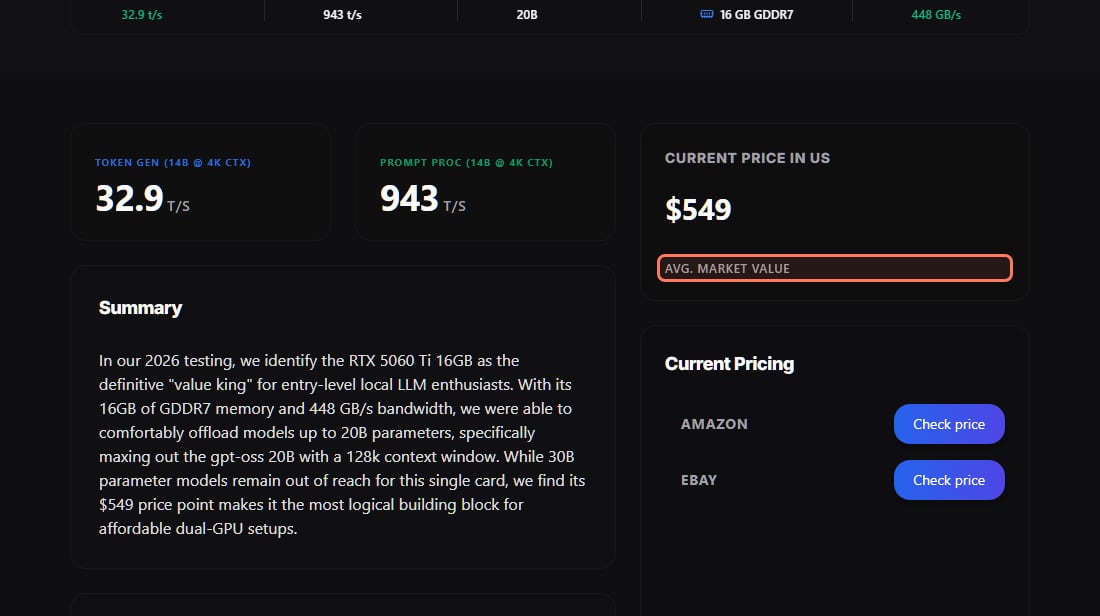
The RTX 5060 Ti 16GB's average US market value on Nov 3, 2026. hardware-corner.net tracks it for LLM use, but it's the same card for Stable Diffusion. · Screenshot: hardware-corner.net, RTX 5060 Ti 16GB page, read Nov 3, 2026
RTX 3090 or RTX 5070 Ti at around $1,000?
Both cost about the same on the market (about $1,000 used for the 3090, $916 for the 5070 Ti, read Nov 3, 2026), and they're good at different things:
Used RTX 3090 (24GB): holds all of FLUX.1-dev fp8 in memory, made a Flux image in 23.2 s in the Oct 20 test, and has room for FLUX.2, video models and 27–32B local LLMs. The catch: it's a used card with no new warranty that draws more power. Read our used RTX 3090 buying guide before you buy one.
RTX 5070 Ti (16GB): new, with a warranty, and faster on SDXL (about 6.1 s per image in Back2Gaming's test, as reported by Computingforgeeks). It has 8GB less memory, so big Flux models still stream from system RAM.
If you mainly make SDXL images, the 5070 Ti is the nicer card. If you want Flux, FLUX.2 or LLMs on the same machine, the 3090's 24GB matters more than its age.
Is the RTX 5090 worth it for Stable Diffusion?
Only if you generate a lot and can find one near its price. The 5090 is by far the fastest card here: 8.8 s per Flux image in the Oct 20 test (with the card capped at 450 W), about 407 images an hour, and Black Forest Labs names it, with the RTX 4090, as a consumer card for running FLUX.2 [dev] locally. But hardware-corner.net's average US market value was $3,699 on Nov 3, 2026, almost twice NVIDIA's $1,999 starting price. Our RTX 5090 page covers availability.
At that price, renting is the sensible first step. On Nov 3, 2026 at 15:20 UTC our tracker read an RTX 5090 at $1.19 an hour on-demand on Runpod and from $0.27 an hour as an interruptible spot rental on Vast.ai (median $0.56). $3,699 pays for about 3,100 hours of the Runpod rate.
Can I use an AMD, Intel or Mac GPU for Stable Diffusion?
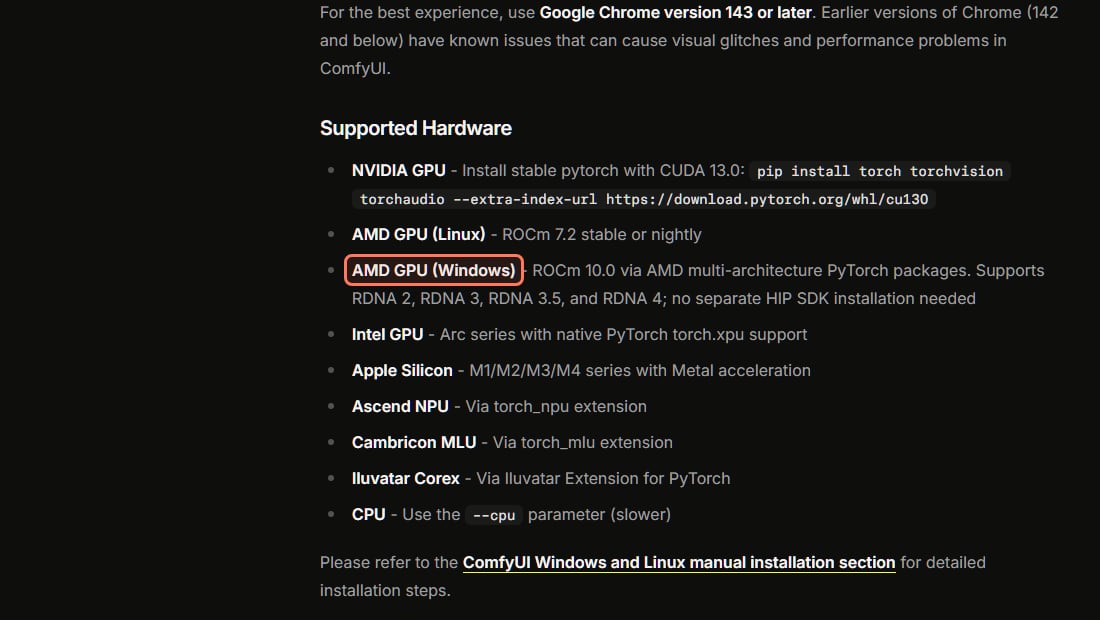
Yes, but NVIDIA is still the easy path. ComfyUI's system requirements (read Nov 3, 2026) list NVIDIA GPUs with CUDA 13.0 first, then AMD GPUs on Linux (ROCm 7.2) and on Windows ("Supports RDNA 2, RDNA 3, RDNA 3.5, and RDNA 4"), Intel Arc and Apple Silicon M1 to M4. Most guides, custom nodes and speed-ups are written and tested on NVIDIA first, so expect more setup work on the others. Our Stable Diffusion on AMD and Intel Arc guide covers what works today.
ComfyUI officially supports AMD on Windows and Linux, Intel Arc and Apple Silicon, not only NVIDIA. · Screenshot: docs.comfy.org, system requirements, read Nov 3, 2026
Should I rent a GPU instead of buying one?
If you generate a few hours a week, yes. On Nov 3, 2026 at 15:20 UTC our tracker read an RTX 4090 (24GB) at $0.89 an hour on-demand on Runpod and from $0.20 an hour as a spot rental on Vast.ai (median $0.40); a 16GB RTX 5060 Ti was from $0.07 an hour on Vast.ai. The $549 for a 5060 Ti 16GB pays for about 600 hours of a Runpod 4090. Rates change hourly, so check today's cloud GPU prices, and our ComfyUI cloud GPU guide shows how to set one up. If you'd use the card most evenings, buying wins; our rent vs buy page does the maths.
Do I need a GPU at all?
Not if you want finished images rather than your own setup. Hosted tools run the models on their servers and charge per image or in credits; Higgsfield's image page (read Nov 3, 2026) lists "Nano Banana Pro, GPT Image, FLUX, and more" in one workspace. You give up control over custom models, LoRAs and node workflows, which is the main reason to run Stable Diffusion locally. We compared two hosted models on one product photo in our AI product photo test.
What this guide doesn't tell you
We didn't test these cards. The timings come from Computingforgeeks' rented-host tests (Oct 20, 2026), plus figures they quote from Back2Gaming and StorageReview. Your speed will vary with settings, sampler, resolution and drivers.
Prices move every week. The market values are averages read on Nov 3, 2026; a good used deal or a sale can change the order.
Licences differ by model. FLUX.1 [dev] and FLUX.2 [dev] come with Black Forest Labs' non-commercial licences for the weights; the FLUX.2 [dev] card says generated outputs "can be used for personal, scientific, and commercial purposes, as described in the FLUX [dev] Non-Commercial License." FLUX.2 [klein] 4B is Apache 2.0. Read the licence before you build a product on a model.
Quick answers
What is the best GPU for Stable Diffusion in November 2026?
For most people the RTX 5060 Ti 16GB: about $549 on the US market (Nov 3, 2026), about 11 s per SDXL image and 37 s per FLUX.1-dev fp8 image in a ComfyUI test published Oct 20, 2026.
How much VRAM do I need for Flux?
FLUX.1-dev fp8 runs on 12GB and 16GB in current ComfyUI by streaming part of the model from system RAM; 24GB holds it entirely. FLUX.2 [klein] 4B needs about 13GB, and Black Forest Labs' own example runs FLUX.2 [dev] 4-bit on a 24GB RTX 4090.
Is 8GB of VRAM enough for Stable Diffusion?
It can run older SD 1.5 and some SDXL workflows, but we'd avoid buying an 8GB card for image generation in 2026. The 16GB RTX 5060 Ti costs a little more and has room for Flux.
Is a used RTX 3090 still worth it for Stable Diffusion?
Yes, if you want 24GB for about $1,000. It held all of FLUX.1-dev in VRAM and made an image in about 23 s, and it also runs 27–32B local LLMs. Buy it from a seller who lets you test it.
Is AMD good for Stable Diffusion?
It works: ComfyUI supports AMD GPUs on Linux and on Windows (RDNA 2 to RDNA 4). Expect more setup than on NVIDIA, which most tools and guides target first.
Should I buy an RTX 5090 for image generation?
Only if you generate all day and can find one near its $1,999 list price; the US market average was $3,699 on Nov 3, 2026. Renting one was $1.19 an hour on Runpod that day.
Verdict
Buy NVIDIA and buy VRAM first. About $230: a used RTX 3060 12GB. About $550: an RTX 5060 Ti 16GB, the pick for most people. About $1,000: a used RTX 3090 for 24GB, Flux in memory and LLMs, or an RTX 5070 Ti for faster SDXL on a new card. RTX 5090 only near list price. A few hours a week: rent instead.