Wan 2.2 is the open video model to run. It's Apache 2.0, its 5B version fits 8 GB with ComfyUI offloading and the 14B runs at 640x640 on a 24 GB card. MiniMax H3's weights are out, but its licence excludes the US. The GPU tier for each setup, and when renting a GPU beats an app.
Some links on this page are referral links: we may earn a commission, at no cost to you.
Share
The best open source AI video generator is Wan 2.2, because it's the open video model a US user can actually use, under Apache 2.0, and it runs on consumer GPUs: the 5B version from 8 GB with ComfyUI's offloading, the 14B at 640x640 on a 24 GB card. The other big open release, MiniMax H3, has a licence that excludes the United States, and Alibaba's newer Wan 3.0 has no open weights at all. Licences, VRAM figures and prices below come from the makers' pages, ComfyUI's and Runpod's docs, and our own GPU pages, read November 1 to 8, 2026.
What each GPU tier runs with Wan 2.2 (ComfyUI and Runpod docs, read Nov 1 to 3, 2026)
8 GB
What it runs
Wan 2.2 5B, with ComfyUI's native offloading
Example cards
8 GB cards and up
Source
ComfyUI's Wan 2.2 docs
24 GB
What it runs
Wan 2.2 14B at 640x640 with fp8 weights; Alibaba's 5B sample command
Example cards
RTX 3090, RTX 4090
Source
Runpod's Wan 2.2 guide; Alibaba's README
48 GB
What it runs
Wan 2.2 14B in fp16, or in fp8 at 720p
Example cards
RTX A6000, A40, L40S
Source
Runpod's Wan 2.2 guide
80 GB
What it runs
Wan 2.2 14B at 720p without offloading
Example cards
H100
Source
Runpod's Wan 2.2 guide
What it runs
Example cards
Source
8 GB
Wan 2.2 5B, with ComfyUI's native offloading
8 GB cards and up
ComfyUI's Wan 2.2 docs
24 GB
Wan 2.2 14B at 640x640 with fp8 weights; Alibaba's 5B sample command
RTX 3090, RTX 4090
Runpod's Wan 2.2 guide; Alibaba's README
48 GB
Wan 2.2 14B in fp16, or in fp8 at 720p
RTX A6000, A40, L40S
Runpod's Wan 2.2 guide
80 GB
Wan 2.2 14B at 720p without offloading
H100
Runpod's Wan 2.2 guide
The 24 GB tier is where most people should start: it covers the 14B models at a modest resolution and the 5B model with room to spare. Runpod's guide says its boundaries are derived from published figures rather than measured on each card, so treat them as starting points. For every hosted model compared job by job, see the best AI video generator guide.
Which open video models can you legally use in the US?
Open weights and an open licence aren't the same thing, and for video in late 2026 the licence decides it.
Open AI video models and their licences (checked Nov 3 to 8, 2026)
Wan 2.2 (Alibaba)
Weights
Yes, on Hugging Face and GitHub
Licence
Apache 2.0
US user can run it?
Yes
MiniMax H3
Weights
Yes, on Hugging Face
Licence
MiniMax H3 Community License
US user can run it?
No, the US is an Excluded Territory
Wan 3.0 / 3.0 Prime (Alibaba)
Weights
None published
Licence
Hosted only
US user can run it?
Only as a hosted service
Wan 2.6 (Alibaba)
Weights
None found
Licence
Hosted; Higgsfield labels it open-weight
US user can run it?
Only as a hosted service
Weights
Licence
US user can run it?
Wan 2.2 (Alibaba)
Yes, on Hugging Face and GitHub
Apache 2.0
Yes
MiniMax H3
Yes, on Hugging Face
MiniMax H3 Community License
No, the US is an Excluded Territory
Wan 3.0 / 3.0 Prime (Alibaba)
None published
Hosted only
Only as a hosted service
Wan 2.6 (Alibaba)
None found
Hosted; Higgsfield labels it open-weight
Only as a hosted service
Wan 2.2 is under Apache 2.0, a permissive licence that allows commercial use. Alibaba's Wan2.2 README lists the variants: T2V-A14B and I2V-A14B at 480P and 720P, TI2V-5B (text and image to video at 720P and 24 fps, 1280x704 or 704x1280, so vertical works), S2V-14B (speech to video) and Animate-14B.
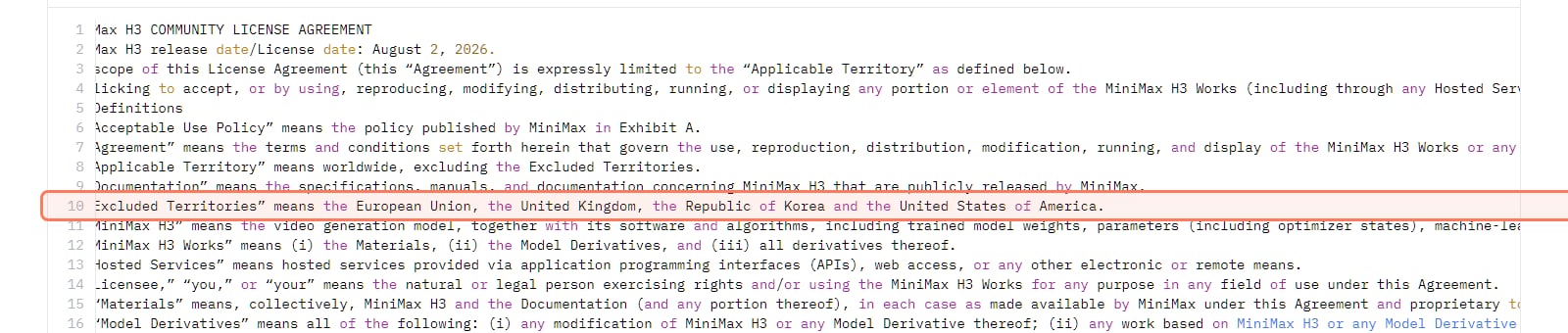
MiniMax H3 launched on July 31, 2026 as an open model with native stereo sound, up to 15 seconds at 2K, per MiniMax. But its licence file defines "Excluded Territories" as "the European Union, the United Kingdom, the Republic of Korea and the United States of America". Renting a GPU in another country doesn't change where you are. MiniMax says people in those places can contact it about a separate licence.
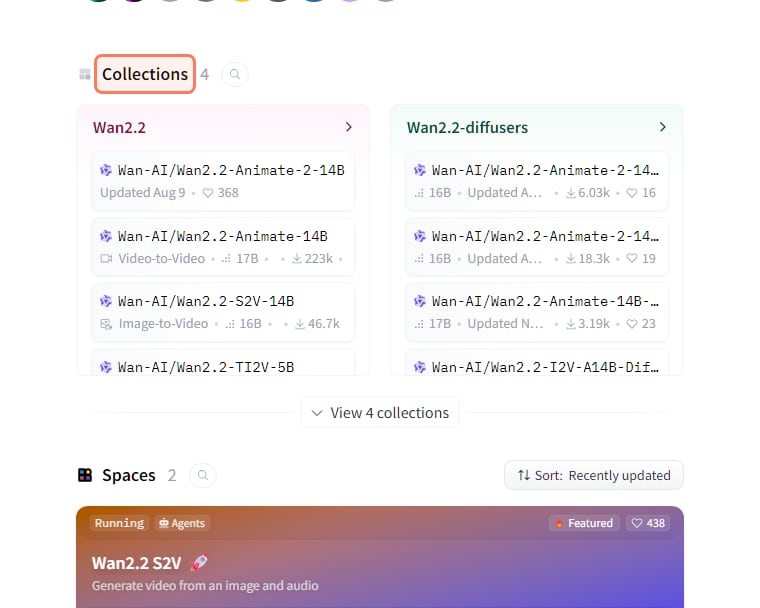
Wan 3.0 has no weights: Alibaba's Wan-AI page on Hugging Face lists Wan 2.1, 2.2 and Wan-Dancer, and the Wan-Video GitHub has no Wan 3.0 repo. You can only use it on Alibaba's app and API or on a platform such as Higgsfield (is Wan 3 free).
Alibaba's Wan-AI page on Hugging Face, read Nov 3, 2026: the newest open Wan models are Wan 2.2. · Screenshot of huggingface.co by aliteq
The MiniMax H3 licence file on Hugging Face, read Nov 3, 2026. Outline ours. · Screenshot of huggingface.co by aliteq
What GPU does Wan 2.2 need?
It depends on which Wan 2.2 and at what resolution, and the three sources you'll read measure different setups, so their numbers look contradictory until you see which setup each one means.
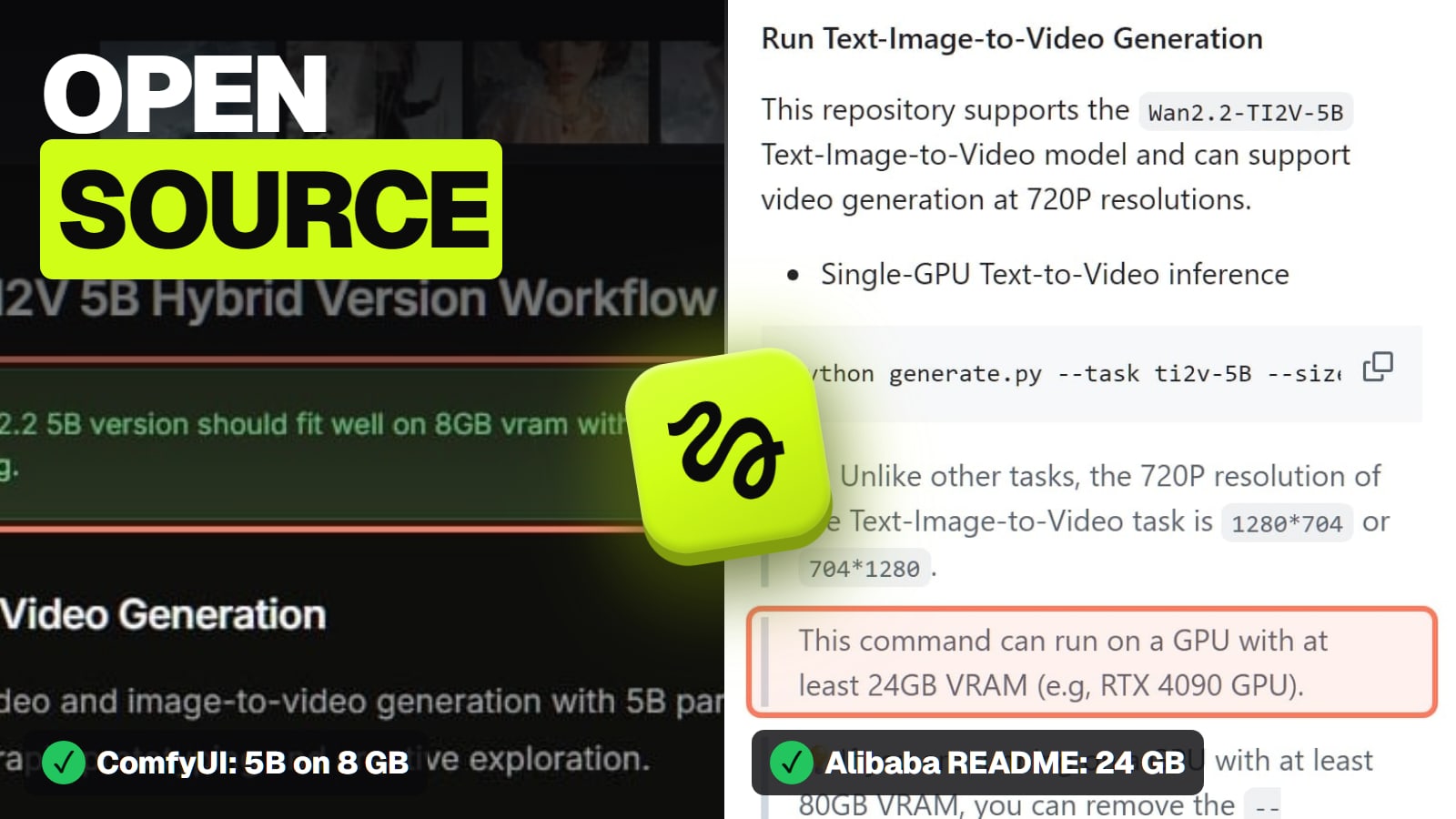
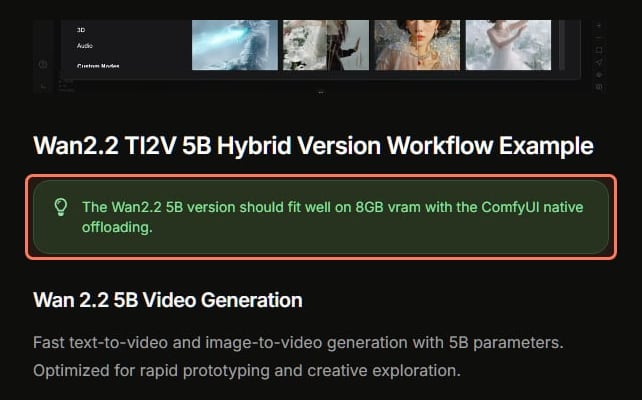
The 5B model is the one to learn on. ComfyUI's docs say it "should fit well on 8GB vram with the ComfyUI native offloading". Alibaba's own README asks for at least 24 GB for its plain sample command, for example an RTX 4090, and says that command makes a 5-second 720P clip in under nine minutes on one consumer GPU. Both are right: ComfyUI moves parts of the model to system memory, and Alibaba's script doesn't.
ComfyUI's Wan 2.2 docs, read Nov 1, 2026 (tip unchanged on Nov 3). · Screenshot of docs.comfy.org by aliteq
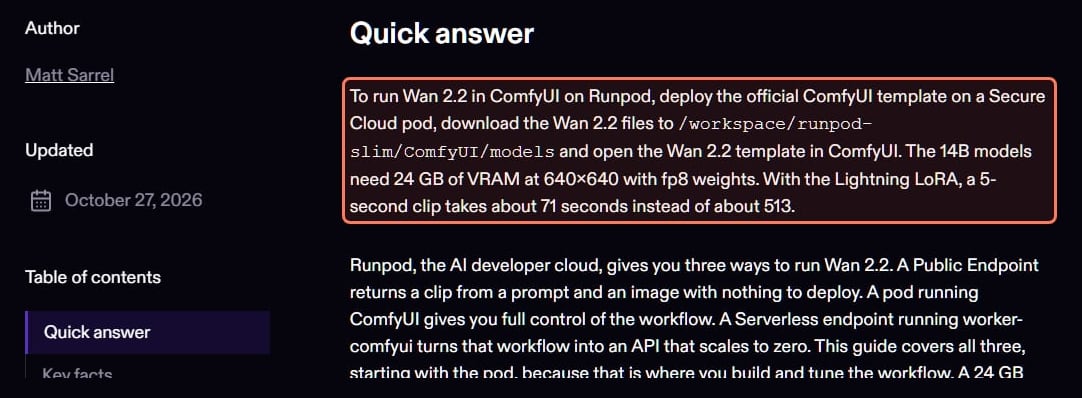
The 14B models are what people mean by Wan 2.2 quality. Runpod's guide says they need 24 GB at 640x640 with fp8 weights; fp16 weights need a 48 GB card, and 720p without offloading belongs on an 80 GB card. Alibaba's README says its 14B sample commands need at least 80 GB. Wan 2.2 14B is two experts rather than one network, so the guide also says to rent a machine with enough system RAM for the idle one.
Our cheapest cloud GPU for ComfyUI and Wan 2.2 page matches each tier to the cheapest card that fits, and there's no Wan entry in our VRAM calculator yet, so use these published tiers rather than a calculator figure.
What does one clip cost on a rented GPU vs an app?
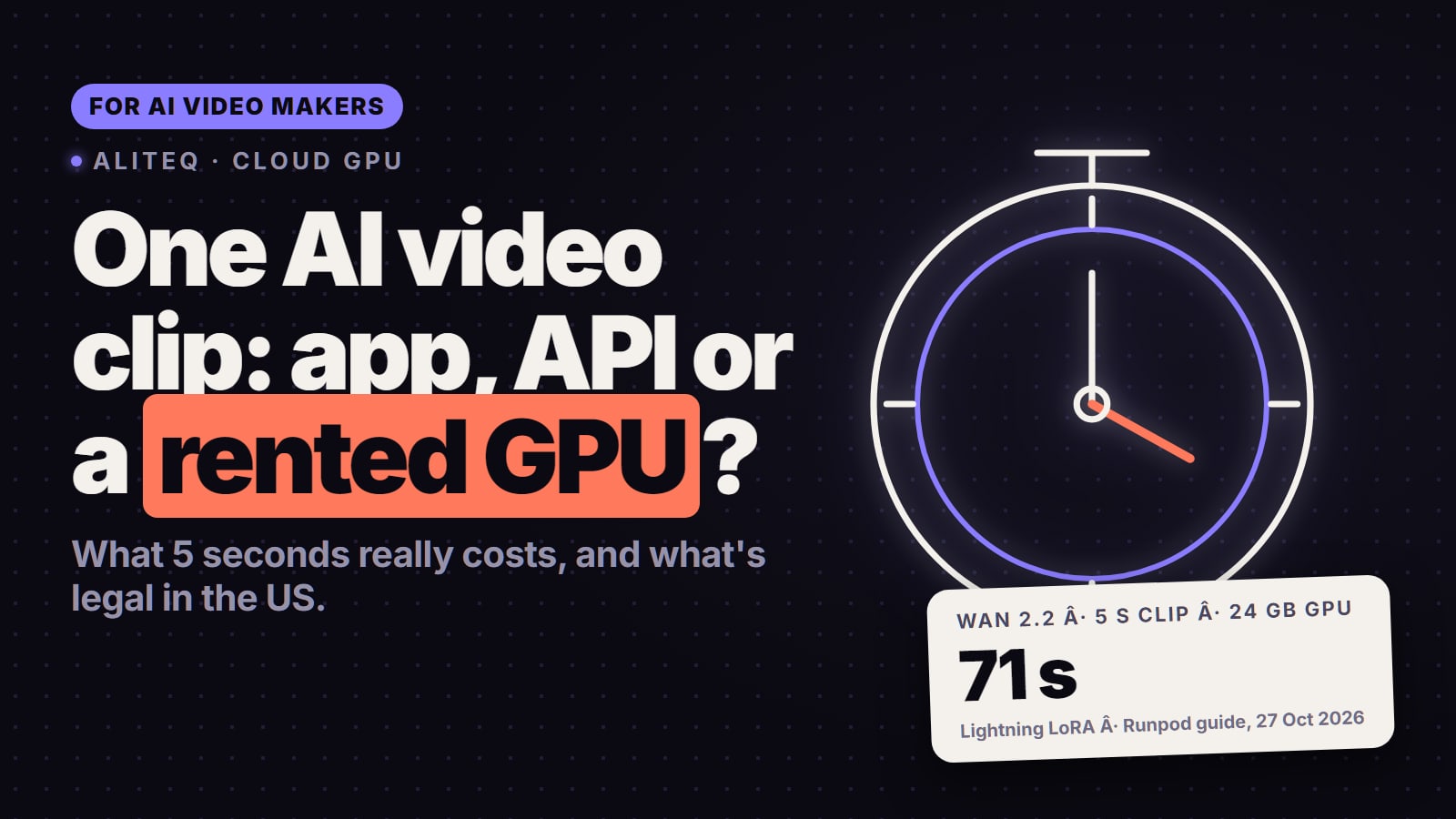
GPU time per clip is tiny; the bill around it isn't. Runpod's guide timed a 5-second Wan 2.2 14B clip at 640x640 on a 24 GB card at about 71 seconds with the 4-step Lightning LoRA and about 513 seconds at 20 steps, after the first run. Here's how that compared with paying per clip, from our app, API or rented GPU cost breakdown and Higgsfield's prices:
Runpod's Wan 2.2 guide (updated Oct 27, 2026), the source of the VRAM tiers and render times. · Screenshot of runpod.io by aliteq
One 5-second clip, open model on a rented GPU vs hosted (our arithmetic, Nov 1 to 3, 2026)
Wan 2.2 14B, Lightning LoRA, GPU time onlyabout $0.02
RTX 4090 at Runpod's Nov 1 Secure Cloud price
Wan 2.2 14B, 20 steps, GPU time onlyabout $0.13
Wan 2.2 rented, 100 clips a month, with setup and storageabout $0.12 per kept clip
Wan 2.2 rented, 20 clips a month, with setup and storageabout $0.43 per kept clip
Runpod Wan 2.2 image-to-video 720p endpoint$0.30
Per 5 s of output, per Runpod's guide (October 2026)
Wan 3.0 on Higgsfield, 720p, Ultra yearlyabout $0.30
9 credits (Nov 3)
Kling 3.0 on Higgsfield, 720p, Plus monthlyabout $0.37
7.5 credits, sound off
The rented-GPU rows assume each clip is rendered twice, half an hour of setup per session and 100 GB of models on a network volume, the inputs in our cost breakdown; change them and the totals move. Runpod also lists a different Wan 2.2 endpoint, "with LoRAs", at $0.35 per 5 seconds. GPU prices move every hour, so don't plan on these: today's rates for every card are in our live cloud GPU price table.
The pattern holds whatever the hourly rate: at about 20 clips a month, renting costs as much as an app or more; at 100, it costs a fraction. Storage and setup are fixed costs, so small batches carry them badly.
When an app beats running it yourself
Open source isn't the answer for everyone, and it's worth being honest about the trade:
Sound. Alibaba's README doesn't mention generated audio for Wan 2.2's text and image models; S2V-14B animates from a speech track you supply. Hosted Wan 3.0, Kling and Seedance make sound with the picture.
Resolution and length. Wan 2.2 tops out at 720P, and the README's example is a 5-second clip. Hosted Wan 3.0 goes to 1080p and 30 seconds per Alibaba.
Your time. The first session on a rented GPU goes to downloading tens of gigabytes of models and setting up a workflow. An app is a prompt box.
So: rent a GPU for Wan 2.2 if you make 50 or more clips a month, want full control of the workflow (LoRAs, your own fine-tunes) or need a licence you can read in full. Use a hosted model for a handful of clips, for sound, or for 1080p.
Where does Higgsfield fit?
Higgsfield is the no-GPU side of this choice. Its catalogue (Nov 8) hosts Alibaba's Wan 2.6, 2.7, 3.0 and 3.0 Prime, not Wan 2.2, alongside Kling, Seedance, Veo, MiniMax H3 and Grok Imagine. Wan 3.0 cost 9 credits for 5 seconds at 720p on November 3, about $0.30 on Ultra billed yearly ($99 a month for 3,000 credits) and about $0.44 on Plus monthly ($59 for 1,200), our arithmetic. Higgsfield also runs MiniMax H3 as a hosted service, which is a different thing from running its open weights. Prices change often, so check the price shown to you before paying. For the hosted models priced side by side, see Kling AI alternatives and the Kling hub.
The best AI video generator for other jobs
Each page below answers one job from the same checked facts. All of them, grouped by job, are in our best AI video generator guide.
Best free AI video generator: Google Flow's 50 daily credits are the biggest free allowance; Dreamina's 120 a day is the US runner-up.
Best image to video AI: Seedance 2.5 to put your photo's subject in a new scene; Kling 3.0 when the photo is already the first frame.
Best text to video AI: Kling 4.0: up to 30 seconds per prompt, multi-shot and stereo sound; Google Flow and Dreamina for free tries.
Best AI animation generator: Kling 3.0 animates your drawing from its first frame; Kling 3.0 Omni and 4.0 keep one character across scenes.
What we couldn't verify
Wan 2.2 render times on any specific card we rented. We haven't timed Wan 2.2 ourselves; the 71-second and 513-second figures are Runpod's, and the under-nine-minutes figure is Alibaba's.
MiniMax H3's VRAM needs. MiniMax publishes no VRAM figure, and for US readers the licence makes it moot.
Wan 2.6 weights. Higgsfield labels Wan 2.6 open-weight, but we found no Wan 2.6 weights on Alibaba's Hugging Face or GitHub pages.
Today's GPU prices. The dollar figures above use prices read Nov 1 to 3; the live table has today's.
Video quality of Wan 2.2 against hosted models. We haven't run Wan 2.2, so we make no claim about how its clips compare.
Verdict
Wan 2.2 on a 24 GB card
Wan 2.2 is the best open source AI video generator for US users: Apache 2.0, five variants, the 5B from 8 GB with ComfyUI's offloading and the 14B at 640x640 on a 24 GB card. Skip MiniMax H3's open weights if you're in the US, the EU, the UK or South Korea; its licence excludes you. Rent a GPU when you make 50 or more clips a month; below about 20, a hosted model such as Wan 3.0 or Kling 3.0 costs the same or less and comes with sound.
Best for: Creators and developers who want an AI video model they can run, fine-tune and keep, on their own GPU or a rented one
Frequently asked
What is the best open source AI video generator?
Wan 2.2 from Alibaba, released under Apache 2.0. It has text-to-video, image-to-video, a 5B text-and-image model, speech-to-video and an animation model, and it runs on consumer GPUs: the 5B from 8 GB with ComfyUI's offloading, the 14B at 640x640 on 24 GB.
How much VRAM do I need for Wan 2.2?
ComfyUI's docs say the 5B model fits on 8 GB with native offloading; Alibaba's README asks 24 GB for its 5B sample command. Runpod's guide says the 14B models need 24 GB at 640x640 with fp8 weights, 48 GB in fp16 or at 720p, and 80 GB for 720p without offloading.
Can I use MiniMax H3 open weights in the US?
Not under its open licence. The MiniMax H3 Community License lists the United States, the EU, the UK and South Korea as Excluded Territories, and renting a GPU abroad doesn't change where you are. MiniMax says people there can ask it about a separate licence.
Is Wan 3.0 open source?
No. Alibaba hasn't published Wan 3.0 weights: its Hugging Face page lists Wan 2.1, 2.2 and Wan-Dancer, and there's no Wan 3.0 repo on GitHub. Wan 3.0 runs only as a hosted model, for example on create.wan.video, Alibaba's API or Higgsfield.
Is it cheaper to run an open video model on a rented GPU?
Only at volume. A 5-second Wan 2.2 clip is a few cents of GPU time, but with setup and model storage our breakdown came to about $0.43 a kept clip at 20 clips a month and about $0.12 at 100, against about $0.25 to $0.53 for a Kling 3.0 clip on Higgsfield.
Does Wan 2.2 make sound?
Not in its text-to-video and image-to-video models, per Alibaba's README. Its S2V-14B model animates a picture from a speech track you provide. Hosted models such as Wan 3.0, Kling and Seedance generate sound with the video.
If you're unsure whether you'll make enough clips to justify a GPU, price a month of clips on a hosted model first; if the number keeps growing, that's the signal to rent.