No graphics card comes close. DeepSeek V4.1 Flash is a 763-billion-parameter download that needs a 4x H200 or 8x H100 server, a 512GB Mac Studio, or Unsloth's 1-bit build on 128GB+ of RAM. What each route costs, what Ollama offers, how it differs from V4 Flash, and when DeepSeek's API is cheaper, checked Nov 7, 2026.
Some links on this page are referral links: we may earn a commission, at no cost to you.
Share
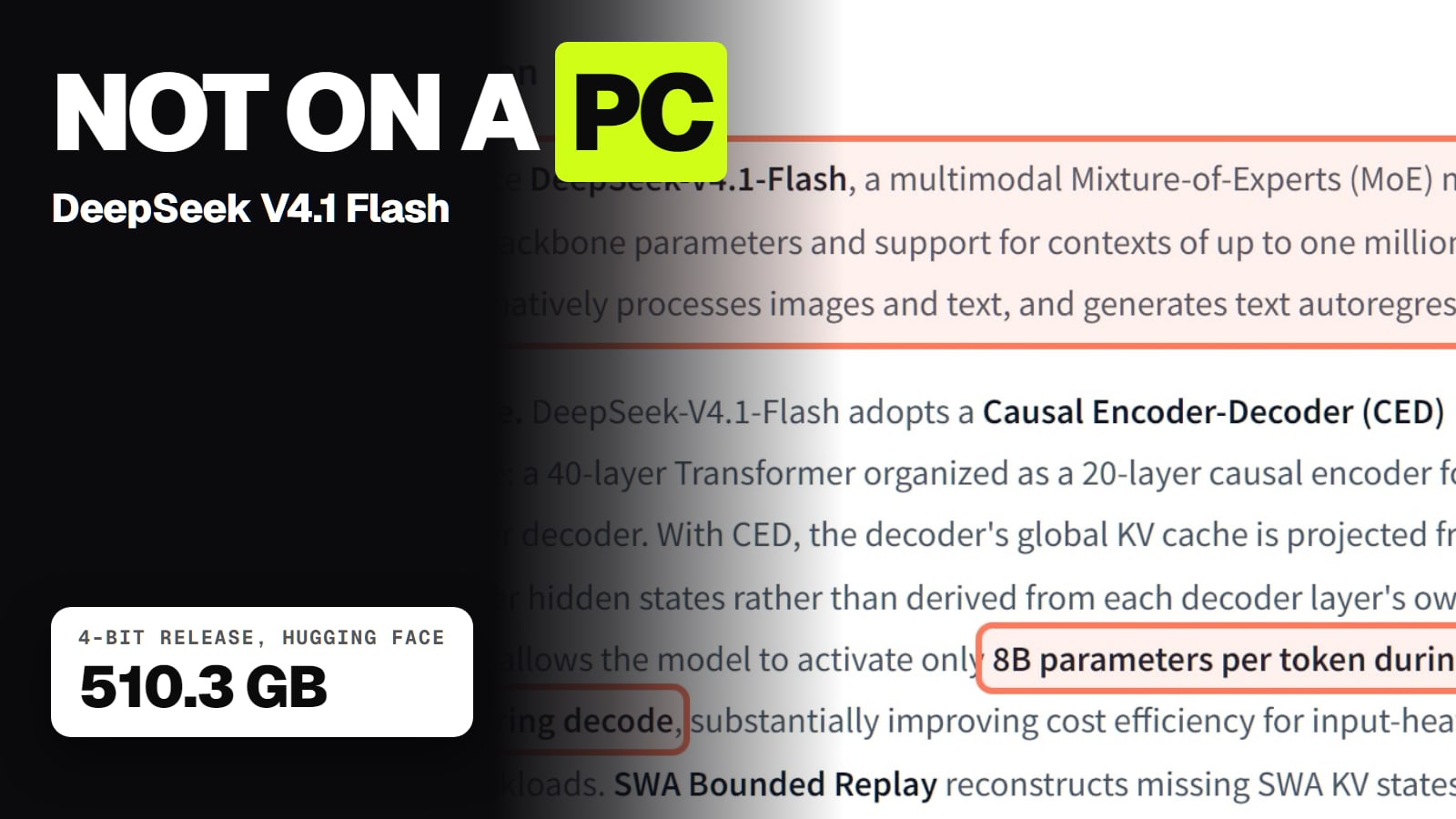
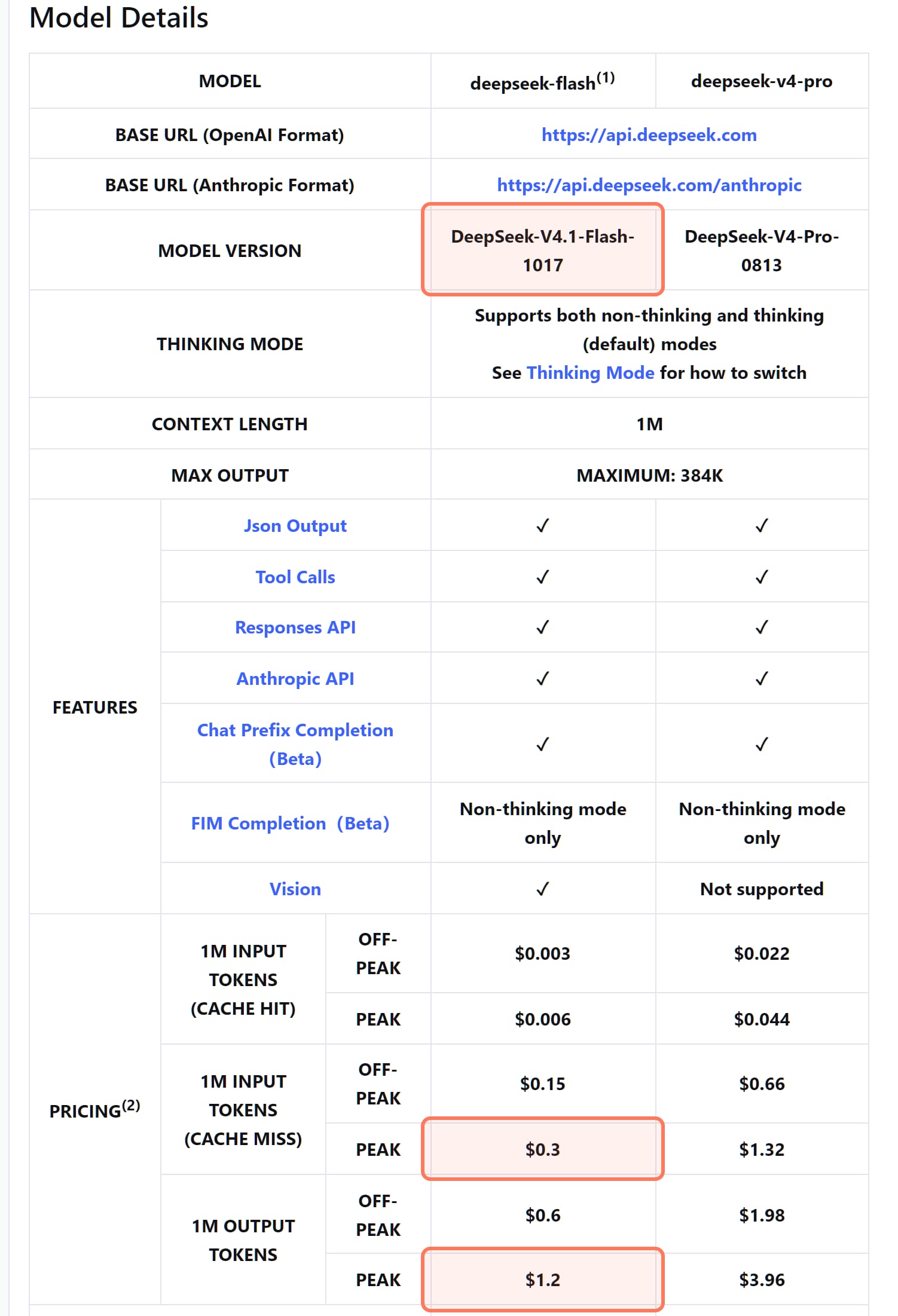
Can you run DeepSeek V4.1 Flash locally? Not on a normal PC, and not on any single graphics card. Hugging Face counts 763 billion parameters in DeepSeek's release: a 552B backbone, a 196B Engram memory table and smaller parts such as the vision encoder. DeepSeek ships it already in 4-bit (4-bit experts, 8-bit for the rest), and that release needs about 476 GB of memory by our VRAM engine. That takes a server with four H200s or eight H100s, or, with little to spare, a Mac Studio with 512GB of unified memory. Unsloth's 1-bit build gets by on 128GB-plus of RAM by leaving the Engram table on an SSD, at a real cost in accuracy. For most people, DeepSeek's own API is far cheaper: $0.30 per million input tokens and $1.20 per million output tokens at peak, half that off-peak. Every figure below was read on its source page on Nov 7, 2026.
What is DeepSeek V4.1 Flash?
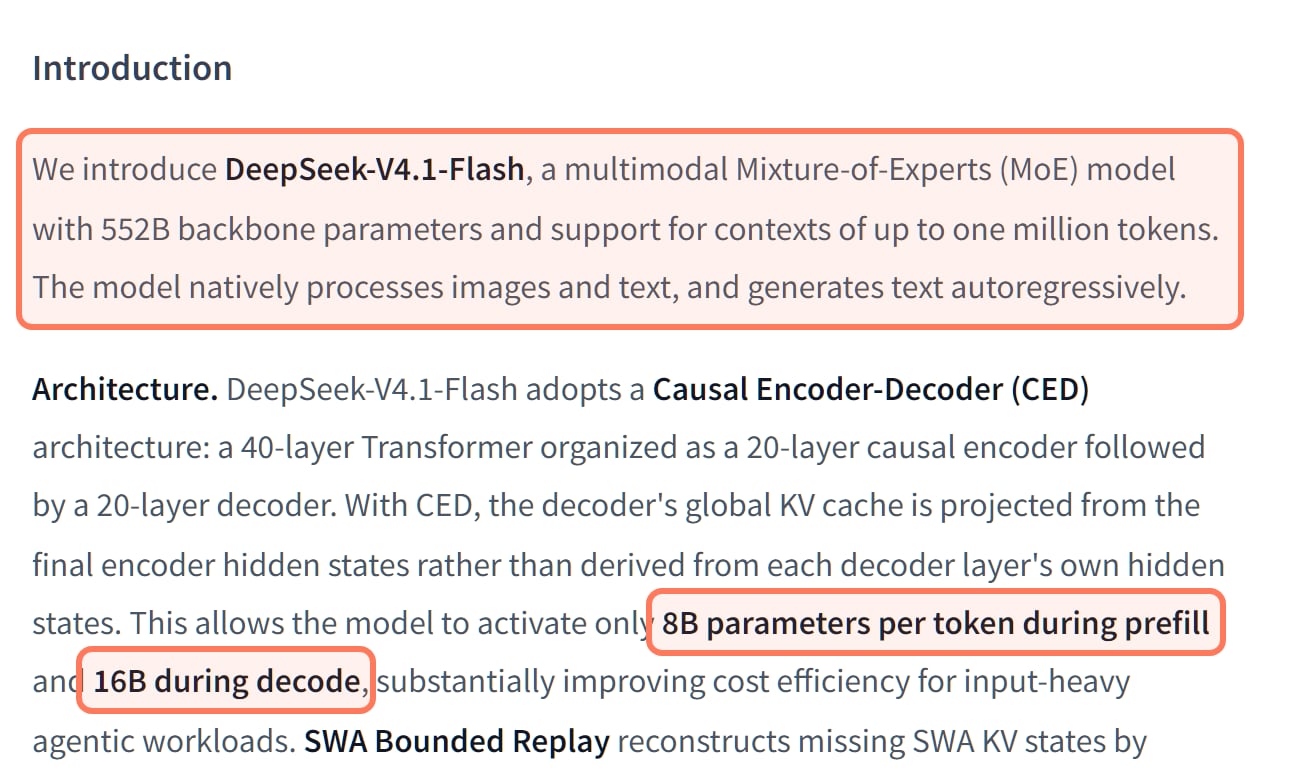
It's DeepSeek's open-weight model for text and images: a mixture-of-experts design that went up on Hugging Face on Sep 10, 2026 under the MIT licence. DeepSeek's card calls it "a multimodal Mixture-of-Experts (MoE) model with 552B backbone parameters and support for contexts of up to one million tokens", and says it activates "8B parameters per token during prefill and 16B during decode". In plain terms, it reads your prompt with 8B parameters and writes each new token with 16B.
On top of the backbone sits what DeepSeek calls Engram conditional memory, 196B parameters of lookup tables. Per Unsloth's guide, the model reads "a few table rows per token" from it, "so the table need not stay in GPU memory". Hugging Face's count for the whole repository is 763,205,315,794 parameters, and that total is what our engine sizes.
Experts: each MoE layer has 384 routed experts and 1 shared expert, and 6 routed experts fire per token, per the card. Only 16B parameters do the math for each token, but all the experts have to be loaded, because each token can pick different ones. Memory, not compute, is the wall. Our MoE explainer walks through why.
Layers: a 40-layer causal encoder-decoder, 20 layers each.
As shipped: FP8 weights with 4-bit (FP4) experts, per the repo's config.json. The 48 weight files total 510.3 GB.
The 1017 update: DeepSeek posted DeepSeek-V4.1-Flash-1017 on Oct 17, 2026, a "minor update" per its card, with the same 763,205,315,794-parameter count, so every memory figure here covers both. DeepSeek's API and Unsloth's GGUF files now use 1017.
Usage: OpenRouter's public leaderboard for the 30 days through Nov 6, 2026 ranks DeepSeek V4.1 Flash 1017 first by tokens processed (128T) and the original V4.1 Flash second (101T).
DeepSeek's own V4.1 Flash card, huggingface.co/deepseek-ai/DeepSeek-V4.1-Flash, read Nov 7, 2026. · Screenshot of huggingface.co by aliteq
DeepSeek V4.1 Flash vs V4 Flash, from the official pages (read Nov 7, 2026)
On Hugging Face since
DeepSeek V4.1 Flash
Sep 10, 2026 (1017 update Oct 17)
DeepSeek V4 Flash
Apr 22, 2026, as a preview (update Jul 31)
Parameters (DeepSeek's card)
DeepSeek V4.1 Flash
552B backbone + 196B Engram memory
DeepSeek V4 Flash
284B
Parameters (Hugging Face count)
DeepSeek V4.1 Flash
763B
DeepSeek V4 Flash
291B
Active per token
DeepSeek V4.1 Flash
8B reading the prompt, 16B writing
DeepSeek V4 Flash
13B
Context
DeepSeek V4.1 Flash
1M tokens
DeepSeek V4 Flash
1M tokens
Input
DeepSeek V4.1 Flash
Text and images
DeepSeek V4 Flash
Text
Licence
DeepSeek V4.1 Flash
MIT
DeepSeek V4 Flash
MIT
Official weights
DeepSeek V4.1 Flash
510.3 GB
DeepSeek V4 Flash
159.6 GB
Global KV cache
DeepSeek V4.1 Flash
890 bytes per token
DeepSeek V4 Flash
About 4x V4.1's (per DeepSeek)
Unsloth GGUF, 1-bit to 8-bit
DeepSeek V4.1 Flash
233.0 to 508.4 GB
DeepSeek V4 Flash
82.5 to 161.9 GB
Ollama
DeepSeek V4.1 Flash
Cloud only (:cloud, :1017-cloud)
DeepSeek V4 Flash
Retired Sep 25, 2026
DeepSeek API
DeepSeek V4.1 Flash
deepseek-flash, served by V4.1-Flash-1017
DeepSeek V4 Flash
Retired; the old name is served by V4.1-Flash-1017
DeepSeek V4.1 Flash
DeepSeek V4 Flash
On Hugging Face since
Sep 10, 2026 (1017 update Oct 17)
Apr 22, 2026, as a preview (update Jul 31)
Parameters (DeepSeek's card)
552B backbone + 196B Engram memory
284B
Parameters (Hugging Face count)
763B
291B
Active per token
8B reading the prompt, 16B writing
13B
Context
1M tokens
1M tokens
Input
Text and images
Text
Licence
MIT
MIT
Official weights
510.3 GB
159.6 GB
Global KV cache
890 bytes per token
About 4x V4.1's (per DeepSeek)
Unsloth GGUF, 1-bit to 8-bit
233.0 to 508.4 GB
82.5 to 161.9 GB
Ollama
Cloud only (:cloud, :1017-cloud)
Retired Sep 25, 2026
DeepSeek API
deepseek-flash, served by V4.1-Flash-1017
Retired; the old name is served by V4.1-Flash-1017
What about DeepSeek V4 Flash?
It has been replaced, but it is the easier of the two to run at home. DeepSeek's card lists "DeepSeek-V4-Flash with 284B parameters (13B activated)", a 1M-token context and the MIT licence. It first went up on Hugging Face on Apr 22, 2026 as a preview, with an update on Jul 31. Ollama retired deepseek-v4-flash on September 25, 2026, and DeepSeek's API now answers requests for the old deepseek-v4-flash name with V4.1-Flash-1017, "billed at the Flash price". On DeepSeek's own V4.1 table, V4.1 Flash scores 74.2 on DeepSWE v1.1 against 54.4 for V4 Flash.
Size is the reason to still look at it. V4 Flash's official weights are 159.6 GB against 510.3 GB for V4.1 Flash, about a third. Unsloth's GGUF builds run from 82.5 GB (1-bit UD-IQ1_S) to 161.9 GB (8-bit), with the 4-bit UD-Q4_K_XL at 155.1 GB. By file size alone, a 256GB Mac Studio holds the 4-bit copy and a 128GB machine holds the 1-bit one. Our VRAM engine has no V4 Flash entry, so those are Unsloth's file sizes, not our estimates.
How much memory does DeepSeek V4.1 Flash need?
About 476 GB to hold a 4-bit copy in fast memory, by our VRAM engine. DeepSeek's own checkpoint is already 4-bit: its 510.3 GB of files are 475.3 GB of weights in the binary gigabytes memory is sold in, plus a KV cache that rounds to 0.0 GB at 8K context and about 0.8 GB of overhead. A standard 4-bit GGUF is no smaller. Unsloth's 4-bit UD-Q4_K_XL is a 500.7 GB download, and like DeepSeek's checkpoint it keeps the 4-bit experts as they are and stores more of everything else at 8-bit. (Our engine first sized this page at 432 GB, for a generic Q4_K_M copy. Since Nov 7 it sizes models that ship in 4-bit by their own release, because a re-quantised 4-bit copy saves almost nothing.) In Unsloth's words, "Q4 stores many non-expert weights in Q8_0". That's also why Unsloth's 4-bit and 8-bit builds are almost the same size (500.7 GB and 508.4 GB).
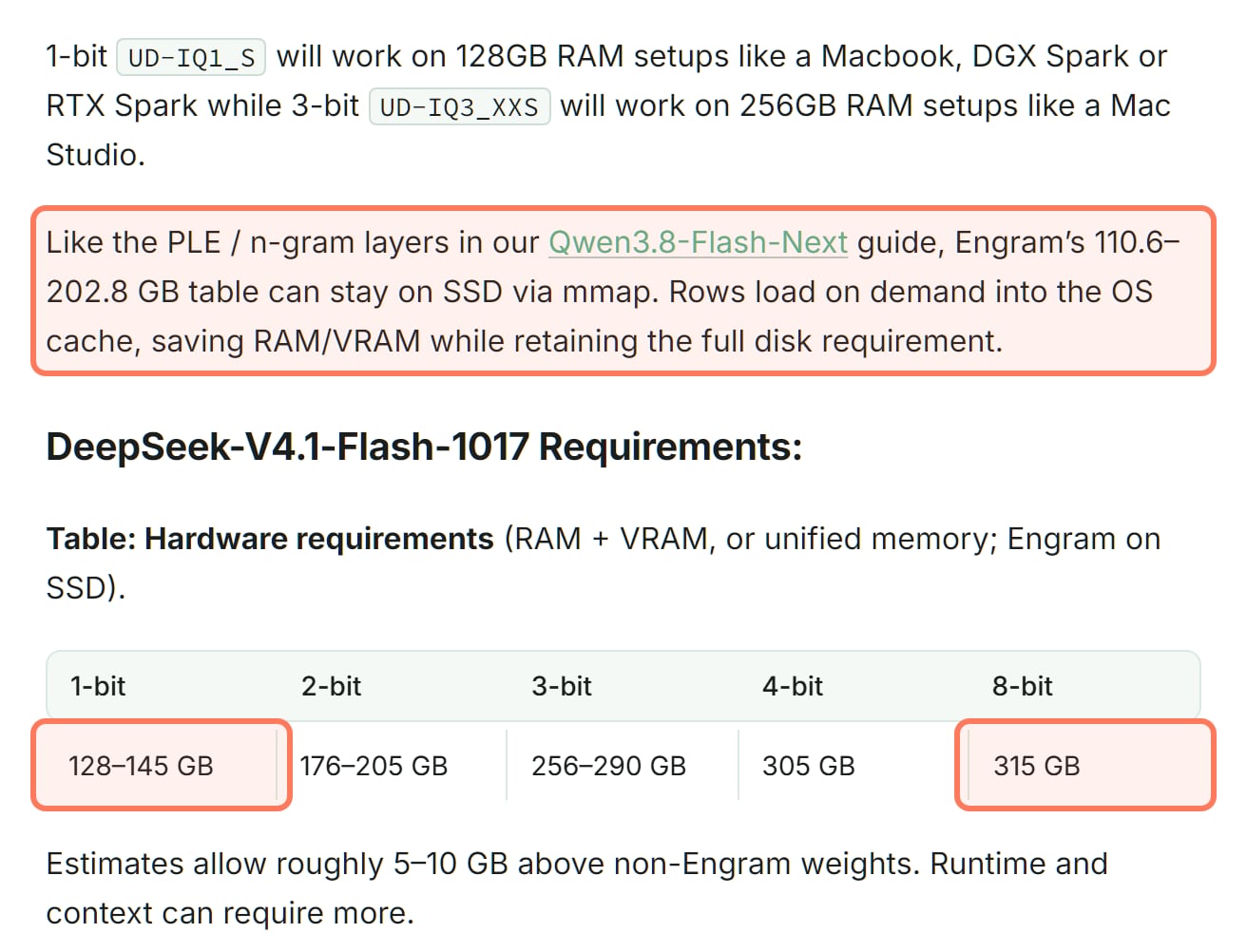
The exception is Unsloth's llama.cpp build, which reads the Engram table from the SSD on demand. Unsloth says "Engram's 110.6–202.8 GB table can stay on SSD via mmap", and on that basis lists 128 to 145 GB of RAM plus VRAM for its 1-bit builds and 305 GB for 4-bit. The whole file still has to sit on the drive.
How to read it: "Minimum RAM + VRAM" is Unsloth's "absolutely minimum amount of RAM/VRAM", and Unsloth's own summary adds 5 to 10 GB on top. The last column is Unsloth's top-1 agreement with DeepSeek's original on its wiki1100 test, meaning how often the quantized model picks the same next token. The lower it is, the more often the output drifts from what the original model would write. Our quantization explainer covers the trade-off.
Unsloth's memory table for V4.1 Flash 1017 with the Engram table on SSD, unsloth.ai/docs/models/deepseek-v4.1-flash, read Nov 7, 2026. · Screenshot of unsloth.ai by aliteq
Change the quant or the context on our V4.1 Flash cost page. The best-GPU ranking finds no single card we price that fits a 4-bit copy, and the VRAM guide explains the math behind both.
What hardware can actually run DeepSeek V4.1 Flash?
Three kinds of machine, and none of them is a normal PC: a multi-GPU server, a 512GB Mac Studio, or a workstation with lots of RAM running Unsloth's low-bit builds. Treat V4.1 Flash as a server model that happens to publish its weights.
A multi-GPU server, rented or owned
A 4-bit copy held entirely in GPU memory needs about 430 to 510 GB of VRAM spread across the cards. Four H200s (141 GB each, 564 GB in total), four B200s (192 GB each, 768 GB) or eight H100s (80 GB each, 640 GB) clear that on paper. The vendors' own setups are server-sized too. DeepSeek's reference code converts the weights for eight GPUs in its example (MP=8). NVIDIA tested its own 4-bit NVFP4 build, a 429.0 GB download, on four GB300 GPUs, and its SGLang setup keeps the Engram tables in host memory, "about 97 GiB per node".
Renting a V4.1 Flash server: per-card prices from our tracker (Nov 7, 2026, 12:20 UTC)
H200 SXM
Memory per card
141 GB
Cards for a 4-bit copy
4
Cheapest spot per card (Vast.ai)
$1.32/hr
On-demand per card (Runpod)
$5.29/hr
Whole server, Runpod on-demand
$21.16/hr
B200
Memory per card
192 GB
Cards for a 4-bit copy
4
Cheapest spot per card (Vast.ai)
$3.13/hr
On-demand per card (Runpod)
$7.99/hr
Whole server, Runpod on-demand
$31.96/hr
H100 SXM
Memory per card
80 GB
Cards for a 4-bit copy
8
Cheapest spot per card (Vast.ai)
$0.65/hr
On-demand per card (Runpod)
$3.99/hr
Whole server, Runpod on-demand
$31.92/hr
Memory per card
Cards for a 4-bit copy
Cheapest spot per card (Vast.ai)
On-demand per card (Runpod)
Whole server, Runpod on-demand
H200 SXM
141 GB
4
$1.32/hr
$5.29/hr
$21.16/hr
B200
192 GB
4
$3.13/hr
$7.99/hr
$31.96/hr
H100 SXM
80 GB
8
$0.65/hr
$3.99/hr
$31.92/hr
These are single-card prices multiplied out. Our tracker records single-card offers, so treat the totals as a floor: a 4- or 8-card machine is its own listing, and spot capacity can be reclaimed mid-job. Renting the Runpod H200 server 8 hours a day for 30 days costs about $5,080 at that rate. Live prices are on our cloud GPU page, and the Vast.ai review and Runpod review cover the fees that aren't in the hourly rate.
A Mac Studio with 512GB of unified memory
A 512GB Mac Studio is a single box that holds a 4-bit copy, just. Apple's spec page lists the M5 Ultra Mac Studio with 256GB or 512GB of unified memory (both need the 36-core CPU and 80-core GPU version) and 1.2TB/s of memory bandwidth. By our engine, DeepSeek's 4-bit release takes about 476 GB, 93% of 512GB: it fits, with little left for macOS and your apps. Unsloth's 4-bit build needs about 305 GB with the Engram table left on the SSD. Mind the drive: the M5 Ultra comes with a 1TB SSD as standard (configurable up to 16TB), and Unsloth's 4-bit files alone are 500.7 GB.
The 256GB model is borderline. Unsloth says its 3-bit UD-IQ3_XXS "will work on 256GB RAM setups like a Mac Studio", which is the bottom of its own 256 to 290 GB range for 3-bit. We haven't run V4.1 Flash on a Mac and don't publish a speed estimate for it. Our Mac buying guide covers the memory tiers, and this comparison sets the M5 Ultra against NVIDIA's workstation cards.
A workstation with lots of RAM, at 1-bit to 3-bit
Unsloth's llama.cpp build splits the model between system RAM and the GPU and reads the Engram table from the SSD on demand. Its table puts the 1-bit UD-IQ1_S at a minimum of 122.4 GB of RAM plus VRAM (128 to 145 GB with headroom), so 128GB of system RAM plus a 24GB card clears it on paper. Unsloth says it also runs on 64GB of RAM, more slowly.
The catch is quality: on Unsloth's own test, the 1-bit build picks the same next token as the original 82.8% of the time, against 98.2% for its 4-bit build. You also need the full 233.0 GB file on a fast SSD. Unsloth's guide builds llama.cpp from a pull request (#30817) or uses its Unsloth Desktop app. Mainline llama.cpp merged its own V4.1 Flash support on Oct 25, 2026 (pull request #31086). Our --n-cpu-moe explainer shows how the RAM and GPU split works.
One gaming GPU
No. A 24GB RTX 4090 or a 32GB RTX 5090 holds well under a tenth of a 4-bit copy (about 476 GB). Our best-GPU ranking finds no single card we price that fits. The last section lists what to run instead.
Does Ollama have DeepSeek V4.1 Flash?
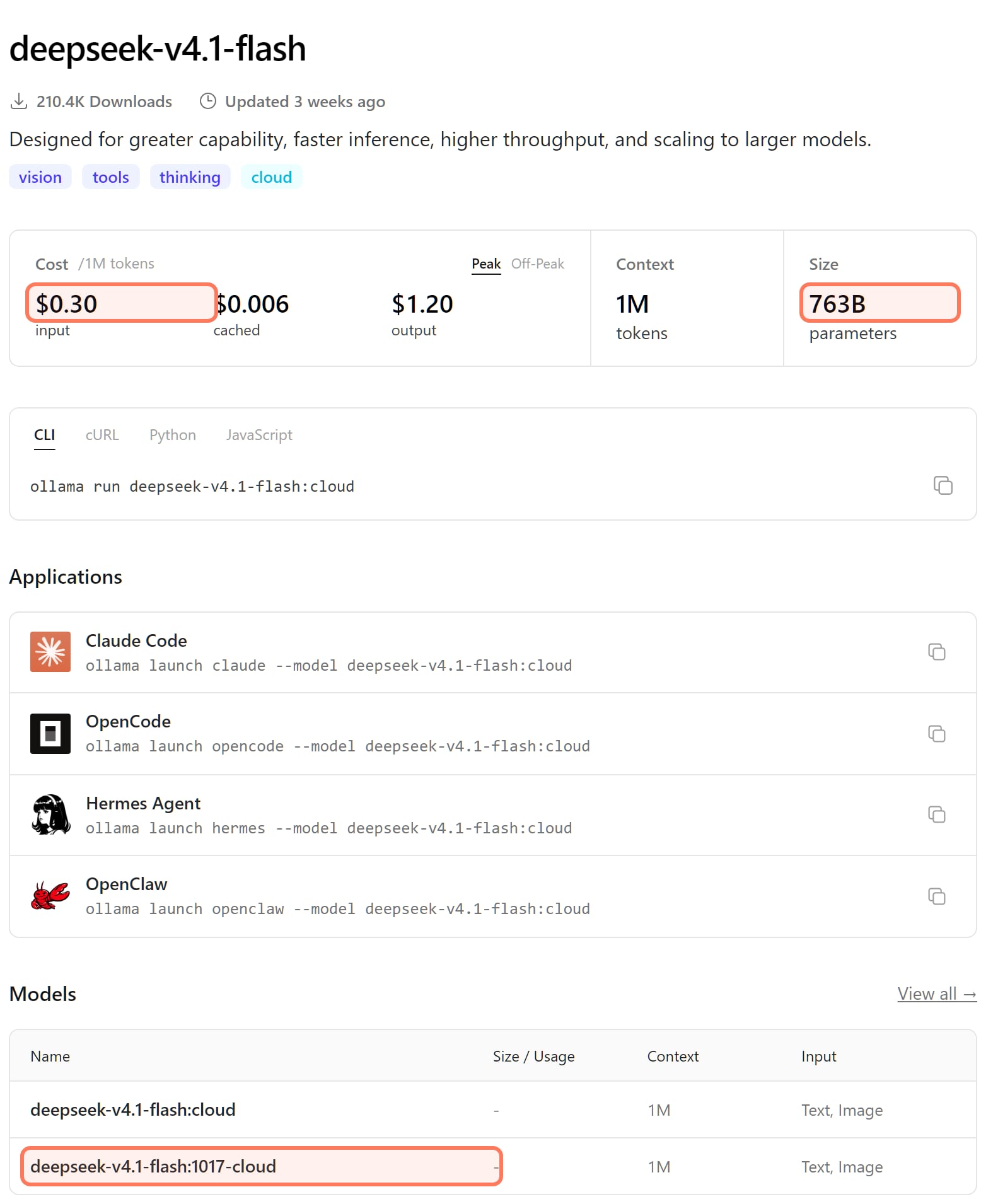
Only as a cloud model, not as a download. Ollama's library page lists two tags, deepseek-v4.1-flash:cloud and deepseek-v4.1-flash:1017-cloud, both with no download size, and marks the model "cloud". Running ollama run deepseek-v4.1-flash:cloud sends your prompts to Ollama's servers, billed per token: $0.30 per 1M input tokens, $0.006 cached and $1.20 output at peak, and $0.15, $0.003 and $0.60 off-peak. Those are the same rates DeepSeek charges directly. The page lists 763B parameters and a 1M-token context. The older deepseek-v4-flash entry was retired on September 25, 2026.
Ollama's V4.1 Flash entry offers cloud tags only, ollama.com/library/deepseek-v4.1-flash, read Nov 7, 2026. · Screenshot of ollama.com by aliteq
To run it on your own machine you need llama.cpp and one of the GGUF builds above. For DeepSeek models that Ollama can download, see which DeepSeek your PC can run.
Is DeepSeek's API cheaper than running it yourself?
Yes, unless you can keep a server busy around the clock. DeepSeek's deepseek-flash model, which its pricing page says is now served by DeepSeek-V4.1-Flash-1017, costs these amounts per million tokens:
DeepSeek API, deepseek-flash, per 1M tokens (read Nov 7, 2026)
Input, cache miss
Peak
$0.30
Off-peak
$0.15
Input, cache hit
Peak
$0.006
Off-peak
$0.003
Output
Peak
$1.20
Off-peak
$0.60
Peak
Off-peak
Input, cache miss
$0.30
$0.15
Input, cache hit
$0.006
$0.003
Output
$1.20
$0.60
Peak hours are 01:00 to 04:00 and 06:00 to 10:00 UTC, Monday to Friday, excluding Chinese public holidays, and everything else is off-peak at half price. US Eastern business hours (9 a.m. to 6 p.m. ET, which is 14:00 to 23:00 UTC in winter) fall entirely in the off-peak window. The page lists a 1M-token context and up to 384K output tokens. Setting it up: how to get a DeepSeek API key.
DeepSeek's price table, api-docs.deepseek.com/quick_start/pricing, read Nov 7, 2026. · Screenshot of api-docs.deepseek.com by aliteq
Now compare the rented server. Four H200s on Runpod cost $21.16 an hour on Nov 7. At DeepSeek's peak output price, $21.16 buys about 17.6 million output tokens. The server only wins on price if it turns out more than that every hour it's switched on, about 4,900 tokens a second; off-peak, the bar doubles. Even at the spot floor of $5.28 an hour for four H200s on Vast.ai, it's about 4.4 million output tokens an hour at peak prices. Unless you can keep a server that busy, the API is cheaper. Our break-even calculator runs the same sum for other models.
Your own hardware still makes sense in three cases:
Your data can't leave your machines. Every API call sends the prompt to the provider's servers.
You want to change the model: fine-tune it, or run a build of your own.
You want it to stay put. DeepSeek's API already moved deepseek-v4-flash to V4.1-Flash-1017; with the weights on your own server, the model changes only when you change it.
Pick a model sized for your card. The DeepSeek-R1 distills on Ollama are smaller dense models fine-tuned on reasoning data from DeepSeek-R1, per Ollama's page. They are not V4.1 Flash, but each one installs with a single Ollama command and runs on your own machine. Download sizes read on Ollama's page on Nov 7, 2026:
8GB card:deepseek-r1:8b, a 5.2GB download.
12 to 16GB:deepseek-r1:14b, 9.0GB.
24GB (RTX 3090, RTX 4090):deepseek-r1:32b, 20GB, or the pick in our 24GB model guide.
48GB, or two 24GB cards:deepseek-r1:70b, 43GB. The 70B guide compares the routes.
Not on a normal PC. Hugging Face lists it at 763B parameters, and even DeepSeek's own 4-bit release needs about 476 GB of memory by our VRAM engine. It takes a server with four H200s or eight H100s, a Mac Studio with 512GB of unified memory (tightly), or Unsloth's 1-bit build on 128 to 145 GB of RAM plus VRAM with the Engram table on SSD.
How much VRAM does DeepSeek V4.1 Flash need?
About 476 GB at 4-bit (8K context) by our VRAM engine, which sizes it by DeepSeek's own checkpoint: the release is already 4-bit, a 510.3 GB download. Unsloth's 4-bit GGUF is about the same, a 500.7 GB download. With the Engram table on SSD, Unsloth lists 128 to 145 GB of RAM plus VRAM at 1-bit and 305 GB at 4-bit (read Nov 7, 2026).
What's the difference between DeepSeek V4.1 Flash and V4 Flash?
V4.1 Flash is bigger and newer: a 552B backbone plus a 196B Engram table (763B on Hugging Face), 8B to 16B active per token, text and images, released Sep 10, 2026. V4 Flash has 284B parameters with 13B active and reads text only. Both have a 1M-token context and the MIT licence. V4 Flash is retired on Ollama and on DeepSeek's API.
Is DeepSeek V4.1 Flash on Ollama?
Only as a cloud model. Ollama lists deepseek-v4.1-flash:cloud and deepseek-v4.1-flash:1017-cloud with no download size. They run on Ollama's servers and cost $0.30 per 1M input and $1.20 per 1M output tokens at peak (read Nov 7, 2026).
Can a Mac Studio run DeepSeek V4.1 Flash?
The 512GB M5 Ultra model holds a 4-bit copy, just: our 476 GB figure is 93% of its memory, and Unsloth's 4-bit build needs about 305 GB with the Engram table on SSD. The 256GB model is borderline, at the bottom of Unsloth's 256 to 290 GB range for its 3-bit build. We haven't measured speed on a Mac.
Is DeepSeek's API cheaper than renting GPUs for V4.1 Flash?
Almost always. The API costs $0.30 per 1M input and $1.20 per 1M output tokens at peak, half off-peak. Four H200s on Runpod cost $21.16 an hour on Nov 7, 2026, so renting only wins if the server produces more than about 17.6 million output tokens every hour.
Can I run DeepSeek V4.1 Flash on an RTX 4090 or RTX 5090?
No. A 24GB or 32GB card holds less than a tenth of a 4-bit copy. Run a model sized for the card instead, such as deepseek-r1:32b (a 20GB download) on a 24GB card.