Magnitude, a free open-source engine relaunched on Nov 24, 2026, streams the experts of giant mixture-of-experts models from your NVMe SSD, so a 249 GB DeepSeek file runs on one RTX 5090. Here are the authors' speeds by machine, which file to download, how it differs from llama.cpp offload, and when renting a GPU is the better deal.
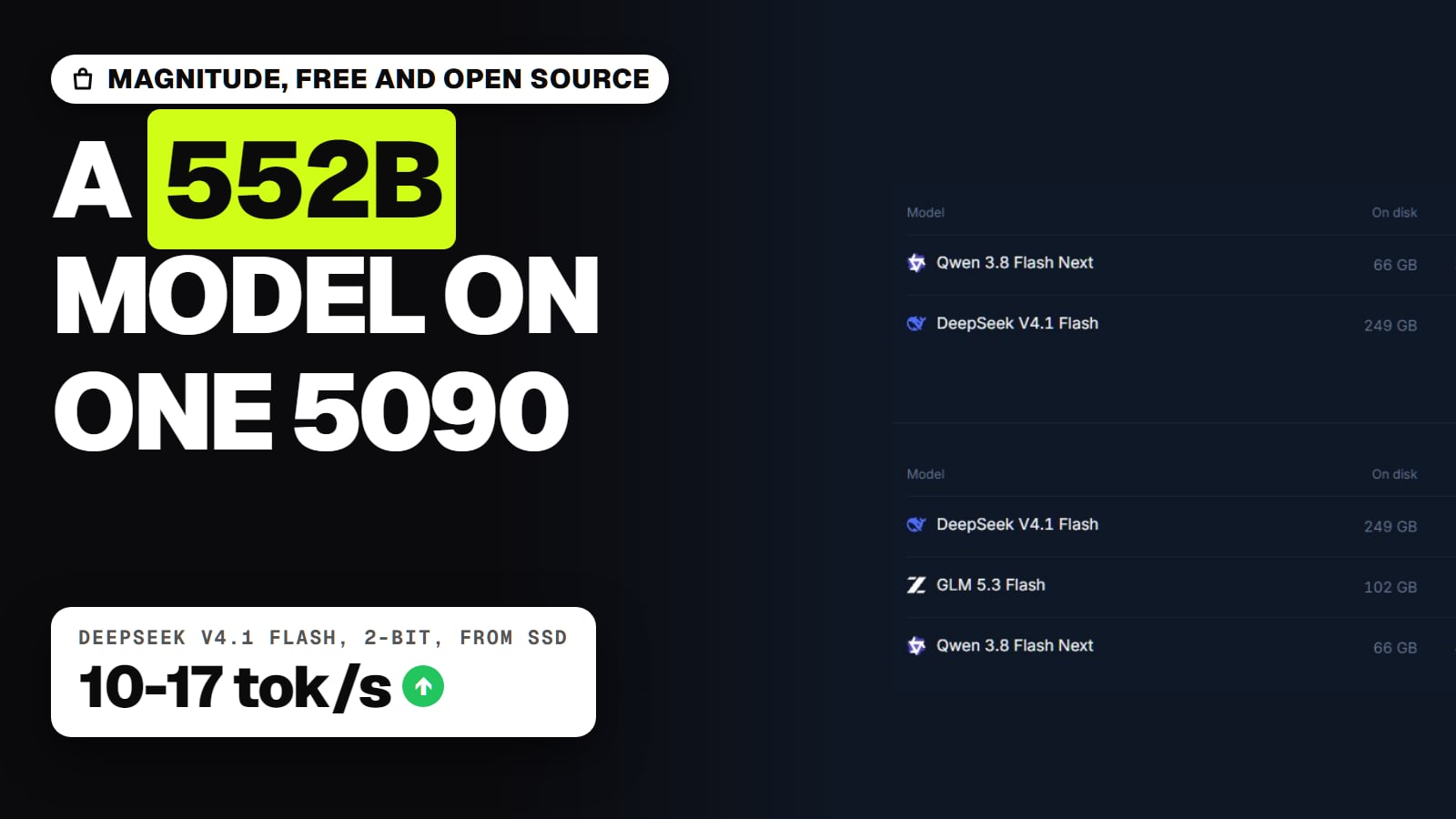
Yes, for mixture-of-experts models, if your GPU can hold the experts each token uses. Magnitude, an open-source engine its authors relaunched on November 24, 2026, keeps a MoE model's busiest experts in VRAM, the next tier in system RAM and the rest on your NVMe SSD, and prefetches what it predicts you'll need next. On its own benchmark page, DeepSeek V4.1 Flash (552B total, 16B active) ran from a 249 GB 2-bit file at 10 to 17 tokens a second on an RTX 5090, and at 10 on a 48 GB Mac mini. Those are the authors' numbers; we haven't run it, and one early user measured it slower than Ollama on an RTX 5080. Checked November 25, 2026.
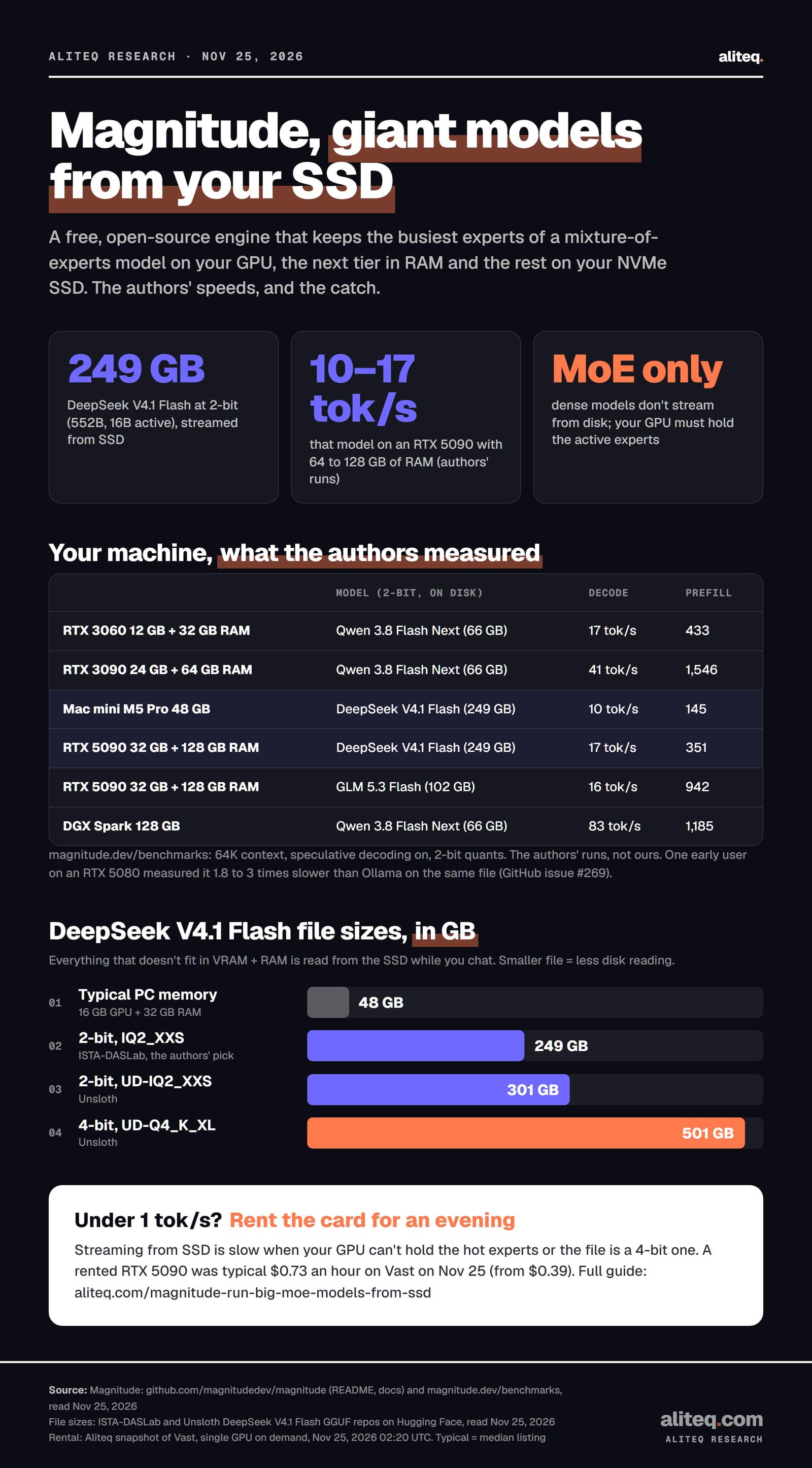
The whole answer on one image, free to share with a link back. Speeds are the authors' runs from magnitude.dev/benchmarks; file sizes from the Hugging Face repos; rental from our Vast snapshot of Nov 25, 2026. · aliteq research
What is Magnitude?
Magnitude is a local AI engine from the team at magnitude.dev, written in Rust and released under Apache-2.0 on GitHub. The project dates back to June 2026, but its relaunch on November 24 is what spread: Tom Greenwald's launch post opened with "You don't need $20k in hardware to run the best open models." It ships as a desktop app, a command line and a Docker image, serves an OpenAI-compatible API, and has one-click setups for Claude Code, Codex, OpenCode and Cline.
Its README puts the idea in one line: it "spreads models across your GPU, RAM, and SSD so they run on everyday Macs and PCs." Before you download anything, it profiles your machine and recommends models that fit (magnitude models recommend). It reads GGUF files from supported model families, including ones you already downloaded with LM Studio, Ollama or llama.cpp.
How does Magnitude run a model bigger than your RAM?
It treats the experts of a mixture-of-experts model like a cache with three tiers. In a MoE model each token only uses a few experts: DeepSeek V4.1 Flash has 384 experts and uses 6 per token. The README says "GPU VRAM holds the shared layers and most used experts, system RAM holds the next tier… your NVMe SSD holds the rest", and Magnitude "predicts and prefetches upcoming experts" before the GPU needs them, using direct reads rather than the operating system's swap.
That's the step past what llama.cpp already does. Its --n-cpu-moe flag moves experts from VRAM to RAM, which we explain in what --n-cpu-moe actually does, and Ollama and LM Studio have their own versions (Ollama MoE offload, LM Studio's expert offload). In the launch post's words, other engines "hit a wall once a model outgrows RAM. Magnitude extends that all the way to the SSD." On SSD wear, the post says it's "100% read-only, there's zero SSD wear". Reading doesn't wear flash the way writing does, so that holds as far as the engine only reads.
How fast is Magnitude on my GPU?
These are the authors' runs from Magnitude's benchmark page, all with 2-bit files, 64K context and speculative decoding on. Prefill is how fast it reads your prompt; decode is how fast it writes.
Magnitude speeds by machine (authors' runs, read Nov 25, 2026)
Mac mini M2 Pro, 32 GB
Model (2-bit, size on disk)
Qwen 3.8 Flash Next (66 GB)
Decode, tok/s
13
Prefill, tok/s
241
RTX 3060 12 GB + 32 GB RAM, PCIe 3.0 SSD
Model (2-bit, size on disk)
Qwen 3.8 Flash Next (66 GB)
Decode, tok/s
17
Prefill, tok/s
433
RTX 3090 24 GB + 64 GB RAM, PCIe 4.0 SSD
Model (2-bit, size on disk)
Qwen 3.8 Flash Next (66 GB)
Decode, tok/s
41
Prefill, tok/s
1,546
Mac mini M5 Pro, 48 GB
Model (2-bit, size on disk)
Qwen 3.8 Flash Next / DeepSeek V4.1 Flash (249 GB)
Decode, tok/s
54 / 10
Prefill, tok/s
883 / 145
DGX Spark, 128 GB
Model (2-bit, size on disk)
Qwen 3.8 Flash Next / GLM 5.3 Flash (102 GB)
Decode, tok/s
83 / 28
Prefill, tok/s
1,185 / 479
RTX 5090 32 GB + 64 GB RAM, PCIe 5.0 SSD
Model (2-bit, size on disk)
Qwen 3.8 Flash Next / DeepSeek V4.1 Flash
Decode, tok/s
87 / 10
Prefill, tok/s
3,718 / 183
RTX 5090 32 GB + 128 GB RAM, PCIe 4.0 SSD
Model (2-bit, size on disk)
DeepSeek V4.1 Flash / GLM 5.3 Flash / Qwen
Decode, tok/s
17 / 16 / 77
Prefill, tok/s
351 / 942 / 4,615
Model (2-bit, size on disk)
Decode, tok/s
Prefill, tok/s
Mac mini M2 Pro, 32 GB
Qwen 3.8 Flash Next (66 GB)
13
241
RTX 3060 12 GB + 32 GB RAM, PCIe 3.0 SSD
Qwen 3.8 Flash Next (66 GB)
17
433
RTX 3090 24 GB + 64 GB RAM, PCIe 4.0 SSD
Qwen 3.8 Flash Next (66 GB)
41
1,546
Mac mini M5 Pro, 48 GB
Qwen 3.8 Flash Next / DeepSeek V4.1 Flash (249 GB)
54 / 10
883 / 145
DGX Spark, 128 GB
Qwen 3.8 Flash Next / GLM 5.3 Flash (102 GB)
83 / 28
1,185 / 479
RTX 5090 32 GB + 64 GB RAM, PCIe 5.0 SSD
Qwen 3.8 Flash Next / DeepSeek V4.1 Flash
87 / 10
3,718 / 183
RTX 5090 32 GB + 128 GB RAM, PCIe 4.0 SSD
DeepSeek V4.1 Flash / GLM 5.3 Flash / Qwen
17 / 16 / 77
351 / 942 / 4,615
Two things stand out. More RAM beats a faster SSD for the biggest model: the 5090 with 128 GB of RAM and a PCIe 4.0 drive decoded DeepSeek at 17 tokens a second, against 10 with 64 GB and a PCIe 5.0 drive. And the 66 GB Qwen runs at a usable speed even on a 12 GB RTX 3060.
An independent check, so far, points the other way on one card. In GitHub issue #269, a user on an RTX 5080 16 GB measured decode "1.8–3× slower than Ollama (llama.cpp) running the same GGUF", for example 25.6 against 79.5 tokens a second on a 4-bit file. The maintainers' benchmark page claims about 2.2 times faster than Ollama on average on a Mac and a DGX Spark. Expect results to depend on your exact card until more people post numbers.
Which file should I download?
A 2-bit file, not the biggest one. Everything that doesn't fit in your VRAM and RAM is read from disk while the model writes, so a smaller file means less reading. The authors use these:
The files behind the benchmarks (Hugging Face, read Nov 25, 2026)
Qwen 3.8 Flash Next (180B, 6B active)
The 2-bit file Magnitude benchmarks
ISTA-DASLab Q2_0, 66 GB
The 4-bit alternative
Unsloth UD-Q4_K_XL is 111 GB
GLM 5.3 Flash (321B, 18B active)
The 2-bit file Magnitude benchmarks
Unsloth UD-IQ2_XXS, 102 GB
The 4-bit alternative
DeepSeek V4.1 Flash (552B, 16B active)
The 2-bit file Magnitude benchmarks
ISTA-DASLab IQ2_XXS, 249 GB (marked Recommended)
The 4-bit alternative
Unsloth UD-Q4_K_XL is 501 GB
The 2-bit file Magnitude benchmarks
The 4-bit alternative
Qwen 3.8 Flash Next (180B, 6B active)
ISTA-DASLab Q2_0, 66 GB
Unsloth UD-Q4_K_XL is 111 GB
GLM 5.3 Flash (321B, 18B active)
Unsloth UD-IQ2_XXS, 102 GB
DeepSeek V4.1 Flash (552B, 16B active)
ISTA-DASLab IQ2_XXS, 249 GB (marked Recommended)
Unsloth UD-Q4_K_XL is 501 GB
A 500 GB 4-bit DeepSeek file streams twice as much from disk as the 249 GB 2-bit one, which is why people who grab the biggest quant see well under a token a second. For what 2-bit costs in quality and why a 20 GB file can work on a 16 GB card, see the best local LLM for your VRAM. Our DeepSeek V4.1 Flash hardware guide covers the model itself.
What doesn't Magnitude do?
Dense models. Only mixture-of-experts models stream from disk. A dense 70B still has to fit in VRAM and RAM.
Older NVIDIA cards. CUDA needs "Ampere generation (RTX 30 series, A100) and newer". AMD and Intel GPUs go through Vulkan; Magnitude "does not use ROCm".
Several GPUs. "On a machine with several GPUs, a model runs on one GPU."
A tiny GPU for a big model. The README says "VRAM needs to fit at least the active experts."
Settled licensing. The root license is Apache-2.0, but issue #270 notes one inference crate is marked "UNLICENSED"; it was still open on November 25.
Windows polish. Open issues include a Vulkan crash on an AMD W7800 and an earlier Windows updater bug.
Should I rent a GPU instead?
If you're getting under a token a second, yes, at least to test. On November 25 an RTX 5090 was from $0.39, typical $0.73 an hour on Vast, an RTX 4090 typical $0.47 and an RTX 3090 typical $0.21. Pick a machine with plenty of system RAM and NVMe storage, since Magnitude uses all three tiers. A three-hour evening on a 5090 costs about $2.20 at the typical price.
Live price check
RTX 5090 rental prices right now
Pricier than usualToday's typical on-demand price is higher than on 100% of the last 23 days. If you can wait, it has been cheaper.
cheapest daypriciest day
Now vs usualThe typical on-demand price is $0.734/hr now, 10% above its median since Nov 2 of $0.667/hr.
Lowest since Nov 2Lowest typical on-demand price since Nov 2: $0.560/hr on Nov 10 (Novita AI).
Last 7 daysOver the last 7 days the typical on-demand price is rising, up 10%.
Cheapest right nowCheapest on-demand right now: Vast.ai at $0.387/hr, then Lium at $0.700/hr.
Provider spreadThe same card costs 3.6× more on Runpod ($1.39/hr) than on Vast.ai ($0.387/hr), so shop around.
InterruptibleInterruptible (spot) offers start at $0.200/hr, 48% less than on-demand, but can be stopped mid-job.
Computed from our live prices as of . Compared like for like: the typical on-demand price is the median listing at the cheapest provider, today and on each past day. Vast.ai, Runpod, Lium and Novita, updated every hour, nothing typed by hand.
A free, open-source (Apache-2.0) local AI engine that runs mixture-of-experts models bigger than your RAM by keeping the busiest experts in VRAM, the next tier in RAM and the rest on your NVMe SSD. It runs on Windows, Linux and macOS.
Can Magnitude run DeepSeek V4.1 Flash on a gaming PC?
Its authors ran the 249 GB 2-bit file at 17 tokens a second on an RTX 5090 with 128 GB of RAM, and at 10 with 64 GB. We haven't tested it, and results on other cards may differ.
Does Magnitude work with any model?
No. Only mixture-of-experts models stream from the SSD, in GGUF from supported families. Dense models must fit in VRAM and RAM as usual.
Which GPUs does Magnitude support?
NVIDIA RTX 30 series and newer through CUDA, AMD and Intel GPUs through Vulkan, Apple Silicon through Metal, or CPU only. It uses one GPU per model and doesn't use ROCm.
Is Magnitude faster than Ollama or llama.cpp?
The authors claim about 2.2 times faster decode than Ollama on average. One user on an RTX 5080 measured it 1.8 to 3 times slower on the same file (GitHub issue #269), so test on your own card.
Does Magnitude wear out my SSD?
Its authors say it's read-only. Reading doesn't wear flash memory the way writing does.
Which file should I use with Magnitude?
A 2-bit one. The authors benchmark DeepSeek V4.1 Flash with the 249 GB IQ2_XXS file; the 501 GB 4-bit file streams twice as much from disk and runs much slower.