You describe an app in plain English and an AI writes it — that's vibe coding, the term Collins named its 2025 Word of the Year. Here's where it came from, what it looks like in a tool like Lovable, and the one thing the definition quietly warns about.
"Vibe coding" went from an off-hand phrase to a dictionary headline in under a year. If you've landed here wondering what it actually means — because you're doing it, or because everyone's suddenly arguing about it — the definition is simple, and the useful part is the bit the definition skips.
Where the word came from
Andrej Karpathy, a well-known AI researcher, coined it in a February 2025 post: "There's a new kind of coding I call 'vibe coding', where you fully give in to the vibes, embrace exponentials, and forget that the code even exists." He meant it loosely — he later described that post as a throwaway tweet — but it named something real that millions of people had started doing.
It spread fast enough that in November 2025, Collins Dictionary named "vibe coding" its Word of the Year, defining it, roughly, as using AI prompted in natural language to write code. Merriam-Webster had already added it as a slang-and-trending term earlier that year. The spelling that won is two words, "vibe coding" — the one-word "vibecoding" exists (it's the name of a big Reddit community) but is far less common. The full set of terms, dated, is in the vibe coding glossary.
What vibe coding actually looks like
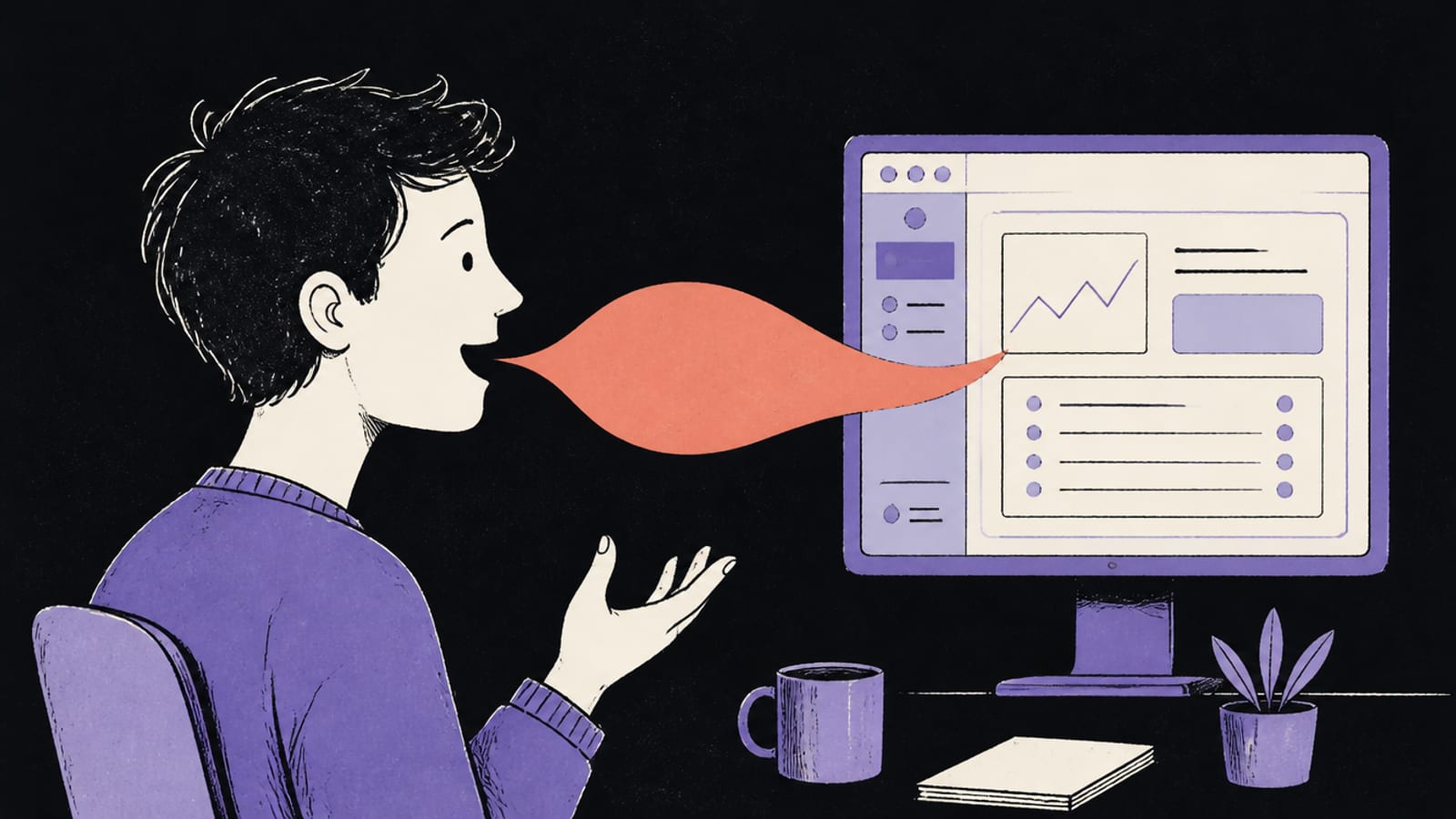
Strip away the buzz and it's a loop. Say you want a simple feedback form for your site. You open a tool like Lovable and type what you want: a page where people leave a message and a star rating, stored so you can read them later. The tool writes the code, wires up a database to hold the responses, maybe adds a login, and shows you a live preview. You ask for changes in plain English — "make it work on phones," "email me when someone submits" — and it edits the app. When it looks right, you publish, and it's live on the internet. At no point did you have to write code. That's vibe coding.
The tools that make this possible are visual app builders like Lovable, Bolt, Replit and v0; the more technical version is a terminal agent like Claude Code.
The part the definition quietly warns about
Go back to Karpathy's phrase: "forget that the code even exists." That's the whole risk in five words. The code does exist — it runs on a server, and it holds real data the moment real people use your app. The most famous vibe-coding failures of 2026 all came from forgetting that: apps that worked perfectly for their makers, who never looked, and left their databases open to anyone. The single setting behind most of those is Row Level Security.
So the honest framing of vibe coding is: the building is easy and genuinely new; the owning is the same as it always was. Everything you're responsible for once strangers use your app — the data, the keys, the bill — is laid out in the guide to shipping a vibe-coded app, and the shortest safe version is the six checks before you share the link.
"Is vibe coding dead?" — no, but the bar moved
You'll see headlines calling vibe coding "passé" and pushing a newer term, "agentic engineering." Don't let them rattle you. In search, "vibe coding" is still by far the more common phrase, and it's still exactly what most people do in these tools. What changed is that professionals raised the bar for themselves — and the difference between the two terms comes down to one habit, whether you read the code, which is its own comparison. The term even survived its own creator moving on: that's the story in what "pencils down" means.
Quick answers
What is vibe coding in simple terms?
Describing an app in plain language and letting an AI write the code for you, usually without reading what it wrote. Tools like Lovable and Bolt turn your sentences into a working, live app.
Who invented the term "vibe coding"?
AI researcher Andrej Karpathy, in a February 2025 post. He described it as fully giving in to the vibes and forgetting that the code exists. Collins Dictionary made it the 2025 Word of the Year.
Is vibe coding the same as using ChatGPT to write code?
It's the same spirit, more automated. Vibe coding usually means a tool or agent that builds and runs the whole app from your description — not just handing you a snippet to paste.
Is vibe coding safe?
The building is; what you ship can be unsafe if you never check it. An app can work perfectly and still leave its database open. A short checklist catches the common gaps before anyone else sees them.
This page has no affiliate links or sponsored placements. Karpathy's wording is taken from the quote as cited on Wikipedia and in The New Stack; the Collins Word of the Year is widely reported, and its definition here is paraphrased rather than quoted.